- Company Articles
- Products and Technology
- Application Cases
- Case Study: 3C Manufacturer Boosts Output by 20% with Four Way Straight Lean Pipe Joint

Case Study: 3C Manufacturer Boosts Output by 20% with Four Way Straight Lean Pipe Joint
Related Product
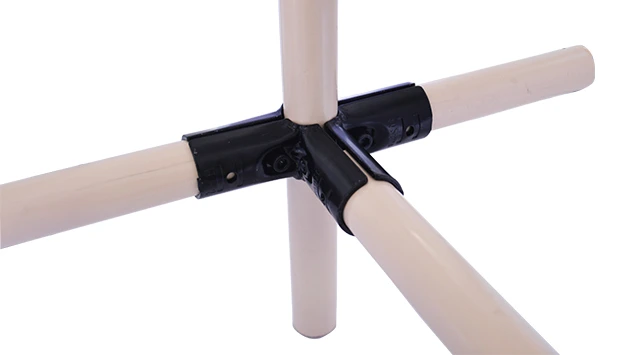
Four Way Straight Lean Pipe Joint
Four way lean pipe joint for 4 pcs 28MM lean pipe connection in straight angle, which used widely in workbench, flow rack, hand trolley frame connection.
In the fast-paced world of 3C manufacturing—where smartphones, laptops, and smartwatches fly off production lines at breakneck speed—every second counts. For TechNova Electronics, a mid-sized manufacturer based in Guangdong, China, the pressure to keep up with demand had become a daily battle. By early 2024, their assembly line was sputtering: bottlenecks formed at every turn, workers wasted precious minutes fetching parts, and reconfiguring the line for new product models felt like trying to rearrange a brick wall with a toothpick. That is, until a small but mighty component changed everything: the four way straight lean pipe joint. Paired with a custom lean system from a trusted supplier, this unassuming connector became the linchpin in a 20% output boost. Here's how it happened.
The Challenge: A Production Line Stuck in Neutral
TechNova's story isn't unique. Like many 3C manufacturers, they'd grown rapidly over five years, scaling from a 50-person workshop to a 300-employee facility churning out 500+ smartphone motherboards daily. But their production setup hadn't kept pace. Walk through their factory floor in early 2024, and you'd see the chaos firsthand.
"Our workbenches were relics," says Maria Gonzalez, TechNova's Production Manager, recalling the frustration. "They were bolted to the floor, made of heavy steel—great for stability, terrible for flexibility. When we launched our new budget smartphone line, we needed to add two more assembly stations. But moving those old workbenches? It took a crew of four guys half a day, and we still couldn't get the layout right. Parts were piling up between stations, and workers were trekking 20 extra steps just to grab a screw tray. By lunch, everyone was drained."
The issues ran deeper than workbenches. Their flow racks—used to shuttle semi-finished parts between the SMT (Surface Mount Technology) area and final assembly—were equally rigid. Made of fixed wooden shelves, they couldn't adjust to different part sizes, leading to jams. The conveyor system, a hodgepodge of second-hand belts and rollers, kept breaking down, causing 2+ hours of downtime weekly. "It was like trying to run a marathon with a broken shoe," Maria sighs. "We knew we needed a lean solution, but where do you even start?"
The Turning Point: A Lean System Supplier with a "Joint" Solution
After a particularly rough week—where a conveyor breakdown cost them 500 units of lost production—Maria's team started researching lean manufacturing systems. They'd heard buzzwords like "modularity" and "flexible workstations," but most suppliers offered one-size-fits-all packages that felt too generic. Then, at a local manufacturing expo, they met LeanPro Solutions, a lean system supplier with a booth showcasing something unexpected: a workbench built from shiny aluminum pipes and colorful joints, being disassembled and reassembled by a single technician in under 10 minutes.
"I was skeptical at first," admits Raj Patel, TechNova's Lead Engineer. "Aluminum? It looked lightweight—would it hold up to our daily grind? But then the LeanPro rep showed us their four way straight lean pipe joint. It's a small, unassuming connector—about the size of a tennis ball—with four ports that let you attach lean pipes in any direction. He snapped together a mini flow rack on the spot, adding a roller track here, a shelf there, and I thought, 'Wait, we could build anything with this.'"
LeanPro's pitch wasn't just about parts—it was about partnership. They offered to conduct a free on-site assessment, mapping TechNova's current workflow and identifying pain points. Over three days, the LeanPro team shadowed workers, timed material transfers, and measured bottlenecks. Their report was eye-opening: 30% of worker time was spent on non-value-added tasks (fetching parts, adjusting workbenches), and 80% of downtime stemmed from inflexible equipment.
The solution? A custom lean system centered on three core components: lean pipe workbenches built with four way straight lean pipe joints, flow racks with adjustable roller tracks, and a streamlined conveyor system. "The four way joint was the star," Raj explains. "It's the reason everything else works. You can connect pipes horizontally, vertically, at angles—no welding, no bolts. Just twist and lock. That meant we could reconfigure a workbench in 15 minutes instead of half a day. It was like going from a flip phone to a smartphone, but for our production line."

Implementation: Building a Line That Breathes
In April 2024, TechNova greenlit the project. The first step was replacing their old steel workbenches with LeanPro's lean pipe workbenches. Each workstation was custom-built to fit the task: assembly stations had adjustable heights (to reduce worker strain), ESD (Electrostatic Discharge) surfaces (critical for sensitive electronics), and built-in tool holders. The four way straight lean pipe joints were everywhere—connecting the main frame, adding side shelves for parts bins, even supporting overhead lighting.
"The day the first workbench arrived, our senior assembler, Li Wei, walked up and pushed it. It glided across the floor on casters—something our old benches couldn't do," Maria laughs. "He looked at me like I'd given him a new car. 'I can move this myself?' he asked. When I said yes, he grinned and started rearranging his station right then. By the end of the day, half the team had personalized their workbenches—adding extra shelves for their most-used tools, adjusting the height to their comfort. It sounds small, but when workers feel ownership over their space, they take pride in their work. That alone boosted morale overnight."
Next came the flow racks. LeanPro's design replaced the fixed wooden shelves with aluminum pipes and roller tracks (specifically, 40 steel roller track with yellow wheels, which glide smoothly even with heavy part trays). The four way straight lean pipe joints allowed TechNova to add or remove shelves on the fly—so when a new batch of larger battery modules came in, they simply added an extra shelf level in 10 minutes. "Before, we'd stack parts on the floor when the racks were full—now, we just adjust the rack," Li Wei says. "No more tripping over boxes, no more wasted time hunting for parts."
The conveyor system was the final piece. LeanPro installed a modular belt conveyor that integrated seamlessly with the flow racks, using the same four way joints to connect sections. "If a roller jams, we can pop out the faulty section, replace it, and be back up in 20 minutes—no more waiting for a repair crew," Raj notes. "And because it's modular, we can extend it later if we expand production. It's future-proof."

By the Numbers: The 20% Boost (and Beyond)
TechNova's new lean system went live in June 2024. By August, the results were impossible to ignore. To quantify the impact, Maria's team tracked key metrics for three months post-implementation, comparing them to the same period the previous year. The data told a clear story:
| Metric | Before Implementation (2023) | After Implementation (2024) | Improvement |
|---|---|---|---|
| Daily Output (Units) | 500 | 600 | 20% |
| Weekly Downtime | 10 hours | 2.5 hours | 75% reduction |
| Worker Steps per Day (Avg.) | 8,500 | 5,200 | 39% reduction |
| Space Utilization | 65% | 80% | 15% improvement |
| New Model Setup Time | 8 hours | 1 hour | 88% reduction |
"The 20% output boost is what gets the headlines, but the real win is the flexibility," Maria says. "Last month, we launched a limited-edition smartwatch. Normally, setting up a new assembly line would take a week. With the lean pipe workbenches and flow racks? We had it up and running in a day. The four way straight lean pipe joint made it possible—we just reconfigured existing stations instead of building new ones. Our CEO called me to say the board wants to roll this out to our other two factories."
Workers have noticed the difference, too. Li Wei, who's been with TechNova for eight years, sums it up: "Before, I'd go home exhausted, my back aching from bending over the old workbench. Now? The bench adjusts to me, parts roll right to my station, and if something's not working, I can fix it myself. It's like the line was designed for us, not against us. I actually look forward to coming to work now."
Why It Worked: The Four Way Joint's Secret Sauce
At first glance, a small connector like the four way straight lean pipe joint might seem insignificant. But its impact lies in its simplicity. Unlike traditional fixed joints, it offers three key advantages:
- Modularity: Connect pipes in any direction—horizontal, vertical, or diagonal—to build workbenches, flow racks, trolleys, or even custom material handlers. No special tools needed; just twist and lock.
- Durability: Made from high-strength aluminum alloy, it can support up to 500kg per joint—plenty for 3C manufacturing's needs. The anodized finish resists scratches and corrosion, even in dusty factory environments.
- Cost-Effectiveness: Instead of buying new equipment for every product change, TechNova reuses the same pipes and joints, cutting capital expenses by 40%.
Raj adds, "We've since ordered extra four way joints and lean pipes to keep on hand. Last week, the packaging team needed a shelf for holiday gift boxes—they built it themselves in 20 minutes using spare parts. That's the power of this system: it puts control back in the hands of the people who use it every day."
Conclusion: Small Parts, Big Results
TechNova's journey isn't about a single product—it's about reimagining what a production line can be. In an industry where change is constant, rigid systems hold you back. The four way straight lean pipe joint, paired with a thoughtful lean system from a trusted supplier like LeanPro, proved that flexibility doesn't have to mean sacrificing strength. It's a reminder that sometimes, the smallest components can deliver the biggest results.
For other 3C manufacturers struggling with bottlenecks, downtime, or worker fatigue, Maria has this advice: "Don't underestimate the power of a line that can adapt. Talk to your workers—find out what's slowing them down. Then look for solutions that put their needs first. For us, that solution started with a joint. Literally."
As TechNova continues to grow, one thing's clear: the four way straight lean pipe joint isn't just a tool—it's the foundation of a production line that can keep up with the future. And in the world of 3C manufacturing, that's the ultimate competitive edge.