- Company Articles
- Products and Technology
- Application Cases
- Case Study: Aluminum Workbench B Transforming Workflow in a 3C Manufacturing Plant

Case Study: Aluminum Workbench B Transforming Workflow in a 3C Manufacturing Plant
Related Product
Aluminum Workbench B
Aluminum tube workbench is more flexible and durable, compared with traditional PE/ABS coated steel tube. It is easy to assemble, anti corrosion, rust protection, and recycle use after disassemble.
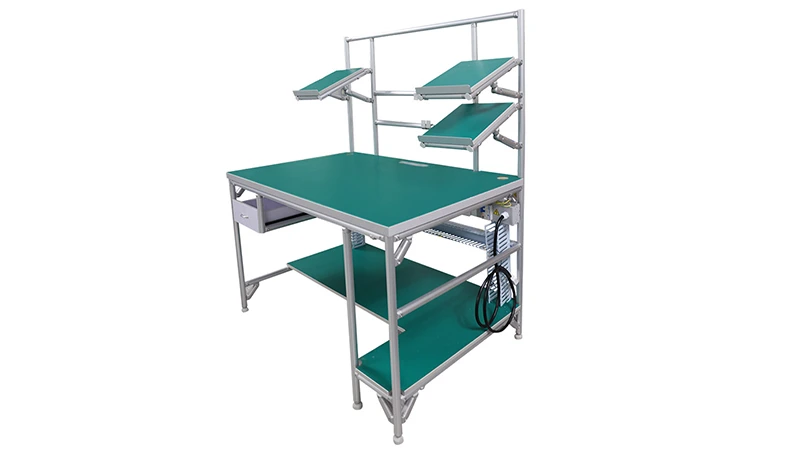
In the fast-paced world of 3C manufacturing—where precision, speed, and reliability are the backbone of success—even small inefficiencies can snowball into major bottlenecks. For BrightTech Electronics, a mid-sized manufacturer of smartphone motherboards in Shenzhen, these inefficiencies had become a daily headache. Walk through their production floor in early 2024, and you'd find workers hunched over cluttered, rickety workbenches, rooting through disorganized bins for parts, and pausing frequently to troubleshoot static damage on sensitive chips. Turnover was high, defects were mounting, and deadlines felt perpetually out of reach. That is, until they introduced Aluminum Workbench B into their workflow. This is the story of how a single piece of equipment, paired with smart complementary tools like Flow Rack and Conveyor systems, turned their chaos into a model of efficiency.
The Breaking Point: A Production Floor Struggling to Keep Up
BrightTech's facility, humming with the energy of 120 assembly line workers, had long relied on a patchwork of old wooden workbenches and metal racks. These setups, while functional in the short term, were ill-suited for the delicate, high-speed assembly of smartphone components. Let's break down the pain points that were costing BrightTech time, money, and morale:
1. Ergonomic Nightmares: The fixed-height wooden workbenches forced workers to either hunch over (causing back and neck strain) or stand on tiptoes (leading to leg fatigue). By mid-shift, productivity would drop (—noticeably), with workers taking longer breaks to stretch. "I'd go home with a headache every day," recalls Maria, a circuit board assembler with five years at BrightTech. "The bench was either too low or too high, and after 8 hours, my shoulders felt like they were made of concrete."
2. Static Threats to Sensitive Components: 3C manufacturing deals with microchips and circuit boards that are (extremely vulnerable) to electrostatic discharge (ESD). The old workbenches had no ESD protection—no grounded surfaces, no wrist strap holders, no anti-static mats. "We were losing 3-4% of our daily output to ESD damage," explains Mr. Chen, BrightTech's production manager. "A worker would reach for a chip, static would zap it, and we'd only find out during testing—wasting hours of assembly time."
3. Disorganized Material Flow: Parts were stored on heavy metal racks 10-15 feet from the workbenches, requiring workers to walk back and forth dozens of times per shift. "I must've logged 5 extra miles a day just fetching resistors and capacitors," jokes Li Wei, a former assembly line lead. Worse, without a systematic storage system, parts often went missing or were mislabeled, leading to assembly errors and delays.
4. Poor Durability and Maintenance: The wooden workbenches warped in Shenzhen's humid climate, creating uneven surfaces that made precise soldering nearly impossible. Metal racks rusted, and their fixed shelves couldn't be adjusted to fit different part sizes. "We were spending more time repairing old equipment than actually producing," Mr. Chen sighs. "It was clear we needed a complete overhaul."
The Turning Point: Discovering Aluminum Workbench B
In March 2024, Mr. Chen attended the China International Industry Fair in Shanghai, hoping to find solutions. Among the rows of automated robots and AI-driven systems, one booth caught his eye: a display of sleek, modular workbenches made from aluminum. The star of the show? Aluminum Workbench B , a product designed specifically for electronics manufacturing. "I stopped because it looked different—lightweight but sturdy, with clean lines and all these little features I'd never seen before," he remembers. "The sales rep explained it was made from aluminum extrusion profiles, which are corrosion-resistant and infinitely customizable. I was sold on the spot."
What made Aluminum Workbench B stand out? Let's dive into the details that convinced Mr. Chen it was the answer to BrightTech's woes:
Adjustable Height for Every Worker: Unlike the fixed wooden benches, Aluminum Workbench B featured a crank system that let workers adjust the height from 70cm to 90cm in seconds. "I thought of Maria and Li Wei immediately," Mr. Chen says. "No more one-size-fits-all pain."
Built-In ESD Protection: The workbench's surface was layered with an anti-static laminate, grounded via a hidden cable to the factory floor. It also came with integrated ESD wrist strap holders and a built-in voltmeter to monitor static levels. "Finally, we could protect our chips from day one," Mr. Chen notes.
Modular Aluminum Profile Accessories: The workbench's frame was made from T-slot aluminum extrusion profiles, meaning BrightTech could add or remove shelves, tool hooks, LED task lights, and cable management trays using simple aluminum profile accessories . "If a worker needed a extra shelf for small parts, we could bolt one on in 5 minutes," explains the supplier's technical consultant, Ms. Zhang.
Lightweight but Rock-Solid: Aluminum's high strength-to-weight ratio meant the workbench was easy to move (with optional casters) but stable enough for precision work. "We tested it by slamming a toolbox on the surface—no wobble, no scratch," Mr. Chen laughs. "That sealed the deal."
But Mr. Chen didn't stop at the workbench. He also noticed that the supplier offered complementary solutions: Flow Rack for nearby parts storage and a compact Conveyor system to move assemblies between stations. "Why fix just the workbench when we could rethink the entire workflow?" he reasoned. "I ordered 20 Aluminum Workbench B units, 10 Flow Racks, and 5 Conveyor sections on the spot."

From Blueprint to Reality: Implementing the New System
The supplier's team arrived at BrightTech two weeks later to map out the installation. They spent three days observing the workflow, measuring distances, and interviewing workers to understand their needs. "They didn't just drop off equipment—they collaborated with us," Mr. Chen says. "For example, they suggested placing Flow Racks within arm's reach of each workbench and aligning the Conveyor to feed directly into the testing area. It was like they could see our bottlenecks better than we could."
Installation happened over a long weekend to avoid disrupting production. The old wooden workbenches and metal racks were hauled away, and the new Aluminum Workbench B units were wheeled into place (thanks to their temporary casters). Flow Racks, loaded with labeled bins of parts, were positioned between every two workbenches. The Conveyor system—a 20-foot-long belt with adjustable speed—was installed along the back of the assembly line, connecting the last workbench to the testing station.
Monday morning arrived, and the team gathered for training. "At first, some workers were skeptical," admits Li Wei. "Change is scary, especially when you've been doing something one way for years." But the supplier's trainers walked everyone through the basics: adjusting the workbench height, using the ESD wrist straps, organizing parts in the Flow Rack bins, and operating the Conveyor. "Within an hour, Maria was showing me how to tweak the LED light brightness," Li Wei laughs. "By lunch, we were all hooked."
The first week had its hiccups. A few workers forgot to ground their wrist straps, and one Flow Rack bin was labeled incorrectly, causing a minor mix-up. But the supplier's on-site support team quickly addressed these issues, and by week two, the kinks were ironed out. "It was like night and day," Mr. Chen says. "The floor was quieter, workers were focused, and the assembly line was moving— actually moving —without constant stops."

The Results: 3 Months Later
By June 2024, three months after the installation, BrightTech's transformation was undeniable. Let's look at the numbers that tell the story:
| Metric | Before (Q1 2024) | After (Q2 2024) | Improvement |
|---|---|---|---|
| Average Assembly Time per Unit | 8.5 minutes | 7.2 minutes | 15.3% faster |
| Defect Rate (ESD + Assembly Errors) | 4.2% | 1.2% | 71.4% reduction |
| Monthly ESD-Related Losses | ~300 units | 12 units | 96% reduction |
| Worker Fatigue Reports (per 100 shifts) | 28 | 7 | 75% decrease |
| Material Retrieval Time per Shift | 45 minutes | 12 minutes | 73.3% faster |
But numbers only tell part of the story. The human impact has been equally profound. "My back pain is gone," Maria says, grinning as she adjusts her workbench to her height. "I can focus on soldering instead of stretching. And the ESD mat? I don't panic every time I touch a chip anymore." Li Wei, now promoted to supervisor, adds: "Turnover has dropped by 40%. Workers aren't quitting because they're exhausted—they actually enjoy coming to work now."
The Flow Racks, in particular, have been a game-changer for material flow. Each bin is color-coded and labeled with QR codes that link to inventory data, so workers scan a code to check stock levels before even opening the bin. "No more 'Where's the 10k resistor?' panic," Li Wei says. "It's all right there, arm's reach away." The Conveyor system, meanwhile, has eliminated the need for manual carrying, reducing the risk of dropping assemblies and cutting transit time between stations from 2 minutes to 30 seconds.
Mr. Chen is most proud of the ripple effects. "Faster assembly means we can take on more orders. Fewer defects mean happier clients. Happier workers mean better quality. It's a virtuous cycle," he says. "And the aluminum workbenches? They still look brand-new. No warping, no rust, no scratches. We're already planning to expand the line with 10 more units next quarter."
Why Aluminum Workbench B? It's All in the Details
What makes Aluminum Workbench B more than just a "fancy table"? It's the attention to the unique needs of 3C manufacturing. Let's unpack a few design choices that set it apart:
Aluminum Extrusion Profiles: The workbench's frame is made from 40x40mm aluminum extrusion profiles—lightweight but strong enough to support 200kg of equipment. The T-slot design lets workers attach accessories like tool holders, monitor arms, or even small 3D printers without drilling holes. "We added a USB charging port to my bench last month," Maria says. "Now I can charge my soldering iron and phone without trailing cables everywhere."
Anti-Fatigue Mat Integration: The workbench comes with a cut-to-fit anti-fatigue mat that cushions workers' feet during long shifts. "Standing for 8 hours used to kill my legs," Li Wei says. "Now the mat absorbs the impact—it's like standing on a cloud compared to concrete."
Modular Cable Management: A built-in cable tray runs along the back of the workbench, with clips to organize wires and prevent tangling. "No more tripping over soldering iron cords," Mr. Chen notes. "It also keeps the surface clutter-free, which makes cleaning a breeze."
Compatibility with Lean Principles: Aluminum Workbench B is designed for lean manufacturing—its modularity means BrightTech can reconfigure the line in hours, not days, to adapt to new product models. "Last month, we switched from assembling smartphone X to smartphone Y," Mr. Chen explains. "We just swapped out a few shelves and repositioned the Flow Racks. Done in a day. With the old setup, that would've taken a week."
The Road Ahead: Scaling Success
BrightTech's success with Aluminum Workbench B has caught the attention of other 3C manufacturers in the region. "We've had three factory tours in the past month," Mr. Chen says, smiling. "I tell them the same thing: It's not just about buying equipment—it's about investing in your team's ability to do their best work."
Looking forward, BrightTech plans to expand the system to its testing and packaging lines, adding specialized ESD workstations (yes, ESD Workstation features are already built into the Aluminum Workbench B) and automated Flow Racks with sensors that alert staff when parts are low. "The supplier mentioned they're releasing a smart version of the workbench with IoT sensors that track usage and predict maintenance needs," Mr. Chen says. "We'll be first in line to try it."
Final Thoughts: Tools That Empower, Not Just Equip
Aluminum Workbench B didn't just solve BrightTech's workflow problems—it transformed the way the company thinks about production. "We used to see equipment as a cost," Mr. Chen reflects. "Now we see it as an investment in our people and our future. When your workers have tools that fit their needs, that protect their health, that make their jobs easier—magic happens."
For 3C manufacturers grappling with similar challenges, the message is clear: efficiency isn't just about speed. It's about creating a workspace where precision, safety, and ergonomics come together. Aluminum Workbench B, paired with smart Flow Racks and Conveyors, does exactly that—turning chaos into calm, frustration into focus, and bottlenecks into breakthroughs.
As Maria puts it, tightening a screw on a motherboard with steady hands: "This workbench doesn't just hold parts. It holds our potential."