- Company Articles
- Products and Technology
- Installation And Maintenance
- Castor Install Base for Automotive Component Racks: Withstanding Harsh Environments

Castor Install Base for Automotive Component Racks: Withstanding Harsh Environments
Related Product
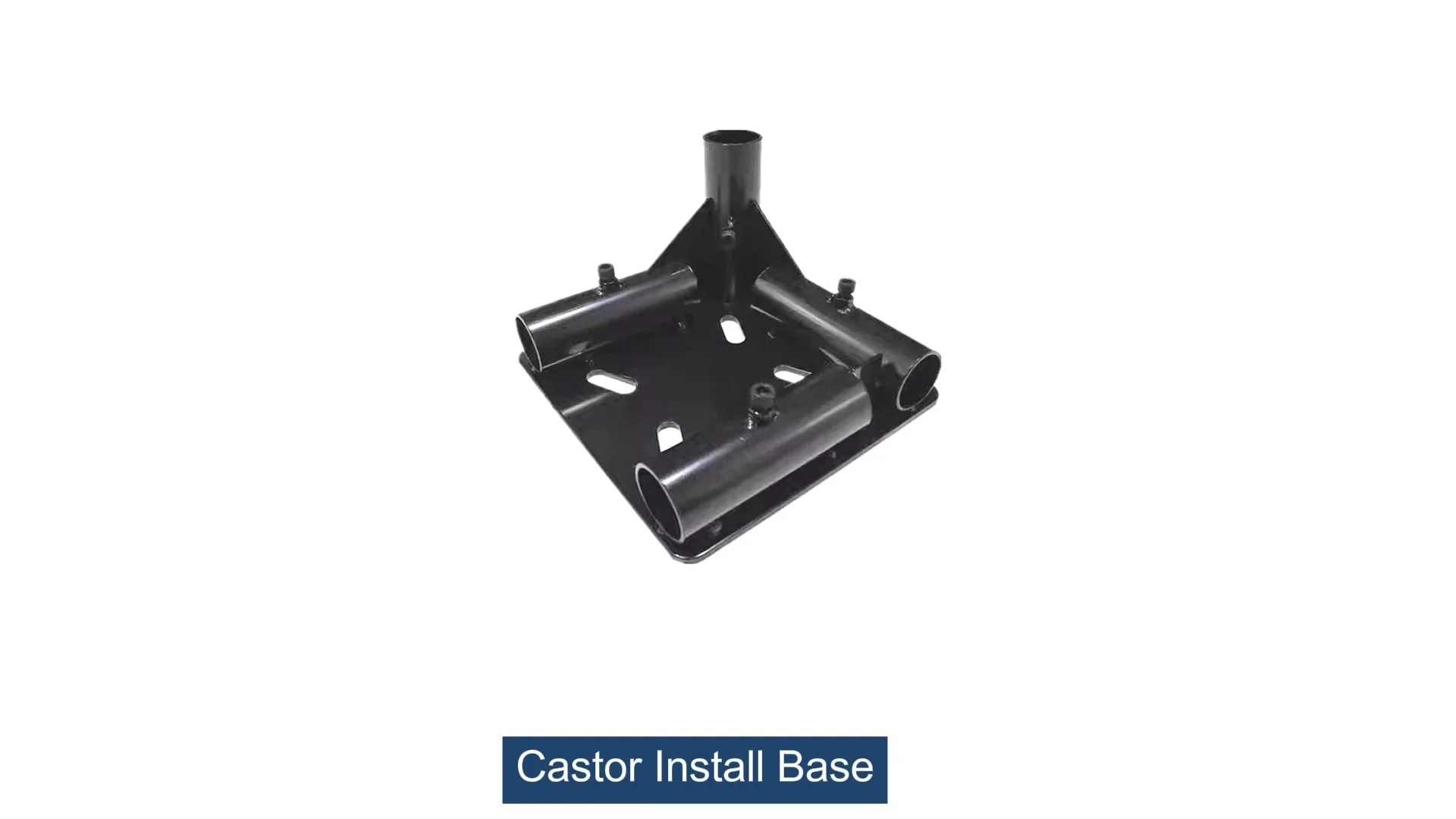
Castor Install Base
Castor install base, used for connection between pipe and castor, it can connect 4 pcs pipe by 1 pcs castor base, to make the structure strong and stable.
The unsung backbone of mobility and durability in demanding automotive settings
Walk into any automotive manufacturing plant or repair shop, and you'll be met with a symphony of activity: the hum of machinery, the clink of metal tools, and the steady rhythm of workers moving parts and components. In this chaos, one element often goes unnoticed but is absolutely critical to keeping operations running smoothly: the humble castor install base. These unassuming metal or aluminum plates serve as the bridge between heavy-duty caster wheels and the racks, workbenches, and trolleys that carry everything from engine blocks to small fasteners.
But automotive environments are unforgiving. Picture this: a rack loaded with 800kg of transmission parts gliding across a floor slick with oil and coolant. Nearby, a welder sparks away, raising temperatures in the area to over 40°C. A few hours later, that same rack might be wheeled into a cold storage room for parts, dropping to 10°C. Through it all, the castor install base must not just hold on—it must maintain stability, support the load, and keep the caster wheels aligned. Fail here, and the consequences ripple outward: delayed production, damaged components, even safety risks for workers.
This article dives into the world of castor install bases for automotive component racks, exploring how they're designed to withstand harsh conditions, the materials that make them durable, and why they're indispensable to modern lean system workflows. We'll also look at real-world applications, from workbenches to turnover trolley and rack setups, and share maintenance tips to keep these critical components performing at their best.
The Unsung Hero: What Exactly Is a Castor Install Base?
At first glance, a castor install base might look like little more than a flat piece of metal with holes for bolts. But that simplicity is deceptive. It's the critical link between the caster wheel assembly and the structure it supports—whether that's a heavy-duty material rack, a mobile workbench, or a turnover trolley. Think of it as the foundation of mobility: without a strong, well-designed base, even the best caster wheels (and their accompanying caster and accessories) will fail to perform.
The primary job of a castor install base is load distribution. When a rack is loaded with automotive parts, the weight isn't just on the caster wheels—it's transferred through the base. A poorly designed base might bend under pressure, causing the rack to tilt or the caster wheels to misalign. Over time, this can lead to uneven wear on wheels, difficulty rolling, or even catastrophic failure. On the flip side, a well-engineered base spreads the load evenly across all casters, ensuring stability and smooth movement even with heavy or unbalanced loads.
Castor install bases also play a role in adaptability. Automotive facilities often reconfigure workspaces to accommodate new production lines or repair tasks. A base that's compatible with different caster types (swivel, fixed, braked) or can be easily attached to various rack designs (like those made with aluminum profile) gives teams the flexibility to adjust on the fly. This adaptability is key to maintaining efficiency in dynamic environments.
Why Automotive Environments Are So Hard on Equipment
To understand why castor install bases need to be so robust, let's break down the specific challenges of automotive settings. These environments are a perfect storm of factors that can degrade even the toughest equipment over time.
1. Chemical Exposure: Oils, Grease, and Corrosives
Automotive work revolves around lubricants, coolants, and cleaning agents. Engine oil, transmission fluid, and brake cleaner are everywhere—spilled on floors, splashed on racks, and even dripping onto castor bases. Many of these substances are highly corrosive or can break down protective coatings on metal. For example, mineral oil can degrade rubber over time, while acidic degreasers can eat away at unprotected steel. A castor install base that isn't resistant to these chemicals will start to rust, weaken, or corrode, compromising its structural integrity.
2. Heavy Loads: From Small Bolts to Full Engines
Automotive components aren't light. A single engine block can weigh 200kg; a transmission, 100kg. Multiply that by multiple components on a rack, and you're looking at loads of 500kg or more. Even smaller parts, like brake calipers or suspension components, add up quickly. Castor install bases must support these weights day in and day out without bending, warping, or fatiguing. A base that flexes under load will put extra strain on caster wheels and joints, leading to premature wear.
3. Temperature Extremes: Hot Shops and Cold Storage
Many automotive facilities have areas with extreme temperatures. Welding stations or engine test cells can reach 40°C or higher, while parts storage rooms might be kept at 10°C to slow degradation. Metal expands and contracts with temperature changes, and repeated cycles can loosen bolts or weaken welds in a castor install base. In cold environments, lubricants in caster wheels can thicken, making movement harder—so the base must maintain alignment to prevent extra friction.
4. Physical Impact: Bumps, Scrapes, and Accidental Collisions
In busy shops, collisions are inevitable. A forklift might nudge a rack while maneuvering, or a worker could accidentally bump a trolley into a wall. These impacts can bend or dent a castor install base, especially if it's made from thin or low-grade material. Even minor dents can throw off load distribution, causing the rack to wobble or the casters to lock up. Over time, repeated impacts can lead to cracks in the base, which are dangerous and expensive to repair.

Material Matters: Choosing the Right Foundation
The secret to a castor install base that withstands harsh environments lies in its material. Manufacturers have several options, each with its own strengths and weaknesses. Let's take a closer look at the most common materials and how they stack up in automotive settings.
| Material | Typical Thickness (mm) | Max Load Capacity (kg) | Corrosion Resistance | Weight (kg per m²) | Best For |
|---|---|---|---|---|---|
| Stainless Steel (304 Grade) | 3–6mm | 800–1200 | Excellent (resists oils, acids) | 24–48 | High-corrosion areas (e.g., parts washing stations) |
| Aluminum (6061 Alloy) | 4–8mm | 500–800 | Very Good (natural oxide layer) | 10–20 | Lightweight mobility (e.g., workbenches, turnover trolleys) |
| Powder-Coated Steel | 3–5mm | 600–1000 | Good (if coating intact) | 24–40 | General-purpose racks, dry environments |
| Reinforced Plastic (Nylon) | 8–12mm | 300–500 | Excellent (chemical-resistant) | 8–12 | Light loads, cleanrooms, non-conductive applications |
Stainless Steel: The Heavyweight Champion of Corrosion Resistance
Stainless steel, particularly 304 grade, is a top choice for castor install bases in harsh automotive environments. Its chromium content (at least 18%) forms a thin, invisible oxide layer that resists corrosion—even when exposed to oils, greases, and mild acids. This makes it ideal for areas like parts washing stations or garages where chemical spills are common. Stainless steel is also incredibly strong: a 5mm thick base can easily support 1000kg, making it suitable for heavy engine or transmission racks. The downside? It's heavy. A 1m² stainless steel base can weigh 40kg or more, which adds to the overall load the caster wheels must move. This can be a trade-off in facilities where frequent repositioning is needed.
Aluminum: Lightweight and Rust-Proof
Aluminum, often in the form of 6061 alloy, is another popular option—especially when mobility is a priority. It's about one-third the weight of steel, so an aluminum profile base is easier to push and maneuver, which aligns well with lean system goals of reducing worker fatigue. Aluminum also resists corrosion naturally: when exposed to air, it forms a thin oxide layer that protects the underlying metal from rust. While it's not as strong as stainless steel (a 6mm aluminum base typically supports 600–800kg), it's more than sufficient for most turnover trolley and rack applications or workbenches. Many manufacturers also anodize aluminum bases to scratch resistance, making them even more durable in high-traffic areas.
Powder-Coated Steel: The Budget-Friendly Workhorse
For facilities on a tighter budget, powder-coated steel is a reliable choice. The steel base is coated with a dry powder that's baked on, creating a hard, protective layer that resists scratches and minor chemical exposure. It's strong (comparable to stainless steel in load capacity) and less expensive than both stainless steel and aluminum. However, the coating can chip or scratch over time—especially in high-impact areas. Once the steel is exposed, it's prone to rust if not touched up. For this reason, powder-coated steel is best suited for dry environments or areas with minimal chemical exposure, like general storage racks.

Design Features That Make a Difference
Material is just one piece of the puzzle. A castor install base must also be thoughtfully designed to handle the unique stresses of automotive environments. Here are key features that set durable bases apart from the rest:
1. Reinforced Edges and Corners
Corners and edges are the weakest points of any flat structure. In automotive settings, where racks are constantly bumped or dragged, these areas take the brunt of impacts. High-quality castor install bases often have folded or welded edges (known as "flanges") that add rigidity. Some even use gussets—triangular metal plates welded at the corners—to distribute impact force more evenly. For example, a base with 50mm flanges along the edges can withstand twice the impact of a flat, unflanged base without bending.
2. Precision-Drilled Mounting Holes
A castor install base is only as secure as its connection to the rack and caster wheels. Loose bolts can lead to wobbling, which accelerates wear on both the base and the caster and accessories. Manufacturers of premium bases use computer numerical control (CNC) drilling to ensure mounting holes are perfectly aligned and sized. This precision ensures bolts fit snugly, reducing the risk of loosening over time. Many bases also include threaded inserts or weld nuts, which provide a stronger hold than tapping threads directly into the base material.
3. Drainage Slots for Liquids
In areas where liquids are common (like parts washing stations or oil change bays), standing water or chemicals on the base can lead to corrosion. To combat this, some bases feature drainage slots or holes that allow liquids to flow through, preventing pooling. For example, a stainless steel base with 10mm-wide slots spaced every 50mm will dry out quickly after a spill, reducing the risk of rust or chemical damage.
4. Compatibility with Heavy-Duty Caster and Accessories
A great base is wasted if paired with subpar casters. The best castor install bases are designed to work with heavy-duty caster and accessories, like 8-inch diameter wheels with double-ball bearings and brake mechanisms. They often include recessed areas for caster mounting plates, which lower the overall height of the rack and improve stability. Some bases even have adjustable mounting points, allowing teams to swap out casters (e.g., switching from swivel to fixed) based on the task at hand.

Supporting Lean System Goals: Mobility Meets Efficiency
In today's automotive industry, lean system principles—focused on minimizing waste and maximizing value—are more important than ever. Castor install bases play a quiet but vital role in enabling these principles by making material handling more efficient and flexible.
Reducing Movement Waste
One of the biggest wastes in manufacturing is unnecessary movement—workers walking back and forth to fetch parts or tools. A mobile rack with a reliable castor install base eliminates this waste by bringing materials directly to the point of use. For example, in an assembly line, a turnover trolley loaded with door panels can be wheeled alongside the vehicle, allowing workers to grab parts without leaving their station. This not only saves time but also reduces fatigue, leading to higher productivity and fewer errors.
Enabling Quick Changeovers
Automotive plants often switch between production runs (e.g., building sedans one week, SUVs the next). With traditional fixed racks, reconfiguring the workspace can take hours or even days. Mobile racks with castor install bases change that. Teams can quickly roll racks into new positions, swap out workbenches, or rearrange material storage to match the new production layout. This agility is a cornerstone of lean system thinking, allowing facilities to adapt to changing demand without costly downtime.
Just-In-Time (JIT) Material Delivery
JIT manufacturing, a key lean system practice, involves delivering parts to the assembly line exactly when they're needed—not before. This reduces inventory costs and frees up floor space. Castor install bases make JIT possible by enabling precise, on-demand movement of materials. For instance, a rack of fasteners can be wheeled to the line 10 minutes before they're needed, then moved to the next station once empty. Without reliable mobility, JIT would require extra inventory to buffer against delays in material transport.
Real-World Applications: Where Castor Install Bases Shine
To see the impact of castor install bases in action, let's look at three common applications in automotive facilities:
1. Mobile Workbenches for Assembly Tasks
Workbenches are the heart of many automotive tasks, from assembling small components to repairing electrical systems. A mobile workbench, mounted on a castor install base, allows workers to bring tools, parts, and documentation directly to the job. For example, a mechanic repairing a car's suspension can roll a workbench stocked with wrenches, sockets, and replacement parts right next to the vehicle. The base must support the weight of the bench, tools, and parts (often 200–300kg) while remaining easy to move. Aluminum bases are popular here for their lightweight design, while stainless steel bases are preferred in areas where oil or coolant spills are frequent.
2. Turnover Trolley and Rack Systems for Parts Transport
Turnover trolleys and racks are used to move parts between storage, assembly, and shipping areas. These systems often have multiple shelves, each holding dozens of components. A well-designed castor install base ensures the trolley remains stable even when loaded unevenly (e.g., heavier parts on one shelf). For example, a three-shelf turnover trolley carrying brake components might weigh 400kg. The base must distribute this weight across four casters, preventing tipping during turns. Many facilities opt for swivel casters with brakes (part of caster and accessories) to allow precise maneuvering and secure positioning when loading/unloading.
3. Heavy-Duty Material Racks for Engine and Transmission Storage
Storing engines, transmissions, or axles requires racks that can handle extreme weights. A typical engine rack might hold 5–6 engines, totaling 1000kg or more. Here, stainless steel castor install bases are the gold standard, thanks to their high load capacity and corrosion resistance. The bases are often paired with large-diameter (10–12 inch) caster wheels designed for heavy loads. Some racks even have dual-wheel casters (two wheels per base corner) to further distribute weight. In this application, the base isn't just about mobility—it's about safety. A failed base could lead to engines falling, causing serious injury or damage.
Keeping Your Bases in Top Shape: Maintenance Tips
Even the most durable castor install base will degrade over time without proper care. Here's how to extend their lifespan and ensure they continue to perform in harsh environments:
1. Regular Cleaning to Prevent Buildup
Oil, grease, and debris can accumulate on the base, trapping moisture and accelerating corrosion. Wipe down bases weekly with a degreaser and a stiff brush to remove buildup. For stainless steel bases, use a mild detergent to avoid damaging the oxide layer. For aluminum bases, avoid abrasive cleaners that can scratch the surface. In high-spill areas, consider rinsing bases with water (if compatible with the material) to flush away chemicals.
2. Lubricate Casters and Check Fasteners
While the base itself doesn't have moving parts, the casters and their connection to the base do. Lubricate caster wheels and swivel joints monthly with a silicone-based lubricant (avoid petroleum-based lubricants, which can degrade rubber wheels). At the same time, inspect all bolts connecting the base to the rack and casters. Tighten any loose fasteners, and replace any bolts that show signs of stripping or corrosion. This prevents the base from shifting under load, which can cause warping or cracking.
3. Inspect for Damage and Repair Promptly
Dents, cracks, or rust spots on the base are red flags. Even small cracks can grow under repeated loading, leading to failure. Inspect bases monthly for damage, paying close attention to corners and edges. For powder-coated steel bases, touch up chips in the coating with a matching paint to prevent rust. For aluminum or stainless steel bases, sand down any rough spots and apply a protective sealant if needed. If a base is bent or cracked beyond repair, replace it immediately—don't risk using it, as the consequences can be severe.
Conclusion: The Foundation of Efficient, Safe Automotive Operations
Castor install bases may not be the most glamorous components in an automotive facility, but they're undeniably essential. By withstanding harsh chemicals, heavy loads, temperature extremes, and constant impact, these bases keep material handling systems moving—literally and figuratively. They enable lean system workflows, reduce waste, and ensure workers can focus on building and repairing vehicles, not struggling with immobile or unstable equipment.
When choosing a castor install base, consider the specific demands of your environment: Is corrosion resistance critical? Will you need to move heavy loads? Do you prioritize mobility over raw strength? Materials like stainless steel, aluminum, and powder-coated steel each have their place, and the right choice depends on your unique needs. Pairing the base with high-quality caster and accessories (like braked swivel wheels or reinforced joints) further enhances performance and longevity.
In the end, investing in a durable castor install base isn't just about equipment—it's about investing in efficiency, safety, and the long-term success of your operations. After all, in the fast-paced world of automotive manufacturing and repair, the last thing you need is a weak link in your material handling chain.