- Company Articles
- Products and Technology
- Installation And Maintenance
- Castor Installation Base for Home Appliance Assembly Lines: Workflow Optimization

Castor Installation Base for Home Appliance Assembly Lines: Workflow Optimization
Related Product
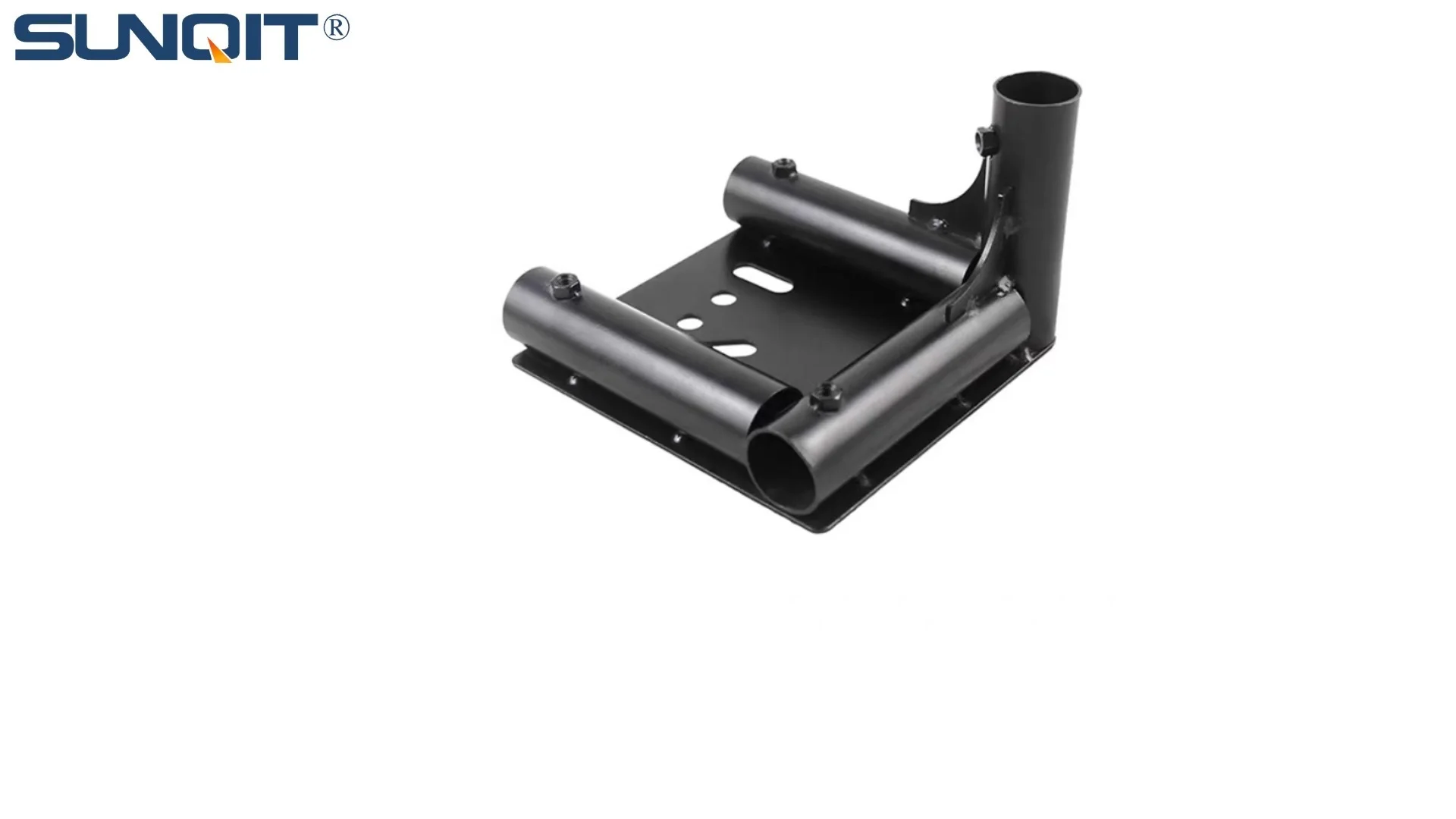
Castor Installation Base
Pipe fitting castor installation base,Well made, precise and strong. Made of high quality of steel,black painting surface treatment for greater resistance to corrosion. It is used for castor or foot lever connection with lean pipe.
The hum of machinery fills the air as Maria, a line worker at a home appliance factory, starts her shift on the washing machine assembly line. By 9 a.m., she's already wheeled a heavy parts bin back and forth between her workstation and the storage area three times—each trip taking precious minutes, each strain on her shoulders a quiet reminder of the day ahead. Nearby, Juan struggles to reposition a fixed workbench to align with the conveyor belt, his frustration mounting as the misalignment causes parts to jostle and occasionally fall. "If only this bench could move," he mutters, wiping sweat from his brow. This scene is all too familiar in manufacturing facilities worldwide: assembly lines bogged down by rigid, immovable equipment, where every second spent adjusting, moving, or compensating for inefficiencies chips away at productivity. But what if the solution to these daily headaches was smaller than you'd think? Enter the castor installation base—a humble component that's quietly revolutionizing how home appliance assembly lines operate. In this article, we'll explore how this unassuming tool, when paired with thoughtful design and lean principles, transforms workflows, empowers workers, and drives bottom-line results.
1. The Home Appliance Assembly Line: A Balancing Act of Precision and Speed
Home appliance manufacturing is a dance of precision and pace. Whether assembling a 200-pound refrigerator, a compact microwave, or a high-efficiency dryer, every step demands accuracy—from fitting delicate circuit boards to aligning heavy metal panels. Yet, speed is equally critical: consumer demand fluctuates, competitors loom, and profit margins depend on producing more units in less time without sacrificing quality. To meet these demands, assembly lines rely on a symphony of tools: workbenches for detailed tasks, conveyors for moving partially assembled units, and trolleys for transporting parts. But here's the catch: these tools are only as effective as their ability to adapt. A fixed workbench might work for one product model, but when the line switches to a larger appliance, that same bench becomes a barrier. A parts trolley that's hard to maneuver wastes time better spent assembling. And when workers are forced to bend, reach, or carry heavy loads repeatedly, fatigue sets in—and with it, slower work and higher error rates. "We used to have workbenches bolted to the floor," says Elena, a production manager at a leading appliance manufacturer. "When we launched our new line of smart ovens, which are taller than our previous models, half the team had to stand on footstools to reach the top shelves. It was unsafe, and quality suffered—screws were over-tightened, wires misrouted. We knew we needed flexibility, but we didn't know where to start." This is where the castor installation base enters the picture. By turning static workbenches, trolleys, and material racks into movable assets, it addresses one of the biggest hidden wastes in manufacturing: motion waste. As defined by lean manufacturing principles, motion waste includes unnecessary walking, bending, or repositioning—activities that don't add value to the product but drain time and energy. For Elena's team, the solution was simple: attach workbenches to castor installation bases, allowing them to adjust heights, positions, and orientations in seconds, not hours.
2. Castor Installation Bases and the Lean System: A Match Made in Efficiency
At its core, lean manufacturing is about eliminating waste to create more value with fewer resources. The "lean system" framework—pioneered by Toyota—identifies eight types of waste, from overproduction to unused talent. Motion waste, as mentioned, is a silent culprit in assembly lines, often overlooked until its cumulative impact becomes impossible to ignore. Castor installation bases directly target motion waste by enabling flexible mobility . Imagine a workbench that can glide smoothly alongside a conveyor belt, aligning perfectly with each incoming unit. Or a parts trolley that follows a worker from station to station, eliminating trips to the storage room. These scenarios aren't just convenient—they're transformative. Consider a typical refrigerator assembly line. Before castor installation bases, each workstation was fixed: Station A handled door hinges, Station B installed the compressor, and so on. If a bottleneck formed at Station B (say, due to a slow batch of compressors), workers at Station C would stand idle, waiting for units to arrive. With movable workbenches on castor bases, the line supervisor can quickly reposition Station C to assist Station B, redistributing labor and keeping the line flowing. "We used to lose 2-3 hours a week to bottlenecks," says Mike, a floor supervisor at a mid-sized appliance plant. "After switching to workbenches with castor installation bases, we've cut that down to 30 minutes. The team can rearrange the line on the fly—no tools, no downtime. It's like giving the assembly line a brain." But the benefits of castor installation bases extend beyond just motion waste. They also support another lean principle: respect for people . When workers no longer have to strain to move heavy equipment or walk excessive distances, job satisfaction rises. Injury rates drop, absenteeism decreases, and retention improves—all of which feed back into higher productivity and better quality. As one worker put it: "I used to go home with a sore back every night. Now, I feel like the company cares about how I work, not just how much I produce."

3. Inside the Design: What Makes a Castor Installation Base Work?
At first glance, a castor installation base might seem simple: a metal plate with holes for attaching casters, right? But effective design requires careful consideration of load capacity, durability, compatibility, and ease of use. Let's break down the key components that make these bases indispensable.
Materials: Lightweight Strength
Most modern castor installation bases are made from aluminum or steel, though aluminum has emerged as a favorite for its winning combination of strength and lightness. Aluminum—often in the form of extruded aluminum profiles—resists corrosion (critical in factories with moisture or chemicals), won't rust, and is easy to machine for custom holes or attachments. For heavier loads (like workbenches holding industrial ovens), steel bases offer extra durability, but aluminum remains the go-to for most applications due to its maneuverability. "We tested both steel and aluminum bases," Elena recalls. "Steel was sturdier, but our workers struggled to push the heavier benches. Aluminum cut the weight by 30%, and it still handles our standard loads (up to 500 pounds) without a problem."
Caster Compatibility: The Wheels That Move the Line
A castor installation base is only as good as the casters it supports. Most bases are designed to fit standard caster sizes, with pre-drilled holes that align with common caster mounting patterns. Key caster features to consider include: - Swivel vs. rigid casters : Swivel casters (which rotate 360°) offer maximum maneuverability, ideal for tight spaces or frequent repositioning. Rigid casters (fixed in direction) work best for straight-line movement, like along a conveyor. - Brake mechanisms : Locking brakes keep the base stationary during use, preventing accidental movement. Some advanced models have "total lock" brakes that lock both swivel and wheel rotation for extra stability. - Wheel material : Rubber wheels absorb shocks and protect factory floors, while polyurethane wheels offer better durability for heavy loads. For ESD (electrostatic discharge) environments (common in electronics assembly), conductive wheels prevent static buildup. The best castor installation bases allow mixing swivel and rigid casters (e.g., two swivel with brakes, two rigid) for optimal control. For example, a parts trolley might use two swivel casters at the front for steering and two rigid at the back for straight tracking—making it easy to push but stable when stopped.
Load Capacity: Built to Handle the Heavy Lifting
Home appliance parts aren't light. A single washing machine drum can weigh 80 pounds; a refrigerator compressor, 50 pounds. Add tools, bins, and the workbench itself, and a typical workstation might carry 300-600 pounds. Castor installation bases must be rated for these loads—often with a safety margin (e.g., a 1000-pound base for a 600-pound load). Manufacturers test load capacity rigorously, simulating years of use with weighted platforms and repeated movement. Look for bases with reinforced corners or cross-bracing for added strength. As Mike puts it: "We once had a cheap base bend under a loaded workbench. Never again—now we only buy bases rated for 150% of our maximum load. Peace of mind is worth the extra cost."
Compatibility with Workbenches and Trolleys
Castor installation bases are designed to integrate seamlessly with existing equipment, from standard workbenches to custom trolleys. Many bases come with universal mounting plates that attach to wooden, metal, or aluminum workbench frames using bolts or clamps. For aluminum workbenches (a popular choice in modern factories), bases often feature T-slot compatibility, allowing quick attachment with T-nuts or brackets—no drilling required. This versatility means factories don't have to replace their entire fleet of workbenches to go mobile. Instead, they can retrofit existing equipment with castor installation bases, reducing upfront costs and minimizing disruption.
Comparing Castor Installation Base Types: A Quick Reference
| Base Type | Key Features | Best For | Max Load (lbs) |
|---|---|---|---|
| Aluminum Light-Duty | Lightweight, corrosion-resistant, T-slot compatible | Small parts assembly, workbenches under 300 lbs | 500 |
| Steel Medium-Duty | Reinforced corners, compatible with rigid/swivel casters | Heavy parts trolleys, conveyor-side workstations | 1000 |
| Aluminum Heavy-Duty | Thick aluminum extrusion, cross-bracing, total-lock brakes | Refrigerator/dryer assembly, 600+ lb workbenches | 1500 |
| Stainless Steel ESD | Conductive wheels, corrosion-resistant, ESD-safe coating | Electronics assembly (control panels, circuit boards) | 800 |

4. From Concept to Reality: Workflow Optimization in Action
To truly understand the impact of castor installation bases, let's dive into two real-world case studies—one from a large appliance manufacturer and one from a small-to-medium enterprise (SME). Both illustrate how this simple tool can deliver outsized results.
Case Study 1: Large-Scale Refrigerator Plant Eliminates Bottlenecks
A Fortune 500 appliance maker with a 500-worker plant producing 500 refrigerators daily faced a persistent problem: bottlenecks at the final assembly station, where workers installed doors, handles, and gaskets. The station's fixed workbench couldn't keep up with the flow from upstream stations, leading to a backlog of 10-15 units by mid-shift. The plant's lean team proposed a solution: replace the fixed workbench with two movable workbenches on aluminum heavy-duty castor installation bases. Each workbench would be equipped with swivel casters with total-lock brakes, allowing workers to position them alongside the conveyor as needed. The results were striking: - Throughput increased by 12% : By splitting the final assembly tasks between two movable workbenches, the team could process 560 refrigerators daily—an extra 60 units, or $30,000 in daily revenue (based on average profit per unit). - Worker fatigue dropped by 40% : Before, workers had to reach across the fixed bench, straining their shoulders. With movable benches, they could position themselves at the optimal angle, reducing physical stress. - Bottlenecks eliminated : The backlog vanished, and the line ran smoothly from start to finish. "We used to have to do overtime twice a week to clear the backlog," says the plant manager. "Now, we're done by 3 p.m. with time to spare for maintenance."
Case Study 2: SME Washing Machine Plant Cuts Costs and Improves Safety
A family-owned SME producing 100 washing machines daily faced a different challenge: high injury rates. Workers were manually pushing steel parts trolleys (loaded with motors and drums) across the factory floor, leading to 8-10 strains/sprains per month and $50,000 in annual workers' comp claims. The plant couldn't afford to replace all its trolleys, so the operations manager suggested a cheaper alternative: retrofit existing trolleys with steel medium-duty castor installation bases and swivel casters with brakes. The total investment was $15,000 (15 trolleys × $1,000 per base/caster set). Within six months: - Injury rates dropped to zero : The trolleys now glide effortlessly, requiring 70% less force to push. No new strains or sprains were reported. - Productivity rose by 8% : Workers spent less time moving trolleys and more time assembling, increasing daily output to 108 units. - ROI achieved in 3 months : The savings from reduced workers' comp claims and increased production paid for the investment in just 12 weeks. "We thought we'd have to live with the injuries," says the owner. "Now, I kick myself for not doing this sooner."

5. Choosing the Right Castor Installation Base: What to Look for in a Supplier
Not all castor installation bases are created equal—and neither are their suppliers. To ensure you're getting a product that delivers on its promises, keep these key factors in mind when choosing a supplier:
- Quality testing and certifications : Look for suppliers who test their bases to industry standards (e.g., ISO 9001) and provide load capacity certifications. Avoid "no-name" suppliers with no testing data—your workers' safety depends on it.
- Customization options : Every assembly line is unique. A good supplier will offer custom sizes, hole patterns, or materials to fit your specific equipment (e.g., a base designed to fit your existing workbench frames).
- Technical support : Installing castor bases shouldn't require an engineering degree. Choose a supplier that provides clear instructions, video tutorials, or even on-site support to help with installation and troubleshooting.
- Lead times and inventory : For urgent needs, look for suppliers with local warehouses and short lead times. Avoid those who outsource production overseas with 12-week wait times—downtime costs add up fast.
- Warranty and after-sales service : A strong warranty (e.g., 5 years for structural defects) shows the supplier stands behind their product. Check if they offer replacement parts or repair services for worn components like caster brakes.
Many leading lean pipe suppliers also offer castor installation bases as part of their product lineup, making it easy to source related components (like aluminum pipes or workbench accessories) from a single partner. This can streamline ordering, reduce shipping costs, and ensure compatibility across your equipment.
6. The Future of Assembly Line Efficiency: Castor Bases in a Smart Factory World
As manufacturing embraces Industry 4.0—with IoT sensors, automation, and AI—you might wonder: Will castor installation bases become obsolete? Far from it. In fact, they're poised to play an even bigger role in the smart factories of tomorrow. Imagine a castor installation base equipped with IoT sensors that track movement, load, and maintenance needs. The base could send alerts when casters are wearing out (based on vibration data), or when a workbench is being moved too frequently (indicating a potential workflow issue). AI algorithms could then suggest optimal workstation layouts, using real-time data to predict and prevent bottlenecks. For example, if sensor data shows that a particular workbench on castor bases is moved to the conveyor 15 times a day, the system might recommend permanently relocating it closer to the conveyor—saving even more time. Or, if a base's load sensor detects it's consistently carrying 100 pounds over its rated capacity, the system could flag it for a upgrade, preventing failure. Another trend is the integration of castor installation bases with collaborative robots (cobots). Cobots are already working alongside humans in many factories, but they're often confined to fixed areas. With movable workbenches on castor bases, cobots can "follow" workers to different stations, increasing their utility and flexibility. "The future isn't about replacing humans with machines," says a manufacturing technology expert. "It's about giving humans and machines the tools to work together more effectively. Castor installation bases are a bridge between the old and new—simple, reliable, and ready to adapt to whatever comes next."
Conclusion: Small Tool, Big Impact
As we've explored, the castor installation base is more than just a metal plate with wheels. It's a catalyst for change—a tool that transforms rigid, frustrating assembly lines into dynamic, worker-centric environments where efficiency and humanity go hand in hand. From reducing motion waste and eliminating bottlenecks to improving worker safety and satisfaction, the benefits are clear. And with the rise of smart manufacturing, its role will only grow, adapting to new technologies and challenges. So, the next time you walk through a factory—or even just use a home appliance—take a moment to appreciate the small innovations that make it all possible. The castor installation base may not grab headlines, but for the workers who use it every day, it's nothing short of revolutionary. As Maria, the washing machine assembly line worker, puts it: "I don't know how we ever worked without it. It's not just a tool—it's a game-changer."