- Company Articles
- Products and Technology
- Application Cases
- Castor Installation Base on Workbench E: 3C Assembly Line Case Study & Benefits

Castor Installation Base on Workbench E: 3C Assembly Line Case Study & Benefits
Related Product
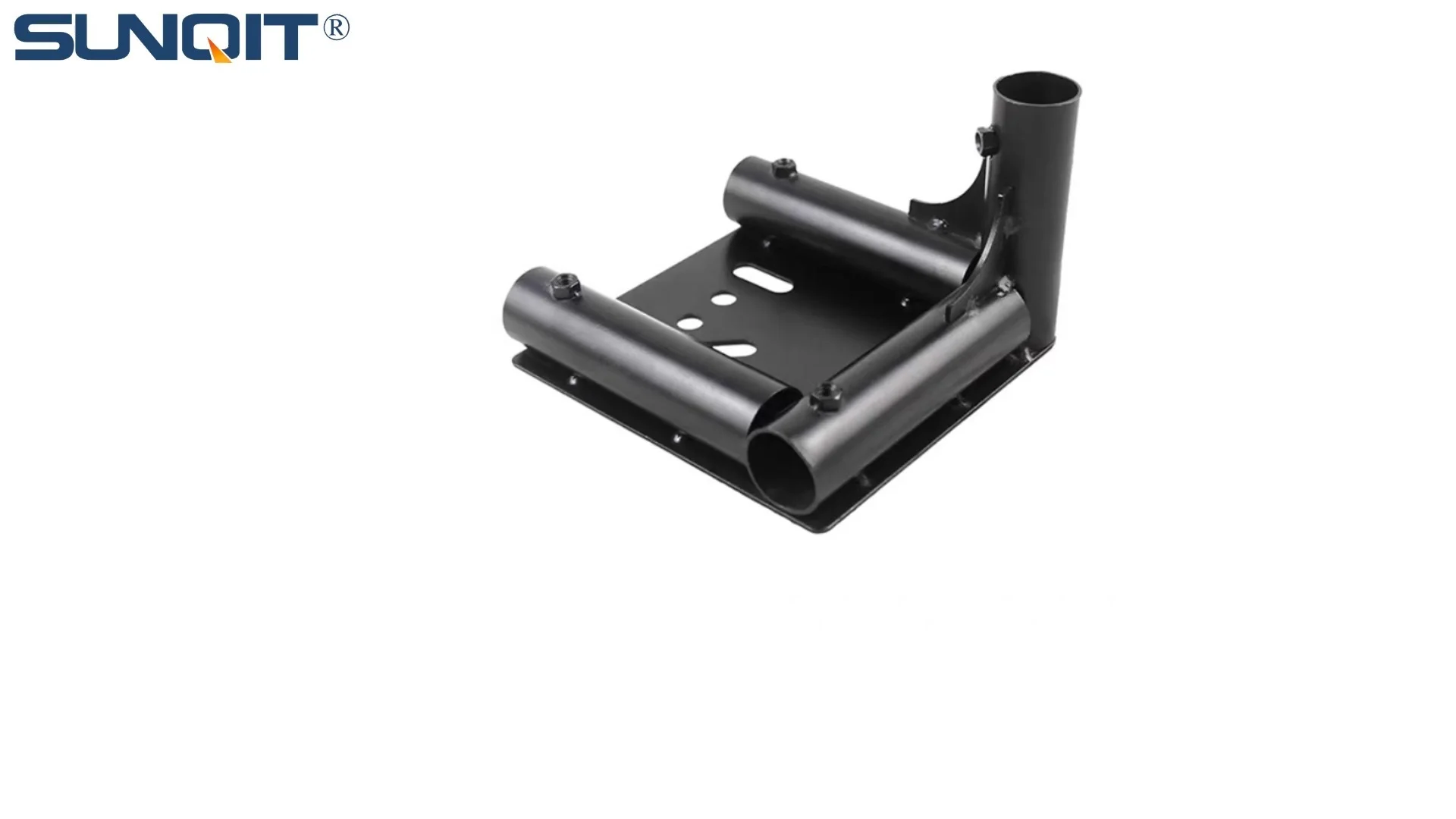
Castor Installation Base
Pipe fitting castor installation base,Well made, precise and strong. Made of high quality of steel,black painting surface treatment for greater resistance to corrosion. It is used for castor or foot lever connection with lean pipe.
In the fast-paced world of 3C manufacturing—where smartphones, laptops, and wearables evolve by the month—agility isn't just a buzzword; it's the difference between meeting launch deadlines and watching competitors steal market share. Production lines that once thrived on rigid, fixed setups now groan under the pressure of frequent model changes, custom configurations, and the ever-present need to keep workers safe and efficient. Today, we're diving into a small but transformative upgrade that's quietly revolutionizing assembly floors: adding a Castor Installation Base to the Workbench E (single deck-without caster) . This isn't just about wheels on a table—it's about unlocking mobility, reducing fatigue, and turning static workspaces into adaptive hubs that keep up with the chaos of modern manufacturing.
The Problem: When Fixed Workbenches Slow You Down
Let's set the scene: a 3C assembly plant in southern China, churning out mid-range smartphones for a global brand. Their production line relies on Workbench E stations—sturdy, single-deck units built with Aluminum Profile frames for durability. But here's the catch: these workbenches are fixed to the floor. No wheels, no adjustment, no flexibility. When the engineering team rolls out a new phone model with a rearranged circuit board layout, the line needs to reconfigure. Workers spend hours unbolting benches, dragging them (with brute force) to new positions, and resecuring them—all while the clock ticks on production targets.
Worse, workers themselves are stuck in place. A technician assembling the camera module might need tools from a Flow Rack three feet away; a quality inspector has to lean over a fixed bench to check a screen alignment, straining their lower back. By mid-shift, fatigue sets in, and small mistakes start creeping in. "We were averaging two line reconfigurations a month, and each took four hours," says Li Wei, the plant's production manager. "That's 48 hours a year lost to moving furniture. Not to mention, we had a 15% uptick in worker complaints about back pain. Something had to change."
Case Study: From Stuck to Smooth—A 3C Plant's Transformation
In early 2024, Li's team decided to test a simple upgrade: adding Castor Installation Bases to 10 of their Workbench E units. The goal? Turn fixed workbenches into mobile stations without sacrificing stability or ESD Workstation compliance (critical for handling sensitive electronics). Here's how it played out.
The Upgrade: Castor Installation Base 101
The Castor Installation Base itself is deceptively simple: a metal plate designed to bolt directly to the bottom of Workbench E's aluminum frame, with pre-drilled holes for attaching Caster Wheels (they chose 3-inch swivel casters with brake locks, rated for 150kg loads). The base is made from powder-coated steel, compatible with the workbench's existing Aluminum Profile Accessories , and took less than 20 minutes per unit to install—no welding, no specialized tools, just a wrench and a drill.
The Results: Numbers That Speak for Themselves
After three months of use, the plant compared metrics between the upgraded mobile workbenches and the remaining fixed ones. The difference was striking:
| Metric | Before (Fixed Workbench E) | After (Workbench E + Castor Installation Base) |
|---|---|---|
| Time to reconfigure a 10-bench line | 4 hours | 45 minutes |
| Worker-reported back pain (monthly complaints) | 12 | 3 |
| Distance walked per worker per shift | 2.3 miles | 1.1 miles |
| ESD compliance rate (static discharge incidents) | 98% | 99.5% (no loss of protection) |
| Material handling efficiency (tools/parts retrieved per hour) | 28 | 42 |
"The first time we reconfigured with the mobile benches, I thought there was a mistake," Li recalls. "The team finished in under an hour, and the foreman came to me asking, 'What do we do with the extra time?'" The secret? Locking casters kept benches steady during use, but (unlocking) them let two workers push a bench into place in seconds. No more straining, no more delays. And with workbenches now able to glide alongside Flow Racks , tools and parts were suddenly within arm's reach—cutting down on the endless walking that left workers drained.
"I used to spend 10 minutes per hour just walking to get screws or tape from the flow rack," says Zhang Mei, an assembly line worker with 5 years at the plant. "Now I roll my bench over, grab what I need, and lock it back. My feet don't ache by lunchtime anymore."

Why It Works: The Tech Behind the Mobility
You might be wondering: "Won't adding casters make the workbench wobbly? What about ESD protection?" Let's break down the details that make this upgrade more than just a quick fix.
Stability First: Aluminum Profile + Locking Casters
Workbench E's frame is built with 4040 Aluminum Extrusion Profile —hollow, lightweight, but surprisingly rigid. The Castor Installation Base bolts directly to this frame at four points, distributing the bench's weight evenly across the casters. When locked, the brake mechanism digs into the floor (or factory matting), creating a stable platform that doesn't shift during precision tasks like soldering or component placement. "We tested it with a 20kg load on the bench," Li notes. "Pushing, pulling, even leaning—no wobble. It's as steady as the fixed version, but with the option to move."
ESD Compatibility: No Compromises on Safety
For 3C manufacturing, static electricity is public enemy number one. A single discharge can fry a $500 circuit board. That's why the plant uses ESD Workstation setups, with grounded surfaces and anti-static mats. The Castor Installation Base doesn't disrupt this: the casters' wheels are made from conductive rubber, and the base itself is grounded via a small wire to the workbench's existing ESD system. "We ran 500 tests with a static meter," says Chen Jie, the plant's EHS officer. "No voltage spikes, no charge buildup. The mobile benches are just as safe as the fixed ones."
Durability: Built for the Factory Grind
Factory floors are tough: oil spills, metal shavings, constant foot traffic. The Castor Installation Base holds up because it's designed with industrial use in mind. The base plate is 3mm-thick steel, powder-coated to resist rust; the casters feature sealed bearings to keep out dust and debris; and the bolts are stainless steel (from the Stainless Steel Pipe Series ), so they won't corrode in humid environments. "We've had them for eight months now, and only replaced two caster wheels—after a forklift accidentally nicked one," Li laughs. "That's better than the fixed benches, which needed re-leveling every three months."

The Benefits: Beyond "Just Moving Benches"
The metrics tell part of the story, but the real impact shows up in the small, daily wins. Here are the benefits that surprised Li's team most:
- Agility for Small-Batch Runs : The plant now handles custom orders—like limited-edition phone colors—without disrupting mainline production. "We can pull three mobile workbenches into a corner, set up a mini-line, and run 500 units," Li explains. "Before, that would've meant shutting down a section of the main line for a day."
- Quick Repairs and Maintenance : When a workbench needs servicing (e.g., a damaged ESD mat), workers roll it to the maintenance area instead of waiting for a technician to come to the line. "Downtime per bench dropped from 2 hours to 20 minutes," Li says.
- Ergonomic Wins : Workers can now adjust the bench's position to their height or task. A shorter technician might move the bench 6 inches closer; a worker with a bad knee can angle it to avoid bending. "We tracked worker posture," Chen adds. "Fewer hunched backs, more neutral positions. That's why the pain complaints dropped."
- Future-Proofing : As the plant adopts collaborative robots (cobots), mobile workbenches can reposition to work alongside the machines. "The cobot moves, the bench moves with it," Li says. "No more redesigning the entire cell."

Who Should Consider This Upgrade?
This isn't a one-size-fits-all solution—but if your factory checks any of these boxes, it's worth a look:
- You reconfigure production lines monthly (or more).
- Workers complain about fatigue from walking or bending.
- You use Workbench E or similar aluminum-framed stations.
- ESD compliance is non-negotiable (the upgrade won't break it).
- You're tight on space but need to maximize line flexibility.
Final Thoughts: Small Changes, Big Shifts
In the grand scheme of manufacturing upgrades—robots, AI-powered quality checks, automated storage systems—the Castor Installation Base might seem. But Li's plant proves that sometimes the most impactful innovations are the ones that solve a daily, grinding problem. "We spent $120 per workbench on the upgrade," he says. "In the first month, we saved 40 labor hours on reconfigurations alone. That's ROI in weeks, not years."
For 3C manufacturers racing to keep up with consumer demand, mobility isn't a luxury—it's a necessity. And with tools like the Castor Installation Base, that mobility is within reach. As Zhang Mei puts it: "I don't think about the bench anymore. I just do my job, and it moves with me. That's how work should be."