- Company Articles
- Products and Technology
- Product knowledge
- Choosing a Castor Install Base for Lightweight vs. Heavy-Duty Material Racks

Choosing a Castor Install Base for Lightweight vs. Heavy-Duty Material Racks
Related Product
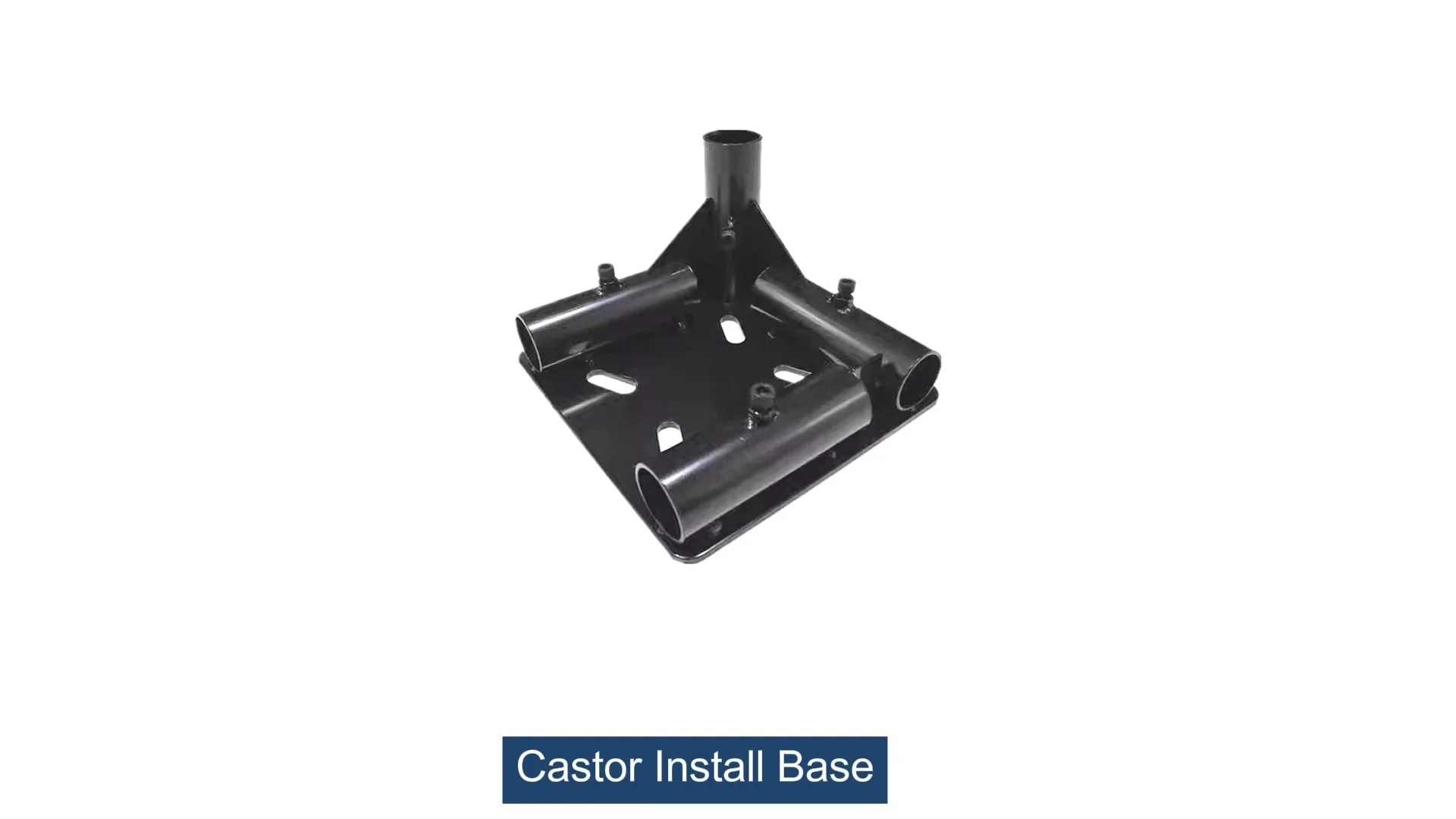
Castor Install Base
Castor install base, used for connection between pipe and castor, it can connect 4 pcs pipe by 1 pcs castor base, to make the structure strong and stable.
Walk into any warehouse, workshop, or manufacturing facility, and you'll notice a silent workhorse keeping operations moving: material racks. These structures hold everything from small components to bulky machinery, but their efficiency hinges on one often-overlooked detail: the castor install base. It's the unsung hero that turns a static rack into a mobile asset, letting teams rearrange workflows, transport materials, and adapt to shifting demands with ease. But here's the catch: not all castor install bases are created equal. A lightweight rack for small parts needs a different foundation than a heavy-duty unit hauling steel beams. Choose the wrong one, and you're looking at wobbly racks, damaged floors, or even safety hazards. So, how do you pick the right castor install base for your needs? Let's dive in.
Why the Castor Install Base Matters More Than You Think
Think of a material rack as a puzzle. The shelves, frames, and supports are the obvious pieces, but the castor install base is the cornerstone that holds it all together—literally. It's the interface between the rack and the floor, responsible for distributing weight, absorbing shocks, and enabling smooth movement. A poorly chosen base can turn a reliable rack into a liability: too flimsy, and it might bend under load; too rigid, and it could scratch delicate floors; misaligned, and the rack might wobble, risking spills or collapses.
In lean system environments, where efficiency and adaptability are king, the right castor install base becomes even more critical. Lean principles emphasize minimizing waste, and a mobile rack with a sturdy base lets teams reduce unnecessary movement—no more manually carrying parts across the shop floor when the rack can glide to the workstation. But if the base isn't suited to the rack's weight or the floor type, that mobility becomes a hassle. Imagine a workbench loaded with tools, perched on a base that sticks or swivels unpredictably—suddenly, "lean" becomes "clunky."
Lightweight vs. Heavy-Duty: Defining Your Needs
Before shopping for a castor install base, you need to answer one question: What's your rack actually doing? Lightweight and heavy-duty material racks live in entirely different worlds, and their bases need to reflect that.
Lightweight Material Racks: Nimble and Versatile
Lightweight racks typically handle loads under 500 pounds. Think of them as the "everyday carriers" of the workspace: holding small electronics components, office supplies, or tools in a garage workshop. They're often used in dynamic environments where racks need to be moved frequently—maybe a small manufacturing line that reconfigures weekly, or a retail stockroom where inventory shifts seasonally.
For these racks, the castor install base needs to prioritize mobility and floor protection . Since the loads are lighter, the base doesn't need to be overly bulky, but it still must keep the rack stable during movement. Common scenarios include: a "material rack b (3 row and 3 floor)" used for storing plastic bins of screws and washers, or a rolling cart next to a workbench holding daily-use tools. In these cases, a base with non-marking caster wheels and a simple plate mount might be all you need.
Heavy-Duty Material Racks: Built for the Big Leagues
Heavy-duty racks, on the other hand, are the workhorses. They're designed for loads over 1,000 pounds—think metal sheets, engine parts, or pallets of raw materials. These racks are the backbone of warehouses and factories, often staying in place for months but needing occasional repositioning (like during a facility redesign or deep cleaning). Stability and durability here aren't just preferences—they're safety requirements.
A heavy-duty castor install base must withstand constant pressure without bending or warping. It might feature reinforced steel plates, larger caster wheels for weight distribution, and locking mechanisms to keep the rack anchored during loading/unloading. For example, a rack storing automotive transmissions would need a base that can handle the uneven weight of each unit, prevent tipping, and roll smoothly even with 2,000 pounds on board.

5 Key Factors to Choose the Right Castor Install Base
Now that you've defined lightweight vs. heavy-duty, let's break down the critical factors that will guide your decision. These aren't just specs—they're the difference between a rack that works for years and one that becomes a frustrating, costly mistake.
1. Weight Capacity: Don't Guess—Calculate
This is non-negotiable. Every castor install base has a weight rating, but it's not just about the rack's total load. You need to account for dynamic weight too—how the load shifts when the rack is moving. A 500-pound static load might feel like 600 pounds when you're rolling over a floor crack, so always choose a base rated for 20-30% more than your maximum expected load.
For lightweight racks: Look for bases rated 600-800 pounds (to cover dynamic shifts). Heavy-duty racks? Start at 1,500 pounds and go up—some industrial bases handle 10,000+ pounds.
2. Floor Type: Protect Your Surfaces
Concrete, hardwood, tile, or carpet—your floor type dictates the caster wheel material, which is part of the castor install base system. Soft floors like carpet need larger, wider wheels to prevent sinking; hard floors like concrete or tile require non-marking wheels to avoid scratches. For example, a plastic caster wheel might be great for a lightweight rack on office carpet, but a heavy-duty rack on concrete needs steel or polyurethane wheels to resist wear.
3. Mobility Needs: How Often Will You Move It?
A rack that stays in one spot 90% of the time needs a different base than one that's rolled across the shop daily. Lightweight racks moved frequently benefit from swivel casters (360° rotation) with brakes for quick locking. Heavy-duty racks might use rigid casters (fixed direction) for straight-line movement, with swivel casters only on the front for steering—think of a forklift vs. a shopping cart.
4. Durability: Material and Construction
Lightweight bases often use aluminum or plastic components for cost and weight savings. They're fine for dry, indoor environments but might corrode in humid or dusty settings. Heavy-duty bases? Steel is the gold standard—galvanized or stainless steel if you're dealing with moisture (like a food processing plant). The welds, bolts, and plate thickness matter too: a flimsy steel plate will bend under stress, while a ¼-inch thick plate will stand firm.
5. Mounting Style: Plate vs. Stem
Castor install bases attach to racks in two main ways: plate mounts (bolted to the rack's frame) or stem mounts (inserted into a hollow tube on the rack). Plate mounts are sturdier for heavy loads—they distribute weight across a larger surface area. Stem mounts are common in lightweight racks, where the rack's frame is a thin tube (like a "basic aluminum tube"). Always check your rack's frame design before choosing—you don't want to drill holes in a rack that's meant for stem mounts!

Types of Castor Install Bases: Which One Fits?
Not all bases are built the same. Let's break down the most common types, from lightweight to heavy-duty, and when to use each.
| Base Type | Weight Capacity | Ideal For | Best Features | Limitations |
|---|---|---|---|---|
| Plastic Plate Base | 300-600 lbs | Lightweight racks, dry indoor use (e.g., office supply racks) | Low cost, non-marking, corrosion-resistant | Not for heavy loads or rough floors |
| Aluminum Plate Base | 600-1,200 lbs | Medium-light racks, clean rooms, lean system workstations | Lightweight, rust-resistant, easy to maneuver | Prone to bending under sudden impacts |
| Steel Plate Base (Mild Steel) | 1,200-3,000 lbs | Heavy-duty racks in warehouses, workshops with concrete floors | Durable, affordable, high weight capacity | Can rust if not painted/coated |
| Stainless Steel Plate Base | 1,500-5,000 lbs | Food processing, chemical plants, or wet environments | Corrosion-proof, hygienic, long-lasting | Expensive; overkill for dry, indoor use |
| Reinforced Stem Base | 400-800 lbs | Lightweight racks with hollow tube frames (e.g., "basic aluminum tube" racks) | Easy installation, low profile | Not as stable as plate mounts for heavy loads |

Real-World Applications: How the Pros Choose
Let's look at two scenarios to see how these factors play out in practice—one lightweight, one heavy-duty.
Scenario 1: A Lean System Workbench in an Electronics Factory
A manufacturer of circuit boards uses "workbench e (single deck-without caster)" as part of their lean system. They need to add mobility to the workbench to move it between assembly stations, but the bench only holds small tools and circuit boards (total load: 450 lbs). The floor is smooth concrete, and the bench is moved 2-3 times per shift.
Solution: An aluminum plate base with 4-inch polyurethane wheels. Aluminum is lightweight enough to keep the bench easy to push, polyurethane wheels protect the concrete floor, and the plate mount distributes the 450 lbs evenly. They opt for swivel casters with brakes to lock the bench in place during assembly.
Scenario 2: A "Material Rack b (3 row and 3 floor)" in a Automotive Warehouse
A warehouse stores car engines on a "material rack b (3 row and 3 floor)"—each engine weighs 600 lbs, and the rack holds 3 engines per shelf (total load: 5,400 lbs). The rack is moved monthly for deep cleaning, and the floor is rough concrete with occasional cracks.
Solution: A stainless steel plate base with 8-inch steel wheels and dual-locking brakes. Stainless steel resists oil and grease from the engines, 8-inch wheels roll over cracks easily, and the plate base (rated for 6,000 lbs) handles the dynamic load when moving. Rigid casters on two corners and swivel casters on the other two make steering easier with the heavy load.
5 Common Mistakes to Avoid
Even with the best intentions, it's easy to slip up. Here are the pitfalls to watch for:
1. Underestimating Weight
The #1 mistake! A customer once bought a 500-lb rated base for a rack that "only holds boxes of paper." What they forgot: each box was 50 lbs, and they stacked 12 boxes—600 lbs. The base bent within a week. Always calculate the maximum possible load , not just the "average."
2. Ignoring Floor Conditions
Rough floors, thresholds, or even small gaps can turn a smooth-rolling base into a stuck one. If your facility has uneven floors, opt for larger wheels (6+ inches) with shock-absorbing features.
3. Overlooking Locking Mechanisms
A rack that rolls while you're loading it is dangerous. Look for bases with "total lock" brakes—they lock both the wheel and the swivel, preventing movement in any direction.
4. Mismatching Mount Type
Drilling plate mount holes into a stem-mount rack weakens the frame. Always check the rack's specifications—most manufacturers list compatible base types (e.g., "use stem mounts with 1.5-inch aluminum tube frames").
5. Skimping on Quality for Cost
A $20 plastic base might seem like a deal, but if it fails and damages inventory (or worse, causes an injury), the cost skyrockets. Invest in a base from a reputable "caster and accessories" supplier—quality parts last 5-10 times longer than cheap knockoffs.
Final Thoughts: Your Rack Deserves the Right Foundation
Choosing a castor install base isn't just about picking a part—it's about protecting your workflow, your team, and your investment. Whether you're outfitting a lightweight "workbench e (single deck-without caster)" or a heavy-duty "material rack b (3 row and 3 floor)," the base is the foundation that turns a static structure into a tool for efficiency. By focusing on weight capacity, floor type, mobility, and quality, you'll ensure your racks move when you need them to, stay put when you don't, and last for years to come.
Remember: In the world of material handling, the smallest details often make the biggest difference. And when it comes to racks, that detail is the castor install base. Choose wisely, and watch your operations run smoother than ever.