- Company Articles
- Products and Technology
- Product knowledge
- Choosing Between Standard and Custom Aluminum Workbench D: Which Fits Your Needs?

Choosing Between Standard and Custom Aluminum Workbench D: Which Fits Your Needs?
Related Product
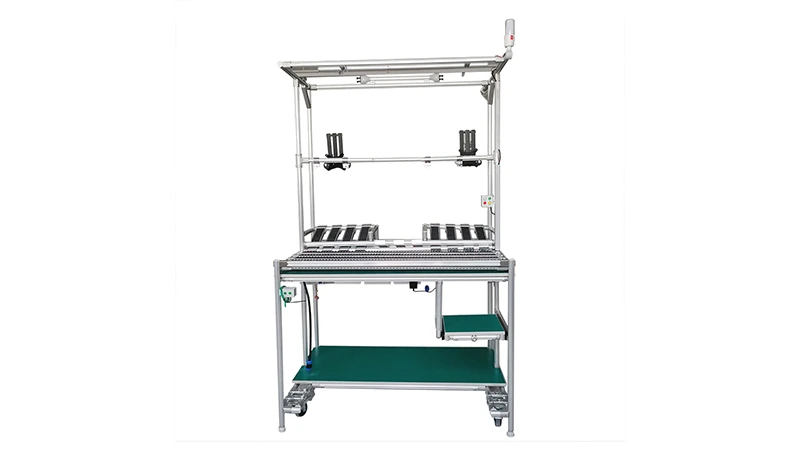
Aluminum Workbench D
Aluminum tube workbench is more flexible and durable, compared with traditional PE/ABS coated steel tube. It is easy to assemble, anti corrosion, rust protection, and recycle use after disassemble.
Introduction: The Workbench as the Backbone of Production
Walk into any manufacturing facility, warehouse, or assembly plant, and you'll notice a silent hero holding everything together: the workbench. It's more than just a table; it's the stage where ideas become products, where teams collaborate, and where the rhythm of production finds its beat. For decades, workbenches have evolved from simple wooden surfaces to sophisticated, material-specific setups, and today, aluminum stands out as a top choice for its unique blend of strength, flexibility, and durability. Among aluminum workbenches, two options dominate the market: the tried-and-true standard models and the tailored-to-fit custom designs. But how do you decide which one is right for your operation? Whether you're a small startup scaling up or a large enterprise optimizing workflows, the choice between standard and custom aluminum workbench D (or any workbench, for that matter) can impact everything from daily efficiency to long-term profitability. Let's dive in.
What is a Standard Aluminum Workbench?
A standard aluminum workbench is like the "off-the-shelf" option of the industrial world. Think of it as a pre-designed, mass-produced solution built to meet common needs across various industries. These workbenches typically come with fixed dimensions, standard features, and a one-size-fits-most approach. For example, models like "Workbench E (single deck-without caster)" – a simple, no-frills setup with a single flat surface and no wheels – fall into this category. They're designed using standardized aluminum profile and aluminum extrusion profile, ensuring consistency in quality and compatibility with basic accessories.
So, who opts for standard workbenches? Often, small businesses, startups, or teams with straightforward, repetitive tasks. If your workflow involves basic assembly, packaging, or light manufacturing – and your space and tools fit within common parameters – a standard model might be all you need. Let's break down the pros and cons.
Pros of Standard Aluminum Workbenches
Cost-Effective: Since they're mass-produced, standard workbenches spread manufacturing costs across many units, making them significantly cheaper than custom alternatives. For businesses watching their bottom line, this upfront savings can be a game-changer, especially in the early stages.
Quick Availability: No waiting for design drafts, material sourcing, or custom fabrication. Standard workbenches are ready to ship, meaning you can have them in your facility within days (or weeks, at most) of ordering. This speed is critical for operations that need to get up and running fast.
Easy to replace: If a workbench gets damaged or outdated, replacing it is as simple as ordering a new one. No need to rework designs or renegotiate with suppliers – just swap and go. This minimizes downtime, which is invaluable in high-paced environments.
Cons of Standard Aluminum Workbenches
Limited Customization: The biggest downside is rigidity. Standard workbenches come with fixed heights, surface sizes, and accessory options. If your team uses oversized tools, requires extra storage, or needs ESD (electrostatic discharge) protection, a standard model might not deliver. For example, if your workflow involves integrating a conveyor system to move parts between stations, a standard bench likely won't have pre-built slots or mounting points for that.
Potential Ergonomic Gaps: Ergonomics – the science of designing tools for human comfort and efficiency – is often an afterthought with standard workbenches. If your operators are taller or shorter than average, a fixed-height bench can lead to strained backs, neck pain, or reduced productivity over time. Over weeks and months, these small discomforts add up to higher turnover and lower morale.
Mismatched Workflows: Every operation has unique rhythms. Maybe your team uses a lean system to minimize waste, requiring parts to flow in a specific U-shape around the bench. A standard rectangular workbench might disrupt that flow, forcing operators to take extra steps or reach awkwardly – exactly the kind of inefficiency lean principles aim to eliminate.
"We started with a standard aluminum workbench because it was cheap and easy to get," says Maria, operations manager at a small electronics assembly startup. "But after six months, we realized our technicians were wasting 15 minutes a day just walking around the bench to grab tools. The surface was too small, and there was no way to add a side shelf without drilling holes – which we didn't want to do on a brand-new bench."

What is a Custom Aluminum Workbench?
Custom aluminum workbenches, on the other hand, are the "bespoke suits" of the industrial world. They're designed from the ground up to fit your unique needs, workflows, and space constraints. Unlike standard models, which follow a one-size-fits-most template, custom workbenches are collaborative projects between you and your supplier. You'll work together to analyze tasks, measure space, and even interview operators to ensure every inch serves a purpose. The result? A workbench that feels like it was built for your team, not just for anyone.
Custom workbenches still rely on aluminum profile and aluminum extrusion profile for their core structure – after all, aluminum's lightweight strength and modularity make it ideal for customization. But here's where things get interesting: you can tweak everything from the height (adjustable or fixed) to the surface material (wood, steel, or anti-static laminates), add integrated tools holders, or even mount a mini conveyor system directly onto the bench. For example, if your workflow involves moving small parts from one end to the other, a custom design might include a built-in roller track or conveyor belt that syncs with your upstream and downstream processes.
So, who invests in custom workbenches? Typically, medium to large businesses with complex workflows, teams with specialized needs (like ESD-sensitive electronics or heavy machinery assembly), or operations focused on long-term efficiency. Let's explore the pros and cons.
Pros of Custom Aluminum Workbenches
Perfect Fit for Workflows: The biggest advantage of custom workbenches is their ability to align with your unique processes. If your team follows a lean system, a custom bench can be shaped to reduce motion waste – think curved edges to minimize reaching, built-in bins for tools at arm's length, or integrated conveyor rails to keep parts moving smoothly. For example, a custom "Workbench D" might include a sloped surface to let gravity feed parts into the next station, eliminating the need for manual lifting.
Ergonomic Excellence: Custom workbenches prioritize people. By involving operators in the design process, you can adjust heights, add footrests, or tilt surfaces to reduce strain. A study by the Occupational Safety and Health Administration (OSHA) found that ergonomic workstations can reduce musculoskeletal disorders by up to 60% – a statistic that translates to fewer sick days, happier teams, and higher productivity.
Future-Proofing: Custom workbenches are built with growth in mind. Maybe today you need a single station, but next year you'll expand to three. A good custom design will include modular components – like detachable side panels or extendable aluminum profile – that let you scale without replacing the entire bench. This adaptability saves money in the long run and keeps your workflow consistent as you grow.
Cons of Custom Aluminum Workbenches
Higher Upfront Cost: Customization comes with a price tag. Designing, engineering, and fabricating a one-of-a-kind workbench takes time and resources, so expect to pay 30-50% more than a standard model. For small businesses with tight budgets, this can be a barrier – though many find the long-term ROI (fewer inefficiencies, lower turnover) justifies the cost.
Longer Lead Time: Standard workbenches ship in days; custom ones can take weeks or even months. From initial design meetings to material sourcing and fabrication, the process requires patience. If you need a bench ASAP to meet a project deadline, a custom model might not be feasible.
Requires Detailed Planning: To get a custom workbench right, you need to know your workflow inside out. Vague requirements (e.g., "We need more space") can lead to designs that miss the mark. This means investing time in workflow analysis, team interviews, and space mapping – a step some busy operations might skip, leading to costly revisions later.
"We switched to custom aluminum workbenches after struggling with standard models for years," says Raj, production manager at a automotive parts manufacturer. "Our old benches were too low for our tallest technicians and too narrow for our tools. The custom design? We measured every operator's height, mapped out tool placement, and even added a mini conveyor to connect the bench to our main assembly line. Now, our team saves 2 hours a day in wasted motion. The upfront cost hurt, but it paid for itself in three months."

Key Factors to Consider When Choosing
Deciding between standard and custom aluminum workbench D isn't about picking "better" or "worse" – it's about picking right for your unique situation. To make the call, ask yourself these five critical questions:
1. What Does Your Workflow Look Like?
Start by mapping your process from start to finish. Do you have repetitive, predictable tasks (e.g., packaging boxes) or complex, multi-step assembly (e.g., building circuit boards)? Standard workbenches thrive in simple, consistent workflows where the tools and space needs don't vary. Custom workbenches shine in complex environments – think integrating with conveyor systems, ESD requirements, or specialized tooling. For example, if your workflow involves moving parts from the bench to a conveyor belt every 5 minutes, a custom bench with a built-in roller track could eliminate the need for operators to carry parts, cutting down on errors and fatigue.
2. How Tight is Your Space?
Measure your facility carefully. Standard workbenches come in fixed sizes (e.g., 4ft x 2ft, 6ft x 3ft), which can be a problem if your space is irregularly shaped (e.g., a narrow corner or a room with pillars). Custom workbenches can be built to fit odd angles, utilize vertical space, or even fold down when not in use. For example, a custom "Workbench D" might be designed with a slim profile to slide between two machines, maximizing every inch of your facility.
3. What's Your Budget – Now and Later?
Standard workbenches have lower upfront costs, but they might cost more in the long run if they slow down workflows or require replacement sooner. Custom workbenches have higher initial prices, but their efficiency gains and durability often lead to better ROI. Ask: How much time does a standard bench waste daily? If the answer is 1 hour per operator, and you have 10 operators paid $25/hour, that's $250/day in lost productivity – adding up to $65,000/year. A custom bench costing $5,000 more could save that in months.
4. Have You Asked Your Team?
Your operators use the workbench every day – they know its flaws better than anyone. Conduct short interviews: What do they struggle with? Is the surface too high? Are tools hard to reach? Their feedback can reveal hidden inefficiencies a standard bench can't fix. For example, one team might mention that they constantly drop small parts on the floor – a custom bench with a raised lip or magnetic strip could solve that problem instantly.
5. Do You Plan to Grow or Change?
Businesses evolve, and your workbench should too. If you're expanding, adding new products, or adopting new technologies (e.g., automation), a standard bench might become obsolete quickly. Custom workbenches with modular aluminum profile and detachable accessories can adapt – add a new shelf, extend the surface, or integrate with a new conveyor system as needed. Standard benches, on the other hand, often need to be replaced entirely when workflows change.
Standard vs. Custom: A Side-by-Side Comparison
Still on the fence? Let's put standard and custom aluminum workbenches head-to-head in key categories:
| Factor | Standard Aluminum Workbench | Custom Aluminum Workbench |
|---|---|---|
| Cost | Lower upfront cost ($500–$1,500 on average) | Higher upfront cost ($1,500–$5,000+ depending on complexity) |
| Lead Time | Fast (1–2 weeks) | Longer (4–8 weeks for design and fabrication) |
| Customization | Limited (fixed size, basic accessories) | Unlimited (adjustable height, integrated tools, conveyor compatibility, etc.) |
| Ergonomics | Basic (one-size-fits-most design) | Tailored to team needs (adjustable, operator-specific features) |
| Workflow Alignment | Best for simple, repetitive tasks | Best for complex, multi-step workflows (e.g., lean system integration) |
| Scalability | Hard to scale (replace entire bench when needs change) | Easy to scale (modular aluminum profile and accessories) |
Real-World Examples: When to Choose Standard vs. Custom
Example 1: The Startup Packaging Operation
Scenario: A small e-commerce startup with 5 employees packaging orders. They have a 20ft x 20ft warehouse space and use basic tools (tape guns, scissors, label printers). Their workflow is simple: unbox products, place in shipping boxes, seal, label, and stack.
Recommendation: Standard Workbench. Their needs are straightforward, space is limited but regular, and they don't have specialized tooling. A standard 4ft x 2ft aluminum workbench with a lower shelf for storage would fit perfectly. It's cost-effective, quick to set up, and easy to replace if they outgrow it.
Example 2: The Mid-Size Electronics Assembly Plant
Scenario: A company with 30 employees assembling smartphones. Their workflow involves ESD-sensitive components, multiple tools (soldering irons, microscopes), and integration with a conveyor belt that moves parts between stations. They follow a lean system to minimize waste and have operators of varying heights (5'2" to 6'4").
Recommendation: Custom Workbench. Their workflow is complex, with ESD requirements, conveyor integration, and ergonomic needs. A custom aluminum workbench D could include adjustable height (via hydraulic lifts), ESD-safe surfaces, built-in tool holders, and a sloped surface to feed parts onto the conveyor belt. The upfront cost would be offset by reduced errors, faster assembly times, and lower injury rates.
Conclusion: It's About Alignment, Not Perfection
Choosing between standard and custom aluminum workbench D (or any workbench) boils down to one question: Does it align with your workflow, team, and goals? Standard workbenches are the practical choice for simple, budget-conscious operations with steady, predictable needs. They're quick, affordable, and get the job done. Custom workbenches are the strategic choice for complex workflows, ergonomic priorities, or long-term growth. They're an investment in your team's productivity and well-being.
Remember, there's no "wrong" choice – only the choice that's right for you . Start by analyzing your workflow, talking to your team, and mapping your space. If you're still unsure, consider a hybrid approach: start with a standard workbench to test your needs, then upgrade to a custom model once you've identified pain points. Whichever path you choose, your workbench should be more than a piece of equipment – it should be a partner in your success.