- Company Articles
- Products and Technology
- Product knowledge
- Choosing the Right Flat Adjustable Swivel Castor Wheel: Load Capacity Guide

Choosing the Right Flat Adjustable Swivel Castor Wheel: Load Capacity Guide
Related Product
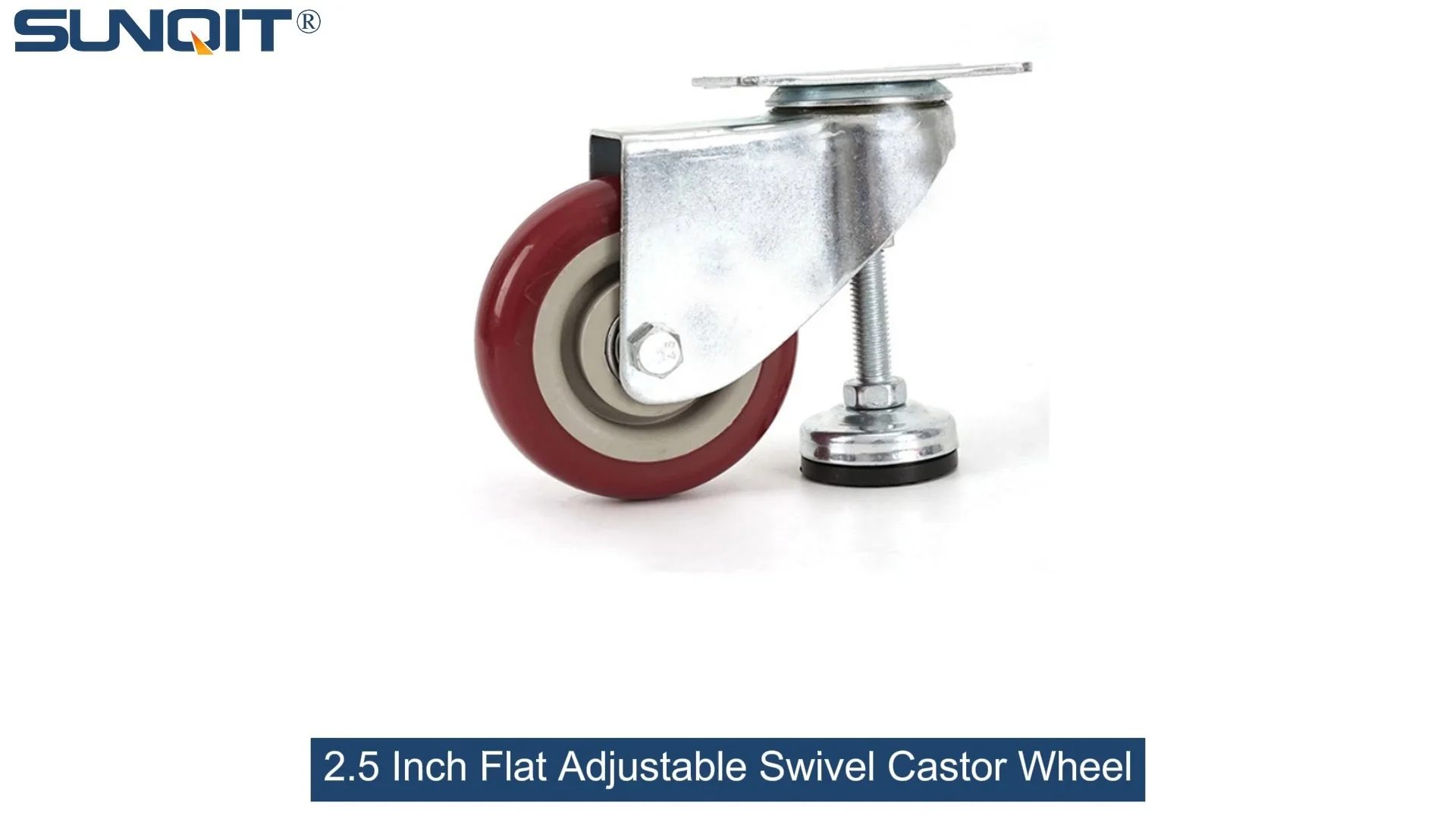
Flat Adjustable Swivel Castor Wheel
Swivel Chair Casters Ball Bearing Wheels Rubber Base with adjustable height function. Resistant to abrasion, impact and corrosion. Heavy payload can hold 80Kgs per pcs,which can make it works at a stable and smooth status.
In the bustling world of manufacturing, warehousing, and workshop operations, there's an unsung hero that keeps things moving—quite literally: the caster wheel . From heavy-duty material racks to nimble workbenches, these small but mighty components bear the weight of efficiency, safety, and productivity. Among the many types of casters available, the flat adjustable swivel castor wheel stands out for its versatility, especially in environments where adaptability and precision matter most. But here's the thing: not all casters are created equal, and choosing the wrong one can turn a smooth workflow into a recipe for frustration, downtime, or even disaster. At the heart of this decision lies a critical factor: load capacity. In this guide, we'll dive deep into what load capacity means, why it matters, and how to select the perfect flat adjustable swivel castor wheel for your needs—whether you're outfitting a workbench, a turnover trolley, or an entire production line.
What Are Flat Adjustable Swivel Castor Wheels?
Before we get into load capacity, let's make sure we're all on the same page about what a flat adjustable swivel castor wheel actually is. Unlike rigid casters that only roll forward and backward, swivel casters have a rotating mechanism that allows 360-degree movement, making it easy to maneuver heavy or bulky items with minimal effort. The "flat adjustable" part adds another layer of utility: these casters feature a mounting plate (the "flat" part) that sits flush against the equipment, and an adjustable height mechanism—often a threaded stem or a bolt system—that lets you tweak the caster's height to level uneven surfaces, compensate for floor irregularities, or align equipment with workstations.
Imagine a busy workshop where a workbench needs to be moved from one station to another, then locked into place at a precise height to match a conveyor belt. A flat adjustable swivel castor wheel makes this possible: its swivel function allows easy navigation around corners, its flat mounting plate ensures stability when stationary, and its adjustability ensures the workbench stays level, even if the floor has a slight slope. It's this combination of mobility, stability, and precision that makes these casters indispensable in settings where flexibility is key.
Why Load Capacity Isn't Just a Number—It's a Safety Imperative
Load capacity is the maximum weight a caster can safely support under normal operating conditions. Sounds straightforward, right? But here's why it's non-negotiable: underloading a caster might lead to inefficiency (why pay for a heavy-duty caster if you don't need it?), but overloading is a safety hazard. A caster that's pushed beyond its load limit can fail unexpectedly—wheels might crack, bearings could seize, or the mounting plate might bend or break. The result? Equipment tipping, goods damaged, or worse, injuries to workers. In industrial settings, where loads can range from a few hundred pounds to several tons, getting load capacity right isn't just about equipment longevity; it's about protecting people and profits.
But load capacity isn't a one-size-fits-all metric. There are two key types to understand: static load capacity and dynamic load capacity . Static load capacity refers to the maximum weight a caster can support when it's stationary—think of a workbench loaded with tools sitting idle in a corner. Dynamic load capacity, on the other hand, is the weight it can handle while in motion—like that same workbench being wheeled across the workshop floor. Dynamic load capacity is almost always lower than static, because movement adds stress: vibrations, uneven floors, and sudden stops or starts all put extra strain on the caster's components. For example, a caster with a static load capacity of 500 lbs might only have a dynamic capacity of 350 lbs. Ignore this difference, and you're setting yourself up for trouble.

Breaking Down Load Capacity: Key Factors That Influence Performance
Load capacity isn't determined by a single feature; it's a result of how several components work together. Let's break down the most important factors that affect how much weight a flat adjustable swivel castor wheel can handle:
1. Wheel Diameter and Width
It might seem counterintuitive, but larger wheels often have higher load capacities—up to a point. A larger wheel distributes weight over a bigger surface area, reducing pressure on the floor and the wheel itself. For example, a 5-inch diameter wheel will typically support more weight than a 3-inch wheel of the same material. Width matters too: wider wheels spread the load further, which is why heavy-duty casters often have wide, flat treads. That said, bigger isn't always better—larger wheels can be harder to maneuver in tight spaces, so you'll need to balance capacity with practicality.
2. Wheel Material
The material of the wheel itself plays a huge role in load capacity. Here's a quick breakdown of common materials and their load-handling abilities:
- Polyurethane (PU): A popular choice for general use, PU wheels offer a good balance of load capacity (medium to high), floor protection (they're soft enough to avoid scratching), and quiet operation. They're ideal for indoor settings like workshops and offices.
- Rubber: Rubber wheels excel at shock absorption and grip, but they have lower load capacities (best for light to medium loads). They're great for uneven floors but can wear down quickly under heavy weight.
- Steel: When it comes to heavy loads, steel wheels are the workhorses. They can handle thousands of pounds and stand up to rough surfaces, but they're noisy and can damage delicate floors (like polished concrete or tile).
- Nylon: Nylon wheels are tough, chemical-resistant, and have high load capacities (similar to steel in some cases). They're a good alternative to steel if you need durability without the noise or floor damage.
3. Bearing Type
The bearings inside the wheel determine how smoothly it rolls—and how much weight it can support. There are two main types:
- Ball bearings: Common in light to medium-duty casters, ball bearings use small metal balls to reduce friction. They're affordable and work well for loads up to around 500 lbs per caster.
- Roller bearings (or tapered roller bearings): These use cylindrical rollers instead of balls, which distribute weight more evenly. They're better for heavy loads (1,000 lbs and up) and offer smoother rolling under pressure.
A caster with high-quality roller bearings will not only support more weight but also last longer, even under constant use.
4. Swivel Mechanism and Housing
The swivel mechanism (the part that allows the wheel to rotate) and the housing (the metal frame that holds everything together) are often overlooked, but they're critical for load capacity. A sturdy housing made from thick steel or reinforced aluminum can withstand more weight than a flimsy, thin-gauge metal housing. Similarly, a well-sealed swivel mechanism with lubricated raceways will prevent jamming and ensure the caster can handle dynamic loads without failing.

How to Calculate Load Capacity: A Step-by-Step Guide
Now that you know what affects load capacity, let's walk through how to calculate the right capacity for your needs. It's not as complicated as it sounds—just follow these steps:
Step 1: Determine the Total Load
First, add up the weight of everything the caster will need to support. This includes:
- The weight of the equipment itself (e.g., a workbench, trolley, or material rack).
- The maximum weight of the items you'll place on the equipment (tools, materials, products, etc.).
- Any additional weight from movement (like vibrations or sudden stops—we'll account for this later with a safety factor).
For example, if you're outfitting a workbench that weighs 150 lbs, and you plan to load it with tools and materials up to 300 lbs, your total load is 150 + 300 = 450 lbs.
Step 2: Decide How Many Casters You'll Use
Most equipment uses 4 casters (one at each corner), but some larger items might use 6 or 8 for extra stability. The more casters you use, the less weight each one has to bear. For example, 4 casters will each support 25% of the total load, while 6 casters will each support ~16.7%.
Pro tip: Even if your equipment has 4 casters, assume that only 3 will bear the load at any given time (this accounts for uneven floors or slight tilting during movement). This is called the "3-point rule" and adds an extra layer of safety.
Step 3: Add a Safety Factor
Never choose a caster with a load capacity equal to your calculated per-caster load. Always add a safety factor to account for unexpected stress, like rough handling, uneven floors, or occasional overloading. A good rule of thumb is to multiply your per-caster load by 1.5 (for light to medium use) or 2.0 (for heavy-duty or critical applications, like medical equipment or industrial machinery).
Example: Calculating Load Capacity for a Workbench
Total load:
450 lbs (workbench + tools/materials)
Number of casters:
4
Per-caster load (using 3-point rule):
450 lbs ÷ 3 casters = 150 lbs per caster
Safety factor (1.5x for workshop use):
150 lbs × 1.5 = 225 lbs
Required dynamic load capacity:
At least 225 lbs per caster
So, for this workbench, you'd need a flat adjustable swivel castor wheel with a dynamic load capacity of 225 lbs or higher.

Load Capacity Ratings: Static vs. Dynamic (And Why It Matters)
We touched on this earlier, but it's worth repeating: caster manufacturers list two load capacities: static and dynamic. Here's why you can't ignore either:
- Static load capacity: This is the maximum weight the caster can support when it's not moving. It's higher than dynamic capacity because there's no additional stress from rolling, turning, or vibrations. Think of it as the "parked" weight.
- Dynamic load capacity: This is the maximum weight when the caster is in motion. It's lower because rolling introduces friction, and swiveling or stopping suddenly adds shock loads. This is the number you should focus on for most applications—after all, if your equipment is on casters, it's probably going to move at some point!
To illustrate, let's say a caster has a static capacity of 500 lbs and a dynamic capacity of 350 lbs. If you load it with 400 lbs and leave it parked, it might hold—but if you try to roll it, you're exceeding the dynamic capacity, and the wheel or bearings could fail. Always, always use dynamic capacity as your primary benchmark.
| Wheel Diameter (Inches) | Wheel Material | Static Load Capacity (Lbs) | Dynamic Load Capacity (Lbs) | Best For |
|---|---|---|---|---|
| 3 | Polyurethane | 400 | 250 | Light workbenches, small trolleys |
| 5 | Polyurethane | 800 | 500 | Medium-duty material racks, tool cabinets |
| 6 | Steel | 2,000 | 1,500 | Heavy machinery, industrial trolleys |
| 4 | Nylon | 1,200 | 800 | Chemical labs, warehouses with rough floors |
Table 1: Load capacity examples for common flat adjustable swivel castor wheel sizes and materials. Always check manufacturer specs for exact ratings.
Common Mistakes to Avoid When Choosing a Caster
Even with the best intentions, it's easy to make missteps when selecting a flat adjustable swivel castor wheel. Here are the most common mistakes and how to steer clear of them:
Mistake 1: Focusing Only on Static Load Capacity
As we discussed, dynamic load capacity is what matters for moving equipment. Yet many people see a high static rating and assume it's enough. Don't fall into this trap! If your caster will be rolled, even occasionally, prioritize dynamic capacity.
Mistake 2: Ignoring the Environment
A caster that works perfectly in a climate-controlled workshop might fail miserably in a damp warehouse or a dusty factory. For example, steel casters can rust in humid environments, while rubber wheels can degrade in oily or chemical-heavy settings. Consider factors like temperature, moisture, debris, and floor type (smooth vs. rough) when choosing materials.
Mistake 3: Skimping on Quality for Price
It's tempting to buy the cheapest caster that meets your load capacity needs, but low-quality casters often cut corners on materials (thin housing, cheap bearings) or skip testing. This can lead to premature failure, which costs more in replacements, downtime, and potential accidents than investing in a quality caster upfront.
Mistake 4: Forgetting About Adjustability
The "adjustable" feature of a flat adjustable swivel castor wheel is there for a reason. If your floor is uneven (and let's be real, most floors are), a non-adjustable caster will leave your equipment wobbly, which can strain the casters and make work harder. Always check the adjustability range (how much you can raise or lower the caster) and ensure it's easy to adjust—some casters require tools, while others have hand-turn knobs for quick tweaks.
Mistake 5: Overlooking Caster Accessories
Caster accessories like brakes, locks, and swivel stops might not directly affect load capacity, but they impact safety and usability. For example, a brake that fails could cause a loaded trolley to roll away, while a swivel stop can prevent the caster from rotating unexpectedly under heavy loads. Don't forget to factor these into your decision—they're small additions that make a big difference.
Applications: Where Flat Adjustable Swivel Casters Shine
Flat adjustable swivel castor wheels are versatile, but they truly excel in specific environments. Here are some common applications where they're the best choice:
1. Workbenches and Assembly Stations
Workbenches need to be both stable (for precise tasks like assembly or repairs) and mobile (to reconfigure the workspace). A flat adjustable swivel castor wheel lets you lock the bench in place when needed, adjust the height to match the worker's ergonomics, and roll it out of the way when extra space is needed. They're especially popular in lean manufacturing setups, where flexibility is key to optimizing workflow.
2. Material Racks and Storage Systems
In warehouses, material racks loaded with parts or products need to be moved to where they're needed—fast. Flat adjustable casters make it easy to reposition racks without unload them, and the adjustability ensures the racks stay level, preventing items from sliding off. For heavy racks, pair adjustable casters with high-capacity steel wheels and roller bearings.
3. Medical and Laboratory Equipment
In hospitals and labs, precision and cleanliness are paramount. Flat adjustable swivel casters with non-marking polyurethane wheels keep equipment mobile (like medical carts or lab workstations) while allowing height adjustments for patient comfort or experiment accuracy. They're also easy to clean, which is critical in sterile environments.
4. Retail and Display Setups
Retailers often reconfigure displays seasonally or for promotions. Flat adjustable casters let them move heavy shelving units or product displays with ease, and the adjustability ensures displays are level and stable—no more wobbly racks that make products look unprofessional.
How to Choose the Right Flat Adjustable Swivel Castor Wheel: A Final Checklist
By now, you're armed with the knowledge to make an informed decision. To wrap things up, here's a quick checklist to guide your selection:
- Calculate your total load: Add equipment weight + maximum load + safety factor (1.5–2.0x).
- Determine per-caster load: Divide total load by the number of casters (use the 3-point rule for uneven floors).
- Choose wheel material: Match material to load capacity, floor type, and environment (e.g., steel for heavy loads, polyurethane for indoor smooth floors).
- Check bearing type: Roller bearings for heavy loads, ball bearings for light to medium.
- Verify adjustability: Ensure the caster's height range fits your needs (measure floor unevenness if possible).
- Add necessary accessories: Brakes, locks, or swivel stops for safety and control.
- Read reviews and specs: Look for reputable brands with positive feedback on durability and performance.
Final Thoughts: Invest in the Right Caster, Invest in Peace of Mind
Choosing the right flat adjustable swivel castor wheel isn't just about checking a box on a shopping list—it's about investing in safety, efficiency, and longevity. A well-chosen caster will keep your equipment moving smoothly, reduce downtime, and protect your workers and products from harm. Whether you're outfitting a single workbench or an entire warehouse, take the time to calculate load capacity, consider your environment, and prioritize quality. Your back (and your bottom line) will thank you.
Remember: the best caster is the one that works so well you forget it's there—until you need to move something, and it makes the job feel effortless. That's the power of a properly selected flat adjustable swivel castor wheel. Now go out there and find yours.