- Company Articles
- Products and Technology
- Product knowledge
- Chrome Plating Process: How Five Way Straight Lean Pipe Joints Are Coated

Chrome Plating Process: How Five Way Straight Lean Pipe Joints Are Coated
Related Product
Five Way Straight Lean Pipe Joint
Five way straight lean pipe joint, for 5 pcs 28mm lean pipe connect in straight angle,which used widely in workbench, flow rack, hand trolley frame connection.
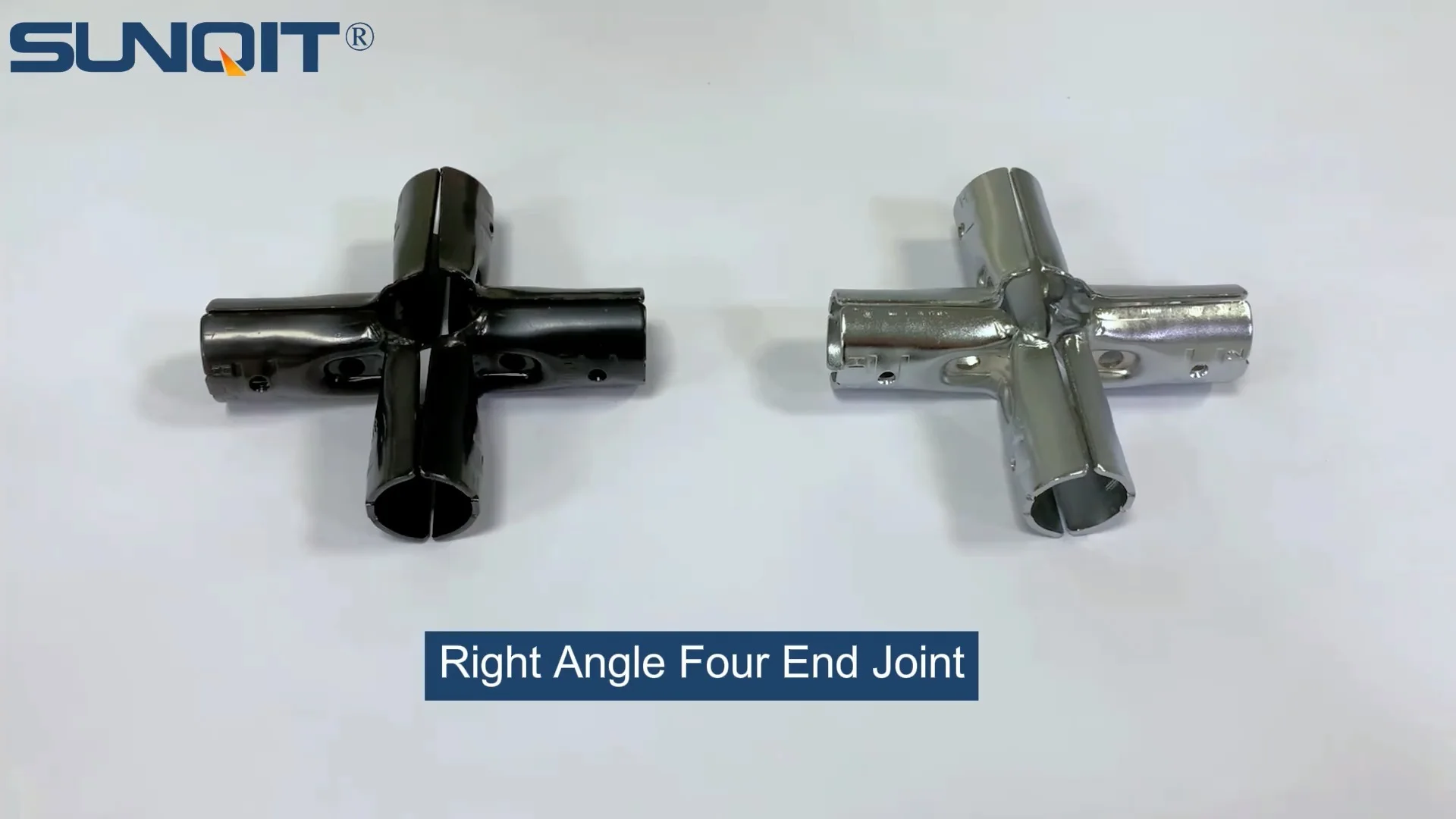
The Unsung Heroes of Lean Systems: Five Way Straight Lean Pipe Joints
Walk into any modern manufacturing facility, and you'll likely spot a network of workbenches, flow racks, and material trolleys—all working in harmony to keep production lines moving. What holds these structures together? More often than not, it's a humble yet critical component: the lean pipe joint. Among these, the five way straight lean pipe joint chrome stands out, designed to connect multiple pipes at once, enabling the creation of complex, customized workspaces. But what makes these joints so reliable, especially in high-stress industrial environments? The answer lies in their finishing touch: chrome plating. In this article, we'll pull back the curtain on the chrome plating process for these essential components, exploring how a simple coating transforms a metal part into a durable, corrosion-resistant workhorse.
Why Chrome Plating? The Science Behind the Shine
Before diving into the process, let's clarify: not all plating is created equal. Chrome plating, specifically, is a electrochemical process that deposits a thin layer of chromium onto a metal surface. For industrial parts like lean pipe joints, two types matter most: decorative chrome (for aesthetics and basic protection) and hard chrome (for durability and wear resistance). The five way straight lean pipe joint chrome typically uses hard chrome, as these joints endure constant stress—think repeated assembly, disassembly, and the weight of materials on workbenches or flow racks.
Why chromium? For starters, it's naturally resistant to corrosion, a must in factories where moisture, oils, and chemicals are part of daily life. Chrome also has a low coefficient of friction, meaning parts slide smoothly against it—handy for joints that need to rotate or adjust. Plus, it's hard. Really hard. On the Mohs scale, chromium ranks an 8.5, just below diamonds and sapphires. That hardness prevents scratches and dents, ensuring the joint maintains its structural integrity over years of use. For suppliers and wholesalers, this translates to a selling point: a chrome-plated joint isn't just a part—it's a promise of longevity.

Step 1: Pre-Treatment – The Foundation of a Perfect Coating
Imagine painting a wall covered in dust and grease—the paint would peel in weeks. The same logic applies to chrome plating. Pre-treatment is the unsung hero of the process, ensuring the metal surface is spotless and ready to bond with chromium. For five way straight lean pipe joints, this step involves several meticulous stages, each critical to the final result.
Degreasing: Say Goodbye to Oils and Grime
Freshly manufactured joints arrive coated in machining oils, fingerprints, and dirt—leftovers from cutting, bending, or stamping. Degreasing removes these contaminants, and it's not as simple as wiping with a cloth. Most facilities use either solvent degreasing (using chemicals like trichloroethylene) or aqueous degreasing (using hot, soapy water and ultrasonic waves). Aqueous degreasing is more eco-friendly and common today; the ultrasonic waves create tiny bubbles that implode, dislodging even stubborn grease from the joint's crevices—including the nooks where pipes connect. This step typically takes 10–15 minutes, depending on how dirty the joints are.
Pickling: Etching the Surface for Better Adhesion
Next, the joints undergo pickling, a chemical bath that removes rust, scale, and any remaining oxides from the metal surface. For steel joints (the base material for most lean pipe components), this usually involves submerging them in a dilute hydrochloric or sulfuric acid solution. The acid etches the surface, creating tiny pores that help the chromium coating "grab" onto the metal. It's a delicate balance: too little pickling, and the chrome won't adhere; too much, and the joint could weaken. Operators monitor the bath's pH and temperature closely, with pickling times ranging from 5–20 minutes.
Activation: A Final Cleanse
After pickling, the joints are rinsed thoroughly to remove acid residues, then dipped in an activation bath—often a weak sulfuric acid solution. This step neutralizes any remaining contaminants and ensures the surface is chemically active, ready to accept the chromium ions in the plating bath. Think of it as a final "scrub" before applying a primer; without activation, the chrome layer might peel or bubble later.
| Pre-Treatment Stage | Method | Purpose | Duration |
|---|---|---|---|
| Degreasing | Aqueous ultrasonic bath | Remove oils, fingerprints, and dirt | 10–15 minutes |
| Pickling | Hydrochloric/sulfuric acid bath | Remove rust, scale, and oxides; etch surface | 5–20 minutes |
| Activation | Weak sulfuric acid dip | Neutralize residues; prepare surface for plating | 2–5 minutes |

Step 2: The Chrome Plating Bath – Where Magic Meets Science
With pre-treatment complete, the joints are ready for the main event: plating. The heart of this stage is the chrome plating bath, a large tank filled with a solution of chromic acid (CrO3) and sulfuric acid (H2SO4), mixed in a ratio of roughly 100:1. This "chrome electrolyte" is heated to 45–55°C (113–131°F) and agitated to keep the solution uniform.
Setting Up the Electroplating Cell
The joints are hung from racks, carefully positioned to ensure every surface is exposed to the electrolyte. They act as the cathode (negative electrode) in the circuit. The anode (positive electrode) is typically made of lead or lead-antimony alloy, which doesn't dissolve during plating—unlike anodes in other processes like nickel plating. This setup ensures the only metal deposited is chromium.
Electrolysis: The Dance of Ions
When an electric current is applied, the chromic acid breaks down into chromium ions (Cr³⁺ and Cr⁶⁺). These ions are attracted to the negatively charged joint, where they gain electrons and deposit as metallic chromium (Cr⁰). The process is slow—hard chrome plating for industrial parts usually requires 1–3 hours per 0.001 inches of thickness. For five way straight lean pipe joints, a thickness of 0.0005–0.002 inches is standard: enough to protect against wear without adding bulk that might interfere with pipe fitting.
Operators monitor the current density (measured in amps per square foot) closely. Too low, and the plating is thin and uneven; too high, and it becomes porous or cracked. For complex shapes like five-way joints, which have crevices and corners, "throwing power" is key—the ability of the current to reach all areas equally. Special racking techniques, like using auxiliary anodes near hard-to-reach spots, ensure even coverage.

Step 3: Post-Treatment – Sealing the Deal
Once the desired thickness is achieved, the joints are removed from the bath—but the process isn't over yet. Post-treatment ensures the chrome layer is stable, corrosion-resistant, and ready for action.
Rinsing: Washing Away Excess Electrolyte
First, the joints are rinsed in a series of cold and hot water baths to remove any leftover chromic acid. This is critical: chromic acid is toxic, so proper rinsing protects workers and prevents environmental contamination. Some facilities use "reverse osmosis" water for the final rinse to avoid mineral deposits that could dull the chrome's shine.
Drying and Inspecting: The Final Check
After rinsing, the joints are dried—either with hot air blowers or in ovens set to 80–100°C (176–212°F). Once dry, they undergo a rigorous inspection. Technicians check for:
- Uniform thickness (using a magnetic thickness gauge)
- Adhesion (via a bend test, where the joint is flexed to see if the chrome cracks or peels)
- Corrosion resistance (some joints undergo a salt spray test, where they're exposed to salt fog for 24–48 hours to check for rust)
- Aesthetic flaws (pitting, discoloration, or "burns" from high current density)
Rejected joints are stripped of their chrome (using a chemical bath) and reprocessed—a testament to the industry's commitment to quality. After all, a faulty joint could compromise an entire workbench or flow rack, risking downtime or even injury.
Beyond the Plating Tank: How Chrome Coating Elevates Lean Systems
So, why does all this matter for the average manufacturer or workshop? Let's take a real example: a busy electronics assembly line using a workbench E (single deck-without caster), built with five way straight lean pipe joints. Without chrome plating, the joints would rust from exposure to soldering fluxes or cleaning agents. They'd scratch easily when workers adjust the bench height or reconfigure the layout. Over time, loose or corroded joints could cause the workbench to wobble, leading to errors in delicate assembly tasks.
With chrome plating, the joints resist rust, even in humid environments. Their smooth, hard surface means pipes slide into place easily during setup, and the coating prevents galling (metal-on-metal wear) when joints are tightened. For suppliers and wholesalers, this reliability is a selling point: a chrome-plated joint lasts 3–5 times longer than an unplated one, reducing replacement costs for customers. It's no wonder that lean pipe supplier catalogs often highlight "chrome-plated" as a premium feature.
Chrome plating also plays a role in sustainability. By extending the life of joints, manufacturers reduce waste—fewer discarded parts mean less scrap metal and lower environmental impact. Plus, the smooth surface of chrome makes joints easier to clean, supporting hygiene standards in industries like food processing or pharmaceuticals, where stainless steel pipe series are also common.
What to Look for in a Chrome-Plated Lean Pipe Joint Supplier
For businesses sourcing five way straight lean pipe joint chrome, not all suppliers are equal. Here's what to prioritize:
- Plating certifications: Look for suppliers with ISO 9001 certification, which ensures consistent quality control. For medical or aerospace applications, AS9100 may be required.
- Thickness guarantees: Reputable suppliers will specify the chrome thickness (e.g., 0.001 inches) and provide test reports upon request.
- Customization options: Some joints need special plating (e.g., extra-thick for heavy-duty racks) or passivation (a post-plating treatment for stainless steel components). A flexible supplier can accommodate these needs.
- Lead times: Chrome plating adds time to production, so ask about turnaround times—especially if you're building a new line and need joints quickly.
Remember, the cheapest joint isn't always the best. A poorly plated joint might save money upfront but cost more in replacements and downtime later. As the saying goes: "Buy quality, cry once. Buy cheap, cry often."
The Bottom Line: Chrome Plating as a Cornerstone of Lean Manufacturing
From degreasing to final inspection, the chrome plating process for five way straight lean pipe joints is a masterclass in precision and care. It transforms a simple metal part into a component that can withstand the rigors of industrial life, ensuring workbenches stay stable, flow racks keep moving, and production lines run smoothly. For anyone involved in lean manufacturing—whether you're a plant manager, a supplier, or a small business owner building your first workspace—understanding this process isn't just about appreciating a shiny finish. It's about recognizing that the smallest components often have the biggest impact on efficiency, safety, and bottom-line success.
So, the next time you walk past a workbench or a material rack, take a moment to look at the joints holding it together. Chances are, there's a layer of chrome there—quietly doing its job, and doing it well.