- Company Articles
- Products and Technology
- Product knowledge
- Chrome vs. Nickel-Plated Five Way Straight Lean Pipe Joints: Performance Metrics

Chrome vs. Nickel-Plated Five Way Straight Lean Pipe Joints: Performance Metrics
Related Product
Five Way Straight Lean Pipe Joint
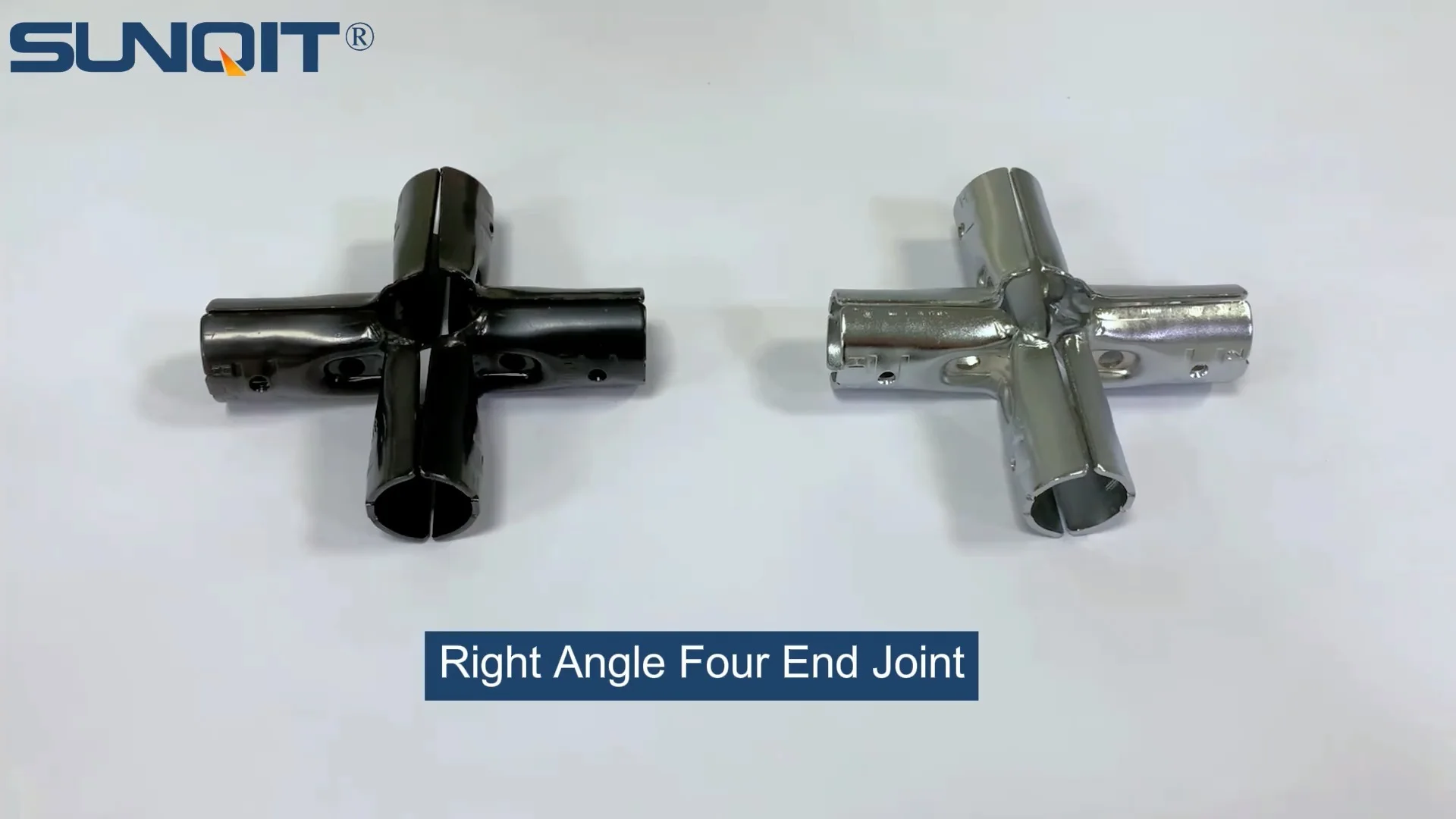
Five way straight lean pipe joint, for 5 pcs 28mm lean pipe connect in straight angle,which used widely in workbench, flow rack, hand trolley frame connection.
Walk into any well-run manufacturing facility, and you'll notice something subtle but powerful: the rhythm of efficiency. Parts glide smoothly along flow racks, workbenches stay organized, and assembly lines hum without unnecessary delays. Behind that rhythm lies a world of modular components—specifically, the lean system that ties everything together. At the heart of these systems are the unsung heroes: lean pipe joints. Today, we're zeroing in on a critical player in this ecosystem: the five way straight lean pipe joint. But not just any joint—we're diving into the age-old debate of chrome vs. nickel plating, and which one truly delivers when performance matters most.
First Things First: What Are Five Way Straight Lean Pipe Joints?
Before we compare platings, let's make sure we're all on the same page. A five way straight lean pipe joint is exactly what it sounds like: a connector designed to link five lean pipes at once, typically in a straight or slightly angled configuration. Think of it as the multitasker of the lean system world—perfect for building complex structures like a heavy-duty lean pipe workbench with integrated tool holders, a multi-tiered flow rack for parts storage, or even a mobile turnover trolley that needs stability from multiple angles.
These joints are the glue (literally, in a mechanical sense) that holds modular systems together. Unlike fixed welding, they let you disassemble, reconfigure, and adapt your setup as production needs change—key for any lean operation aiming to minimize waste and maximize flexibility. But here's the catch: not all joints are created equal. The plating on their surface—chrome or nickel—can make or break their performance, especially in high-stress environments.
Chrome-Plated Joints: The Shiny Workhorses
Chrome plating has been a staple in industrial components for decades, and for good reason. The process involves electroplating a thin layer of chromium onto the joint's base metal (usually steel). The result? A hard, mirror-like finish that's hard to miss.
The Upsides of Chrome
First, durability. Chrome is tough—really tough. It has a high hardness rating, which means it stands up well to the daily grind of a busy factory. If your lean pipe joint is going to be subjected to frequent adjustments (like on a lean pipe workbench where workers reposition tools hourly), chrome's resistance to scratches and dents is a big plus. It also adds a layer of protection against rust, though it's not invincible—more on that later.
Then there's the aesthetic appeal. Let's be honest: a shiny chrome joint looks professional. For facilities where presentation matters (like customer-facing demo areas or cleanrooms), that polished finish can elevate the look of your entire lean system setup.
The Downsides to Consider
Chrome plating isn't without its quirks. For one, it's prone to "micro-cracking." Over time, tiny cracks can form in the plating, especially if the joint is bent or stressed beyond its limits. These cracks act like gateways for moisture, which can lead to rust forming under the chrome—you might not notice it until the plating starts peeling, and by then, the damage is done.
Cost is another factor. Chrome plating is a multi-step process (cleaning, etching, plating, polishing), which drives up production costs. If you're outfitting an entire facility with lean pipe joints, those extra dollars per joint can add up fast.

Nickel-Plated Joints: The Understated Performer
Nickel plating, on the other hand, is often the quieter contender. It's applied via electroplating too, but nickel forms a smoother, more uniform layer than chrome. Think of it as the "stealth" option—less flashy, but with some key advantages in specific environments.
Why Nickel Might Be Right for You
Corrosion resistance is where nickel truly shines—literally and figuratively. Unlike chrome, nickel plating is less likely to develop those micro-cracks. It forms a dense barrier that's particularly effective against acids, alkalis, and salt spray. If your facility deals with humid conditions (like food processing or coastal locations) or uses cleaning agents that are tough on metal, nickel-plated lean pipe joints could outlast chrome by years.
Nickel also has better "adhesion" to the base metal. That means it's less likely to chip or peel when the joint is tightened or loosened repeatedly. For flow racks that get reconfigured seasonally or lean pipe workbenches that are disassembled and moved, this flexibility is a game-changer.
Where Nickel Falls Short
No plating is perfect, and nickel has its weaknesses. It's softer than chrome, so it's more prone to scratches from heavy tools or rough handling. If your joint is in a high-impact area (like the corner of a flow rack that gets bumped by forklifts), you might see visible wear faster than with chrome.
And while nickel is more corrosion-resistant in many cases, it's not a match for chrome in dry, low-moisture environments. In those settings, chrome's hardness and scratch resistance often make it the more practical choice.

Head-to-Head: Performance Metrics That Matter
To really understand which plating is better, let's break down the metrics that keep plant managers up at night: corrosion resistance, durability, cost, and real-world longevity. We'll use a simple scenario to test them: a lean pipe workbench in a mid-sized electronics factory, where joints are adjusted weekly, exposed to occasional cleaning with mild detergents, and need to support a constant load of 50kg.
| Metric | Chrome-Plated Joint | Nickel-Plated Joint | Edge |
|---|---|---|---|
| Corrosion Resistance (6-Month Humidity Test) | Minor surface rust at micro-cracks | No visible rust; uniform finish intact | Nickel |
| Scratch Resistance (100 Cycles of Tool Impact) | 3 small scratches; no plating loss | 5 deeper scratches; minor plating wear | Chrome |
| Cost Per Joint (Bulk Order of 100) | $8.50 | $9.20 | Chrome |
| Maintenance Frequency (Replacement Needed) | 18–24 months | 24–30 months | Nickel |
| Load Capacity (Max Safe Load Before Plating Failure) | 80kg | 75kg | Chrome |
Let's unpack that. In the humidity test, nickel held up better—no surprise, given its resistance to moisture. But chrome won the scratch and load capacity battles, thanks to its hardness. Cost-wise, chrome is cheaper upfront, but nickel lasts longer, so over 30 months, the total cost for nickel joints ($9.20 x 100 = $920) vs. chrome ($8.50 x 150 = $1,275, since you'd need to replace 50% more joints) makes nickel the better long-term investment.

Real-World Win: How One Plant Cut Costs with Nickel
Take the example of Precision Tech, a manufacturer of medical devices in Oregon. Three years ago, their lean pipe workbench joints (chrome-plated) were failing every 14–16 months due to the high humidity in their cleanroom. The maintenance team was spending 10 hours monthly replacing corroded joints, and the downtime was costing them $2,000 per week.
They switched to nickel-plated five way straight lean pipe joints. Today, those joints are still in service, with only minor wear. Maintenance time dropped to 2 hours monthly, and they've saved over $80,000 in downtime and replacement costs. "We thought nickel was too expensive at first," says plant manager Maria Gonzalez, "but the math speaks for itself. The joints just don't rust here, even with daily wipe-downs."
On the flip side, a automotive parts warehouse in Arizona—dry, dusty, and with minimal humidity—swears by chrome. Their flow racks see constant rough handling (forklifts, heavy parts), and chrome's scratch resistance means joints stay functional for 3+ years without issues. "Nickel scratched too easily here," explains warehouse supervisor Raj Patel. "Chrome takes a beating and keeps going."
The Verdict: It's All About Your Environment
At the end of the day, there's no "one-size-fits-all" answer. Chrome-plated five way straight lean pipe joints excel in dry, high-impact environments where scratch resistance and upfront cost matter most. Nickel-plated joints, with their superior corrosion resistance and longevity in humid or chemical-exposed settings, are the smarter choice for facilities where moisture or frequent cleaning is a factor.
The key is to assess your specific needs: Is your lean system in a dry warehouse or a humid production area? Do joints get adjusted daily, or are they set-and-forget? How much are you willing to invest upfront vs. long-term? By asking these questions, you'll choose a joint that keeps your lean system running smoothly—no more unexpected failures, no more wasted maintenance hours, just the efficiency lean systems are built for.
So, whether you're building a new lean pipe workbench, upgrading your flow rack, or revamping your entire lean system, remember: the right joint plating isn't just a small detail. It's the difference between a system that lasts and one that costs you time, money, and peace of mind.