- Company Articles
- Products and Technology
- Product knowledge
- Cleanroom Compatibility: 40 Steel Roller Track Black ESD Wheels for Medical Assembly

Cleanroom Compatibility: 40 Steel Roller Track Black ESD Wheels for Medical Assembly
Related Product
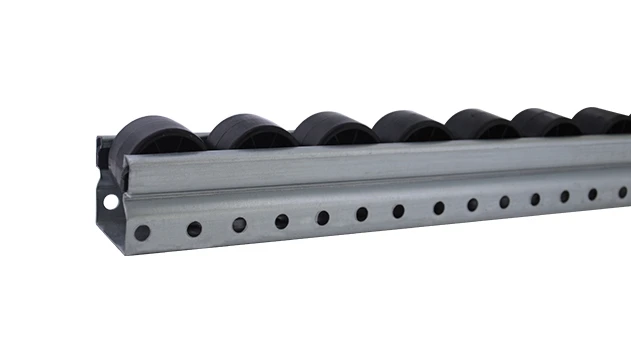
40 Steel Roller Track Black ESD Wheel
The roller track can be installed with multiple accessories to create different slopes and configurations of flow racks.All steel conveyor 40 roller track accessories are engineered to perfectly fit the sliding rail.
The Hidden Challenges of Medical Assembly in Cleanroom Environments
In the world of medical device manufacturing, where precision can mean the difference between life and death, the assembly process is governed by uncompromising standards. Cleanrooms, the heart of medical assembly, demand environments free from contaminants, electrostatic discharge (ESD), and operational inefficiencies. Yet, even the most advanced cleanrooms can stumble over a critical detail: how materials and components move through the assembly line. This is where the right material handling equipment becomes more than a tool—it becomes a guardian of quality, compliance, and patient safety. Today, we're diving into a solution that's quietly transforming medical assembly floors: the 40 Steel Roller Track with Black ESD Wheels. Let's unpack why this unassuming component is becoming indispensable for teams building everything from surgical instruments to diagnostic machines.
Why ESD Control Isn't Optional in Medical Assembly
First, let's talk about electrostatic discharge—ESD for short. In everyday life, a static shock might make you jump, but in a medical cleanroom, it's a silent threat. Medical devices increasingly rely on microelectronics: tiny sensors that monitor vital signs, circuit boards that power imaging systems, and delicate components in drug delivery devices. These parts can be damaged by ESD voltages as low as 250 volts—far below the threshold of what a human can feel (which is around 3,000 volts). A single ESD event might not just ruin a component; it could create latent defects that fail later, when the device is in use with a patient.
Regulators like the FDA and ISO (through standards like ISO 13485) don't just recommend ESD control—they mandate it. Cleanrooms operating at ISO Class 7 or higher (common in medical device manufacturing) must maintain strict ESD protection protocols. This includes everything from floor mats to clothing, but one often-overlooked area is the equipment that moves parts through the assembly process. If a roller track isn't ESD-safe, it can generate static as components slide across it, turning a routine material transfer into a quality risk.

Inside the 40 Steel Roller Track: Built for Cleanrooms, Engineered for ESD Safety
So, what makes the 40 Steel Roller Track with Black ESD Wheels different? Let's start with the basics: the "40" in its name refers to its standard width, a size optimized for medical assembly lines where space is often limited but load capacity can't be compromised. The track itself is made from high-grade steel, chosen for two key reasons: durability and cleanliness. Steel resists corrosion in humid cleanroom environments, and its smooth surface minimizes particle shedding—critical for maintaining ISO Class 7/8 air quality standards. Unlike plastic tracks, which can degrade over time and release microplastics, steel stands up to constant use and cleaning with harsh disinfectants.
Now, the star of the show: the black ESD wheels. These aren't just any wheels—they're formulated with a specialized rubber compound infused with conductive carbon particles. This gives them a surface resistance between 10^6 and 10^9 ohms, the sweet spot for ESD control: low enough to dissipate static charges safely to ground, but not so conductive that they risk creating electrical shorts. The black color isn't just aesthetic; it's a visual cue that these wheels meet ESD specifications, making it easy for operators to verify compliance at a glance during inspections.
Key Specifications of 40 Steel Roller Track Black ESD Wheels
| Feature | Specification | Benefit for Medical Cleanrooms |
|---|---|---|
| Wheel Material | Conductive rubber (carbon-infused) | Dissipates static charges; minimizes particle generation |
| Surface Resistance | 10^6 – 10^9 ohms | Complies with ANSI/ESD S20.20 standards |
| Track Material | 304 Stainless Steel (electropolished) | Corrosion-resistant; easy to disinfect with IPA/bleach |
| Load Capacity | Up to 50 kg/meter | Supports heavy medical components (e.g., MRI machine parts) |
| Wheel Diameter | 40mm | Reduces rolling resistance for smooth, quiet operation |
Another design detail that sets this track apart is its precision-engineered rollers. Each wheel is mounted on sealed ball bearings, which eliminate the need for lubrication (a potential source of contamination in cleanrooms) and ensure smooth, consistent movement. The rollers are spaced evenly to prevent component tilting, a common issue with cheaper tracks that can damage delicate medical parts like catheters or sensor arrays.

Working in Tandem: ESD Wheels, Lean Pipe Workbenches, and Flow Racks
In medical assembly, no single piece of equipment works alone. The 40 Steel Roller Track shines brightest when integrated with other lean tools, creating a seamless, ESD-safe workflow. Take the lean pipe workbench, for example. These workstations, built from modular aluminum pipes and joints, are a staple in lean manufacturing because they're customizable and adaptable. When paired with the 40 Steel Roller Track, they become a powerhouse for assembly cells. Imagine a workbench where components flow in on the ESD roller track, are assembled by technicians, and then move out on another track—all without ever touching a non-ESD surface. This integration reduces handling time by up to 30% in some cases, according to customer feedback, while eliminating static-related defects.
Then there's the flow rack, a critical tool for kanban-based material management in medical facilities. Flow racks use gravity to feed components to operators, ensuring "first in, first out" (FIFO) inventory rotation—essential for products with expiration dates, like sterile medical kits. By equipping flow racks with the same 40 Steel Roller Track Black ESD Wheels, manufacturers create a closed-loop ESD system. Components move from the warehouse on ESD flow racks, through the cleanroom on ESD roller tracks, and to the lean pipe workbench—static-free at every step. This level of consistency is why leading medical device companies now specify ESD-compliant flow racks and roller tracks as part of their standard operating procedures.
But what about larger systems? Conveyors are often used to move subassemblies between cleanroom zones, and here too, ESD safety matters. The 40 Steel Roller Track can be integrated into powered conveyors, with the black ESD wheels ensuring that even as parts are transported over longer distances, static charges don't build up. This is especially important for automated lines, where components might be in motion for extended periods—without ESD protection, static could accumulate to dangerous levels by the time they reach the next assembly station.
Real-World Impact: A Medical Device Manufacturer's Success Story
To put this in context, let's look at a recent project with a manufacturer of diagnostic imaging equipment. This company was struggling with two issues: frequent ESD-related failures in their ultrasound probe assemblies, and bottlenecks in their cleanroom material flow. Their old roller tracks were made from plastic, which generated static, and their workbenches weren't integrated with their flow racks, leading to operators wasting time fetching parts.
We worked with their team to design a custom lean solution: replacing all plastic tracks with 40 Steel Roller Track Black ESD Wheels, integrating them with new lean pipe workbenches, and retrofitting their flow racks with matching ESD rollers. The results were striking. Within three months, ESD-related defects dropped from 8% to 0.5%—a 94% reduction. Material handling time decreased by 25%, as components now flowed directly to the workbench. Perhaps most importantly, the company passed their next FDA audit with zero observations related to static control, a first in their five-year history.
What made this project successful wasn't just the product—it was the focus on lean principles. The system was designed to be modular, so as the manufacturer introduces new probe models, they can reconfigure the tracks and workbenches without replacing entire lines. This aligns with the "sustainable improvement" ethos at the core of lean manufacturing: investing in equipment that grows with your needs, rather than becoming obsolete after a single product cycle.
Beyond Off-the-Shelf: Custom Lean Solutions for Unique Medical Needs
Medical assembly isn't one-size-fits-all. A manufacturer of pacemakers has different needs than a company building surgical robots, and cleanroom requirements can vary dramatically (e.g., ISO Class 5 for implantables vs. ISO Class 8 for non-sterile devices). That's why custom lean solutions are often the key to success. For example, one client needed a roller track system that could handle both metal surgical tools (heavy, non-sensitive to static) and delicate circuit boards (light, ESD-sensitive). The solution? A dual-lane track: one with 40 Steel Roller Track Black ESD Wheels for the circuit boards, and a parallel lane with standard steel wheels for the tools. This "hybrid" design saved space while meeting both needs.
Another common customization is length and curvature. Cleanrooms are often laid out with tight corners to maximize space, so standard straight tracks won't work. The 40 Steel Roller Track can be bent to custom radii (as small as 30cm) without compromising structural integrity, allowing it to navigate around equipment or follow the contour of cleanroom walls. For a manufacturer of endoscopes, we designed a U-shaped track system that reduced their assembly line footprint by 15%, freeing up space for additional inspection stations.
Material compatibility is also a consideration. Some cleanrooms use hydrogen peroxide vapor (HPV) sterilization, which can degrade certain rubbers. In these cases, we offer ESD wheels made from HPV-resistant silicone, ensuring the track remains functional even after repeated sterilization cycles. It's these small, tailored adjustments that turn a good product into a great solution.
Meeting Medical Standards: From ISO to FDA
In the medical industry, compliance isn't optional—it's survival. The 40 Steel Roller Track Black ESD Wheels are designed with this in mind, meeting a host of global standards. For ESD performance, they comply with ANSI/ESD S20.20 and IEC 61340-5-1, the two most widely recognized benchmarks for electrostatic control. For cleanroom compatibility, the steel track is electropolished to a Ra < 0.8μm surface finish, minimizing particle adhesion, and the ESD wheels are tested to ISO 14644-1 for particle emissions, ensuring they don't contribute to cleanroom contamination.
Material safety is equally important. The rubber in the ESD wheels is FDA-compliant (21 CFR 177.2600), meaning it's safe for use in environments where there's potential contact with medical devices or pharmaceuticals. The steel track is RoHS-compliant, free from lead and other restricted substances, and the entire system is compatible with common cleanroom disinfectants, including isopropyl alcohol, quaternary ammonium compounds, and bleach solutions. This level of compliance gives quality managers peace of mind, knowing the equipment won't introduce regulatory risks.
More Than a Track: Building the Future of Medical Assembly
At the end of the day, the 40 Steel Roller Track with Black ESD Wheels is more than just a piece of material handling equipment. It's a bridge between two critical goals in medical manufacturing: efficiency and safety. By combining ESD protection, cleanroom compatibility, and lean flexibility, it helps manufacturers produce better devices faster—all while reducing the risk of costly defects or regulatory issues. Whether integrated with lean pipe workbenches, flow racks, or custom conveyor systems, it's a tool that adapts to your needs, not the other way around.
As medical technology advances—with smaller, more sensitive components and stricter cleanroom requirements—the demand for solutions like this will only grow. The manufacturers who thrive will be those who invest in equipment that doesn't just meet today's standards, but can evolve with tomorrow's challenges. The 40 Steel Roller Track Black ESD Wheels are built for that future: durable enough to last, flexible enough to adapt, and safe enough to protect what matters most—patient health.