- Company Articles
- Products and Technology
- Product knowledge
- Comparing Aluminum Workbench D with Other Aluminum Workbench Models: Key Differences

Comparing Aluminum Workbench D with Other Aluminum Workbench Models: Key Differences
Related Product
Aluminum Workbench D
Aluminum tube workbench is more flexible and durable, compared with traditional PE/ABS coated steel tube. It is easy to assemble, anti corrosion, rust protection, and recycle use after disassemble.
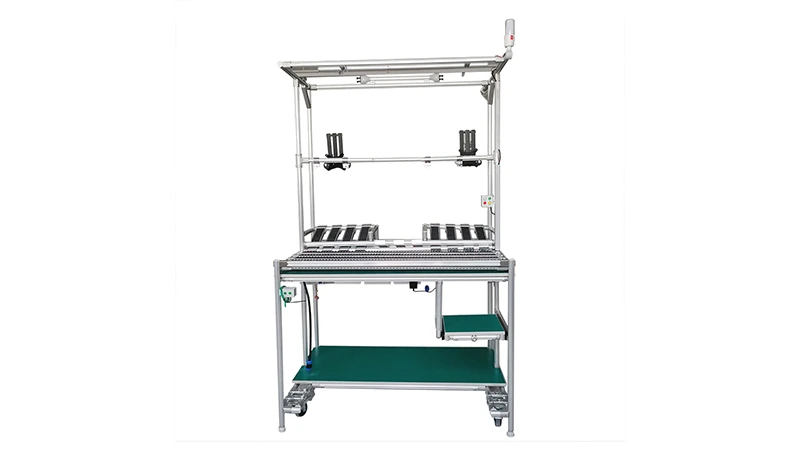
Walk into any modern production facility, and you'll notice one thing quickly: the workbench isn't just a table—it's the heartbeat of the operation. It's where parts come together, where precision meets pace, and where teams spend hours crafting, assembling, and problem-solving. For anyone in production assemble , choosing the right workbench isn't just about having a surface to work on; it's about investing in efficiency, durability, and the comfort of your team. And when it comes to workbenches that balance all three, aluminum models have become the gold standard.
Today, we're zooming in on one particular standout: Aluminum Workbench D. But here's the thing—with so many aluminum workbench models on the market, how do you know if D is the right fit for your space? Is it better than Workbench E, with its single deck and no casters? Or maybe Aluminum Workbench A, which seems to pop up in every supplier catalog? Let's break it down. We'll start by understanding what makes aluminum workbenches tick, then dive deep into Workbench D's design and features, and finally stack it up against other popular models. By the end, you'll have a clear picture of which workbench deserves a spot in your workflow.
Why Aluminum? The Backbone of Modern Workbenches
Before we get into specific models, let's talk about why aluminum has become the go-to material for workbenches in production settings. Unlike wood, which warps over time, or steel, which is heavy and prone to rust, aluminum hits that sweet spot of strength and practicality. It's lightweight enough to move (when paired with casters) but sturdy enough to handle heavy tools and components. It resists corrosion, which is a big deal in environments where spills or humidity are common. And perhaps most importantly, it's highly customizable—thanks to aluminum profile systems and a wide range of aluminum profile accessories , you can tweak an aluminum workbench to fit almost any need.
Aluminum profiles, those modular, T-slot rails you see in industrial setups, are the secret sauce here. They let you add shelves, tool hooks, lighting, or even ESD (electrostatic discharge) mats with ease. And with accessories like end caps, connectors, and brackets, you're not stuck with a one-size-fits-all design. This flexibility is why aluminum workbenches have become indispensable in production assemble lines—they grow with your needs, not against them.
Meet Aluminum Workbench D: What Makes It Tick?
Let's start with the star of the show: Aluminum Workbench D. If you've ever scrolled through a supplier's catalog, you've probably seen it listed alongside other models, but what really sets it apart? Let's break down its design, features, and who it's built for.
Design & Construction
Aluminum Workbench D is built around a frame of high-grade aluminum lean pipe and sturdy aluminum profiles. The lean pipe—sometimes called "lean tube"—is lightweight but reinforced, giving the bench a solid foundation without adding unnecessary bulk. The work surface itself is typically a single deck, though some variants offer a double-deck option for extra storage. What's notable here is the deck material: most models use a thick aluminum panel, often with a honeycomb core for added strength, or a non-slip surface to keep tools and parts from sliding during assembly.
One of the first things you'll notice about Workbench D is its attention to mobility. Unlike some fixed workbenches, it comes standard with casters (though you can opt for fixed feet if needed). These aren't just any casters, either—they're heavy-duty, swivel casters with locks, so you can move the bench across the shop floor with ease, then lock it in place when you need stability. For teams that reconfigure their workspace often or need to bring the workbench to the project (instead of the other way around), this mobility is a game-changer.
Key Features
- Adjustable Height: Many Workbench D models let you tweak the height from around 70cm to 90cm, which might not sound like much, but for anyone spending 8+ hours a day at the bench, ergonomics matter. No more hunching over or straining your back—you can set it to a height that feels natural.
- Integrated Storage: Under the main deck, you'll often find a lower shelf or a series of hooks and bins for tools. Some models even include side-mounted tool rails, perfect for hanging wrenches, tape measures, or cable organizers. These aren't just add-ons; they're built into the design, so you don't have to kludge together storage solutions later.
- ESD Compatibility: While not all Workbench D variants are ESD-rated, many can be upgraded with ESD mats or grounded aluminum surfaces. This is a big plus for electronics assembly lines, where static electricity can damage sensitive components.
- Accessory-Friendly: Thanks to its T-slot aluminum profiles, adding aluminum profile accessories is a breeze. Need a monitor arm for digital work instructions? Just slide a bracket into the slot. Want a bin for small parts? Clip on a hanging basket. It's designed to grow with your needs, not limit them.
Who Is Workbench D For?
Workbench D shines in environments where versatility and mobility are key. Think small to medium-sized production lines, repair shops, or R&D labs where teams need to move their workspace or adapt quickly to new projects. It's also a favorite in facilities that prioritize ergonomics—its adjustable height and integrated storage mean less bending, reaching, and clutter, which translates to happier, more productive teams.

The Competition: How Workbench D Stacks Up Against Other Models
Now, let's put Workbench D head-to-head with three other popular aluminum workbench models: Workbench E (Single Deck-Without Caster), Aluminum Workbench A, and Aluminum Workbench B. Each has its own strengths and weaknesses, so we'll focus on the factors that matter most: mobility, storage, durability, and ideal use cases.
| Feature | Aluminum Workbench D | Workbench E (Single Deck-Without Caster) | Aluminum Workbench A | Aluminum Workbench B |
|---|---|---|---|---|
| Mobility | Standard swivel casters with locks; easy to move and secure | No casters; fixed feet only | Optional casters (often sold separately) | Heavy-duty industrial casters; built for frequent movement |
| Storage Options | Under-deck shelf, side hooks, and T-slot rails for accessories | Basic under-shelf; limited accessory compatibility | Double-deck design with multiple shelves and drawers | Minimal storage; focus on open workspace |
| Weight Capacity | 300-400 lbs (work surface); 150 lbs (shelf) | 400-500 lbs (work surface); no shelf | 500+ lbs (work surface); 200 lbs per shelf | 250-300 lbs (work surface); no built-in storage |
| ESD Protection | Optional ESD mat/surface upgrade | Not available | Standard ESD surface on most models | Optional, but limited accessory support |
| Ideal Environment | Medium production lines, repair shops, R&D labs | Fixed assembly stations, heavy machinery workshops | Electronics manufacturing, labs with tool-heavy workflows | Light assembly, packaging, or temporary workstations |
| Assembly Difficulty | Moderate; tool-free T-slot connections | Simple; bolt-together frame with fixed parts | Complex; multiple shelves and drawers require alignment | Easy; minimal parts, quick setup |
Workbench D vs. Workbench E: Mobility vs. Stability
Let's start with Workbench E, which is essentially Workbench D's fixed counterpart. Workbench E has a single deck and no casters—its legs are bolted to the floor or sit on fixed feet. This makes it incredibly stable, which is great for heavy-duty tasks like welding or machining, where even a slight wobble could ruin a project. Its weight capacity is also slightly higher than Workbench D's, topping out at 500 lbs on the work surface.
But here's where Workbench D pulls ahead: mobility. If your team needs to reconfigure the shop floor for a new product line or move the workbench to a different area for cleaning, Workbench E is stuck. Workbench D's casters let you adapt on the fly. Plus, Workbench E lacks the T-slot rails that make Workbench D so customizable—you're stuck with whatever storage it comes with, and adding accessories later is a hassle. So, if stability is your top priority and you never need to move the bench, E might work. But for most modern production environments, D's flexibility wins out.
Workbench D vs. Aluminum Workbench A: Storage vs. Simplicity
Aluminum Workbench A is the overachiever of the group. It boasts a double-deck design with built-in drawers, multiple shelves, and even cabinets in some models. If your workflow requires keeping a lot of tools, parts, or documentation within arm's reach, A seems like a dream. It also often comes with a standard ESD surface, making it a favorite in electronics manufacturing.
But all that storage comes with a trade-off: complexity. Workbench A is heavier, harder to assemble, and bulkier than Workbench D. Its double-deck design can also feel cramped if you're working on large items, and the drawers and cabinets limit how you can customize the space. Workbench D, by contrast, keeps things open and adaptable. Its under-shelf and T-slot rails give you storage without the rigidity, and it's lighter and easier to set up. For teams that need storage but value flexibility, D is the smarter choice. A is better suited for highly specialized workflows where every tool has a fixed place.
Workbench D vs. Aluminum Workbench B: Durability vs. Adaptability
Aluminum Workbench B is the minimalist's option. It has a single deck, no frills, and focuses on being lightweight and affordable. It's often used in temporary workstations or packaging areas where the primary need is a flat surface, not storage or mobility.
Workbench D outperforms B in almost every category: it has more storage, better mobility, and higher weight capacity. The only area where B might edge out is cost—it's usually cheaper upfront. But here's the catch: B lacks the aluminum profile rails, so you can't add accessories later. If your needs change (and they almost always do), you'll end up replacing B entirely. Workbench D, with its T-slot system, grows with you. So while B might save you money today, D is the better long-term investment.

Real-World Use Cases: When to Choose Workbench D (and When Not To)
Let's ground this in real scenarios. Here are three examples of teams that chose Workbench D—and why it worked (or didn't).
Case 1: A Small Electronics Repair Shop
A local repair shop with 5 technicians needed workbenches that could handle laptops, smartphones, and small tools. They opted for Workbench D because of its mobility (they reconfigure the shop weekly for different repair batches) and ESD compatibility. The under-shelf storage holds toolkits, and the T-slot rails let them add monitor arms for repair guides. "We used to have fixed workbenches, and moving equipment around was a nightmare," said the shop manager. "With D, we can rearrange in 10 minutes, and the ESD mats keep our repairs safe. It's been a game-changer."
Case 2: A Large Automotive Assembly Line
A automotive plant needed workbenches for their component assembly area. They initially considered Workbench E for its stability but switched to Workbench D after testing. "We realized we needed to move the benches to align with the production line's flow," explained the floor supervisor. "E was too heavy, but D's casters let us shift quickly. The under-shelf storage for bolts and washers keeps the space tidy, and we added tool hooks on the T-slots. Productivity went up 15% in the first month."
Case 3: A Heavy Machinery Workshop
A workshop building industrial pumps tried Workbench D but switched to Workbench E. Why? They needed to mount heavy vises and hydraulic tools, which exceeded D's weight capacity. "D is great, but our tools are just too heavy," said the lead mechanic. "Workbench E's fixed feet and higher weight limit keep everything stable. For us, stability trumped mobility."
The takeaway? Workbench D is versatile, but it's not. If you're working with extremely heavy equipment or need a permanently fixed station, E or A might be better. But for most production assemble environments, D hits the sweet spot.
Final Thoughts: Why Workbench D Stands Out
At the end of the day, choosing a workbench is about balancing your team's needs: mobility, storage, durability, and cost. Aluminum Workbench D doesn't just check boxes—it redefines what a workbench can be. Its combination of aluminum lean pipe construction, swivel casters, and T-slot aluminum profile accessories makes it adaptable to almost any workflow, while its ergonomic design keeps teams comfortable and productive.
Compared to Workbench E, it offers mobility without sacrificing stability. Against Workbench A, it provides flexibility without the bulk. And versus Workbench B, it delivers long-term value through customization. For small to medium-sized teams in production assemble , repair, or R&D, Workbench D isn't just a workbench—it's a partner in getting the job done right.
So, if you're in the market for a new workbench, ask yourself: Do we need to move it? Will our storage needs change? Do we value adaptability? If you answered "yes" to any of these, Workbench D is worth a closer look. After all, the best workbench isn't the one with the most features—it's the one that grows with you.