- Company Articles
- Products and Technology
- Product knowledge
- Components of 40 Steel Roller Track Black ESD Wheel: Steel Core, ESD Coating & Roller Design

Components of 40 Steel Roller Track Black ESD Wheel: Steel Core, ESD Coating & Roller Design
Related Product
40 Steel Roller Track Black ESD Wheel
The roller track can be installed with multiple accessories to create different slopes and configurations of flow racks.All steel conveyor 40 roller track accessories are engineered to perfectly fit the sliding rail.
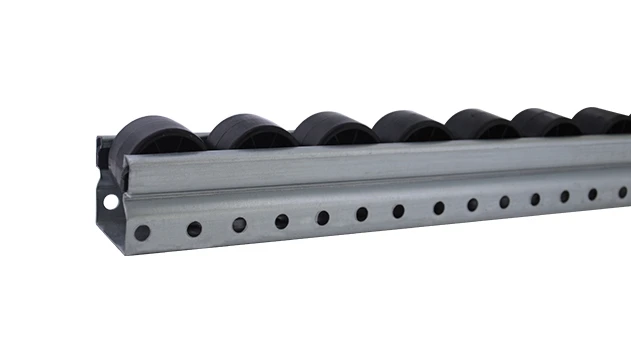
Walk into any modern manufacturing plant today, and you'll notice a quiet hero working behind the scenes: the roller track system. It's the unsung champion that keeps production lines moving, parts flowing, and deadlines met. Among the many types of roller tracks, one stands out for its reliability and precision in sensitive manufacturing environments: the 40 Steel Roller Track Black ESD Wheel. More than just a metal wheel on a track, it's a carefully engineered component where every part—from the steel core to the ESD coating—plays a critical role in keeping your operations smooth, safe, and efficient. Let's dive into the details of what makes this roller track wheel a must-have for industries like 3C assembly, medical device production, and electronics manufacturing.
1. Steel Core: The Backbone of Durability
Think of the steel core as the "skeleton" of the 40 Steel Roller Track Black ESD Wheel. Without a strong, resilient core, the wheel would bend, warp, or fail under the daily grind of a busy factory. But what exactly goes into making this core so reliable?
Material Selection: Why Low-Carbon Steel Takes the Lead
At the heart of every 40 Steel Roller Track Black ESD Wheel is a core made from high-quality low-carbon steel. Why low-carbon steel? Unlike high-carbon steel, which is brittle and prone to cracking under repeated stress, low-carbon steel (typically with a carbon content of 0.05% to 0.25%) offers the perfect balance of strength and flexibility. This means it can handle heavy loads without breaking and absorb shocks from sudden impacts—like when a pallet of circuit boards is rolled onto the track—without permanent damage.
But not all low-carbon steel is created equal. We source our steel from suppliers who meet strict quality standards, ensuring each batch has uniform thickness and minimal impurities. Impurities like sulfur or phosphorus can weaken the steel, so we test every shipment to make sure it meets our specs before it even reaches our production line.
Manufacturing Process: From Raw Steel to Precision Core
Turning raw steel into a roller track core is a multi-step process that requires precision and care. Here's how we do it:
- Cold Rolling: The steel is passed through a series of rollers at room temperature to reduce its thickness and improve its surface finish. For the 40 Steel Roller Track Black ESD Wheel, we use a 1.5mm cold-rolled steel sheet—thick enough to support heavy loads, but thin enough to keep the wheel lightweight. Cold rolling also strengthens the steel by aligning its grain structure, making it more resistant to wear and tear.
- Stamping and Forming: Using custom dies, the cold-rolled steel is stamped into the shape of the wheel core. This process ensures every core is identical, with precise dimensions that fit perfectly with the roller track's axle and bearings. No more "close enough" fits—our stamping machines have a tolerance of ±0.1mm, so you can trust that every wheel will work seamlessly with your existing system.
- Deburring and Cleaning: After stamping, sharp edges (called burrs) are removed using abrasive tools to prevent injuries during installation and ensure smooth rotation. The cores are then cleaned to remove oil, dirt, and metal particles, which could interfere with the ESD coating process later on.
Performance Benefits: What This Means for Your Factory
So, why does all this matter for your operations? Let's break it down with real-world examples:
- Load Capacity: The 1.5mm low-carbon steel core can support up to 30kg per wheel, which means a single section of roller track (with 6 wheels) can handle 180kg—more than enough for most manufacturing needs. In a 3C assembly plant, that's enough to carry a cart loaded with 20 laptops or 50 smartphones.
- Longevity: Cold-rolled steel is naturally resistant to corrosion, but when combined with the ESD coating (more on that later), the core can last up to 10 years in a typical factory environment. That's a far cry from cheaper plastic wheels that might crack or wear out in just 1-2 years, saving you money on replacements and downtime.
- Consistency: Because each core is stamped with precision, you won't have to deal with wobbly wheels or uneven tracks. This consistency reduces noise in the factory (no more rattling!) and ensures products move smoothly, preventing jams that could slow down your production line.
| Core Material | Thickness | Load Capacity (per wheel) | Expected Lifespan |
|---|---|---|---|
| 1.5mm Low-Carbon Steel (Ours) | 1.5mm | 30kg | 10+ years |
| 1.0mm Low-Carbon Steel (Competitor A) | 1.0mm | 20kg | 5-7 years |
| Plastic (Competitor B) | N/A | 10kg | 1-2 years |
As you can see, investing in a high-quality steel core pays off in the long run. It's not just about strength—it's about reliability, consistency, and peace of mind knowing your roller track will keep working, day in and day out.
2. ESD Coating: Protecting Sensitive Electronics from Static Damage
Now that we've covered the steel core, let's talk about the feature that makes this wheel indispensable for electronics manufacturing: the ESD coating. ESD stands for "electrostatic discharge," and if you work with sensitive components like microchips, circuit boards, or medical sensors, you know how dangerous static electricity can be. A single electrostatic discharge—even one you can't feel—can fry a $500 chip or ruin a batch of heart monitors. That's where the black ESD coating on the 40 Steel Roller Track Black ESD Wheel comes in.
What Is ESD Coating, and How Does It Work?
Our ESD coating is a specialized layer of conductive polyurethane that's applied to the surface of the steel core. Polyurethane is chosen for its durability and flexibility, but what makes it "ESD" is the addition of conductive particles—usually carbon black or graphite—that create a path for static electricity to flow away from the wheel and into the ground. This prevents static buildup on the wheel's surface, which could otherwise transfer to the products rolling over it.
The key here is the surface resistance of the coating. For ESD protection to be effective, the surface resistance should be between 10^6 (1 million) and 10^9 (1 billion) ohms. If it's too low (less than 10^6 ohms), the coating could conduct electricity too well and create a shock hazard for workers. If it's too high (more than 10^9 ohms), it won't dissipate static fast enough to protect sensitive components. Our coating is carefully formulated to hit that sweet spot, with surface resistance consistently measuring between 10^7 and 10^8 ohms—perfect for safe, reliable static protection.
Application Process: Ensuring Even Coverage and Long-Lasting Protection
Applying the ESD coating is a precision operation that requires clean conditions and strict quality control. Here's a step-by-step look at how we do it:
- Pre-Treatment: Before coating, the steel cores are cleaned again—this time with a chemical solution to remove any remaining oils, fingerprints, or dust. Even a tiny speck of dirt can prevent the coating from adhering properly, so we use ultrasonic cleaners to ensure every nook and cranny is spotless.
- Priming: A thin layer of primer is applied to the steel to improve adhesion between the metal and the polyurethane coating. Without primer, the coating might peel off over time, exposing the steel and losing its ESD properties.
- Spray Coating: The cores are loaded onto a rotating fixture and sprayed with the ESD polyurethane using automated guns. This ensures the coating is applied evenly, with a thickness of 0.2mm—thick enough to last but thin enough to maintain the wheel's precise dimensions. We use a black pigment in the coating not just for aesthetics, but because dark colors hide scratches and wear, making it easier to inspect the wheels for damage.
- Curing: The coated cores are baked in an oven at 80°C for 2 hours to harden the polyurethane. Curing at the right temperature and time is crucial—too hot, and the coating might become brittle; too cold, and it won't fully harden, leading to premature wear.
- Testing: After curing, each wheel is tested for surface resistance using a specialized meter. If a wheel's resistance is outside the 10^6-10^9 ohm range, it's rejected. We also perform adhesion tests by scratching the coating with a knife—if it chips or peels, it goes back to the beginning of the process.
Why ESD Coating Matters in Your Factory
Let's put this into perspective with a real scenario: Imagine you're running a 3C assembly line for smartphones. Each phone's motherboard has hundreds of tiny components, some as small as a grain of sand. If a static charge builds up on the roller track wheel and discharges when the motherboard touches it, that charge could destroy a transistor or short a circuit. The result? A phone that fails quality control, costing you time and money to repair or replace.
With the 40 Steel Roller Track Black ESD Wheel, that risk is eliminated. The ESD coating safely channels static away, protecting your components and ensuring your products work as intended when they reach your customers. And because the coating is so durable, it maintains its ESD properties even after years of use—unlike cheaper wheels where the coating wears off after a few months, leaving your products vulnerable.
But ESD protection isn't just for electronics. Medical device manufacturers, for example, use our wheels to transport sensitive equipment like MRI machine parts, where static could interfere with delicate sensors. Even in automotive plants, where components like airbag control modules are handled, ESD protection is critical to prevent malfunctions that could put lives at risk.

3. Roller Design: Engineering for Smooth, Silent Movement
The steel core provides strength, the ESD coating provides protection, but it's the roller design that makes the 40 Steel Roller Track Black ESD Wheel actually work. A well-designed roller should move smoothly, quietly, and with minimal effort—even under heavy loads. Let's take a closer look at the engineering that goes into making this happen.
Bearing Selection: The Secret to Smooth Rotation
At the center of every roller wheel is a bearing—a set of small metal balls or rollers that reduce friction between the wheel and its axle. For the 40 Steel Roller Track Black ESD Wheel, we use deep groove ball bearings, which are ideal for radial loads (the weight pushing down on the wheel) and can handle some axial loads (sideways pressure) too. Each bearing is made from high-carbon chromium steel, which is hardened to resist wear, and sealed with rubber gaskets to keep out dust and debris.
Why sealed bearings? In a factory environment, dust, oil, and metal shavings are everywhere. If these particles get into the bearing, they can scratch the balls or raceways, causing the wheel to seize up or become noisy. Sealed bearings keep contaminants out, extending the wheel's lifespan and reducing maintenance needs. We also lubricate each bearing with high-temperature grease that won't break down under the heat of continuous operation—even if the wheel runs for 12 hours straight.
Wheel Geometry: Size, Shape, and Tread Design
The 40 Steel Roller Track Black ESD Wheel has a diameter of 40mm—hence the "40" in its name. Why 40mm? It's a balance between load capacity and maneuverability. Larger wheels can handle more weight, but they take up more space and are harder to install in tight areas. Smaller wheels are more compact but might not roll as smoothly over uneven surfaces. 40mm is the sweet spot for most manufacturing applications, fitting easily into standard roller track systems while providing enough surface area to distribute loads evenly.
The wheel's tread (the part that touches the track) is slightly crowned—meaning it's higher in the center than at the edges. This design helps keep the wheel centered on the track, preventing it from slipping off during use. The tread is also slightly textured to improve grip, which is important when moving heavy or uneven loads—like a pallet with boxes of varying heights. And because the tread is made from the same ESD polyurethane as the coating, it maintains the wheel's static-dissipative properties even as it wears down.
Installation and Compatibility: Designed to Work with Your Existing System
We know that replacing roller track wheels can be a hassle, so we designed the 40 Steel Roller Track Black ESD Wheel to be compatible with most standard roller track systems. It has a 6mm axle hole that fits common axle diameters, and its overall width of 20mm matches the spacing between track rails in most lean manufacturing setups. This means you don't have to replace your entire track—just swap out the old wheels with ours, and you're good to go.
Installation is simple, too. Each wheel comes with a retaining clip or nut to secure it to the axle, and we include installation instructions with every order. If you're not sure if it will fit your system, our technical support team is happy to help—just send us a photo of your current wheels, and we'll confirm compatibility.
Real-World Performance: Smooth, Quiet, and Reliable
What does all this design work mean for your factory floor? Let's ask one of our customers, a medical device manufacturer in California. They were using generic plastic wheels on their roller tracks, and they were having two major issues: static damage to their sensors and noisy wheels that made the production line uncomfortably loud. After switching to the 40 Steel Roller Track Black ESD Wheel, they reported:
- No more static-related product failures—saving them an estimated $50,000 per year in scrap and rework.
- Noise levels dropped by 15 decibels—making the workspace more pleasant for employees and reducing the need for hearing protection.
- Wheels lasted 3 times longer than the plastic ones, cutting their replacement costs by two-thirds.
That's the difference good design makes. It's not just about a wheel that rolls—it's about a wheel that solves problems, improves efficiency, and makes your job easier.

How the 40 Steel Roller Track Black ESD Wheel Fits into Your Lean System
So far, we've talked about the steel core, ESD coating, and roller design—all the parts that make this wheel a great product on its own. But what really sets it apart is how it integrates with the principles of lean manufacturing. Lean is all about eliminating waste, improving efficiency, and creating systems that can adapt and grow with your business. Let's see how the 40 Steel Roller Track Black ESD Wheel supports these goals.
Eliminating Waste: Durability and Reusability
One of the biggest wastes in manufacturing is unnecessary replacement of equipment. Cheap wheels that wear out quickly, crack, or lose their ESD properties force you to spend time and money replacing them—time that could be spent making products, and money that could be invested elsewhere. The 40 Steel Roller Track Black ESD Wheel is built to last, with a steel core that resists bending, an ESD coating that stands up to years of use, and sealed bearings that keep rolling smoothly. This durability means fewer replacements, less downtime, and lower long-term costs.
But lean isn't just about durability—it's about reusability. If you rearrange your production line or expand into a new facility, you can easily remove these wheels from their current track and install them in the new setup. They're compatible with standard lean pipe systems and aluminum profiles, so you don't have to buy new wheels every time you make a change. That's sustainability in action—getting more value out of your equipment and reducing waste.
Improving Efficiency: Smooth Flow for Faster Production
Lean manufacturing is also about creating a smooth, continuous flow of materials and products. When your roller track wheels are sticky, noisy, or prone to jamming, they disrupt that flow. Workers have to push harder to move loads, production slows down, and frustration builds. The 40 Steel Roller Track Black ESD Wheel's smooth bearings and crowned tread reduce friction, making it easier to move even heavy loads with minimal effort. This means faster throughput, fewer bottlenecks, and a more efficient production line.
Take a typical electronics assembly line: products move from station to station on roller tracks, where workers add components, test circuits, and package the final product. If the wheels are hard to roll, each worker might spend an extra 10 seconds pushing the cart to the next station. Multiply that by 1000 carts per day and 20 workers, and you're losing over 5 hours of productive time every week. With smooth-rolling wheels, that time is saved—time that can be used to make more products or improve quality.
Supporting Custom Solutions: Adaptable to Your Unique Needs
Every factory is different, and a one-size-fits-all approach rarely works in lean manufacturing. That's why we don't just sell wheels—we offer custom solutions tailored to your specific needs. Whether you need a longer roller track for your automotive plant, a curved track for your medical device assembly line, or a specialized ESD workstation for your 3C products, the 40 Steel Roller Track Black ESD Wheel can be integrated into the design.
For example, a customer in the aerospace industry needed a roller track system that could handle extremely heavy loads—up to 500kg per cart. We worked with them to design a reinforced track using our 40 Steel Roller Track Black ESD Wheels paired with thicker axles and double bearings. The result? A system that could support their heavy components while still providing ESD protection for their sensitive avionics. That's the power of customization—using standard components in creative ways to solve unique problems.
Why the 40 Steel Roller Track Black ESD Wheel Is the Right Choice for Your Business
At the end of the day, choosing roller track wheels might seem like a small decision. But as we've seen, the right wheel can make a big difference in your production line—protecting your products from static damage, reducing noise and downtime, and supporting your lean manufacturing goals. The 40 Steel Roller Track Black ESD Wheel isn't just a component; it's an investment in your business's success.
So, what makes this wheel stand out from the competition? Let's recap:
- Durable Steel Core: 1.5mm low-carbon cold-rolled steel that handles heavy loads and resists wear, ensuring long-lasting performance.
- Reliable ESD Coating: Conductive polyurethane with surface resistance between 10^6-10^9 ohms, protecting sensitive electronics from static damage.
- Engineered Roller Design: Sealed deep groove ball bearings, 40mm diameter, and crowned tread for smooth, quiet, and efficient movement.
- Lean Compatibility: Reusable, adaptable, and designed to eliminate waste—perfect for lean systems and custom solutions.
But don't just take our word for it. We offer free samples so you can test the 40 Steel Roller Track Black ESD Wheel in your own facility. See how smoothly it rolls, feel the quality of the construction, and experience the difference for yourself. We're confident that once you try it, you'll wonder how you ever managed with your old wheels.
Manufacturing is challenging enough without having to worry about your roller track wheels. Let us take that worry off your plate. Contact us today to learn more about how the 40 Steel Roller Track Black ESD Wheel can improve your production line, protect your products, and help you achieve your lean manufacturing goals. Your factory floor will thank you.