- Company Articles
- Products and Technology
- Application Cases
- Computer Peripherals Manufacturing: Chrome Four Way Straight Lean Pipe Joint Applications

Computer Peripherals Manufacturing: Chrome Four Way Straight Lean Pipe Joint Applications
Related Product
Four Way Straight Lean Pipe Joint
Four way lean pipe joint for 4 pcs 28MM lean pipe connection in straight angle, which used widely in workbench, flow rack, hand trolley frame connection.
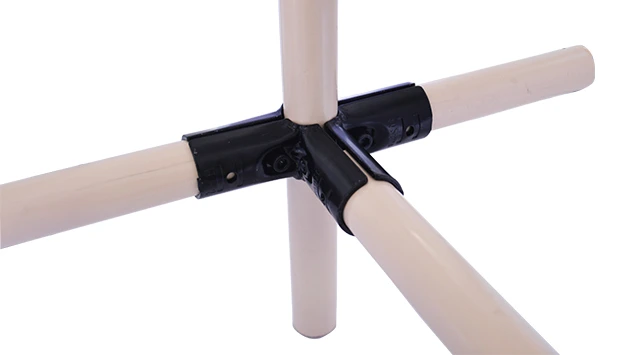
In the fast-paced world of computer peripherals manufacturing, where precision, efficiency, and adaptability can make or break production lines, the tools and systems that keep operations running smoothly are more critical than ever. From keyboards and mice to monitors and printers, every step—from component assembly to final packaging—demands a workflow that's both rigid enough to ensure consistency and flexible enough to adapt to shifting product designs or market demands. This is where lean manufacturing systems shine, and at the heart of these systems lies a humble yet indispensable component: the chrome four way straight lean pipe joint . In this article, we'll explore how this unassuming piece of hardware, paired with lean pipe and other modular components, transforms manufacturing floors, with a focus on its applications in building workbenches, flow racks, and conveyors—three pillars of efficient computer peripherals production.
The Role of Lean Systems in Modern Manufacturing
Before diving into the specifics of the chrome four way straight lean pipe joint, let's take a step back to understand why lean systems have become the backbone of computer peripherals manufacturing. Lean manufacturing, at its core, is about eliminating waste—whether that's wasted time, materials, or space—while maximizing value for the customer. In an industry where product lifecycles are short (think of how quickly new keyboard designs or wireless mouse models hit the market) and production volumes can swing dramatically, rigidity is the enemy. A traditional, fixed production line might work for a single product, but when a manufacturer needs to switch from assembling mechanical keyboards to ergonomic ones, or from wired mice to Bluetooth-enabled versions, that rigidity becomes a bottleneck.
Lean systems solve this by prioritizing modularity. Instead of permanent, welded structures, lean setups use lightweight, reconfigurable components that can be assembled, disassembled, and reassembled in hours—no welding torches or specialized tools required. This flexibility not only reduces downtime during retooling but also allows manufacturers to experiment with workflow layouts, test new production methods, and scale operations up or down as needed. And at the center of this modularity is the lean pipe and its accompanying joints—simple, durable connectors that turn basic pipes into everything from workbenches to material racks.
Understanding Lean Pipes and Joints: The Building Blocks of Flexibility
At first glance, a lean pipe might look like little more than a metal tube, but its design is purpose-built for manufacturing environments. Typically made from steel with a plastic or chrome coating, lean pipes are lightweight yet strong enough to support the weight of components, tools, and even finished products. What truly sets them apart, though, is their compatibility with a wide range of joints—connectors that allow pipes to be joined at various angles and configurations. These joints are the "glue" of lean systems, turning individual pipes into cohesive structures.
Joints come in all shapes and sizes, each tailored to specific needs: three-way joints for T-shaped connections, 90-degree joints for right angles, and swivel joints for adjustable angles. But among the most versatile is the chrome four way straight lean pipe joint . As the name suggests, this joint features four connection points aligned in a straight line (two on each end, perpendicular to the joint's body), allowing for pipes to extend in four directions. This design makes it ideal for building symmetrical structures or creating multi-directional support—think of a workbench with shelves extending from both sides, or a flow rack with levels that branch out to accommodate different component sizes.
Chrome plating adds another layer of utility. In manufacturing settings where spills, moisture, or chemicals are common (such as during cleaning or assembly processes involving adhesives), chrome resists corrosion and wear, ensuring the joint maintains its strength and functionality over time. Unlike plastic-coated joints, which might crack or degrade under heavy use, chrome joints stand up to the daily rigors of a busy production floor, making them a reliable choice for long-term setups.
| Joint Type | Material | Key Features | Best For | Limitations |
|---|---|---|---|---|
| Chrome Four Way Straight | Chrome-plated steel | Four straight connection points, corrosion-resistant, high load capacity | Symmetrical structures, multi-directional workbenches, flow rack frames | Not ideal for angled connections (requires additional joints) |
| Standard Plastic Three Way | ABS plastic | Lightweight, low cost, 90-degree and T-shaped connections | Temporary setups, low-weight applications (e.g., small part storage) | Less durable; prone to cracking under heavy loads |
| Stainless Steel 90-Degree | Stainless steel | High strength, rust-resistant, fixed right-angle connections | Heavy-duty shelving, rigid frame structures | Limited to 90-degree angles; less flexible for reconfiguration |
| Aluminum Swivel Joint | Aluminum alloy | Adjustable angles, lightweight, compatible with aluminum pipes | Ergonomic workstations, adjustable-height structures | Lower load capacity compared to chrome or stainless steel |

Application 1: Building Ergonomic Workbenches
Walk into any computer peripherals manufacturing plant, and you'll likely see rows of workbenches where operators assemble components—soldering circuit boards for wireless mice, attaching keycaps to keyboard frames, or testing touchscreen monitors. These workbenches are more than just tables; they're command centers where tools, parts, and documentation need to be within arm's reach, and the layout must minimize unnecessary movement (a key lean principle to reduce fatigue and improve efficiency).
This is where the chrome four way straight lean pipe joint truly shines. By combining lean pipes with these joints, manufacturers can build custom workbenches tailored to the specific needs of each task. For example, a keyboard assembly workstation might require a main surface for the assembly area, a shelf above for tools (screwdrivers, tweezers, soldering irons), and a bin rack below for spare components (key switches, springs, plastic keycaps). The four-way joint simplifies this setup: pipes run vertically from the floor to the workbench surface (supported by four-way joints at the base for stability), then extend horizontally to create the shelf above and the bin rack below. Since the joints connect pipes in straight lines, the structure remains symmetrical and balanced, reducing the risk of wobbling—critical when precision work like soldering tiny components is involved.
Ergonomics also play a role. Computer peripherals manufacturing often involves repetitive motions, and poorly designed workbenches can lead to operator strain. With the chrome four way joint, manufacturers can adjust the height of shelves or tool holders by simply repositioning the joint along the vertical pipes. For instance, a taller operator might need the tool shelf 6 inches higher than a shorter colleague; instead of building a new workbench, the team can loosen the joint's bolts, slide the horizontal pipe to the desired height, and retighten. This adjustability ensures every operator can work comfortably, reducing the risk of injuries and boosting productivity.
Another advantage is the ease of adding accessories. Many lean pipe systems are compatible with add-ons like monitor mounts, cable organizers, and tool hooks—all of which can be attached using additional joints. A workbench for testing wireless mice, for example, might need a monitor to display test results; using a four-way joint as a mounting point, a pipe can extend upward from the bench, with a swivel joint attaching the monitor arm. This keeps the screen at eye level without cluttering the workspace, a small detail that makes a big difference in operator focus and efficiency.

Application 2: Streamlining Material Flow with Flow Racks
In computer peripherals manufacturing, components rarely stay in one place. A single keyboard might require plastic keycaps from one bin, circuit boards from another, and rubber domes from a third—all of which need to be delivered to the assembly line efficiently. This is where flow racks come in. Designed with inclined shelves and roller tracks, flow racks use gravity to move components from the back (where stock is replenished) to the front (where operators pick parts), ensuring a steady supply without manual lifting or searching.
The chrome four way straight lean pipe joint is instrumental in building these racks. Flow racks need to be sturdy enough to support heavy bins of components (some circuit boards, for example, can be dense and weighty), while also being configurable to accommodate different bin sizes. A typical flow rack might have three levels (for small, medium, and large components) and three rows (for different part types), with each level supported by horizontal pipes connected via four-way joints. The joints provide a stable base for the roller tracks (often made of aluminum or plastic), ensuring the tracks stay aligned and the bins glide smoothly without jamming.
Consider a flow rack used for storing keyboard keycaps. Keycaps come in various sizes (for letters, numbers, and special keys) and are often housed in shallow plastic bins. The rack's levels need to be spaced evenly to prevent bins from overlapping, and the roller tracks must be angled just right to control the bin's descent speed. Using four-way joints, manufacturers can set the vertical pipes at precise intervals (say, 18 inches apart) and attach horizontal pipes at each level. Since the joints are straight, the horizontal pipes run parallel to each other, keeping the roller tracks aligned—a critical detail, as misaligned tracks can cause bins to get stuck, leading to delays in assembly.
Chrome's durability is especially valuable here. Flow racks are often located in high-traffic areas, where forklifts or pallet jacks might accidentally bump into them. A chrome-plated joint can withstand these minor impacts without bending or breaking, whereas a plastic joint might crack, compromising the rack's stability. Over time, this resilience reduces maintenance costs and downtime, ensuring the flow of components remains uninterrupted.
Application 3: Integrating Conveyors for Seamless Production Lines
As components move from flow racks to workbenches and finished products move to packaging, conveyors bridge the gap, automating the transport of goods across the manufacturing floor. In computer peripherals manufacturing, conveyors might carry circuit boards through soldering stations, move assembled keyboards to quality control, or transport packaged mice to shipping. To maximize efficiency, these conveyors need to integrate smoothly with workbenches and flow racks—often requiring custom layouts that fit the plant's unique space constraints.
Here, the chrome four way straight lean pipe joint excels at creating support structures for conveyor systems. While the conveyors themselves are typically made of metal or plastic belts, their frames and side guards are often built using lean pipes. For example, a small belt conveyor used to move assembled mice from the workbench to quality control might need side guards to prevent products from falling off. These guards can be constructed using vertical pipes attached to the conveyor frame with four-way joints, ensuring the guards are tall enough (usually 6-8 inches) and spaced evenly along the conveyor's length.
In larger setups, such as a conveyor that feeds components to multiple workbenches, the frame might need to branch off into smaller "feeder" conveyors. A four-way joint can serve as a junction point, with one pipe continuing straight and another branching off at a 90-degree angle (using a secondary 90-degree joint). This modular approach allows manufacturers to expand or reconfigure conveyors as production needs change—say, adding a new feeder line when a second assembly station is brought online.
Durability is again a key factor. Conveyors vibrate during operation, and over time, this vibration can loosen joints if they're not robust. Chrome four-way joints, with their tight, bolted connections and corrosion-resistant coating, maintain their grip even under constant motion, reducing the need for frequent maintenance checks. This reliability is crucial in high-volume manufacturing, where a conveyor breakdown could halt the entire line, costing thousands in lost production.
Why Chrome Four Way Joints Stand Out in Lean Systems
With so many joint types available, what makes the chrome four way straight lean pipe joint a go-to choice for computer peripherals manufacturers? It boils down to three key benefits: versatility, durability, and cost-effectiveness.
Versatility : The four-way design means a single joint can connect pipes in multiple directions, reducing the number of parts needed for complex structures. A workbench with shelves on both sides, for example, can be built using fewer joints than if three-way or two-way joints were used, simplifying assembly and reducing the risk of errors.
Durability : Chrome plating and steel construction make these joints resistant to corrosion, impacts, and wear—essential in manufacturing environments where equipment is used around the clock. Unlike plastic joints, which might need replacement after a year or two, chrome joints can last for decades with minimal maintenance, lowering long-term costs.
Cost-effectiveness : While chrome joints might have a higher upfront cost than plastic ones, their longevity and reusability more than make up for it. When a production line is reconfigured, the joints can be disassembled and reused in the new setup, eliminating the need to buy new parts. This "recycle and reuse" model aligns perfectly with lean principles, reducing waste and keeping material costs in check.
Real-World Impact: A Case Study
To put these applications into perspective, consider a mid-sized computer peripherals manufacturer that recently upgraded its assembly line using lean pipe systems with chrome four way straight joints. Prior to the upgrade, the plant relied on fixed wooden workbenches and metal shelving—setups that were difficult to adjust when new products were introduced. Assembly operators often had to walk to distant shelves to fetch components, and flow was inconsistent, leading to occasional bottlenecks.
After switching to lean systems, the manufacturer built 12 custom workbenches using chrome four-way joints, each with tool shelves, monitor mounts, and under-bench flow racks. The workbenches were adjustable, allowing operators to set heights between 30 and 36 inches, and the flow racks were stocked with components delivered via gravity from the back. Within three months, the plant reported a 20% reduction in assembly time, as operators spent less time moving and more time building. Error rates also dropped by 15%, thanks to better organization and easier access to tools and parts.
The flow racks, built with four-way joints and aluminum roller tracks, proved especially impactful. Stock replenishment times decreased by 30%, as warehouse staff could load bins from the back of the racks without disrupting assembly. And when the manufacturer introduced a new ergonomic keyboard line, the existing workbenches and flow racks were reconfigured in a single day by adjusting the joint positions—no new equipment needed.
Looking Ahead: Lean Systems in the Age of Smart Manufacturing
As computer peripherals manufacturing continues to evolve—with trends like automation, IoT integration, and sustainability shaping the industry—lean systems will only grow in importance. Smart factories, for example, use sensors to monitor production flow and adjust processes in real time; modular lean structures built with joints like the chrome four way straight lean pipe joint can easily accommodate these sensors, with pipes serving as mounting points for cameras, barcode scanners, and IoT devices.
Sustainability is another area where lean systems excel. By using reusable components (like chrome joints that can be repurposed for years), manufacturers reduce waste from disposable or single-use equipment. Additionally, the energy savings from more efficient workflows (less lighting needed in organized spaces, reduced heating/cooling in streamlined layouts) align with global efforts to lower carbon footprints.
For computer peripherals manufacturers, the message is clear: investing in flexible, durable lean systems isn't just about improving today's production—it's about future-proofing operations for tomorrow's challenges. And at the center of that investment is the chrome four way straight lean pipe joint —a small component with a big impact on how we build, adapt, and thrive in the manufacturing world.
In the end, it's the little things that make the biggest difference. A joint that connects pipes in four directions, resists corrosion, and stands up to daily use might not grab headlines, but in the hands of skilled manufacturers, it becomes a tool for innovation—turning chaos into order, inefficiency into productivity, and static setups into dynamic, future-ready production lines. For anyone in computer peripherals manufacturing, that's not just a win for the bottom line—it's a win for the people who build the tools we rely on every day.