- Company Articles
- Products and Technology
- Solution
- Constructing Flexible Production Lines Using 3060 National Standard Profile A

Constructing Flexible Production Lines Using 3060 National Standard Profile A
Related Product
3060 National Standard Profile A
Workbench, production line, logistic rack, warehouse rack Industry: Manufacturer workshop, Automobile, Electronic, Assembling, logistic
Step onto any factory floor, and you'll feel it—the quiet tension between the need to stay efficient and the pressure to adapt. A supervisor sighs as workers spend hours reconfiguring a workbench for a new product. A production manager stares at a rigid conveyor system, knowing it can't keep up with next month's bigger orders. These aren't just logistical hurdles; they're roadblocks to growth, creativity, and employee morale. For decades, manufacturers have accepted rigidity as the cost of doing business. But what if there was a way to build production lines that bend, not break, when demands change? Enter the 3060 National Standard Profile A—a simple aluminum extrusion that's quietly revolutionizing how factories, workshops, and warehouses operate.
This isn't just about metal and bolts. It's about empowering teams to work smarter, not harder. It's about giving small businesses the agility to compete with industry giants. It's about turning "we can't" into "we can—let's try." Let's explore how this unassuming profile is transforming production floors, one flexible setup at a time.
What Is 3060 National Standard Profile A, Anyway?
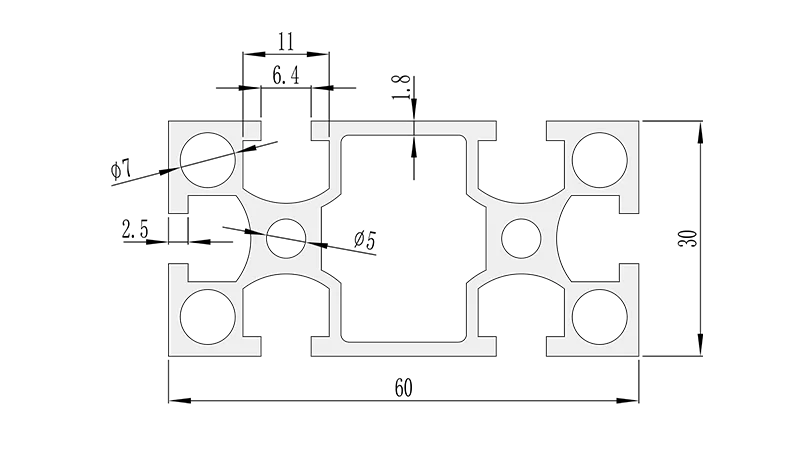
At first glance, 3060 National Standard Profile A looks like any other aluminum bar—sleek, silver, and unremarkable. But that's where appearances deceive. This profile is a masterpiece of industrial design: 30mm wide, 60mm tall, with precision-machined T-slots running along its length. Those slots are the key. They're not just grooves; they're the gateway to infinite configurations. Slide a connector into a slot, tighten a screw, and suddenly you've built a corner. Add a bracket, and you've got a shelf. Attach a roller track, and materials start flowing seamlessly. It's modularity reimagined—strong enough to hold heavy tools, light enough to carry by hand, and adaptable enough to grow with your business.
Why 30x60mm? That specific size is a sweet spot. It's narrow enough to fit in tight spaces (think between two machines) but robust enough to support hundreds of kilograms when properly assembled. Whether you're building a small workbench for electronics assembly or a large material rack for automotive parts, this profile balances strength and versatility like no other. It's the Goldilocks of industrial framing—just right for most manufacturing needs.
Aluminum: The Unsung Hero of Flexible Manufacturing
You might be thinking, "Why not steel? It's stronger." True, steel has its merits, but aluminum brings something steel can't: adaptability . Let's break it down.
First, weight. Aluminum is 3x lighter than steel. That means two workers can carry a 6-meter length of 3060 profile without a forklift. Try that with steel, and you'll need a crane or a team of four. When reconfiguring a production line, every minute counts. Lighter materials mean faster setup, less downtime, and fewer injuries from heavy lifting. Imagine moving a workbench in 15 minutes instead of 2 hours—that's the aluminum advantage.
Corrosion resistance is another win. Factories are harsh environments: oil, water, chemicals, and humidity all take a toll. Steel rusts, requiring constant painting or replacement. Aluminum? It forms a natural oxide layer that fights corrosion, even in damp or coastal settings. That means your 3060 profiles will look and perform like new for years, with minimal maintenance. No more replacing rusted frames or repainting every quarter—just reliable, long-lasting performance.
And let's talk sustainability. In an era where customers care about your carbon footprint, aluminum is a game-changer. It's 100% recyclable, and recycling it uses just 5% of the energy needed to make new aluminum. When your production line eventually needs an upgrade, those 3060 profiles won't end up in a landfill—they'll be melted down and turned into new profiles, closing the loop on waste. For businesses aiming to go green, this isn't just a trend; it's a responsibility.
Accessories: The "Secret Sauce" of Modularity
A 3060 profile alone is just a piece of aluminum. What turns it into a production powerhouse is the ecosystem of aluminum profile accessories designed to work with it. Think of the profile as the canvas; the accessories are the paintbrushes that let you create anything.
Connectors are the foundation. Need to join two profiles at a right angle? Grab a 90° aluminum profile connector—slide it into the T-slot, tighten a nut, and you're done. Want a corner that can pivot? Use a movable hinge. For extra strength, add a gusset plate. These connectors are precision-engineered, with tolerances as tight as 0.1mm, ensuring a wobble-free fit that holds up to vibrations and heavy use. No welding, no drilling, no hassle—just quick, secure connections.
Then there are the finishing touches that make a setup practical. End caps snap onto profile ends, covering sharp edges and giving a clean look—no more scraped knuckles. Adjustable leveling feet screw into the base, letting you stabilize workbenches even on uneven floors. Need to move a setup? Add casters with brake locks—suddenly your stationary workbench becomes a mobile cart. And for specialized tasks? There's a tool for that: roller track placon mounts for conveyor systems, plastic roller track guide rails to keep materials on course, and even aluminum honeycomb panels for lightweight, durable work surfaces.
The beauty is in the mix-and-match. Start with a basic frame: four 3060 profiles as legs, connected by horizontal profiles at the top and bottom. Add a workbench top (aluminum, wood, or even a ESD surface for electronics). Attach a shelf using 45° aluminum profile connectors. Install a mini aluminum roller track along the back for moving parts. Need more storage? Slide brackets into the T-slots and hang bins. When your needs change, take it apart and rebuild—no waste, no new parts needed. It's like having a production line that's always in beta, evolving with your business.
Building a Workbench: From Rigid to Responsive
Let's get practical. One of the most common uses for 3060 National Standard Profile A is building workbenches—and for good reason. Traditional workbenches are fixed: too tall for some workers, too short for others, with no room to add shelves or tools. A 3060-based workbench? It's a custom solution that adapts to your team, not the other way around.
Start with the frame: four vertical 3060 profiles, each with adjustable leveling feet. Why vertical? Because you can set the height to match your workers. Studies show that ergonomic workstations reduce musculoskeletal injuries by up to 60%—and with 3060 profiles, adjusting height is as easy as loosening the feet, sliding the frame up or down, and retightening. No more hunching over a bench that's too low or straining to reach a surface that's too high.
Next, the work surface. An aluminum honeycomb panel is a popular choice: lightweight, flat, and resistant to scratches and stains. Attach it to the frame using brackets that slide into the T-slots—no drilling required. Now, customize: Add a pegboard for tools using 90° connectors. Install a power strip by sliding clips into the T-slots. Need a vice? Bolt it directly to the bench top, positioning it exactly where you need it using the slots. It's a workstation tailored to your task, not a one-size-fits-all afterthought.
Here's a real example: A small woodworking shop was using a fixed workbench that was too low for the owner, causing back pain. With 3060 profiles, they built a new bench in an afternoon—adjustable to their height, with a shelf for clamps, and a mini aluminum roller track along the edge for moving heavy boards. Six months later, when they hired an assistant, they simply raised the bench to fit the new worker. No new bench, no wasted money—just a tool that grows with the team.
Roller Tracks: Moving Materials Without the Headaches
Workbenches are where the magic happens, but materials need to get there first. That's where roller tracks come in—and 3060 profiles make them smarter, faster, and more flexible than ever.
Traditional roller tracks are often steel, bolted to the floor, and impossible to modify. A 3060-based roller track? It's a modular system that adapts to your needs. Start with two parallel 3060 profiles. Attach roller track placon mounts to the T-slots—these hold the rollers in place. Choose from 1-inch swivel roller balls for smooth, multi-directional movement, or steel wheel roller tracks for heavier loads. Add plastic roller track guide rails (yellow for visibility, grey for a sleek look) to keep items on course. It's assembly line building, simplified.
Take a electronics manufacturer, for example. They used to have a fixed conveyor that moved circuit boards from soldering to testing. When they launched a new, larger motherboard, the conveyor was too narrow—so workers had to carry boards by hand, slowing production and increasing the risk of damage. With 3060 profiles, they built a new roller track in a day: wider, with adjustable guide rails, and raised to match both stations. Best of all, when they add a smaller product line next year, they can reposition the rails and swap in narrower rollers—no new conveyor needed.
Roller tracks built with 3060 profiles also excel at integration. Need to connect two tracks at a 45° angle? Use a 45° aluminum profile connector. Want to add a curve? Bend the profiles (aluminum is malleable with the right tools) and use flexible placon mounts. Even elevation changes are easy: stack profiles vertically to create a gravity-fed track that moves materials downhill without power. It's efficiency meets ingenuity, all thanks to a profile that was designed to work with, not against, your workflow.
Case Study: How a Furniture Maker Doubled Output with Flexibility
Let's hear from a business that's reaping the rewards. ABC Furniture, a mid-sized manufacturer of custom sofas, was stuck in a rut. Their production line was built around fixed workbenches and steel conveyors, each designed for a specific sofa model. When a customer ordered a sectional with an extra module, the line ground to a halt—workers spent two days disassembling and rebuilding the bench, costing thousands in lost production.
In 2024, they switched to 3060 National Standard Profile A. The results were immediate. Their new workbenches, built with aluminum profiles and adjustable leveling feet, could be extended in minutes by adding a few extra profiles. Roller tracks, with plastic guide rails and swivel roller balls, replaced the old conveyors—wider for large sectionals, narrower for loveseats, and reconfigurable in hours, not days. When a rush order for 50 sofas came in just before the holidays, they reconfigured three workstations in 4 hours and delivered on time—something they'd never done before.
Workers noticed the difference, too. "No more breaking my back moving benches," said one assembler. "Now I can adjust my station to fit the sofa, not the other way around." Morale improved, and turnover dropped by 20%. Best of all, when ABC expanded to a larger factory this year, they disassembled their entire production line, moved it, and reassembled it in a week—saving $50,000 in new equipment costs.
Beyond the Line: The Hidden Benefits of Flexibility
Flexible production lines aren't just about speed or savings—though those are big wins. They're about creating a workplace that empowers people. When workers can adjust their environment to fit their needs, they feel valued. When managers can pivot quickly to meet demand, they gain confidence. And when a business can take on new projects without worrying about infrastructure, it opens doors to growth.
Consider scalability. Startups often hesitate to invest in production equipment, fearing they'll outgrow it. With 3060 profiles, growth isn't a problem—just add more profiles. A home-based craft business can start with a single workbench, then expand to a roller track system as orders pick up. A tech startup can build a prototype line with a few profiles and accessories, then scale up to full production without replacing a single component. It's investment that grows with you, not against you.
Or take innovation. When your production line is flexible, experimentation becomes easier. Want to test a new assembly process? Rearrange a few profiles and see. Need to prototype a product? Build a mini line in a day. This culture of experimentation leads to better products, happier customers, and a competitive edge in the market.
Choosing a Supplier: What to Look For
Of course, none of this works without a reliable supplier. When shopping for 3060 National Standard Profile A and accessories, look for a partner who offers more than just parts. They should provide technical support—helping you design your first workbench or troubleshoot a roller track connection. They should have a wide range of accessories in stock, so you're not waiting weeks for a connector. And they should stand behind their products, offering warranties that give you peace of mind.
Don't be afraid to ask for samples. A good supplier will send you a profile and a few connectors so you can feel the quality. Test the T-slot fit—should be snug but not tight. Check the connectors for sturdiness. Remember: this is the backbone of your production line—you want it to feel solid, precise, and built to last.
The Future of Manufacturing Is Flexible
Rigid production lines belong to the past. Today's manufacturers need systems that adapt, evolve, and grow with their business. 3060 National Standard Profile A isn't just a material—it's a mindset shift: from "this is how we've always done it" to "how can we do it better?"
Whether you're a small workshop or a large factory, the message is clear: flexibility isn't a luxury; it's a necessity. It's the difference between struggling to keep up and leading the pack. It's the difference between a workforce that dreads change and one that embraces it. And with 3060 profiles, it's within reach—no matter your size or budget.
So, take a look at your production line. What's holding you back? A workbench that can't adjust? A conveyor that can't expand? It's time to break free. Invest in flexibility. Invest in 3060 National Standard Profile A. Your team, your bottom line, and your future self will thank you.