- Company Articles
- Products and Technology
- Application Cases
- Continuous Improvement with 4040r EU Standard Aluminum Profile: Lean Case Study

Continuous Improvement with 4040r EU Standard Aluminum Profile: Lean Case Study
Related Product
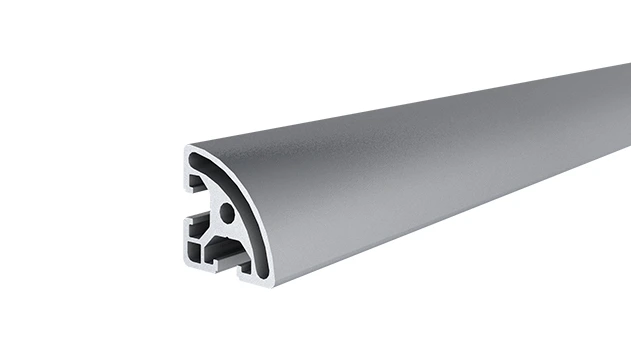
4040R EU Standard Aluminum Profile
4040R is a 4.00x4.00 CM fractional 40 series square extrusion T-slot profile with two side open T-slots, each side with 4.00cm face,the other side is round face. The profile has align-a-grooves to assist in aligning connecting profiles.
In the fast-paced world of manufacturing, where every second counts and efficiency is the name of the game, the difference between a thriving operation and one stuck in the mud often comes down to the tools we use to organize our work. For years, many factories have relied on rigid, one-size-fits-all equipment that resists change—workbenches bolted to the floor, flow racks that can't adapt to new products, and caster wheels that wobble under the weight of daily use. But what if there was a way to build a workspace that grows with your needs, reduces waste, and makes your team's day-to-day just a little easier? That's exactly the question PrecisionWorks, a mid-sized electronics assembly plant in the heart of the Midwest, set out to answer. And their solution? The 4040r EU Standard Aluminum Profile. Let's dive into their story.
The Challenge: When "Good Enough" Stops Cutting It
PrecisionWorks had been chugging along for a decade, assembling circuit boards and small electronic components for medical devices. Their team of 50 operators prided themselves on quality, but by 2023, cracks were starting to show in their workflow. Walk through their shop floor, and you'd notice the same frustrations cropping up again and again.
First, the workbenches. Most were hand-me-downs from the 2000s—heavy wooden structures with fixed shelves that couldn't be adjusted. "If you're 5'4", you're hunched over all day; if you're 6'2", you're stooping," said Maria Gonzalez, a lead assembler with 8 years at the company. "We'd prop up monitors with old phone books or stack boxes under our feet just to make it bearable. And forget about rearranging them—they weighed a ton, so we just lived with the layout, even when new product lines came in."
Then there were the flow racks. These metal structures, used to move components from the warehouse to the assembly line, were supposed to keep materials flowing smoothly. But more often than not, they turned into bottlenecks. "The rollers were cheap plastic, so they'd jam if a box was even slightly off-kilter," explained Tom Reeves, the plant manager. "We'd have operators stopping their work to unstick a jam, or worse, components would topple off and get damaged. It felt like we were fighting our own equipment half the time."
Mobility was another headache. The few trolleys they had came with caster wheels that felt like they belonged on a shopping cart, not an industrial setting. "We'd load up a trolley with PCBs, push it 10 feet, and suddenly a wheel would lock up or even fall off," Tom recalled. "Once, a cart tipped over, and we lost $2,000 worth of parts. After that, people started avoiding using them altogether, which meant more walking back and forth—wasted steps, wasted time."
Worst of all, their lean system felt more like a buzzword than a reality. With rigid equipment, they couldn't implement 5S properly—sorting, setting in order, shining, standardizing, sustaining. Tools got misplaced because there was no built-in storage; excess inventory piled up because the flow racks couldn't keep pace; and changeovers between product models took hours instead of minutes. "We were stuck in a loop," Tom admitted. "We'd talk about 'continuous improvement,' but our workspace was holding us back."
Discovering the 4040r EU Standard Aluminum Profile: A Lightbulb Moment
It wasn't until Tom attended a manufacturing trade show in Chicago that things started to shift. There, he stumbled upon a booth showcasing modular aluminum profiles—and specifically, the 4040r EU Standard Aluminum Profile. "I'd seen aluminum extrusions before, but this was different," he said. "The rep didn't just show me a metal tube; he showed me a system. He snapped together joints, added shelves, attached caster wheels, and suddenly I had a workbench, a flow rack, and a trolley—all from the same basic parts. I thought, 'Why haven't we been using this?'"
So, what exactly is the 4040r EU Standard Aluminum Profile? In simple terms, it's a lightweight but sturdy aluminum extrusion with a square cross-section (40mm x 40mm) and a series of T-slots running along its length. These slots let you attach accessories—joints, shelves, wheels, brackets—without drilling or welding. The "r" in 4040r stands for "rounded," referring to its smooth, deburred edges, which reduce the risk of cuts and make cleaning easier (a big plus for electronics, where dust and debris are enemies).
But what really sold Tom was its versatility. Unlike the fixed wooden workbenches or clunky metal racks they were used to, the 4040r profile could be reconfigured in minutes. Need a taller shelf? Swap out a joint. Want to add a tool rail? Slide in a bracket. "It's like building with adult Legos," he laughed. "And because it's aluminum, it's lightweight enough to move but strong enough to handle heavy loads—exactly what we needed for our circuit boards and equipment."
He brought back a sample kit to the plant, and the team's reaction was immediate. "We set up a small mock workbench in the break room, and within an hour, operators were gathering around, suggesting changes," Maria said. "'Can we add a bin here for screws?' 'What if we tilt the monitor shelf?' It was the first time people felt like they could shape their workspace, not just work around it."

Designing the Solution: From Paper to Prototype
PrecisionWorks didn't jump in blindly. They started with a pilot project: revamping one assembly line, focusing on three key areas: workbenches, flow racks, and mobility.
Aluminum Workbench A: Built for People, Not Just Parts
The goal here was simple: create a workbench that could adjust to different operators, store tools within arm's reach, and integrate with their assembly tools. Using the 4040r profile as the frame, they designed what they called "Aluminum Workbench A"—a modular station with adjustable height (from 30" to 42"), a lightweight aluminum honeycomb top (resistant to scratches and static), and T-slot accessories for holding screwdrivers, tweezers, and even small monitors. "We added a footrest bar that slides up and down, too," Maria noted. "Now, whether you're sitting or standing, you're comfortable. No more phone books under the feet!"
Flow Racks: Smooth Sailing for Materials
For the flow racks, they replaced the old plastic rollers with 4040r-based roller tracks, paired with durable steel wheels. The aluminum profile's rigidity meant the racks didn't flex under weight, so materials glided evenly. "We also added side guides to keep boxes centered—no more jams," Tom explained. "And because the 4040r is corrosion-resistant, we didn't have to worry about rust from the occasional spill or humidity in the warehouse. It was like night and day."
Caster Wheels: Mobility Without the Headaches
To solve the trolley problem, they swapped out the flimsy shopping-cart wheels for heavy-duty caster wheels designed to fit the 4040r profile. These wheels had locking brakes, shock-absorbing rubber tires, and reinforced axles. "We tested one by loading it with 300 pounds of parts and pushing it across the shop floor—it rolled like a dream," Tom said. "No wobbling, no locking up. The operators couldn't believe it. Now, they actually fight over who gets to use the new trolleys!"
"Before, I'd dread changeover days—taking apart the old workbench, moving shelves, reconfiguring tools. With the 4040r profile, I can adjust the height, add a new bin, or even move the entire bench in 10 minutes. It's like having a workspace that thinks ahead." — Raj Patel, Assembly Technician
Implementation: From Design to "Wow, That Actually Works"
Turning the design into reality took six weeks, and it wasn't without its learning curves. The team started by mapping out the assembly line with tape on the floor, marking where workbenches, flow racks, and trolleys would go. Then, they ordered the 4040r profiles, joints, caster wheels, and accessories from a local supplier. "We were nervous about assembling them ourselves—none of us were engineers," Tom admitted. "But the supplier sent a tech to walk us through the first workbench, and after that, it clicked. The joints just snap into the T-slots, and you tighten a bolt with an Allen wrench. Even the new guys on the team were putting together racks by the end of the week."
Training was another key step. They held a workshop where operators got to build their own "mini workbenches" using leftover 4040r pieces. "We wanted everyone to feel ownership," Maria said. "If you build it, you're more likely to take care of it. Plus, they came up with ideas we hadn't thought of—like adding a cup holder that attaches to the side, or a cable management slot to keep wires from tangling."
The first full day with the new setup was a mix of excitement and nerves. "I walked in at 6 AM, and the shop floor looked different—cleaner, more open," Tom remembered. "The operators were already gathered around the new Aluminum Workbench A, adjusting the height and testing the tool holders. By 8 AM, when production started, I was holding my breath. Would it live up to the hype?"
Results: The Numbers (and the Stories) Speak for Themselves
Three months later, the results were undeniable. PrecisionWorks tracked key metrics before and after the 4040r implementation, and the improvements were stark. Here's how things stacked up:
| Metric | Before (2023 Q1) | After (2023 Q3) | Improvement |
|---|---|---|---|
| Assembly Line Changeover Time | 2.5 hours | 45 minutes | 60% reduction |
| Material Handling Errors (Jams/Drops) | 12 per week | 2 per week | 83% reduction |
| Operator Ergonomic Complaints | 8 per month | 1 per month | 88% reduction |
| On-Time Production Rate | 78% | 94% | 16% increase |
| Employee Satisfaction Score (1-10) | 6.2 | 8.9 | 2.7-point increase |
But numbers only tell part of the story. Ask the operators, and they'll paint a picture of a workplace that finally works with them, not against them. "I used to go home with a stiff neck and sore shoulders," Maria said. "Now, I adjust my workbench height when I start my shift, and I don't think about my posture again. It's the little things—like having my screwdrivers right where I need them, not in a drawer across the bench—that make the day fly by."
Raj Patel, who'd been vocal about the old workbenches, summed it up: "Before, I felt like the job was fighting me. Now? I feel in control. If a new part comes in that's bigger than the others, I just loosen a few bolts, adjust the shelf, and keep going. That's the power of this stuff—it lets you focus on the work, not the workspace."
Beyond the Workbench: Scaling Lean with 4040r
PrecisionWorks didn't stop with the pilot line. By the end of 2023, they'd rolled out 4040r-based solutions across the entire plant—from the warehouse to the shipping department. They built custom turnover trolleys for finished products, adjustable material racks for inventory, and even a mobile testing station with integrated caster wheels that could be wheeled right to the assembly line.
"The best part is how easy it is to adapt," Tom said. "Last month, we got a contract for a new medical device that's slightly larger than our usual products. Instead of buying new equipment, we just reconfigured three of our Aluminum Workbench A stations and added longer roller tracks to the flow racks. It took two guys half a day. That's the definition of lean—no waste, no waiting, just action."
They also noticed unexpected benefits, like better housekeeping. "With the T-slots, we could add labeled bins and tool hooks, so everything has a home," Maria explained. "Our 5S audits used to take hours; now, they're done in 30 minutes because the place stays organized. It's not just about the equipment—it's about building good habits, and the 4040r makes those habits easy."
Conclusion: The Journey of Continuous Improvement
PrecisionWorks' story isn't about a magic bullet. It's about finding a tool—the 4040r EU Standard Aluminum Profile—that aligns with their commitment to lean principles and continuous improvement. "We didn't solve all our problems overnight," Tom said. "But we built a foundation. Now, when our team says, 'We can do better,' we believe them—because we have the flexibility to try new things."
For manufacturers still struggling with rigid, outdated equipment, the message is clear: your workspace shouldn't be a barrier to progress. The 4040r profile isn't just metal and joints; it's a canvas for innovation. It lets you build, adapt, and grow—one workbench, one flow rack, one caster wheel at a time.
As Maria put it: "At the end of the day, we're all here to make something great. When your tools help you do that instead of getting in the way? That's when the magic happens." And for PrecisionWorks, that magic started with a simple aluminum profile—and a commitment to never stop improving.