- Company Articles
- Products and Technology
- Procurement Guidelines
- Cost Analysis: Lean Pipe Clamp B vs. Traditional Fittings in 5-Year Projects

Cost Analysis: Lean Pipe Clamp B vs. Traditional Fittings in 5-Year Projects
Related Product
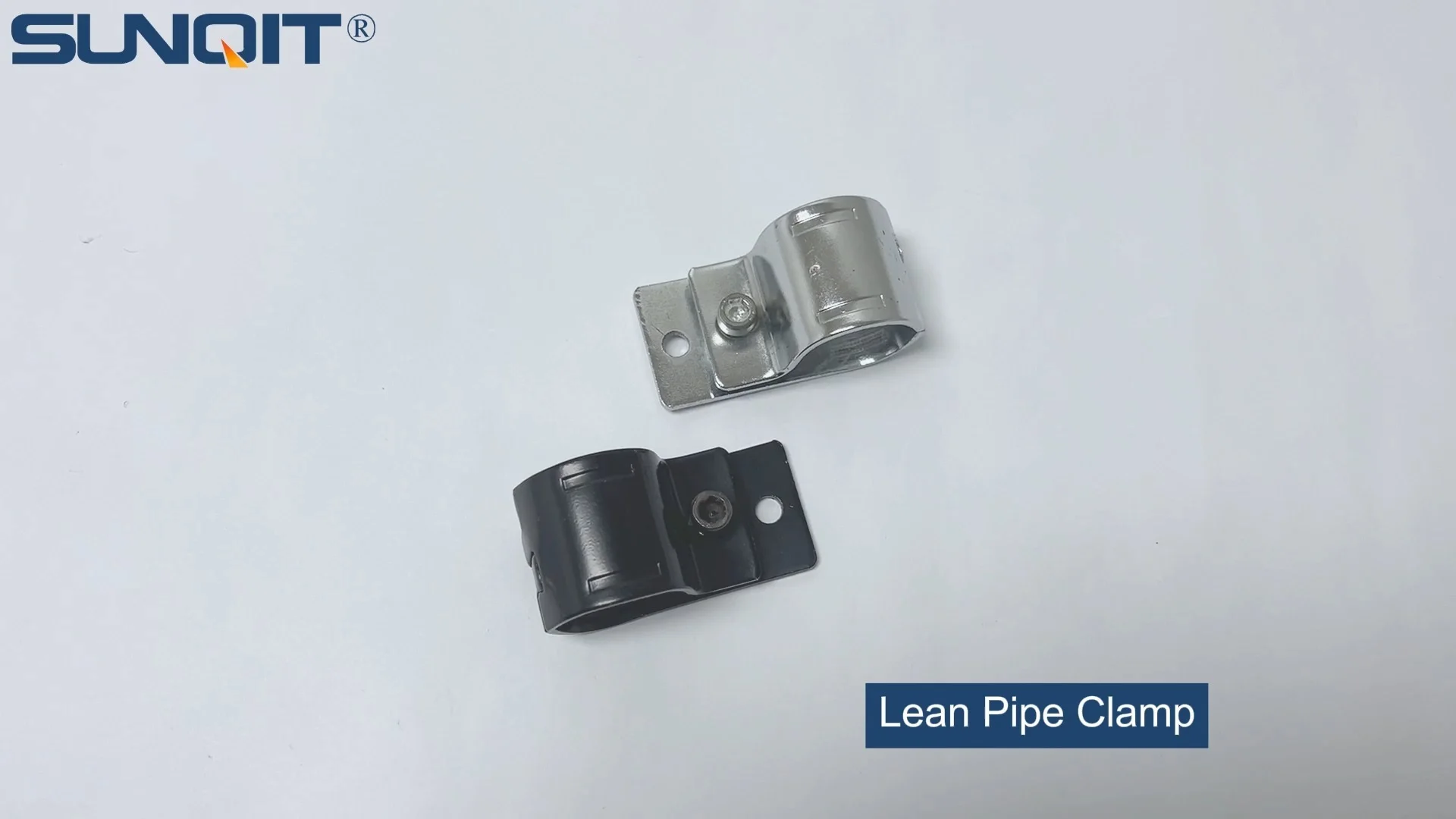
Lean Pipe Clamp
Lean pipe clamp is used for rack system hang monitor or other panel for workbenck, flowrack in production daily use.
Introduction: The Hidden Costs of "Cheap" Solutions
When a manufacturing plant manager sits down to plan a new production line or upgrade an existing workspace, the first question often boils down to cost. "What's the cheapest way to get this up and running?" It's a natural reflex—budgets are tight, and every dollar saved upfront feels like a win. But here's the thing: in industrial setups, where equipment and workspaces need to last 5 years or more, "cheap upfront" rarely translates to "cost-effective long-term."
Take, for example, the choice between lean pipe clamp B and traditional metal fittings. Traditional fittings—think heavy steel brackets, welded joints, and fixed metal components—might seem like the budget-friendly option at first glance. But over half a decade of use, their rigidity, maintenance needs, and lack of adaptability can turn that initial "savings" into a hidden drain on resources. On the flip side, lean pipe clamp B , a modular component in the broader lean pipe and accessories ecosystem, often costs more to purchase upfront. But its modular design, durability, and ease of modification can make it the smarter investment over time.
In this article, we'll break down the true cost of both options over a 5-year project timeline. We'll look beyond the price tag on the parts themselves and dig into installation labor, maintenance, downtime, and the ability to adapt as your needs change. By the end, you'll see why more and more facilities are swapping out traditional fittings for lean pipe clamp B —and why it might be time for your team to consider the switch, too.
Upfront Costs: Traditional Fittings vs. Lean Pipe Clamp B
Let's start with the most obvious number: the initial purchase price. If you're comparing a bag of traditional steel brackets to a box of lean pipe clamp B components, traditional fittings will almost always come out cheaper. For example, a standard 90-degree traditional metal joint might cost $5, while a comparable lean pipe clamp B could run $8–$10. Multiply that by hundreds of joints needed for a production line, and the gap feels significant—maybe $2,000 vs. $3,500 for a mid-sized setup. It's easy to think, "Why pay 75% more upfront?"
But here's where the comparison gets tricky: traditional fittings rarely come alone. To use them, you'll need additional parts and tools. Welding rods, cutting torches, grinding wheels—these add up. A single welding setup can cost $500 or more, and if you don't have a certified welder on staff, you'll need to hire one. Lean pipe clamp B , on the other hand, is designed to be modular. It works with standard lean pipe and accessories like aluminum pipes, plastic roller tracks, and casters—all of which connect without welding, drilling, or specialized tools. You just slide the clamp onto the pipe, tighten a knob, and you're done.
Let's run the numbers for a hypothetical 50-foot production line. For traditional fittings, you might need:
- 200 traditional joints: $5 each = $1,000
- Welding equipment rental (if not owned): $200/week for 2 weeks = $400
- Welder labor: $30/hour for 40 hours = $1,200
- Steel pipes (uncoated, requiring painting): $150
- Total upfront: ~$2,750
For lean pipe clamp B :
- 200 lean pipe clamp B joints: $9 each = $1,800
- Aluminum pipes (pre-coated, no painting needed): $200
- Basic hand tools (already in most workshops): $0
- General labor (no specialized skills needed): $15/hour for 20 hours = $300
- Total upfront: ~$2,300
Wait—suddenly, lean pipe clamp B is cheaper upfront? That's right. When you factor in the cost of welding labor and equipment, the modular system closes the gap. Traditional fittings' "low cost per joint" disappears when you realize you need to pay someone to weld them together. And that's before we even talk about mistakes: if a welder makes an error with traditional fittings, you might have to cut and re-weld, adding more time (and money) to the project. With lean pipe clamp B , you can adjust a joint in seconds if it's misaligned—no extra cost, no wasted materials.

Installation Time: Labor Costs That Add Up
Time is money, especially in manufacturing. The longer your production line is under construction, the longer you're losing out on potential output. Traditional fittings are notoriously time-consuming to install. Welding each joint, measuring and re-measuring, and waiting for paint or sealant to dry can drag out a project for weeks. A small 10-station workbench setup with traditional fittings might take a team of 2 workers 5 days to complete. With lean pipe clamp B , that same team could finish in 2 days—less than half the time.
Let's quantify that. If your workers earn $25/hour (including benefits), and a traditional installation takes 80 hours (2 workers x 8 hours/day x 5 days) vs. 32 hours (2 workers x 8 hours/day x 2 days) for lean pipe clamp B , the labor cost difference is $25 x (80-32) = $1,200 saved on installation alone. That's a significant chunk of change—and that's for a single workbench . Scale that up to a full factory floor with dozens of stations, and the savings could reach tens of thousands of dollars.
Another hidden time cost: training. If you don't have a welder on staff, you'll need to train someone or hire a contractor. Training a new welder can take months, and contractors often charge premium rates for short-term projects. Lean pipe clamp B , by contrast, requires no special training. A new hire can learn to assemble a basic structure in 15 minutes by watching a quick tutorial. That means you can use your existing team—no need to wait for specialized labor.

Maintenance and Repairs: The 5-Year Drain of Traditional Fittings
Now, let's fast-forward to year 2 of your 5-year project. Your production line is up and running, but wear and tear are starting to show. Traditional steel fittings, especially if they're not stainless steel, are prone to rust. That rust doesn't just look bad—it weakens the joints over time. A rusted joint might start to loosen, leading to wobbly workbench surfaces or unstable material racks. To fix it, you'll need to sand off the rust, apply anti-corrosive paint, and possibly re-weld the joint if it's too loose. Each repair could take 2–3 hours of labor and $50 in materials.
Compare that to lean pipe clamp B , which is often made from zinc-plated steel or paired with aluminum pipes (like those in the aluminum lean pipe series). These materials are resistant to rust and corrosion, even in humid or dusty factory environments. If a lean pipe clamp B does start to loosen—which is rare—you can simply tighten the knob with a standard wrench. No sanding, no painting, no welding. The repair takes 5 minutes, and you're back to full operation.
Let's estimate maintenance costs over 5 years. For a traditional setup, assume you have 10 rust-related repairs per year, each costing $100 (labor + materials). That's $500 over 5 years. For lean pipe clamp B , maybe 1 repair every 2 years (e.g., a knob that wears out), costing $10 (new knob) + 5 minutes of labor ($1.25). Total over 5 years: ~$25. That's a $475 difference in maintenance alone.
Then there's downtime. If a traditional joint fails during a production run, you might have to shut down that part of the line for hours to fix it. For a factory producing $500/hour in goods, a 2-hour shutdown costs $1,000. With lean pipe clamp B , the same repair takes 5 minutes—downtime cost: ~$42. Over 5 years, even a single major traditional fitting failure could cost more than all lean pipe clamp B maintenance combined.

Adaptability: When Your Needs Change (And They Will)
Here's a secret no one tells you when you're setting up a production line: your needs will change. Maybe you'll introduce a new product that requires a wider workbench . Maybe demand spikes, and you need to add more material storage. Maybe ergonomic regulations change, and you have to lower a roller track to reduce worker strain. Traditional fittings? They're stuck in time. To modify a traditional setup, you'll likely need to cut, weld, and rebuild—essentially starting from scratch.
Take a common scenario: after 3 years, you need to extend a roller track by 10 feet to accommodate longer materials. With traditional fittings, that might mean:
- Hiring a welder for 8 hours: $30/hour = $240
- Buying new steel pipes and fittings: $200
- Shutting down the line for a day: $500/hour x 8 hours = $4,000
- Total cost: ~$4,440
With lean pipe clamp B and modular roller track components, it's a different story:
- Ordering 10 feet of aluminum pipe and 10 extra lean pipe clamp B joints: $150
- General labor to assemble (no shutdown needed—you can work during a break): $15/hour x 2 hours = $30
- Total cost: ~$180
That's a $4,260 difference for a single modification. And in 5 years, most facilities need at least 2–3 major modifications. Suddenly, the "flexibility tax" of traditional fittings becomes impossible to ignore. Lean pipe clamp B isn't just a tool for today—it's a tool that grows with you. You can disassemble a workbench in the morning and rebuild it as a material cart by afternoon, using the same components. Traditional fittings can't do that—they're permanent, which sounds good until you realize "permanent" also means "permanently outdated."
Durability: How Long Will They Really Last?
Traditional fittings are often made of plain steel, which, as we've discussed, is prone to rust. Even with paint, the constant wear of daily use—bumping carts, heavy tool placement, exposure to oils or chemicals—can chip the coating, exposing the metal to corrosion. By year 5, a traditional setup might have 20–30% of its joints showing signs of significant wear, requiring replacement. That means buying new fittings, paying for labor, and more downtime.
Lean pipe clamp B , when paired with aluminum lean pipe or PE-coated steel pipes, is built to last. Aluminum is naturally resistant to corrosion, and PE coatings add an extra layer of protection. The clamps themselves are designed with reinforced plastic or metal components that withstand repeated tightening and loosening. Many manufacturers warranty lean pipe clamp B for 5+ years, and real-world use shows they can last a decade or more with minimal wear.
Let's say after 5 years, you need to replace 20% of traditional fittings (40 joints) at $5 each: $200. Lean pipe clamp B ? Maybe 5% replacement (10 joints) at $9 each: $90. Another $110 saved.
Then there's resale value. If you decide to upgrade your facility after 5 years, traditional fittings are essentially scrap metal—you might get $50 for the steel. Lean pipe clamp B components, however, are still in usable condition. You could sell them to another facility or repurpose them elsewhere in your plant. Even if you only get 50% of their original value, that's $1,150 (half of the initial $2,300 setup cost) vs. $50 for traditional. That's a $1,100 difference in residual value.
5-Year Total Cost Comparison: The Bottom Line
Let's pull all these numbers together into a single table to see the total cost of ownership over 5 years. We'll use the hypothetical 50-foot production line example from earlier, including upfront costs, installation labor, maintenance, modifications, and residual value.
| Cost Category | Traditional Fittings | Lean Pipe Clamp B | Difference (Traditional - Lean) |
|---|---|---|---|
| Upfront Parts + Labor | $2,750 | $2,300 | $450 |
| Maintenance (5 years) | $500 | $25 | $475 |
| Downtime (5 years) | $1,000 (1 major failure) | $42 (minor repairs) | $958 |
| Modifications (2 major changes) | $8,880 (2 x $4,440) | $360 (2 x $180) | $8,520 |
| Replacement Parts (5 years) | $200 | $90 | $110 |
| Residual Value (after 5 years) | -$50 (scrap value) | -$1,150 (resale value) | -$1,100 |
| Total 5-Year Cost | $13,280 | $1,967 | $11,313 |
The numbers speak for themselves: over 5 years, lean pipe clamp B costs $11,313 less than traditional fittings. That's not a typo. The biggest driver? Modifications. Traditional fittings' lack of adaptability means you're essentially rebuilding parts of your setup every time your needs change, and those rebuilds are expensive. Add in maintenance, downtime, and labor costs, and traditional fittings become a financial liability.
Conclusion: Investing in Flexibility, Not Just Parts
Choosing between traditional fittings and lean pipe clamp B isn't just about buying parts—it's about investing in your facility's future. Traditional fittings might seem like the safe, cheap choice today, but they lock you into a rigid setup that will cost you time, money, and frustration down the line. Lean pipe clamp B , with its modular design, durability, and ease of use, is an investment in flexibility. It lets you adapt to new products, changing demands, and evolving regulations without breaking the bank.
And let's not forget the human element. Workers appreciate lean pipe clamp B setups because they're customizable. If a workbench is too high, they can adjust it. If a roller track isn't flowing smoothly, they can tweak the angle of the clamps. Happier workers are more productive workers—and that's an intangible cost savings that's hard to quantify but impossible to ignore.
So the next time you're planning a project, ask yourself: "Am I buying the cheapest parts, or am I building a workspace that will grow with my business?" For most teams, the answer is clear. Lean pipe clamp B isn't just a better product—it's a smarter way to build for the long haul.