- Company Articles
- Products and Technology
- Procurement Guidelines
- Cost-Benefit Analysis: Investing in Premium vs. Budget Castor Install Bases

Cost-Benefit Analysis: Investing in Premium vs. Budget Castor Install Bases
Related Product
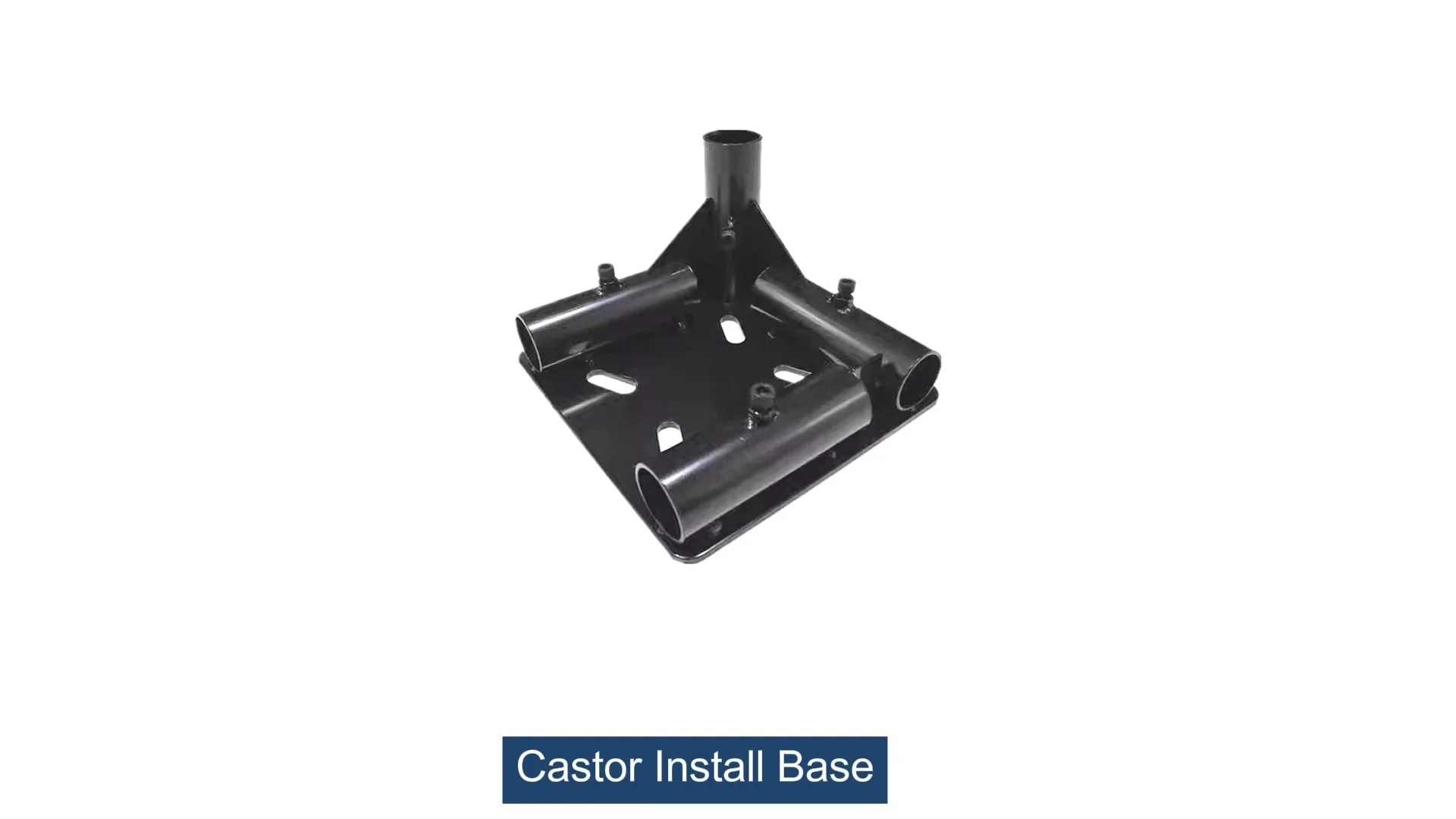
Castor Install Base
Castor install base, used for connection between pipe and castor, it can connect 4 pcs pipe by 1 pcs castor base, to make the structure strong and stable.
Walk into any busy warehouse, manufacturing plant, or workshop, and you'll notice a silent workhorse keeping operations moving: the humble castor install base. It's the unsung component that connects caster wheels to workbenches, trolleys, and material racks, ensuring everything from heavy machinery to delicate tools glides smoothly, stops securely, and stays stable. Yet, when it comes to choosing between premium and budget options, many businesses default to the lower price tag—only to discover later that "cheap" can cost far more in the long run. In this article, we'll dive deep into the true cost of castor install bases, weighing the upfront savings of budget models against the long-term benefits of premium ones. By the end, you'll understand why this small component deserves careful consideration—and how the right choice can boost productivity, reduce downtime, and protect your bottom line.
What Are Castor Install Bases, Anyway?
Before we compare premium and budget options, let's clarify what a castor install base actually does. Think of it as the "bridge" between a caster wheel and the equipment it supports. Whether you're outfitting a workbench, a turnover trolley, or a flow rack, the castor install base is the metal or plastic plate (and its accompanying hardware) that bolts the caster wheel to the equipment's frame. Its job is deceptively simple: distribute weight evenly, absorb shocks from uneven floors, and ensure the caster wheel operates smoothly without wobbling or detaching.
But here's the catch: not all bridges are built the same. A flimsy castor install base might work for a lightweight cart in a home garage, but in a industrial setting—where a single workbench could hold 500+ pounds of tools, or a trolley might be pushed 50 times a day—it's a different story. In these environments, the base's strength, durability, and compatibility with caster wheels and accessories can make or break your workflow.
Premium vs. Budget: The Key Differences That Matter
At first glance, premium and budget castor install bases might look similar—both have holes for bolts, a flat surface to mount the caster wheel, and a design that seems "good enough." But dig deeper, and the differences become stark. Let's break down the most critical factors:
1. Materials: Steel vs. Plastic (or "Cheap Steel")
Budget castor install bases are often made from thin, low-grade steel or even plastic. While plastic might seem lightweight and affordable, it warps under heat, cracks under heavy loads, and degrades quickly in humid or chemical-exposed environments. Low-grade steel, on the other hand, is prone to rust and bending—especially if it's not properly coated. Imagine a plastic base supporting a 300-pound workbench; over time, the mounting holes will stretch, the base will bow, and the caster wheel will start to wobble.
Premium bases, by contrast, use high-grade steel (often 3mm+ thick) or aluminum alloys. These materials are engineered to withstand heavy loads (500–1,000+ pounds, depending on the model) and resist corrosion. Many premium options also include powder-coating or zinc plating, which adds a protective layer against rust and scratches—critical for environments like food processing plants or outdoor warehouses where moisture is a constant threat.
2. Load Capacity: "It Says 200 Lbs… But Can It?"
Budget bases love to advertise "high load capacity," but those numbers are often misleading. A budget base might claim to handle 200 pounds, but that's usually under ideal conditions: perfectly flat floors, minimal movement, and no sudden stops. In reality, daily use—like slamming a trolley to a halt or navigating a slight incline—puts stress on the base that exceeds its rated capacity. Over time, this leads to bent plates, stripped bolts, or even the base tearing away from the equipment.
Premium bases, however, are tested rigorously. Manufacturers like to overengineer them, so a base rated for 500 pounds can often handle short bursts of 600–700 pounds without failing. This "safety margin" is crucial in busy settings where loads might accidentally exceed expectations—say, when an employee piles extra tools on a workbench or a trolley gets overstocked with materials.
3. Compatibility with Caster Wheels and Accessories
Here's a frustration many budget buyers face: the castor install base they bought doesn't fit their caster wheels or accessories. Budget bases often use non-standard hole patterns or flimsy mounting hardware, making it impossible to swap out caster wheels for heavier-duty ones or add features like brakes or locks later. For example, if you start with a budget base and later decide you need adjustable leveling feet to stabilize a wobbly workbench, you might find the base's threads are too weak to support the feet—or the holes don't align at all.
Premium bases, by contrast, are designed with versatility in mind. They use industry-standard hole spacing (like 4x4 inches or 5x5 inches) to fit most caster wheels, and their hardware (bolts, nuts, washers) is made from high-tensile steel that can handle upgrades. Want to add a brake to your caster wheel? No problem. Need to swap out a standard wheel for a larger one to navigate rough floors? The premium base will adapt.
4. Adjustability and Precision
Not all floors are created equal. A warehouse might have cracks, bumps, or uneven concrete, and a workbench that rocks back and forth is more than just annoying—it's a safety hazard. Budget bases rarely account for this; they're flat, rigid, and offer no way to adjust height or level the equipment.
Premium bases often include features like adjustable leveling feet built into the design. These small, threaded feet screw into the base and can be twisted up or down to compensate for uneven floors, ensuring the equipment stays stable. Some premium bases even have slotted holes, allowing for minor adjustments in caster wheel placement—so you can align wheels perfectly to prevent "tracking" issues (where a trolley veers to one side when pushed).

The True Cost-Benefit Breakdown: Premium vs. Budget
Now, let's get to the numbers. Let's say you're outfitting 10 workbenches for a small manufacturing line. A budget castor install base costs $15 per unit, while a premium one costs $50. Upfront, the budget option saves you $350 ($150 total vs. $500 total). But over time, that $350 savings could vanish—and then some. Let's break it down by category:
1. Initial Cost vs. Replacement Costs
Budget bases are cheap upfront, but they don't last. In a busy workshop, a budget base might fail in 6–12 months (think: bent plates, stripped bolts, or rusted hardware). Replacing one base costs $15, but if you have to replace 5 out of 10 bases in a year, that's $75—plus the labor cost of taking the workbench apart and reinstalling the new base (let's say $20 per hour, and each replacement takes 30 minutes: $10 per base, totaling $50). So after one year, your "$150" budget bases have cost you $150 + $75 + $50 = $275.
Premium bases, on the other hand, last 5–7 years with minimal maintenance. Even if you factor in inflation or a price increase, replacing a premium base every 5 years would cost $50 every 5 years, or $10 per year. Labor? Maybe $10 per base every 5 years, so $2 per year. For 10 bases, that's $100 + $20 = $120 over 5 years, or $24 per year. Compare that to the budget option's $275 per year, and the premium base is already cheaper after the first year.
2. Downtime: The Hidden Cost of Budget Bases
Downtime is the silent killer of productivity. When a budget castor install base fails, the equipment it's attached to becomes unusable. A workbench with a wobbly base can't be used safely, so employees have to stop working while it's fixed. A trolley with a broken base might get stuck in the middle of the floor, blocking other workers or delaying material deliveries.
Let's quantify this. Suppose a failed base on a workbench causes 2 hours of downtime (1 hour to diagnose the problem, 1 hour to replace the base). If the employees using that workbench earn $25 per hour, that's $50 in lost wages per incident. If you have 5 base failures in a year (as in the earlier example), that's 5 x $50 = $250 in downtime costs alone. Add that to the $275 in replacement and labor costs, and your "cheap" bases now cost $525 per year—more than triple the upfront cost of premium bases ($500 for 10 bases) in just 12 months.
Premium bases rarely cause downtime. Even if one does fail (which is rare), many manufacturers offer warranties (1–5 years) that cover replacement parts or labor. So instead of losing $50 per incident, you might pay nothing—and the failure is so infrequent that downtime is negligible.
3. Safety Risks and Legal Costs
A failed castor install base isn't just an inconvenience—it's a safety hazard. A workbench that tips over can injure employees or damage expensive equipment. A trolley that suddenly veers off course can crash into other workers or products. In the worst cases, these accidents can lead to workers' compensation claims, OSHA fines, or even lawsuits.
Budget bases are more likely to cause these issues. Their weak materials and poor load capacity make them prone to sudden failure, especially under stress. For example, a budget base on a heavy trolley might snap while being pushed, causing the trolley to tip and spill its contents. If an employee is hit by falling materials, the medical bills, lost workdays, and potential legal fees could easily reach $10,000 or more—far exceeding any savings from budget bases.
Premium bases, with their robust materials and safety margins, drastically reduce this risk. They're designed to fail slowly (e.g., bending gradually instead of snapping) if overloaded, giving employees time to notice and address the issue before an accident occurs. This peace of mind is priceless.
| Factor | Budget Castor Install Bases | Premium Castor Install Bases |
|---|---|---|
| Upfront Cost (10 bases) | $150–$300 | $500–$800 |
| Annual Replacement/Labor Costs | $200–$300 | $20–$50 (over 5 years) |
| Annual Downtime Costs | $200–$500 | Negligible ($0–$50) |
| Safety/Legal Risk | High (potential $10k+ in claims) | Low (warranties and robust design) |
| Lifespan | 6–12 months | 5–7 years |

Real-World Examples: When Budget Bases Failed (and Premium Ones Saved the Day)
To make this tangible, let's look at two scenarios: a small electronics workshop that chose budget bases, and a large automotive plant that invested in premium ones.
Scenario 1: The Small Workshop That Regretted Cutting Corners
A 10-person electronics workshop in Texas needed 8 new workbenches for assembling circuit boards. To save money, they bought budget castor install bases ($18 each) and paired them with basic caster wheels. The upfront cost was $144 for bases, plus $80 for wheels—a total of $224. For the first 6 months, everything seemed fine.
Then, problems started. One workbench began wobbling, so the team tightened the bolts—but the base's threads stripped, making it impossible to fix. They replaced the base ($18) and lost an hour of downtime. A month later, another base bent after a technician accidentally leaned on the workbench, causing tools to crash to the floor (no injuries, but $300 in damaged equipment). By month 10, 5 of the 8 bases had failed, costing $90 in replacements, $200 in downtime, and $300 in damaged tools—total $590, more than double the upfront cost of premium bases.
Finally, the workshop switched to premium bases ($55 each) and hasn't had a failure in 3 years. "We thought we were saving money," the shop manager later said, "but we ended up paying more in repairs and stress than if we'd just bought the good ones upfront."
Scenario 2: The Automotive Plant That Invested in Quality
A large automotive plant in Michigan needed 50 material trolleys to move parts between assembly lines. They chose premium castor install bases ($60 each) with heavy-duty caster wheels and adjustable leveling feet—a total of $3,000 for bases. At the time, some managers pushed for budget bases ($25 each, totaling $1,250) to save $1,750 upfront.
But the plant's operations director argued for premium, citing TCO. "If even 10% of the budget bases fail in a year, the downtime and replacement costs will eat up the savings," he said. Three years later, the data proved him right: only 2 of the 50 premium bases had needed minor repairs (loose bolts, easily fixed), and there had been zero downtime or accidents. The plant estimated it had saved $50,000+ in avoided downtime, repairs, and safety incidents—far more than the $1,750 upfront savings of budget bases.

How to Choose: When to Splurge on Premium (and When Budget Might Work)
Not every business needs premium castor install bases. If you're outfitting a lightweight cart for a home garage or a workbench that's rarely moved and holds minimal weight (under 100 pounds), a budget base might suffice. But for most industrial, commercial, or high-use settings, premium is the smarter choice.
Here's a quick checklist to decide:
- Load capacity: If the equipment holds more than 200 pounds, go premium.
- Usage frequency: If the equipment is moved daily (or more), go premium.
- Environment: If the area is humid, dusty, or has uneven floors, go premium (for corrosion resistance and adjustability).
- Safety criticality: If failure could injure employees or damage expensive equipment, go premium.
- Long-term use: If you plan to keep the equipment for 2+ years, premium will save you money.
If you're still unsure, talk to a reputable supplier. A good lean pipe supplier or material handling expert can assess your needs and recommend the right base for your specific use case—often providing samples or trial periods to test durability.
The Bottom Line: Premium Castor Install Bases Are an Investment, Not a Cost
At first glance, budget castor install bases seem like a smart way to save money. But when you factor in replacement costs, downtime, safety risks, and lost productivity, they're almost always a false economy. Premium bases, with their robust materials, high load capacity, and long lifespans, might cost more upfront—but they pay for themselves quickly, often within a year.
Remember: every time a workbench glides smoothly, a trolley stops securely, or an employee avoids injury, you have the castor install base to thank. Investing in quality here isn't just about equipment—it's about investing in your team's efficiency, safety, and peace of mind. And in business, that's never a bad investment.