- Company Articles
- Products and Technology
- Product knowledge
- Cost-Benefit Analysis: Investing in Quality Lean Pipe Clamps

Cost-Benefit Analysis: Investing in Quality Lean Pipe Clamps
Related Product
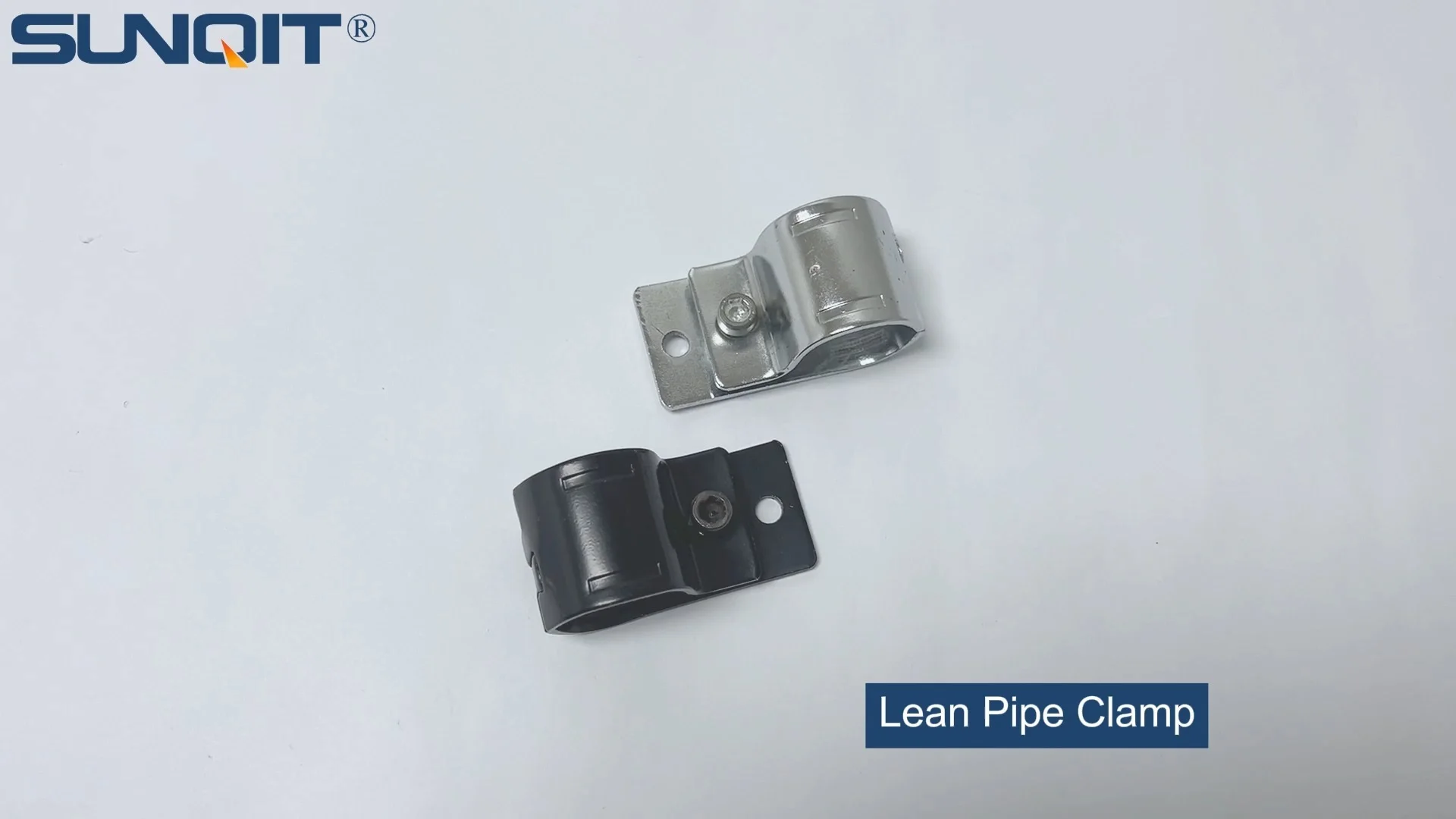
Lean Pipe Clamp
Lean pipe clamp is used for rack system hang monitor or other panel for workbenck, flowrack in production daily use.
Why Skimping on Small Components Costs Big in the Long Run
The Hidden Backbone of Lean Manufacturing
Walk into any modern manufacturing facility, and you'll likely spot rows of sleek workbenches, material racks, and assembly lines humming with efficiency. What you might not notice—unless you're really looking—is the unsung hero holding it all together: the lean pipe clamp. These small, unassuming components are the glue of lean systems, connecting aluminum lean pipes, supporting roller tracks, and ensuring that everything from workbenches to turnover trolleys stays stable, secure, and ready for action.
But here's the thing: not all lean pipe clamps are created equal. In the rush to cut costs, many businesses opt for the cheapest options on the market—thin metal, flimsy plastic, or poorly machined joints. What they don't realize is that these "budget-friendly" choices often end up costing far more in downtime, repairs, and lost productivity than a slightly pricier, high-quality alternative. Today, we're breaking down the true cost of choosing quality over quick savings when it comes to lean pipe clamps.
What Even Is a Lean Pipe Clamp, Anyway?
Before we dive into the numbers, let's make sure we're on the same page. Lean pipe clamps—also called lean pipe joints—are the connectors that hold lean pipes (often aluminum lean pipe or stainless steel pipe series) together. Think of them as the building blocks of your facility's infrastructure: they're what let you assemble a custom lean pipe workbench one day, a flow rack the next, and a mobile turnover trolley the week after. Without reliable clamps, those structures become wobbly, unsafe, and prone to collapse.
These clamps come in all shapes and sizes: 90-degree joints for corners, parallel joints for straight runs, swivel joints for adjustable angles, and even specialized connectors for roller track systems. They're designed to be modular—so you can reconfigure your setup as your needs change—but that modularity only works if the clamps themselves are strong enough to handle repeated use, heavy loads, and the daily wear and tear of a busy factory floor.
Fun fact: A single lean pipe workbench might use 10-15 clamps, while a large material rack could require 50 or more. Multiply that by dozens of workstations, and suddenly those "small" components add up—both in cost and importance.

The False Economy of "Cheap" Clamps
Let's say you're setting up a new assembly line. You need 20 lean pipe workbenches, each requiring 12 clamps. A quick search shows you two options: a budget clamp for $3 each, or a premium clamp for $8 each. At first glance, the math seems obvious: $3 x 240 clamps = $720, versus $8 x 240 = $1,920. Why spend an extra $1,200?
Here's why: that $3 clamp is made of low-grade steel with a weak weld and a plastic locking mechanism that cracks under pressure. Six months in, you start noticing problems. A workbench leg wobbles because a clamp has loosened. A flow rack shelf sags because the parallel joints can't support the weight of materials. A worker trips over a loose caster wheel (connected via a failed clamp), leading to a minor injury and a day of lost productivity. You start replacing clamps one by one—at $3 each, but now you're paying for labor to take apart the workstation, install the new clamp, and test it. Then, six months later, the same thing happens again.
Meanwhile, the factory down the street invested in the $8 clamps. Their workbenches are still rock-solid. Their flow racks haven't sagged. Their workers haven't missed a day due to clamp-related accidents. They've never had to stop production to replace a failed joint. Which factory do you think is more profitable?

The Cost-Benefit Breakdown: Quality vs. Cheap Clamps
To truly understand the impact, let's crunch the numbers over a 5-year period. We'll compare two scenarios: using budget clamps (BC) vs. quality clamps (QC) for a set of 20 workbenches (240 clamps total).
| Factor | Budget Clamps (BC) | Quality Clamps (QC) |
|---|---|---|
| Initial Cost (240 clamps) | $3 x 240 = $720 | $8 x 240 = $1,920 |
| Expected Lifespan | 6-8 months | 5+ years |
| Number of Replacements (5 years) | 7 replacements (every 8 months) | 0 replacements |
| Replacement Cost (Parts + Labor) | $720 (parts) + $250/year (labor) x 5 = $1,970 | $0 |
| Downtime Costs (due to clamp failure) | 5 incidents/year x $500/incident = $2,500 | 0 incidents |
| Safety Incidents (potential fines, medical costs) | 2 incidents x $1,000 = $2,000 | 0 incidents |
| Productivity Loss (slowdowns from wobbly workstations) | $500/year x 5 = $2,500 | $0 |
| Total 5-Year Cost | $720 + $1,970 + $2,500 + $2,000 + $2,500 = $9,690 | $1,920 |
Over five years, the "cheap" clamps end up costing five times more than the quality ones. That's not a typo. The initial $1,200 savings balloon into nearly $10,000 in hidden costs.

The Hidden Benefits of Quality Clamps
Beyond the hard numbers, there are softer—but equally important—benefits to investing in quality clamps. Let's talk about what your team won't experience when you choose better components:
1. Less frustration, more focus. Imagine a worker trying to assemble a product on a wobbly workbench. Every time they lean on it, it shifts. They have to stop, adjust the clamp, and start over. Over a day, that's 10-15 minutes of lost focus per worker. Multiply by 50 workers, and you're losing 500+ minutes of productivity weekly—all because of loose clamps.
2. Improved safety culture. When workers see that management invests in quality tools and infrastructure, it sends a message: "We care about your well-being." That boost in morale translates to lower turnover, higher engagement, and fewer accidents—because employees feel valued and are more likely to follow safety protocols.
3. Flexibility to adapt. Quality clamps are designed to be reused. If you need to reconfigure a workbench to fit a new product line, you can take it apart, move the clamps, and rebuild—without worrying about them breaking in the process. Cheap clamps, on the other hand, often crack or strip when you try to disassemble them, making reconfiguration more expensive than building new.
4. Better relationships with suppliers. Reputable lean pipe suppliers don't just sell clamps—they offer expertise. They'll help you choose the right joint for your needs (e.g., a swivel joint for a mobile trolley vs. a fixed joint for a stationary workbench), provide after-sales support, and even help you troubleshoot issues. Budget suppliers? They're gone once the sale is made.
Real-World Example: How One Factory Turned It Around
Let's look at a real story (names changed for privacy). ABC Electronics, a mid-sized manufacturer, was struggling with constant downtime. Their assembly line workbenches—held together with budget clamps—were always wobbling, and their flow racks kept jamming because the roller track connectors (another type of clamp) would slip. Workers were frustrated, and production targets were consistently missed.
After a particularly bad week—two workbenches collapsed, injuring a worker and halting production for 8 hours—ABC's operations manager decided to switch to premium clamps from a trusted lean pipe supplier. The initial cost was painful: $4,500 for new clamps and labor to replace them. But within three months, the results spoke for themselves:
- Downtime dropped by 70% (no more stopping to fix loose clamps).
- Worker complaints about workstation stability vanished.
- Production increased by 12% because employees could focus on their tasks, not adjusting their workbenches.
- The company avoided a $15,000 OSHA fine after an inspection—inspectors noted the improved workstation safety.
"We thought we were saving money by buying cheap clamps," the operations manager later said. "Turns out, we were just borrowing trouble—and paying interest on it."
How to Choose the Right Clamps (and Supplier)
So, you're convinced: quality clamps are worth the investment. Now what? Here's how to make sure you're getting the best bang for your buck:
1. Check the material. Look for clamps made from high-grade steel (preferably with a zinc or nickel plating to resist corrosion) or aluminum alloy for lightweight applications. Avoid clamps with plastic components in stress points—they'll crack under pressure.
2. Test the locking mechanism. A good clamp should lock securely and stay locked, even after repeated adjustments. Ask your supplier for a sample, and try twisting or pulling it—if it loosens easily, keep looking.
3. Look for certifications. Reputable manufacturers will have ISO 9001 certification (quality management) or even OSHA compliance for safety. These aren't just pieces of paper—they mean the clamps have been tested to meet strict standards.
4. Choose a supplier who understands lean. The best lean pipe suppliers don't just sell parts—they understand lean manufacturing principles. They'll ask about your workflow, your load requirements, and your future plans, then recommend the right clamps (and pipes, and accessories) for the job. For example, if you need a workbench that can hold 500 lbs, they'll suggest heavy-duty parallel joints instead of standard ones.
5. Don't forget the accessories. A clamp is only as good as the pipe and accessories it's paired with. Make sure your supplier offers compatible aluminum lean pipe, roller track and accessories, and caster wheels—mismatched parts can lead to premature failure, even with quality clamps.
The Bottom Line: Invest in What Holds You Up
Lean manufacturing is all about eliminating waste—waste of time, waste of materials, waste of effort. But skimping on lean pipe clamps is the ultimate form of waste: it creates more problems than it solves, costs more in the long run, and puts your team at risk.
Quality clamps aren't an expense—they're an investment in your team's productivity, your facility's safety, and your company's bottom line. They're the quiet foundation that lets your business grow, adapt, and thrive. So the next time you're tempted by that $3 clamp, remember: the strongest buildings are only as strong as their bricks—and the strongest factories are only as strong as their clamps.
Final thought: You wouldn't build a house with cheap nails. Why build your business with cheap clamps?