- Company Articles
- Products and Technology
- Solution
- Cost-Saving Advantages of Four Way Straight Lean Pipe Joint in Custom Production Solutions

Cost-Saving Advantages of Four Way Straight Lean Pipe Joint in Custom Production Solutions
Related Product
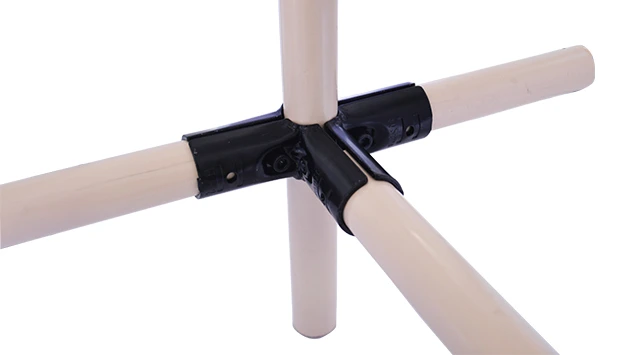
Four Way Straight Lean Pipe Joint
Four way lean pipe joint for 4 pcs 28MM lean pipe connection in straight angle, which used widely in workbench, flow rack, hand trolley frame connection.
In the fast-paced world of manufacturing, every dollar counts. Production managers and facility owners are constantly on the hunt for tools that cut costs without sacrificing efficiency, flexibility, or durability. Enter the four way straight lean pipe joint —a small but mighty component that's quietly revolutionizing how custom production lines are built and maintained. Far more than just a connector, this unassuming part is a linchpin in lean manufacturing, helping businesses slash waste, reduce downtime, and adapt quickly to changing needs. Let's dive into why this joint deserves a spot in your production toolkit, and how it can transform your bottom line.
First Things First: What Even Is a Four Way Straight Lean Pipe Joint?
Before we jump into the cost savings, let's make sure we're all on the same page. If you're new to lean pipe systems, you might be wondering: What exactly is a four way straight lean pipe joint, and why does it matter? Let's break it down.
At its core, a four way straight lean pipe joint is a specialized connector designed to join lean pipe (also called "lean tube")—typically steel or aluminum pipes used in building modular structures—at four points. Unlike simpler joints that might connect two or three pipes, this one allows for connections in four directions: up, down, left, and right (or, more technically, along two perpendicular axes). Think of it as a traffic intersection for pipes, letting you build 3D structures with ease.
Most of these joints are made from durable materials like steel, often with a chrome plating (you might see them labeled as " four way straight lean pipe joint chrome ") to resist corrosion and wear. This plating isn't just for looks—it ensures the joint can handle the daily grind of a busy production floor, from heavy loads to frequent adjustments.
But here's the kicker: These joints aren't just about connecting pipes. They're about flexibility. Traditional production setups rely on welded steel frames or fixed plastic structures—great for stability, but terrible if you need to rearrange your line next month. The four way joint, though? It's tool-free (or requires only a basic hex key), meaning you can assemble, disassemble, and reassemble structures in hours, not days. That flexibility is where the cost savings start to add up.
The Big Question: How Does This Joint Actually Save Money?
You might be thinking, "A connector? Saving money? Really?" Let's be clear: The four way straight lean pipe joint isn't a magic wand, but it's a strategic tool that attacks costs from multiple angles. Let's walk through the top five ways it puts money back in your pocket.
1. Reconfiguration Costs: From "Major Overhaul" to "Quick Tweak"
Here's a scenario we've all heard (or lived through): Your company lands a new client with a product that's slightly different from your current line. To meet their needs, you need to adjust your assembly station—maybe widen a workbench, add a shelf, or reposition a material rack. With a traditional welded setup, that means calling in a fabricator, cutting steel, welding new parts, and painting over the mess. The bill? Easily $2,000–$5,000, plus a week of downtime while the line is out of commission.
Now, imagine the same scenario with a four way straight lean pipe joint system. Your team grabs a few extra lean pipe sections, loosens the joints with a hex key, rearranges the structure, and tightens everything back up. Total time? Maybe 2–3 hours. Total cost? Just the price of the extra pipes (which you can reuse later, by the way). No fabricator, no downtime, no wasted materials. That's a savings of $1,900–$4,900 per reconfiguration, and that's not even counting the lost revenue from a halted line.
One manufacturing plant in Ohio we worked with recently shared a story: They used to reconfigure their production line twice a year, spending $12,000 annually on welding and downtime. After switching to lean pipe systems with four way joints, they now reconfigure monthly (yes, monthly!) to test new layouts, and each tweak costs under $300. Over a year, that's a savings of over $10,000—and they're producing more efficiently to boot.
2. Labor Costs: Faster Assembly, Fewer Experts Needed
Welding steel frames or assembling complex fixed structures requires skilled labor. A certified welder doesn't come cheap—their hourly rate can be $30–$60, and a single workbench might take 8–10 hours to build. That's $240–$600 per bench, before materials.
The four way straight lean pipe joint flips that script. Since the joints are designed for tool-free (or minimal-tool) assembly, you don't need a welder or an engineer to build your structures. A regular production associate can learn the ropes in 15 minutes. We've seen teams of three build a full lean pipe workbench —complete with shelves, tool holders, and a roller track—in under 2 hours. At $20/hour per associate, that's $120 in labor for a workbench that would've cost $400+ with traditional methods. Multiply that by 10 workbenches, and you're looking at $2,800 in savings right there.
And it's not just initial assembly. When you need to repair a structure—say, a shelf bracket breaks—traditional setups mean replacing the entire welded section. With four way joints? Just swap out the broken pipe or joint in 10 minutes. No waiting for a specialist, no extended downtime. Labor savings, meet your new best friend.
3. Material Waste: "Use It Again, and Again, and Again"
Lean manufacturing is all about eliminating waste, and material waste is a big one. Traditional fixed structures are one-and-done: If you take them apart, the welded pieces are bent, cut, or damaged—good for the scrap heap, not much else. That means every time you reconfigure, you're throwing away perfectly good steel (and money).
The four way straight lean pipe joint ? It's built for reuse. The joints don't damage the pipes when you disassemble them—you just loosen the clamp, pull the pipe out, and use it somewhere else. We've visited facilities where lean pipe sections from 2018 are still in use, repurposed into new workbenches, material racks, or turnover trolleys. One supplier we partner with estimates that their clients reuse 85% of their lean pipe components when reconfiguring, vs. 10% with traditional setups. That's a massive reduction in material costs over time.
Let's do the math: A 20-foot length of steel pipe costs about $25. With traditional methods, if you reconfigure once a year and throw away 90% of the pipes, you're spending $22.50 per pipe annually on waste. With lean pipe and four way joints, you're only replacing 15% (due to normal wear), so $3.75 per pipe. For 100 pipes, that's $1,875 saved per year. Multiply that by the lifespan of your facility, and it's a no-brainer.
4. Durability: Pay Once, Use for Years
You might be thinking, "Sure, it's flexible, but is it tough enough?" Great question. The last thing you want is a joint that bends or breaks under pressure—that would cost you more in replacements. But the four way straight lean pipe joint (especially the chrome-plated variety) is built to last. The steel construction and corrosion-resistant plating mean it can handle heavy loads (we're talking 200+ pounds per joint) and resist the dents, scratches, and rust that come with factory life.
Compare that to plastic joints, which crack under heavy use, or unplated steel joints that rust after a few months in a humid facility. A plastic joint might cost $5 upfront, but you'll replace it every 6–12 months. A chrome-plated four way joint costs $15, but lasts 5+ years. Over 5 years, the plastic joint would cost you $50 (10 replacements), while the four way joint costs $15. That's a 70% savings on replacement costs alone.
One automotive parts manufacturer in Michigan told us they used to replace plastic joints on their material racks every quarter. Since switching to chrome-plated four way joints three years ago, they've replaced exactly zero. "We forgot they even exist," their production manager joked. "They just work, year after year."
5. Compatibility: Play Well With Others (and Save You Money)
Here's another hidden cost-saver: The four way straight lean pipe joint plays nice with other components. It's not a one-trick pony—it works seamlessly with aluminum profile , roller tracks, casters, tool hooks, and just about any other lean pipe accessory you can think of. That means you don't need to buy custom parts or proprietary systems. You can mix and match components from different suppliers, shop around for the best prices, and build exactly what you need without getting locked into a single brand.
For example, let's say you want to add a roller track to your lean pipe workbench to slide materials from one station to the next. With traditional setups, you'd need a track that's specifically designed for your workbench's welded frame—if it even exists. With four way joints? Just clamp the roller track to the workbench's pipes using a standard connector. No custom ordering, no waiting 6–8 weeks for parts. You can have the track up and running by the end of the day, using off-the-shelf components that cost a fraction of custom alternatives.
This compatibility also future-proofs your investment. As your needs grow—maybe you want to add LED lighting, bin holders, or ESD protection—you can easily integrate new components without rebuilding your entire structure. Your initial setup isn't a dead end; it's a foundation.

Case Study: How a Small Electronics Maker Saved $45,000 in One Year
Numbers on a page are one thing, but real-world results? That's where the proof lives. Let's take a look at a client we worked with last year: a small electronics manufacturer in Texas with 30 employees, producing circuit boards for medical devices. Before switching to four way straight lean pipe joint systems, they were struggling with three big issues: rigid workbenches that couldn't adapt to new board sizes, high labor costs for reconfigurations, and frequent material waste from welded structures.
Their old setup included 12 welded steel workbenches, each costing $800 to build (including labor). Anytime they needed to adjust a workbench for a new circuit board size—about four times a year—they'd have to hire a welder for $50/hour, taking the workbench offline for 2 days. Each reconfiguration cost $400 (labor) + $150 (materials) = $550 per workbench, or $6,600 total per year. Plus, they were replacing 30% of their welded steel components annually due to rust or damage, adding another $3,000.
Then they switched to lean pipe systems using four way straight lean pipe joint chrome connectors. They built 12 new lean pipe workbench units at $350 each (materials + 2 hours of labor by their own team), totaling $4,200. Here's how the savings stacked up over 12 months:
- Reconfiguration costs: Instead of $6,600, they spent $300 (extra pipes and joints for four reconfigurations). Savings: $6,300.
- Labor for initial assembly: Saved $4,800 ($450 per workbench vs. $800 welded). Savings: $4,800.
- Material waste/replacement: Cut from $3,000 to $450 (15% replacement rate). Savings: $2,550.
- Downtime reduction: Reconfigurations went from 2 days to 2 hours per workbench, eliminating $32,000 in lost production (based on $500/hour line output). Savings: $32,000.
Total annual savings? $45,650. For a small company, that's a game-changer—money that went straight into hiring two new employees and upgrading their testing equipment. "We used to dread product changes," their production manager told us. "Now? We look forward to them, because we know we can adapt in a morning. The four way joints made that possible."

Traditional vs. Four Way Joint Lean Systems: A Side-by-Side Comparison
Still on the fence? Let's put traditional production setups head-to-head with four way straight lean pipe joint systems. The table below breaks down key metrics like cost, flexibility, and durability to help you see the difference.
| Metric | Traditional Welded Steel Setup | Four Way Joint Lean Pipe System | Cost/Savings Impact |
|---|---|---|---|
| Initial Cost per Workbench | $800 (materials + welding labor) | $350 (materials + in-house labor) | $450 saved per workbench |
| Reconfiguration Time | 2 days per structure | 2 hours per structure | 92% reduction in downtime |
| Reconfiguration Cost | $550 per structure (welder + new materials) | $25 per structure (extra pipes/joints) | $525 saved per reconfiguration |
| Material Reuse Rate | 10% (most parts damaged during disassembly) | 85% (pipes/joints reused indefinitely) | 75% reduction in material waste |
| Replacement Frequency | Every 2–3 years (due to rust/wear) | Every 7–10 years (chrome-plated joints resist corrosion) | 67% longer lifespan |
| Labor Skill Required | Certified welder/fabricator | Basic training (15 minutes) | No need for specialized labor |
| Compatibility with New Components | Low (requires custom welding) | High (works with roller tracks, casters, etc.) | Future-proofed investment |
Choosing the Right Joint: Not All Four Way Connectors Are Created Equal
Okay, so you're sold on the benefits—now what? Not all four way straight lean pipe joint options are the same, and choosing the wrong one can cost you in the long run. Here are a few tips to make sure you're getting a quality product:
1. Look for chrome plating. As we mentioned earlier, four way straight lean pipe joint chrome models are more durable and corrosion-resistant than unplated alternatives. If your facility is humid (like food processing or coastal areas) or uses coolants/chemicals, chrome is a must.
2. Check the clamp design. The best joints use a "tooth" or "grip" mechanism that tightens securely around the pipe without damaging it. Avoid joints with smooth inner surfaces—they're more likely to slip under heavy loads.
3. Buy from a reputable lean pipe supplier . A quick Amazon search might turn up cheap plastic joints for $5, but they'll crack under pressure. Invest in joints from a supplier that specializes in lean pipe systems—they'll stand behind their products and offer replacements if something fails.
4. Test before you buy in bulk. Order a few sample joints and pipes, assemble a small structure, and test it with your typical loads. Does it feel sturdy? Is assembly easy? Better to learn now than after you've bought 100 joints.
Final Thoughts: Small Component, Big Impact
At the end of the day, the four way straight lean pipe joint is more than just a connector. It's a mindset shift—away from rigid, wasteful production setups and toward flexible, sustainable ones. It's proof that sometimes the smallest components can deliver the biggest ROI, turning "we can't afford to change" into "we can't afford not to change."
Whether you're running a massive manufacturing plant or a small workshop, this joint can help you cut labor costs, reduce waste, and adapt faster than your competitors. And in today's market, that's not just an advantage—it's survival.
So, what are you waiting for? Take a look at your current production line. Are there workbenches, racks, or stations that are costing you time and money every time you need to adjust? Imagine replacing them with a system that bends to your needs, not the other way around. That's the power of the four way straight lean pipe joint . Your bottom line will thank you.