- Company Articles
- Products and Technology
- Solution
- Custom 3060 National Standard Profile A Solutions for Precision Machinery Manufacturing

Custom 3060 National Standard Profile A Solutions for Precision Machinery Manufacturing
Related Product
3060 National Standard Profile A
Workbench, production line, logistic rack, warehouse rack Industry: Manufacturer workshop, Automobile, Electronic, Assembling, logistic
How modular aluminum profiles are transforming efficiency, flexibility, and adaptability on the factory floor
Picture this: It's 8 AM on a Monday at a precision machinery plant outside Chicago. The air hums with the low whir of CNC machines, and operators in blue coveralls move with focused urgency. Over in the assembly area, a technician pauses, frowning, as they struggle to fit a delicate gear component onto a workbench that's just an inch too low. Nearby, a flow rack creaks under the weight of misaligned parts bins, and a supervisor sighs—this is the third time this week a part has gotten scratched because the rack's fixed rails can't adjust to the new, smaller component size.
Sound familiar? For anyone in precision machinery manufacturing, the balance between rigid precision and dynamic adaptability is a constant dance. Parts get smaller, tolerances tighter, production runs shorter, and suddenly, the "one-size-fits-all" equipment that worked last year feels like a ball and chain. That's where 3060 National Standard Profile A comes in—not just as a material, but as a catalyst for change. When paired with the right aluminum profile accessories , this modular aluminum solution is redefining how factories build workbenches, flow racks, and entire lean systems that grow with their needs.
What Exactly Is 3060 National Standard Profile A?
Let's start with the basics. If you've ever walked through a modern factory, you've probably seen aluminum profiles—those sleek, T-slotted beams holding up workbenches, framing conveyor systems, or forming the backbone of material racks. But not all profiles are created equal. The 3060 National Standard Profile A stands out for a reason.
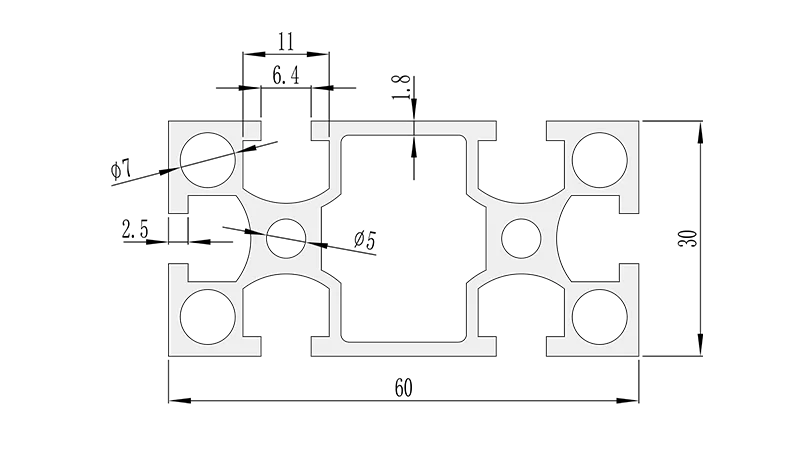
First, the numbers: 30mm by 60mm. That's the cross-sectional dimension, and it's no accident. This size strikes a sweet spot between strength and versatility. It's sturdy enough to support heavy machinery parts (we're talking up to 500kg per linear meter, depending on the setup) but lightweight enough that even a two-person team can reconfigure a workbench in an afternoon. Made from high-grade aluminum alloy (typically 6063-T5), it resists corrosion, won't rust, and holds up to the daily wear of a busy production floor—think oil spills, tool impacts, and constant part movement.
But the real magic is in the design. Like most industrial aluminum profiles, 3060 Profile A features T-slots—longitudinal grooves running the length of the beam. These slots aren't just for show; they're the reason this profile is "modular." Slide a T-slot nut into the groove, bolt on an accessory, and you've got a secure connection—no drilling, no welding, no permanent modifications. Need to move a shelf up by 10cm? Loosen the bolts, adjust, retighten. Done. That's the flexibility precision manufacturers crave.
And "National Standard"? That's your guarantee of consistency. Unlike generic profiles, 3060 Profile A adheres to strict national manufacturing standards, meaning dimensions, slot tolerances, and material composition are uniform across suppliers. When you order a 3060 Profile A from a reputable lean system supplier , you know it will fit with accessories from the same (or even compatible) lines—no guessing if that bracket will slide into the slot or if the hole spacing matches.
Why Precision Manufacturing Can't Settle for "Off-the-Shelf"
Here's the thing about precision machinery: It's… well, precise. We're talking tolerances as tight as ±0.01mm, parts that cost thousands of dollars, and workflows that change with each new order. A medical device manufacturer assembling pacemaker components has different needs than an aerospace shop building turbine blades. And neither can afford to work around equipment that wasn't built for their specific process.
Take workbenches, for example. A standard, fixed-height workbench might work for a warehouse packing station, but in precision assembly, operators need to adjust heights to match their ergonomics (no one wants repetitive strain injuries from hunching over a bench that's 2 inches too low). They might need integrated tool holders for calipers and torque wrenches, ESD (electrostatic discharge) mats to protect sensitive electronics, or even built-in LED lighting to illuminate tiny components. A generic bench can't check all those boxes.
Then there's material flow. In a lean manufacturing setup, parts should move smoothly from one station to the next—no bottlenecks, no damage, no wasted steps. A standard flow rack with fixed roller tracks might work for boxes of the same size, but what if your next order requires smaller, lighter parts that need gentler handling? Or larger, heavier components that need sturdier rails? Rigid systems force you to adapt your process to the equipment, instead of the other way around.
That's where custom 3060 Profile A solutions shine. By starting with a modular base, you design equipment around your workflow, not the other way around. Need a workbench with a tilting top for inspecting curved parts? Add hinges and gas springs via T-slot connections. Want a flow rack that can switch from 3 levels to 5 levels depending on the order? Swap out the cross beams and reposition the roller tracks. It's manufacturing equipment that thinks on its feet—just like your team.
Building the Future: Custom Solutions with 3060 Profile A
Let's dive into the real-world applications. How exactly do manufacturers use 3060 Profile A and aluminum profile accessories to build custom setups? Let's break down three game-changers: workbenches, flow racks, and lean assembly systems.
1. Workbenches: Where Precision Meets Ergonomics
The workbench is the heart of any assembly station. It's where operators spend 8+ hours a day, where parts are measured, assembled, and inspected. A poorly designed bench isn't just uncomfortable—it's a productivity killer.
With 3060 Profile A, the possibilities are endless. Start with the frame: 30x60mm beams form the legs and undercarriage, connected by corner brackets (a must-have aluminum profile accessory). Need adjustable height? Swap fixed legs for telescoping ones with locking pins—operators can tweak the bench from 750mm to 950mm in minutes. Add a wooden or aluminum honeycomb top (both compatible with T-slot mounting) for a stable surface, then bolt on accessories:
- Tool rails: Mounted along the back, these hold hanging tools, cable management clips, or even small parts bins.
- LED light bars: Attached to the overhead frame, they cast shadow-free light on the workspace—critical for inspecting micro-components.
- ESD grounding kits: For electronics manufacturing, conductive T-slots and grounding straps prevent static electricity from frying sensitive parts.
- Adjustable shelves: Positioned under the top, these store manuals, spare tools, or (WIP) without cluttering the workspace.
One manufacturer we worked with—a maker of precision gears for robotics—recently swapped their old wooden benches for 3060 Profile A setups. They added tilting tops (30° angle) to reduce neck strain when inspecting gear teeth, and integrated magnifying glass arms for quality checks. Within a month, operator-reported fatigue dropped by 30%, and rework due to eye strain fell by 15%. Small changes, big impact.
2. Flow Racks: Keeping Parts Moving (and Intact)
In lean manufacturing, "flow" is everything. Parts should glide from receiving to assembly to shipping with minimal handling. Flow racks—those gravity-fed systems where bins slide forward as the front one is emptied—are a cornerstone of this process. But standard racks often fall short.
Custom 3060 Profile A flow racks solve this by letting you tailor every detail: the angle of the roller tracks (steeper for heavy parts, gentler for light ones), the spacing between rollers (to prevent small parts from slipping through), and even the materials (plastic rollers for scratch-sensitive parts, steel for heavy loads). Let's say you're producing both metal brackets (heavy, durable) and plastic components (light, prone to scuffs). With a modular rack, you can have one section with steel roller tracks (from keywords: 40 steel roller track ) for the brackets and another with plastic yellow guide rails (from keywords: plastic roller track guide rail yellow ) for the plastic parts—all in the same unit.
We recently helped a client in the automotive parts industry build a flow rack that adapts to seasonal demand. In Q4, when they're swamped with orders, they add two extra levels using 3060 cross beams and extra roller track placon mounts (those handy brackets that secure tracks to profiles). In slower months, they remove the levels and use the space for storage. No more wasted floor space, no more overcrowded racks—just a system that scales with their business.
3. Lean Systems: From Benches to Assembly Lines
Take modularity up a notch, and 3060 Profile A becomes the backbone of entire lean assembly lines. Imagine a production cell where workbenches, conveyors, and material racks are all connected via T-slotted profiles, allowing you to reconfigure the layout in a day. Need to add a new testing station? Wheel in a 3060-framed cart (fitted with caster wheels from your aluminum profile accessories kit) and bolt it into place. Want to shorten the line for a smaller batch? Unbolt the sections and rearrange—no welding, no heavy machinery, no downtime.
One electronics manufacturer we worked with used this approach to cut changeover time between product models from 8 hours to 2.5 hours. By mounting their soldering stations, inspection benches, and component bins on 3060 profiles with quick-release brackets, they could break down the old line and rebuild the new one in a single shift. That's the power of lean systems built on modular profiles.
Aluminum Profile Accessories: The Unsung Heroes of Customization
You could have the best 3060 Profile A in the world, but without the right accessories, it's just a pile of metal beams. These small, often overlooked components are what turn a profile into a functional system. Let's break down the essentials:
| Accessory Type | What It Does | Why It Matters in Precision Manufacturing |
|---|---|---|
| T-slot Nuts & Bolts | Slide into T-slots to secure brackets, shelves, or tools without drilling. | Enables tool-free adjustments—critical for quick reconfigurations between orders. |
| Angle Brackets | Join profiles at 90°, 45°, or 135° angles for frames, legs, or cross beams. | Adds rigidity to structures like workbenches and flow racks, ensuring stability for precision work. |
| Roller Track Placon Mounts | Attach roller tracks to profiles; available in "flat" or "high" versions for height adjustment. | Allows precise angling of flow rack tracks to control part speed (gentler angles for fragile parts). |
| Caster Wheels | Mount to profile bases for mobile workbenches or carts. | Makes equipment movable—perfect for bringing tools to the part, not the other way around. |
| End Caps | Cover profile ends to prevent debris buildup and protect workers from sharp edges. | Reduces contamination risk (critical for cleanrooms) and improves workplace safety. |
But accessories aren't just about functionality—they're about creativity. We once had a client who used 3060 profiles, hinges, and gas springs to build a fold-down workbench that tucks against the wall when not in use, freeing up 12 square meters of floor space. Another used swivel roller balls (from keywords: swivel roller balls 1 inch ) mounted on a 3060 frame to create a "lazy Susan" style parts tray for assembly stations, cutting the time operators spent reaching for tools by 20%.
The key is to think beyond "standard" uses. Your aluminum profile accessories kit is like a toolbox—with the right pieces, you can build almost anything.
Real Results: How One Shop Transformed with 3060 Profile A
Let's put this all into perspective with a real story. A mid-sized precision machining shop in Michigan (we'll call them "PrecisionWorks") was struggling with two big issues: outdated workbenches causing operator fatigue and inefficient material flow leading to missed deadlines.
Their old setup: Fixed-height wooden workbenches that forced operators to hunch, leading to 3-4 reported back strains per month. Material was moved via manual carts, with parts stored on static metal racks that required constant climbing to reach top shelves. Changeover between jobs took 4-5 hours, as they had to disassemble and rebuild workstations from scratch.
We worked with their team to design a custom solution using 3060 National Standard Profile A: Adjustable-height workbenches with memory settings for each operator (via crank handles and height markers), ESD tops for their electronics projects, and integrated tool rails. Flow racks with adjustable roller tracks (using aluminum guide rail A and plastic grey guide rails) to move parts from storage to assembly. And a modular assembly line frame that could be reconfigured in under 2 hours using quick-release brackets.
The results? In six months: Operator injuries dropped to zero. Changeover time fell to 1.5 hours. And because parts moved directly to stations via flow racks, production output increased by 22%. "It's like night and day," their production manager told us. "We're not just faster—we're better . The guys actually look forward to setting up new jobs now because they know the equipment will work with them, not against them."
Why Choosing the Right Supplier Matters
So, you're sold on 3060 Profile A. Now what? The next step is finding a lean system supplier who doesn't just sell parts—but partners with you to solve problems. Here's what to look for:
- Quality First: Not all aluminum profiles are created equal. Look for suppliers who use high-purity aluminum alloy (6063-T5 is industry standard) and precision extrusion processes. Ask for material certificates to ensure compliance with national standards.
- Accessory Breadth: A good supplier should stock everything from T-slot nuts to custom brackets. If they can't provide the specific roller track or caster you need, you'll end up cobbling together solutions that don't work as well.
- Technical Support: Building a custom workbench or flow rack isn't always straightforward. Choose a supplier with engineers who can help design your setup—whether it's calculating load capacities or suggesting the best accessories for your workflow.
- Lead Times: In manufacturing, downtime is money. Look for suppliers with local warehouses or fast shipping to keep your projects on schedule.
Remember: Your supplier should be an extension of your team. They should understand your goals (faster changeovers, safer workspaces, higher output) and help you get there with the right 3060 Profile A solutions.
The Bottom Line: Adaptability Wins in Precision Manufacturing
Precision machinery manufacturing isn't just about making parts—it's about making parts better , faster, and safer than the competition. In a world where customer demands shift overnight and product lifecycles get shorter, rigid, one-and-done equipment is a liability.
3060 National Standard Profile A, paired with the right aluminum profile accessories, is more than a material—it's a mindset. It's about building factories that adapt, evolve, and thrive. Whether you're a small shop taking on your first big contract or a large manufacturer looking to streamline operations, custom 3060 solutions put you in control.
So, take a walk around your floor. What's slowing your team down? A workbench that's too low? A flow rack that damages parts? A changeover process that takes half a day? Those aren't just annoyances—they're opportunities. With 3060 Profile A, you can turn those pain points into competitive advantages.
The future of manufacturing isn't about bigger machines. It's about smarter, more flexible ones. And it starts with a simple, 30mm by 60mm aluminum profile.