- Company Articles
- Products and Technology
- Product knowledge
- Custom Aluminum Profile 3 Way Connectors for Unique Manufacturing Needs

Custom Aluminum Profile 3 Way Connectors for Unique Manufacturing Needs
Related Product
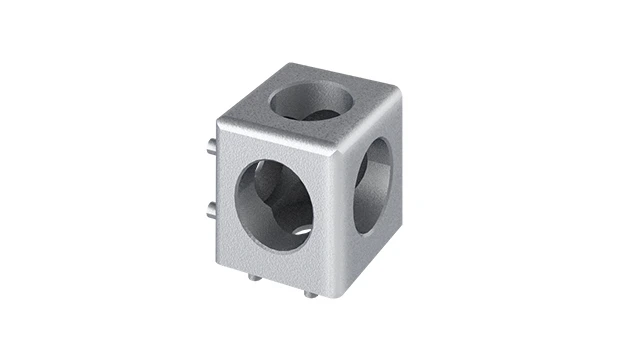
Aluminum Profile 3 Way Connector
The 3 way - squared corner connector is an external fastening method that is typically used to create a corner connection between three profiles. It is a heavy-duty connection that is simple to use and provides a polished look.
Walk into any manufacturing facility today, and you'll notice a silent revolution unfolding—one where rigidity is replaced by adaptability, and one-size-fits-all solutions make way for tools that bend to the rhythm of your production line. At the heart of this revolution lies a humble yet powerful component: the aluminum profile. Lightweight, strong, and infinitely modifiable, aluminum extrusion profiles have become the backbone of modern lean systems, supporting everything from workbenches to material racks, conveyor systems to turnover trolleys. But what truly unlocks their potential? The connectors that hold them together. And among these, the 3 way connector stands out as a unsung hero—especially when it's tailored to your unique needs.
Aluminum Profiles: The Building Blocks of Lean Manufacturing
Before we dive into the world of custom 3 way connectors, let's take a step back and appreciate why aluminum profiles have become indispensable in lean manufacturing. Lean systems thrive on efficiency: eliminating waste, streamlining workflows, and maximizing space. Aluminum extrusion profiles, with their modular design and precision engineering, align perfectly with these goals. Unlike traditional steel structures, they're lightweight enough to reconfigure without heavy machinery but strong enough to support tools, materials, and even automated equipment.
What makes them even more versatile is the ecosystem of aluminum profile accessories that accompany them. From end caps that protect workers from sharp edges to guide rails that ensure smooth material flow, these accessories turn basic profiles into complete solutions. Think about it: a simple aluminum profile can become a workbench with the right brackets, a material rack with the addition of shelves, or a conveyor system with roller track and connectors. It's this modularity that allows manufacturers to build exactly what they need, when they need it—no more, no less.
The Unsung Hero: Why 3 Way Connectors Matter
If aluminum profiles are the building blocks, then connectors are the glue that holds the structure together. And while straight connectors (joining two profiles) or T-joints (joining one profile perpendicular to another) get a lot of attention, 3 way connectors play a unique role: they allow three profiles to intersect at a single point, opening up a world of design possibilities. Imagine building a corner workbench where the main frame, side shelf, and overhead light bar all meet at one joint—that's the 3 way connector at work.
Standard 3 way connectors are designed to handle common scenarios: typically joining profiles at 90-degree angles, with a fixed load capacity. They're reliable for straightforward setups, like a basic material rack or a simple assembly table. But what if your production line isn't "straightforward"? What if you need a workbench that angles slightly to accommodate a conveyor belt? Or a material rack that branches into three directions to reach different workstations? That's where standard connectors hit a wall—and where custom 3 way connectors step in.
| Feature | Standard 3 Way Connectors | Custom 3 Way Connectors |
|---|---|---|
| Angle Flexibility | Limited to 90° or pre-set angles | Tailored to any angle (30°, 45°, 135°, etc.) |
| Load Capacity | Fixed (e.g., 50kg, 100kg) | Engineered for specific loads (up to 500kg+) |
| Compatibility | Fits only standard profile sizes | Works with non-standard or mixed profile sizes |
| Integration with Accessories | Basic (screws, bolts) | Custom holes, slots, or clips for specialized accessories |

Custom Aluminum Profile 3 Way Connectors: Tailoring to Your Unique Needs
Custom 3 way connectors aren't just "better" versions of standard ones—they're solutions designed with you , for your specific challenges. Let's break down how customization transforms these small components into game-changers for your production floor.
Angles Beyond 90 Degrees: Designing for Your Space
Most production floors aren't perfect rectangles. Maybe you have a column in the middle of your workspace that forces your material rack to a 135-degree turn. Or perhaps your assembly line curves gently to reduce worker fatigue. Standard 3 way connectors, which typically lock into 90-degree angles, would require awkward workarounds—like adding extra profiles or sacrificing stability. Custom 3 way connectors eliminate this problem by allowing angles that match your space. For example, a 45-degree custom connector could let you build a triangular workbench corner, maximizing every inch of available area without compromising on strength.
Material & Load Capacity: Built for Your Workload
Not all manufacturing is created equal. A electronics plant assembling small circuit boards has very different needs than an automotive facility moving heavy engine parts. Standard connectors are rated for general use, but if your application involves frequent heavy loads—say, a material rack b (3 row and 3 floor) storing metal components—you need a connector that can handle the stress. Custom 3 way connectors can be engineered with reinforced materials (like high-grade aluminum alloys) or thicker walls to support higher weights. Conversely, if you're building a lightweight turnover trolley for small parts, a custom connector can be optimized for weight reduction, making the trolley easier to maneuver without sacrificing durability.
Compatibility with Mixed Profiles & Accessories
One of the biggest headaches in modular design is mixing old and new components. Maybe you're upgrading from 2020 aluminum profiles to 3030 national standard profiles, but you still need to connect them in some areas. Or perhaps you want to integrate a specialized accessory, like a roller track guide rail, into your workbench frame. Standard connectors often struggle with these mixed setups, leading to gaps, loose joints, or unstable structures. Custom 3 way connectors solve this by bridging different profile sizes, incorporating slots for roller track placon mounts, or even adding threaded holes for caster accessories. It's like having a universal translator for your aluminum profile ecosystem.

Real-World Applications: When Custom 3 Way Connectors Make All the Difference
To truly understand the impact of custom 3 way connectors, let's look at a few scenarios where they've turned "impossible" setups into seamless realities.
Case 1: The Compact Electronics Workbench
A small electronics manufacturer in California needed a workbench for assembling smartphones—a task requiring precision, good lighting, and easy access to tools. Their challenge? Limited floor space meant the workbench had to be compact but still include a main assembly area, a side shelf for tools, and an overhead light bar. Standard 90-degree 3 way connectors would have made the bench too "boxy," wasting precious inches. Instead, they worked with a supplier to create a custom 110-degree 3 way connector, allowing the side shelf to angle slightly inward without overlapping the main workspace. The result? A workbench that fit in their tight corner while still providing all the functionality of a larger setup—proving that sometimes, a 20-degree angle is all it takes to transform efficiency.
Case 2: The Heavy-Duty Automotive Material Rack
An automotive parts supplier in Texas needed a material rack to store bulky, 50kg engine components. They required three levels of storage, with each level branching into three directions to feed parts to three adjacent assembly lines. Standard 3 way connectors, rated for 30kg per joint, couldn't handle the load, and using multiple connectors would have made the rack unstable. Their solution? A custom 3 way connector with reinforced aluminum casting and internal ribbing, rated to support 80kg per joint. The connector also included pre-drilled holes for aluminum guide rails, ensuring the components slid smoothly onto the assembly lines. Today, that material rack—similar to the material rack b (3 row and 3 floor) design—feeds three lines simultaneously, reducing material handling time by 40%.
Case 3: The Mobile Inspection Station
A food packaging plant in Illinois needed a mobile inspection station that could be moved between production lines. The station had to include a flat inspection surface, a side bin for rejected items, and a small shelf for a tablet (to log defects). The challenge? The bin and shelf needed to fold down when the station was being moved, to avoid hitting doorways. Standard connectors couldn't handle the folding mechanism without breaking or jamming. A custom 3 way connector with a built-in hinge solved the problem: the bin and shelf could fold up during transport and lock into place during use, all while maintaining structural integrity. Now, the station glides between lines on caster wheels, proving that mobility and stability can coexist—thanks to a connector that does double duty as a hinge.
The Benefits of Choosing Custom: More Than Just a Connector
At this point, you might be wondering: "Is customizing a 3 way connector worth the extra time and cost?" The answer, for most manufacturers, is a resounding yes. Here's why:
- Reduced Waste: Custom connectors eliminate the need for "workaround" components (like extra brackets or shims), which saves material and reduces clutter in your facility.
- Faster Assembly: A connector designed exactly for your setup means fewer adjustments, looser joints, or rework—cutting down on installation time.
- Long-Term Savings: While custom connectors may cost more upfront, they reduce the need for future replacements or upgrades. A connector built to handle your specific load today won't fail tomorrow when you scale up production.
- Safety First: Loose or overloaded connectors are a safety hazard. Custom connectors engineered for your exact use case minimize the risk of accidents, protecting your team and your equipment.
Choosing the Right Partner: What to Look for in a Custom Connector Supplier
Not all suppliers are created equal when it comes to custom aluminum profile 3 way connectors. To ensure you get a solution that truly meets your needs, look for a partner who offers:
Engineering Expertise: They should have a team that understands both aluminum extrusion profiles and your industry's unique challenges. Ask about their experience with similar projects—do they have case studies or references?
Design Flexibility: Avoid suppliers who push "off-the-shelf with tweaks." The best partners will start with a blank canvas, asking questions about your load, space, and workflow before suggesting designs.
Quality Materials: Custom doesn't mean cutting corners. Ensure they use high-grade aluminum alloys (like 6063-T5, common in extrusion profiles) and precision manufacturing processes to guarantee consistency.
Collaborative Process: You know your production line best—your supplier should listen, iterate, and involve you in the design process. A good supplier will provide 3D models or prototypes before full production, so you can test the connector in your setup.
Conclusion: Building the Future of Manufacturing—One Custom Connector at a Time
In a world where manufacturing is more competitive than ever, the difference between success and stagnation lies in the details. Aluminum extrusion profiles and their accessories have already revolutionized how we build production systems, but it's the custom touches—the 3 way connectors tailored to your angle, your load, your space—that turn good systems into great ones. Whether you're building a simple workbench or a complex material handling system, remember: your production line is unique. Shouldn't your connectors be, too?
The next time you walk onto your production floor, take a closer look at the aluminum frames around you. Behind every smooth workflow, every space-saving design, and every "how did we ever work without this?" moment, there's likely a connector working tirelessly. Make sure it's working for you .