- Company Articles
- Products and Technology
- Product knowledge
- Custom Cutting Services for 3060 National Standard Profile A: Precision & Accuracy

Custom Cutting Services for 3060 National Standard Profile A: Precision & Accuracy
Related Product
3060 National Standard Profile A
Workbench, production line, logistic rack, warehouse rack Industry: Manufacturer workshop, Automobile, Electronic, Assembling, logistic
Introduction: The Backbone of Modern Manufacturing
Walk into any manufacturing facility, warehouse, or workshop today, and you'll likely spot a familiar sight: sturdy, versatile structures that seem to hold everything together—from workbenches where assembly line workers piece together electronics to material racks stacked with components, and even the frames of conveyor systems that keep products moving seamlessly. More often than not, these structures are built from aluminum extrusion profiles—lightweight, durable, and infinitely adaptable. But what makes them truly indispensable isn't just the material itself; it's how well they fit into the unique needs of each workspace. That's where custom cutting services come in, especially for specialized profiles like the 3060 National Standard Profile A.
Imagine a scenario: a small electronics manufacturer needs to build a new workbench for their assembly line. They order standard-length aluminum extrusion profiles, only to find that the pre-cut pieces are either too long (leaving awkward gaps) or too short (requiring messy, imprecise modifications on-site). The result? Wasted material, delayed timelines, and a final product that doesn't quite meet safety or efficiency standards. Now, picture the same manufacturer using custom-cut 3060 National Standard Profile A pieces—each one tailored to their exact specifications, fitting together like puzzle pieces. No gaps, no waste, and a workbench that's not just functional but optimized for their unique workflow. That's the difference precision cutting makes.
In this article, we'll dive deep into the world of custom cutting services for the 3060 National Standard Profile A. We'll explore what this profile is, why custom cutting matters, how the process works, and the real-world benefits it brings to industries ranging from automotive to aerospace. Whether you're a small business owner setting up a new workshop or a large-scale manufacturer looking to streamline operations, understanding the value of precision-cut aluminum extrusion profiles could be the key to unlocking greater efficiency, cost savings, and long-term success.
What is 3060 National Standard Profile A?
Before we talk about cutting, let's get to know the star of the show: the 3060 National Standard Profile A. If you're new to aluminum extrusion profiles, the terminology can feel overwhelming—"3060," "national standard," "Profile A"… what do these all mean? Let's break it down.
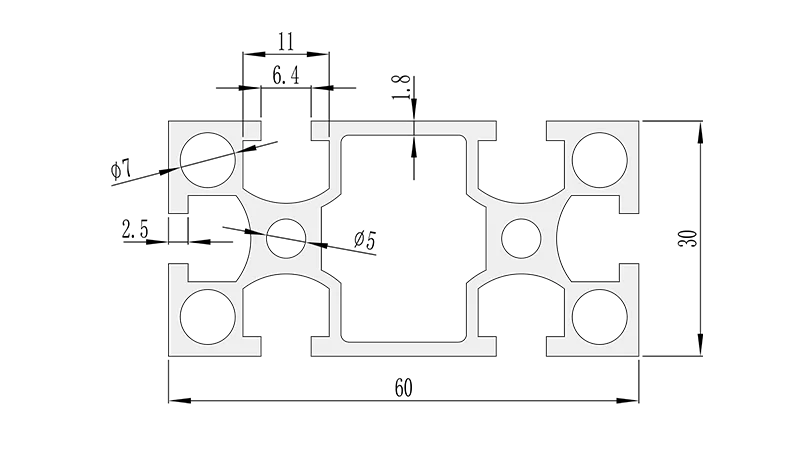
First, "aluminum extrusion profile" refers to the process of shaping aluminum by forcing it through a die (a specialized tool) to create a specific cross-sectional shape. This method allows for consistent, complex designs that can be mass-produced with minimal waste. The "3060" in the name refers to the profile's dimensions: 30mm in width and 60mm in height. Simple enough, right? But "National Standard" is where things get important. This means the profile adheres to strict, government-mandated specifications for dimensions, material thickness, tolerances, and mechanical properties. In short, it's a profile you can trust to be consistent, reliable, and compatible with other standard components—like aluminum profile accessories.
Now, "Profile A" denotes a specific cross-sectional design within the 3060 category. While exact details can vary slightly by region, Profile A typically features T-slots (longitudinal grooves) along its length, which allow for easy attachment of accessories like brackets, shelves, and panels. These T-slots are what make aluminum extrusion profiles so versatile: they turn a simple metal bar into a building block that can be configured into almost any structure imaginable. For example, with the right aluminum profile accessories, a 3060 National Standard Profile A can be transformed into a workbench, a material rack, or even a lightweight machine frame.
Why choose 3060 Profile A over other sizes or designs? Its 30x60mm dimensions strike a perfect balance between strength and weight. It's sturdy enough to support heavy loads (think stacks of metal components on a material rack) but light enough to be easily maneuvered during assembly. This makes it ideal for a wide range of applications, from small-scale projects like a garage workbench to industrial setups like production lines. Plus, as a national standard profile, it's widely available from suppliers, ensuring that replacement parts or additional components can be sourced quickly if needed.
But here's the catch: while standard-length 3060 Profile A pieces are readily available, they're often cut to generic lengths (e.g., 2 meters, 3 meters) that may not align with your specific project. That's where custom cutting services step in, turning this versatile profile into a truly tailor-made solution.
Why Custom Cutting Matters: Beyond "One Size Fits All"
At first glance, ordering pre-cut aluminum extrusion profiles might seem like the easiest, most cost-effective option. After all, standard lengths are mass-produced, so they're often cheaper per unit, and you can get them delivered quickly. But dig a little deeper, and the hidden costs of "one size fits all" become clear. Let's explore why custom cutting isn't just a luxury—it's a necessity for anyone serious about building efficient, durable structures.
1. Minimizing Waste: Every Millimeter Counts
Aluminum isn't cheap, and wasted material adds up fast. Imagine ordering a 3-meter standard length of 3060 Profile A when you only need 2.4 meters for your project. That leaves 0.6 meters of unused profile—enough to build a small shelf or bracket, but instead, it ends up in the scrap bin. Multiply that by dozens or hundreds of pieces across a project, and the waste becomes significant. Custom cutting eliminates this problem by producing only the lengths you need. For example, if your design calls for a 1275mm vertical support, a custom cut ensures you get exactly 1275mm—no more, no less. Over time, this reduces material costs and aligns with sustainable manufacturing practices (a growing priority for many businesses and their customers).
2. Ensuring Perfect Fit: Safety and Structural Integrity
In manufacturing, "close enough" is rarely good enough—especially when it comes to structural components. A profile that's 2mm too long might throw off the alignment of an entire workbench, leading to wobbly surfaces that compromise precision during assembly. A piece that's 1mm too short could create gaps in a material rack, increasing the risk of items slipping through or the structure collapsing under load. Custom cutting ensures that every piece of 3060 Profile A fits exactly as intended, creating tight, secure joints that enhance both safety and durability. This is particularly critical for applications like Workbench E (single deck-without caster), where stability is key to protecting workers and products alike.
3. Streamlining Assembly: Saving Time and Labor
Time is money, and on-site modifications to pre-cut profiles are a major time drain. Picture a team of workers spending hours sawing, filing, and sanding standard-length pieces to fit—all while trying to maintain accuracy. Not only does this slow down the project timeline, but it also increases the risk of human error (a misaligned cut could render an entire piece useless). Custom-cut profiles arrive ready to install, with clean, precise edges that fit into brackets, joints, and aluminum profile accessories without additional work. This means faster assembly, fewer labor hours, and a smoother workflow from start to finish.
4. Optimizing Space: Making the Most of Every Inch
Modern workspaces—whether factories, warehouses, or workshops—are often tight on space. Every square meter counts, and inefficiently sized structures can eat into valuable real estate. Custom cutting allows you to design around existing obstacles: a low ceiling, a support column, or a door that swings a certain way. For example, if you need to build a Material Rack B (3 row and 3 floor) in a corner with limited height, custom-cutting the vertical supports to exactly 1800mm (instead of using a standard 2000mm piece) ensures the rack fits perfectly without wasting vertical space. The result? A workspace that feels larger, more organized, and tailored to your team's needs.
The Custom Cutting Process: How Precision is Achieved
Custom cutting might sound simple—after all, it's just cutting a piece of metal to length, right? But achieving the level of precision required for 3060 National Standard Profile A is a blend of advanced technology, skilled craftsmanship, and rigorous quality control. Let's walk through the process step by step, from initial design to the final cut.
Step 1: Design and Specification
The process starts with you—the customer. You'll work with the supplier to share your project details: blueprints, CAD designs, or even simple sketches indicating the required lengths, angles, and quantities of 3060 Profile A pieces. For example, if you're building a custom workbench, you might need 4 vertical legs (each 900mm), 2 horizontal front/back rails (each 1500mm), and 4 cross-braces (each 450mm). The more detailed your specifications, the more precise the final product will be. Reputable suppliers often provide design assistance, helping you refine measurements to account for factors like joint thickness (since aluminum profile accessories like brackets add a small amount of length) or load-bearing requirements.
Step 2: Material Selection and Preparation
Once the specifications are finalized, the supplier selects the raw material: high-quality 3060 National Standard Profile A aluminum extrusion. It's crucial that the base material meets national standards for strength, straightness, and surface finish—even the most precise cut can't fix a warped or defective profile. The profiles are then inspected for any imperfections (like dents or scratches) and cleaned to remove debris that could interfere with cutting.
Step 3: Precision Cutting Technology
Here's where the magic happens. Most modern custom cutting services use CNC (Computer Numerical Control) saws or lasers to achieve micron-level accuracy. CNC saws are ideal for straight cuts, using computer-programmed movements to ensure each piece is cut to the exact millimeter specified. Laser cutting, on the other hand, is perfect for more complex cuts (e.g., notches, angles) and can handle tight tolerances (often as low as ±0.1mm). For 3060 Profile A, which often requires simple straight cuts, CNC saws are the workhorse—fast, efficient, and incredibly precise.
During cutting, the profile is securely clamped to prevent movement, which could cause deviations in length. The saw blade (or laser) is cooled to avoid overheating the aluminum (excess heat can weaken the material or leave rough edges). After cutting, each piece is deburred—any sharp edges or burrs are smoothed out to ensure safe handling and proper fitting with aluminum profile accessories.
Step 4: Quality Control and Inspection
No custom cutting process is complete without rigorous quality checks. Each cut piece is measured using precision tools like digital calipers, laser measuring devices, or coordinate measuring machines (CMMs) to ensure it matches the specified dimensions. For example, a piece ordered at 1200mm will be checked to confirm it's not 1199.8mm or 1200.2mm—even a tiny deviation could affect how it fits with other components. Additionally, inspectors check for straightness (a bowed piece won't align properly) and surface finish (no scratches or dents that could compromise structural integrity). Pieces that don't meet the standards are either re-cut or discarded, ensuring only perfect parts make it to the customer.
Step 5: Packaging and Delivery
Once all pieces pass inspection, they're carefully packaged to prevent damage during transit. This might involve wrapping each piece in protective film, securing them in sturdy crates, or using dividers to separate components. The goal is to ensure the profiles arrive at your facility in the same pristine condition they left the supplier's workshop—ready to be assembled into your project.
Standard vs. Custom Cut: A Comparative Look
Still on the fence about whether custom cutting is worth the investment? Let's put standard and custom-cut 3060 National Standard Profile A side by side in a head-to-head comparison. The table below breaks down key factors like cost, waste, fit, and application suitability to help you make an informed decision.
| Factor | Standard Pre-Cut Profiles | Custom-Cut Profiles |
|---|---|---|
| Initial Cost Per Unit | Lower (mass-produced, no customization fees) | Higher (customization fees, smaller batch sizes) |
| Material Waste | High (excess length often discarded) | Low (cut to exact length, minimal scrap) |
| Fit and Alignment | Variable (may require on-site adjustments) | Precise (tailored to specifications, no adjustments needed) |
| Assembly Time | Longer (time spent modifying pieces) | Shorter (ready-to-install, no on-site cutting) |
| Suitability for Custom Projects | Limited (best for simple, generic structures) | High (ideal for unique workspaces, complex designs) |
| Long-Term Cost Efficiency | Lower (due to initial savings) but with hidden costs (waste, labor) | Higher upfront but lower long-term (less waste, faster assembly) |
| Structural Integrity | Risk of weakness (from imprecise on-site cuts) | Superior (clean, precise cuts maintain material strength) |
As the table shows, standard profiles have their place—for quick, simple projects where exact dimensions aren't critical. But for most manufacturing, warehousing, or workshop applications, the long-term benefits of custom cutting (less waste, faster assembly, better fit) far outweigh the initial cost difference. It's an investment in efficiency, safety, and peace of mind.
Real-World Applications: Where Custom-Cut 3060 Profile A Shines
To truly understand the value of custom-cut 3060 National Standard Profile A, let's look at some real-world applications where precision cutting makes a tangible difference. From workbenches to material racks, these examples highlight how tailored profiles transform ordinary structures into optimized, high-performance tools.
1. Workbenches: The Heart of the Workshop
Workbenches are the workhorses of any assembly line, lab, or repair shop. They need to be sturdy (to support heavy tools and components), ergonomic (to reduce worker fatigue), and adaptable (to accommodate different tasks). Custom-cut 3060 Profile A is perfect for this. Take Workbench E (single deck-without caster), a popular design for electronics assembly. By custom-cutting the vertical legs to 920mm (instead of a standard 1000mm), the workbench can be adjusted to the ideal height for workers of average stature, reducing back strain. The horizontal rails, cut to 1800mm (matching the length of the work surface), ensure the bench is wide enough to hold tools and components without overcrowding. Even the cross-braces—cut to 450mm—add stability without blocking legroom. The result? A workbench that feels like it was designed specifically for the people using it.
2. Material Racks: Organized, Accessible, and Space-Saving
Material racks are essential for keeping inventory organized and accessible, but a poorly designed rack can lead to wasted space and inefficient workflows. Material Rack B (3 row and 3 floor) is a common design, featuring three rows of shelves across three levels. Using custom-cut 3060 Profile A for the vertical posts and horizontal beams allows businesses to tailor the rack to their specific inventory. For example, a supplier of small electronic components might need shorter shelf heights (250mm between levels) to maximize vertical storage, while a manufacturer storing larger parts could opt for taller shelves (400mm). Custom cutting also ensures the rack fits perfectly in the available space—say, a corner with a ceiling height of 2400mm, requiring the vertical posts to be cut to 2350mm (accounting for the base and top shelf). No more wasted space, no more struggling to reach items on overly high shelves.
3. Conveyor Systems: Smooth, Reliable Product Flow
Conveyor systems are the lifelines of production facilities, moving products from one station to the next. The frames of these systems are often built from aluminum extrusion profiles, which need to be perfectly straight and precisely cut to ensure the conveyor belt or roller track runs smoothly. A custom-cut 3060 Profile A frame, for example, can be designed to follow the exact layout of the facility—curving around corners, fitting through doorways, and aligning with other equipment. Even small deviations (like a frame that's 5mm too long) can cause the conveyor to jam or wear unevenly, leading to costly downtime. With custom cutting, every piece fits seamlessly, ensuring the conveyor runs efficiently for years to come.
4. Retail Displays: Branding Through Precision
It's not just industrial settings that benefit from custom-cut aluminum profiles. Retailers use aluminum extrusion profiles to build eye-catching displays—shelves, product stands, and even checkout counters. The 3060 National Standard Profile A, with its sleek, modern look, is a popular choice for high-end brands. Custom cutting allows retailers to create displays that match their brand aesthetic: for example, a cosmetics store might opt for a curved display using custom-cut, bent 3060 Profile A pieces, while a clothing store could design modular shelves with adjustable heights (thanks to T-slots and custom-cut brackets). The result? Displays that are not just functional but visually appealing, enhancing the overall shopping experience.
Choosing the Right Supplier: What to Look For
Now that you understand the value of custom cutting for 3060 National Standard Profile A, the next step is finding a supplier who can deliver the precision and reliability you need. Not all suppliers are created equal—some may cut corners on quality, while others lack the technology to achieve tight tolerances. Here are key factors to consider when choosing a partner:
1. Experience with Aluminum Extrusion Profiles
Aluminum extrusion profiles have unique properties—they're lightweight but strong, and their T-slots require careful handling during cutting. Look for a supplier with years of experience specifically with aluminum extrusion profiles, not just general metal cutting. Ask about their track record with national standard profiles like the 3060 Profile A—do they understand the specifications? Can they provide examples of past projects similar to yours?
2. Technology and Equipment
Precision cutting requires precision tools. Inquire about the equipment they use: Do they have CNC saws or laser cutters? What's the maximum tolerance they can achieve (ideally ±0.1mm or better for 3060 Profile A)? Do they use automated measuring systems to verify cuts? A supplier with outdated equipment may struggle to meet tight specifications, leading to inconsistent results.
3. Quality Control Processes
A good supplier doesn't just cut and ship—they inspect every piece. Ask about their quality control procedures: How do they check for length, straightness, and surface finish? Do they have a documented process for handling defective pieces? Can they provide certificates of compliance (ensuring the profiles meet national standards)? Transparency here is key—you want to know exactly how they ensure each piece meets your specs.
4. Design and Technical Support
Even if you have detailed blueprints, a great supplier will offer design support to help optimize your project. Do they have in-house engineers or designers who can review your specifications and suggest improvements (e.g., adjusting lengths to reduce waste or enhance structural integrity)? Can they help with selecting the right aluminum profile accessories to complement your custom-cut pieces? This level of support can turn a good project into a great one.
5. Turnaround Time and Flexibility
Projects often have tight deadlines, so you need a supplier who can deliver on time. Ask about their typical lead times for custom orders—do they offer expedited services if needed? Also, consider flexibility: What if you need to adjust your order at the last minute? A supplier with a agile production process will be able to accommodate changes without significant delays.
6. Customer Reviews and References
Finally, do your homework. Check online reviews, ask for references from past clients, and even visit the supplier's facility if possible. A reputable supplier will be happy to share success stories or put you in touch with satisfied customers. Pay attention to feedback about communication (do they keep you updated on order progress?) and problem-solving (how do they handle mistakes or delays?).
Conclusion: Precision That Powers Progress
In the fast-paced world of manufacturing and industrial operations, every detail matters. From the workbench where the first component is assembled to the material rack that holds critical inventory, the structures we build shape how efficiently, safely, and successfully we work. The 3060 National Standard Profile A, with its strength, versatility, and compatibility with aluminum profile accessories, is a cornerstone of these structures—but its true potential is unlocked only when it's cut to fit the unique needs of each workspace.
Custom cutting services for 3060 Profile A aren't just about cutting metal to length; they're about precision, efficiency, and empowerment. They turn generic building blocks into tailored solutions, reducing waste, saving time, and ensuring that every project—whether a small workbench or a large-scale conveyor system—meets the highest standards of quality and functionality. As we've explored, the benefits extend far beyond the workshop: lower long-term costs, safer work environments, and a competitive edge in an industry where efficiency is everything.
So, whether you're launching a new production line, revamping your warehouse, or building a custom retail display, don't settle for "close enough." Invest in custom-cut 3060 National Standard Profile A, and experience the difference precision makes. After all, in manufacturing, as in life, the best results come from paying attention to the details—one perfectly cut piece at a time.