- Company Articles
- Products and Technology
- Product knowledge
- Custom Flat Adjustable Swivel Castor Wheels for 3C Industry Specific Needs

Custom Flat Adjustable Swivel Castor Wheels for 3C Industry Specific Needs
Related Product
Flat Adjustable Swivel Castor Wheel
Swivel Chair Casters Ball Bearing Wheels Rubber Base with adjustable height function. Resistant to abrasion, impact and corrosion. Heavy payload can hold 80Kgs per pcs,which can make it works at a stable and smooth status.
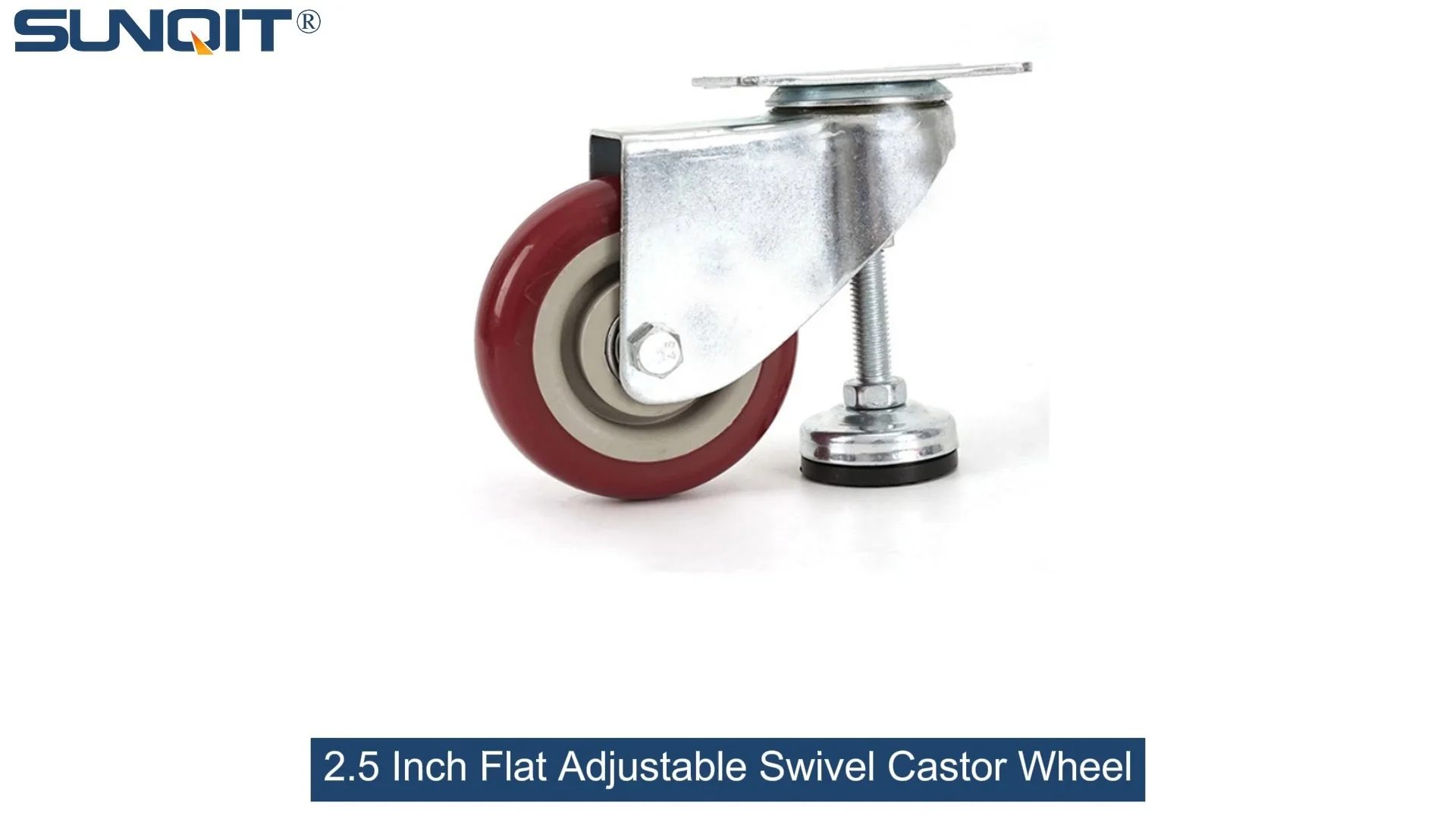
In the fast-paced world of 3C manufacturing—where smartphones, laptops, and consumer electronics fly off production lines at breakneck speeds—every detail matters. From the tiniest microchip to the largest assembly workstation, efficiency, precision, and safety aren't just buzzwords; they're the backbone of keeping up with consumer demand. One often-overlooked hero in this high-stakes environment? The humble castor wheel. But not just any castor wheel. For 3C manufacturers, custom flat adjustable swivel castor wheels have emerged as a silent workhorse, solving unique challenges that standard components simply can't address. Let's dive into why these specialized castors are becoming indispensable, how they integrate with critical systems like ESD workbenches and lean systems, and the tangible difference they make in production assembly lines.
The 3C Industry: Where Precision Meets Pressure
Walk into any 3C manufacturing facility, and you'll be met with a symphony of activity: workers hunched over workbenches, carefully placing components smaller than a grain of rice; conveyor belts humming as half-assembled devices move from station to station; and supervisors monitoring digital dashboards, tracking progress against tight deadlines. It's a world where even a split-second delay or a tiny static discharge can derail an entire production run.
Three key challenges define this space: delicate components , static sensitivity , and constant mobility . 3C products rely on microelectronics that are (extremely vulnerable) to physical shock and electrostatic discharge (ESD). At the same time, workstations, material racks, and even entire assembly lines need to be reconfigured quickly to adapt to new product models—think switching from assembling a 6-inch smartphone to a foldable tablet overnight. Standard equipment, including generic castor wheels, often falls short here. Rigid, non-adjustable castors can trap static, damage floors, or make repositioning workbenches a Herculean task for already overburdened teams.
This is where customization becomes critical. Custom flat adjustable swivel castor wheels aren't just "wheels on a stick"—they're engineered solutions designed to address the 3C industry's unique pain points. Let's break down what makes them so essential.
What Makes Custom Flat Adjustable Swivel Castor Wheels Stand Out?
To understand their value, let's start with the basics: what is a flat adjustable swivel castor wheel, anyway? Unlike fixed castors that only roll forward and backward, swivel castors rotate 360 degrees, allowing for effortless maneuverability. "Flat adjustable" adds two more layers: a low-profile design (flat) to keep workbenches stable and close to the ground, and height-adjustable mechanisms to fine-tune positioning. But for 3C applications, "custom" is where the magic happens.
1. ESD-Safe Materials: Protecting the Unseen
Static electricity is the silent enemy of 3C manufacturing. A single static discharge can fry a $500 microchip in milliseconds, turning hours of work into scrap. Standard castors, often made of non-conductive plastics or rubber, can build up static as they roll, acting like tiny lightning rods waiting to strike. Custom castors for the 3C industry, however, are crafted with ESD-safe materials—rubber blends infused with carbon or metal fibers that conduct static away from sensitive components and safely ground it into the floor. This isn't just a "nice-to-have"; it's a non-negotiable when paired with ESD workbenches, which are already designed to dissipate static. Together, they create a shield that protects both products and workers.
2. Precision Adjustability: One Size Never Fits All
Imagine a production line where workbenches need to align perfectly with conveyor belts to avoid jamming delicate circuit boards. Or a scenario where a team needs to lower a workstation by 5mm to accommodate a shorter worker, reducing strain and improving ergonomics. Standard castors offer fixed heights, forcing compromises that hurt efficiency or worker well-being. Custom flat adjustable castors solve this with easy-to-use adjustment mechanisms—often a simple (twist) of a bolt or a quick-release lever—that let teams tweak height by fractions of an inch. This level of precision ensures that every workstation, trolley, or material rack is exactly where it needs to be, every time.
3. Durability for the Long Haul
3C manufacturing floors are unforgiving. Castors endure constant rolling, heavy loads (think 200kg workbenches loaded with tools and components), and exposure to oils, coolants, and cleaning chemicals. Cheap castors fail quickly—wheels crack, swivel joints seize, and brakes wear out—leading to costly downtime and replacement cycles. Custom castors, by contrast, are built with industrial-grade materials: reinforced steel frames, high-load bearings, and chemical-resistant treads. Some even come with sealed bearings to prevent dust and debris from gumming up the works, ensuring smooth operation for years, not months.
4. Quiet Operation: Reducing the Noise, Boosting Focus
Factory floors are already noisy enough with the clatter of machinery and the hum of conveyor belts. The last thing workers need is the (shrill) squeak of ill-fitting castors adding to the chaos. Custom flat adjustable castors are designed with noise reduction in mind: soft, shock-absorbing treads that cushion against hard floors, and precision-machined swivel joints that glide silently. A quieter workspace isn't just more pleasant—it reduces worker fatigue and improves communication, which is critical when teams need to coordinate on tight assembly tasks.

Integration with Lean Systems: Streamlining Workflows, Eliminating Waste
The 3C industry thrives on lean principles—eliminating waste, optimizing flow, and continuous improvement. A lean system isn't just about cutting costs; it's about creating a workspace where every action adds value, and nothing is redundant. Custom castor wheels play a surprisingly big role in this.
Consider "motion waste"—the time and energy workers spend moving tools, materials, or workstations. In a standard setup, a worker might walk 10 extra steps per hour to retrieve parts because a material rack is stuck in place. Multiply that by 50 workers over a shift, and you're looking at hours of lost productivity. Custom swivel castors turn static workstations into mobile hubs. Need to reposition a line to accommodate a new product? Unlock the castor brakes, glide the workstation into place, and lock it down—all in under a minute. This flexibility reduces motion waste to near-zero, letting teams focus on what matters: building quality products.
Lean systems also demand adaptability. 3C manufacturers rarely stick to one product for long; new models, updates, and design changes are constant. Custom castors, with their adjustable heights and compatibility with modular aluminum profiles (a common component in lean workstations), make reconfiguration a breeze. No need to replace entire workbenches—just adjust the castors, swap out accessories, and you're ready for the next product. This modularity aligns perfectly with the lean mantra of "doing more with less."

A Match Made in Manufacturing: Custom Castors and ESD Workbenches
ESD workbenches are the command centers of 3C assembly. They're where workers spend 8+ hours a day soldering, testing, and assembling components that can't handle static. But an ESD workbench is only as good as its foundation. If the castors under it aren't ESD-safe, the entire system fails—static builds up, discharges, and ruins components.
Custom flat adjustable swivel castors are engineered to work in harmony with ESD workbenches. Here's how:
- Seamless Grounding: ESD workbenches have grounding straps that connect to the floor, but castors can interrupt this path if they're non-conductive. Custom castors, with their conductive materials, act as an extension of the grounding system, ensuring static flows safely away from the bench and into the ground.
- Stability for Precision Work: Soldering a 0.1mm wire requires a steady hand—and a steady workbench. Flat, low-profile castors minimize wobble, keeping the bench stable even when workers lean on it. Adjustable heights also let teams level the bench on uneven factory floors, preventing components from rolling off or tools from slipping.
- Locking Mechanisms: Safety First Mobility is great, but once a workstation is in place, it needs to stay put. Custom castors come with heavy-duty brake locks that engage with a simple foot pedal, holding the bench steady even during vigorous tasks. No more "drifting" workstations mid-assembly.
For example, a leading 3C manufacturer in Shenzhen recently upgraded its ESD workbenches with custom castors after a spate of static-related failures. Within a month, scrap rates dropped by 15%, and workers reported feeling more confident handling delicate components—proof that the right foundation makes all the difference.

Transforming Production Assembly: Beyond the Basics
Production assembly in the 3C industry is a dance of precision and speed. Every station must sync with the next to keep up with demand, and any bottleneck can bring the line to a halt. Custom castors don't just support assembly—they actively improve it.
1. Faster Changeovers, Shorter Lead Times
When a new smartphone model launches, manufacturers have weeks (not months) to retool lines. Custom castors make changeovers faster by letting teams reposition workstations, material racks, and even entire sub-assembly cells in hours instead of days. For example, a team assembling camera modules might need to shift from a 12-hour to an 8-hour production cycle to meet a deadline. With adjustable castors, they can rearrange workstations to create a U-shaped line, reducing travel time between stations and cutting cycle time by 30%.
2. Ergonomics: Happy Workers, Better Output
Repetitive strain injuries are a silent crisis in manufacturing. Workers bending, reaching, or stooping to use poorly positioned workstations often suffer from back pain or carpal tunnel, leading to absenteeism and lower productivity. Custom castors let teams adjust workstation heights to match each worker's ergonomic needs—taller workers can raise benches by 10cm, shorter ones can lower them—reducing strain and keeping teams healthy and motivated.
3. Compatibility with Caster Accessories: Tailored to the Task
Custom castors aren't standalone products; they're part of a ecosystem of caster accessories that enhance their functionality. Need to move a heavy material rack over rough concrete? Add shock-absorbing caster accessories like spring-loaded mounts to smooth the ride. Working in a cleanroom? Opt for non-marking, easy-to-clean treads. These accessories let manufacturers tailor castors to specific tasks, ensuring they're never over-equipped (wasting money) or under-equipped (wasting time).
Case Study: How Custom Castors Solved a 3C Manufacturer's Biggest Headaches
Let's put this all into context with a real-world example (names changed for privacy). "TechNova" is a mid-sized 3C manufacturer specializing in smartwatch components. By 2024, they were struggling with three issues: high scrap rates due to static, slow changeover times between product models, and worker complaints about back pain from poorly positioned workstations.
After auditing their process, TechNova identified their standard castors as a root cause. The castors were non-ESD-safe, making static damage common. They also lacked adjustability, so workbenches sat unevenly, and changing line layouts took 8+ hours. Workers were forced to hunch over benches that were too low, leading to fatigue.
TechNova partnered with a supplier to design custom flat adjustable swivel castors with ESD-safe rubber treads, height adjustability (50-70mm), and foot-operated brakes. Within three months:
- Scrap rates dropped by 22% (static-related failures nearly disappeared).
- Changeover times fell from 8 hours to 2 hours (teams could reposition workstations in minutes).
- Worker absenteeism due to back pain decreased by 30% (adjustable heights reduced strain).
"We didn't realize how much time and money we were losing to bad castors," said TechNova's production manager. "These custom wheels didn't just fix problems—they made our whole line run smoother. Our workers are happier, our products are better, and we're hitting deadlines we never thought possible."
Standard vs. Custom: Why the Extra Investment Pays Off
It's natural to wonder: "Can't we just use standard castors and save money?" The short answer: maybe in the short term, but not in the long run. Let's compare the two side by side:
| Feature | Standard Castors | Custom Flat Adjustable Swivel Castors |
|---|---|---|
| ESD Protection | Minimal or none; risk of static damage | Built-in ESD-safe materials; prevents static buildup |
| Adjustability | Fixed height; no fine-tuning | Height-adjustable (50-100mm); levelable on uneven floors |
| Mobility & Maneuverability | Limited swivel; hard to reposition | 360° swivel; smooth rolling even with heavy loads |
| Durability | Plastic or low-grade rubber; wear out in 6-12 months | Industrial-grade materials; last 3-5+ years |
| Integration with Lean Systems | Static; increases motion waste | Mobile; reduces waste, enables quick reconfigurations |
| Ergonomics | One-size-fits-all; may cause worker strain | Adjustable heights; reduces fatigue, improves comfort |
| Total Cost of Ownership | Low upfront cost, but high replacement and scrap costs | Higher upfront cost, but lower long-term costs (less scrap, fewer replacements) |
The data speaks for itself: custom castors aren't an expense—they're an investment that pays dividends in reduced waste, happier workers, and higher-quality products.
Looking Ahead: The Future of Custom Castors in 3C Manufacturing
The 3C industry isn't slowing down. As products get smaller, more complex, and more sensitive to static, the demand for specialized solutions will only grow. So what's next for custom flat adjustable swivel castors?
One trend is smart castors —equipped with sensors that monitor load weight, wheel wear, and static buildup, sending alerts to managers when maintenance is needed. Imagine a castor that "tells" you it's about to fail before it causes a line shutdown. Another trend is sustainability : manufacturers are experimenting with recycled ESD-safe materials and modular designs that let users replace just the wheel (not the entire castor) when it wears out, reducing waste.
For 3C manufacturers, the message is clear: the right castors aren't an afterthought. They're a strategic tool that can transform production lines, protect products, and empower workers. In an industry where margins are tight and competition is fierce, every advantage counts—and custom flat adjustable swivel castor wheels just might be the advantage that sets you apart.
Final Thoughts: More Than Wheels—A Foundation for Success
In the chaos of 3C manufacturing, it's easy to focus on the "glamorous" technologies: AI-powered quality checks, automated assembly robots, cutting-edge microchips. But as we've seen, success often hinges on the unsung heroes—the components that keep the line moving, protect the products, and support the people behind the scenes.
Custom flat adjustable swivel castor wheels are more than just "wheels under a bench." They're a bridge between lean system efficiency, ESD workbench safety, and production assembly productivity. They turn static workspaces into dynamic, adaptable hubs that can keep up with the 3C industry's relentless pace. They protect delicate components from static, reduce worker strain, and cut waste—all while paying for themselves in reduced scrap and faster changeovers.
So the next time you walk through a 3C factory, take a moment to look down. Under those ESD workbenches, beside those conveyor belts, you'll see the quiet power of custom castors—working tirelessly to build the devices that connect our world. And that, in the end, is what manufacturing is all about: solving problems, big and small, to create something better.