- Company Articles
- Products and Technology
- Solution
- Custom Lean Solutions: Four Way Straight Lean Pipe Joint in Bespoke Production Line Projects

Custom Lean Solutions: Four Way Straight Lean Pipe Joint in Bespoke Production Line Projects
Related Product
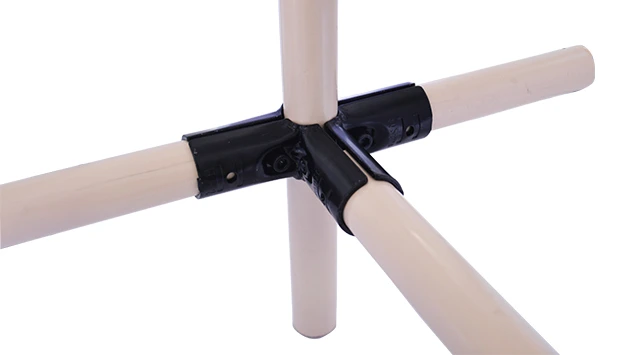
Four Way Straight Lean Pipe Joint
Four way lean pipe joint for 4 pcs 28MM lean pipe connection in straight angle, which used widely in workbench, flow rack, hand trolley frame connection.
Walk into any manufacturing facility, and you'll quickly realize no two production lines are identical. A electronics assembly plant in Vietnam has different needs than a automotive parts workshop in Germany; a small-batch furniture maker requires flexibility that a mass-produced toy factory might not. Yet, across all these diverse spaces, one challenge unites them: how to build a production system that adapts to their unique rhythms, grows with their needs, and eliminates waste at every turn. This is where lean solutions step in—and at the heart of many of these solutions lies a deceptively simple component: the four way straight lean pipe joint.
The Unsung Hero: What Makes the Four Way Straight Lean Pipe Joint So Critical?
At first glance, a four way straight lean pipe joint might look like just another metal connector. But anyone who's worked with lean systems knows better. This small, unassuming piece is the backbone of customization. Unlike fixed, one-size-fits-all machinery, lean pipe systems thrive on modularity—and this joint is what makes that modularity possible. Imagine being able to connect four pipes in a straight line, at precise angles, without welding or complex tools. That's the power of the four way straight lean pipe joint: it turns basic pipes into a canvas for engineers and operators to design exactly what their line needs, when they need it.
Let's break it down. Traditional production setups often rely on rigid, welded structures. If your team needs to reconfigure a workstation to accommodate a new product, you're looking at days (or weeks) of downtime, not to mention the cost of hiring welders or buying new equipment. With a four way straight lean pipe joint, though, reconfiguration becomes a task your own team can handle in hours. Loosen a few screws, adjust the pipes, tighten the joint, and suddenly your line is ready for the next project. It's like building with industrial-grade Legos—strong enough to support heavy loads, but flexible enough to rebuild whenever inspiration (or necessity) strikes.
But its value goes beyond just flexibility. In lean manufacturing, every second counts. When materials flow smoothly from one station to the next, when workers don't have to reach across cluttered workbenches, when tools are exactly where they need to be—productivity soars. The four way straight lean pipe joint helps create these seamless workflows by enabling the construction of custom racks, conveyors, and workstations that fit the exact dimensions of the space and the movement of materials. It's not just about connecting pipes; it's about connecting people to their work in a way that feels intuitive and efficient.
From Joints to Systems: Building Bespoke Solutions with Lean Pipe Workbench, Flow Rack, and Conveyor
A single four way straight lean pipe joint is powerful, but its true potential shines when paired with other lean components. Let's take a typical scenario: a small electronics manufacturer that produces both smartphone chargers (high-volume, small parts) and laptop batteries (lower-volume, bulkier components). Their production line needs to switch between these two products quickly, without sacrificing speed or accuracy. How do lean solutions make this possible?
1. The Lean Pipe Workbench: Your Team's Customized Command Center
At the heart of their line would be a lean pipe workbench. Unlike generic worktables, this isn't just a flat surface—it's a tailored workspace built with the four way straight lean pipe joint as its core. The frame, constructed from aluminum profile (lightweight, durable, and resistant to corrosion), uses the joint to connect vertical and horizontal pipes, allowing the team to adjust the height to match worker ergonomics (no more hunching over or straining shoulders). Add-ons like tool holders, ESD mats (for static-sensitive electronics), and overhead shelves are all attached using the same joint system, so if the laptop battery assembly requires extra tool storage, they can add a shelf in minutes. It's a workstation that grows with the task, not the other way around.
2. Flow Rack: Keeping Materials Moving, Without the Fuss
Next to the workbench, a flow rack ensures materials are always within arm's reach. Built with the same four way straight lean pipe joints and aluminum profile, this rack uses gravity to feed components—like charger casings or battery cells—down to the operator. The joints allow the rack to be configured with multiple levels (three rows, three floors, for example) to separate different parts, and the angle of each shelf can be (fine-tuned) using adjustable feet, ensuring a steady, controlled flow. No more wasted steps walking to a distant storage area; no more searching through disorganized bins. The flow rack becomes a silent assistant, keeping the line supplied so workers can focus on assembly, not hunting for parts.
3. Conveyor: Bridging the Gaps in Your Workflow
Finally, a conveyor system connects the workbench to the next stage of production—say, quality control or packaging. Here, the four way straight lean pipe joint works with roller tracks and aluminum guide rails to create a smooth, reliable transport system. Whether it's a small belt conveyor for delicate charger PCBs or a roller conveyor for heavier battery packs, the joint ensures the conveyor can be extended, shortened, or repositioned as the line evolves. If the team decides to add a testing station midway, they can simply disconnect a section using the joint, insert a new segment, and the conveyor adapts—no need for a complete overhaul.

Why Aluminum Profile? The Material That Elevates Lean Systems
You might be wondering: why aluminum profile, specifically? After all, there are other materials like steel or plastic. The answer lies in balance. Aluminum is lightweight enough that even a single worker can maneuver pipes and joints during reconfiguration, but strong enough to support the daily wear and tear of manufacturing (think: heavy toolboxes, constant material movement, and the occasional bump from a forklift). It's also resistant to rust and corrosion, which is crucial in environments where spills or humidity are common. Plus, its smooth surface makes cleaning a breeze—important for maintaining hygiene standards, especially in electronics or food packaging lines.
When paired with the four way straight lean pipe joint, aluminum profile becomes even more powerful. The joint's design—often with internal threads or clamping mechanisms—grips the aluminum pipe securely, creating a stable structure that won't wobble or loosen over time. And because aluminum is easy to cut (no specialized tools needed), the team can trim pipes to exact lengths on-site, ensuring the workbench, flow rack, or conveyor fits the available space perfectly. It's material and component working in harmony, designed for real-world flexibility.

Case Study: How One Manufacturer Cut Downtime by 40% with Custom Lean Solutions
To see these components in action, let's look at a real-world example. A mid-sized automotive parts supplier in Spain was struggling with a common problem: their production line was built for a single product—a fuel injector component—and when they landed a contract to produce brake caliper parts, they faced a dilemma. Rebuilding their line with traditional welded machinery would take 6 weeks and cost €40,000. Instead, they turned to a lean solution built around the four way straight lean pipe joint, aluminum profile, lean pipe workbench, flow rack, and conveyor.
| Metric | Before (Traditional Setup) | After (Custom Lean Solution) | Improvement |
|---|---|---|---|
| Reconfiguration Time | 6 weeks (welded machinery) | 3 days (modular lean components) | 95% faster |
| Production Downtime | 14 days (full line shutdown) | 2 days (partial reconfiguration) | 86% reduction |
| Space Usage | 120 sq.m (fixed layout) | 90 sq.m (compact modular design) | 25% space saved |
| Worker Fatigue Complaints | 12 per month (poor ergonomics) | 3 per month (adjustable workbench height) | 75% reduction |
| Cost of Expansion | €40,000 (new machinery) | €12,000 (lean components + labor) | 70% cost savings |
The key? The four way straight lean pipe joint allowed them to reuse 80% of their existing lean pipe workbench and flow rack components, simply reconfiguring the layout to fit the brake caliper parts. The aluminum profile frame made it easy to adjust the workbench height to match the new assembly steps, reducing worker strain. The conveyor, which previously moved fuel injectors in a straight line, was split into two segments using the joint, creating a U-shape that optimized material flow for the new product. Three days later, they were up and running—no welders, no expensive machinery, just a team using the flexibility of lean solutions.
Beyond the Joint: Building a Lean Culture, One Component at a Time
At the end of the day, lean solutions are about more than just components like the four way straight lean pipe joint or aluminum profile. They're about empowering teams to take ownership of their workspace. When operators can adjust their lean pipe workbench to fit their height, or reconfigure a flow rack to reduce reaching, they feel valued—and valued workers are more engaged, more productive, and less likely to burn out. It's a ripple effect: a small joint leads to a flexible system, which leads to happier teams, which leads to better products.
For manufacturers navigating today's fast-changing market—where customer demands shift overnight and product lifecycles grow shorter—this flexibility isn't just a nice-to-have; it's a survival tool. The four way straight lean pipe joint, as it may seem, is a symbol of that adaptability. It's proof that sometimes, the most powerful solutions aren't the flashy, high-tech machines, but the simple, thoughtful components that let your team build exactly what they need, when they need it.
So, whether you're a small workshop looking to streamline your first production line or a large factory aiming to stay agile in a competitive market, remember: the right lean solutions start with the right building blocks. And at the center of those blocks? A joint that connects pipes, people, and possibilities.