- Company Articles
- Products and Technology
- Product knowledge
- Custom vs. Standard Aluminum Workbench B: Which Option Fits Your Industry?

Custom vs. Standard Aluminum Workbench B: Which Option Fits Your Industry?
Related Product
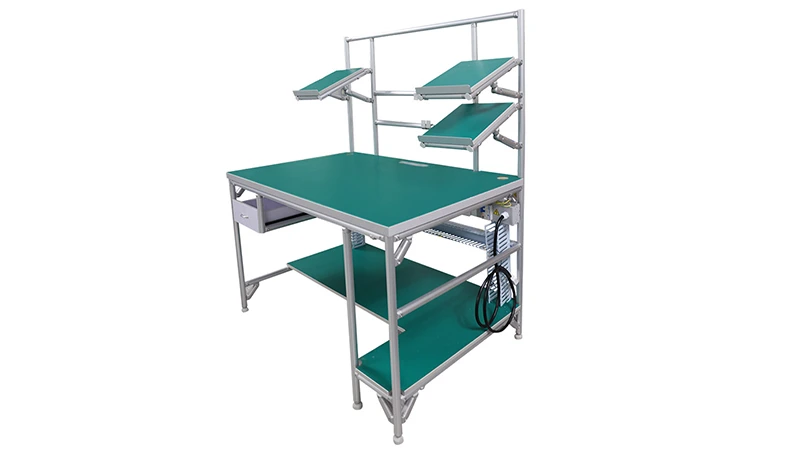
Aluminum Workbench B
Aluminum tube workbench is more flexible and durable, compared with traditional PE/ABS coated steel tube. It is easy to assemble, anti corrosion, rust protection, and recycle use after disassemble.
Walk into any manufacturing plant, warehouse, or workshop, and you'll likely spot a familiar workhorse: the aluminum workbench. Quietly holding tools, parts, and projects, it's more than just a table—it's the backbone of daily operations. For decades, aluminum has risen to prominence in workbench design, thanks to its unbeatable combination of strength, lightweight portability, and resistance to rust and wear. But when it comes to choosing the right aluminum workbench for your business, the decision often boils down to one critical question: standard or custom?
In this article, we're zeroing in on a popular standard model: Aluminum Workbench B. We'll explore what makes it a go-to for many businesses, then contrast it with the flexibility of custom solutions. By the end, you'll have a clear roadmap to decide which option aligns with your industry's unique needs, workflow, and long-term goals. After all, the right workbench doesn't just hold your tools—it holds the key to smoother operations, happier teams, and healthier bottom lines.
What Is Aluminum Workbench B? A Closer Look at the Standard Model
Let's start with the basics: What exactly is Aluminum Workbench B? Think of it as the "off-the-shelf" solution designed to meet the most common workplace needs. Built with aluminum profile and basic aluminum tube construction, it's a product of years of refining what works for general-purpose tasks. While exact specs can vary slightly by supplier, most standard Workbench B models share core features:
- Dimensions: Typically a fixed width (often 120–150cm) and depth (60–80cm), with a height of 80–90cm—ergonomically designed for average user comfort.
- Surface: A single, flat deck made of aluminum honeycomb panel or solid aluminum, providing a smooth, durable workspace.
- Frame: Constructed from lightweight yet sturdy aluminum profile, often with aluminum profile accessories like corner brackets and crossbars for stability.
- Mobility: Many standard models, unlike Workbench E (a similar single-deck design), may include basic casters or come with the option to add caster wheels for limited mobility—though this can vary.
So, who gravitates toward Standard Workbench B? Small to medium-sized businesses with consistent, repetitive workflows are prime candidates. For example, a local electronics repair shop that handles standard-sized circuit boards, or a small-scale furniture manufacturer assembling identical components day in and day out. These businesses thrive on predictability, and a standard workbench delivers just that: no surprises, no delays, and a price tag that fits neatly into tight budgets.
The benefits of going standard are hard to ignore. First, cost: Standard models like Workbench B are mass-produced, which drives down per-unit costs. You won't pay for custom engineering or one-off parts. Second, speed: Since they're readily available, you can have a Workbench B delivered and set up in days, not weeks. Third, simplicity: With a standardized design, training staff to use and maintain it is a breeze—no complicated instructions or unique parts to source.
But standard isn't without its limitations. Imagine a bakery that needs a workbench tall enough to accommodate industrial mixers, or a lab requiring a surface resistant to harsh chemicals. Workbench B, with its fixed dimensions and generic materials, might fall short. And if your team includes taller or shorter members, the "one-size-fits-all" height could lead to ergonomic strain over time. For businesses with unique needs, these limitations can turn a "good enough" workbench into a bottleneck.
The Case for Custom Aluminum Workbenches: Tailoring to Your Industry's Needs
If Standard Workbench B is the "one-size-fits-most" solution, custom aluminum workbenches are the "made-to-measure" alternative. They're designed from the ground up to address your specific challenges, whether that's an odd-shaped workspace, specialized equipment, or strict industry regulations. Let's break down why customization might be worth the investment—and how it transforms a basic workbench into a strategic asset.
Customization Options: Beyond the Basics
Custom workbenches aren't just about changing the length or width (though that's certainly an option). They're about reimagining what a workbench can do. Here are some of the most requested custom features:
- ESD-Ready Surfaces: In electronics manufacturing, static electricity is a silent killer of sensitive components. A custom esd workstation can include anti-static mats, grounding straps, and conductive aluminum surfaces to protect microchips and circuit boards.
- Integrated Storage: Why waste floor space with separate shelves when your workbench can include built-in flow rack for parts, drawers for tools, or overhead bins for supplies? This is a game-changer for lean manufacturing, where minimizing movement equals maximizing efficiency.
- Mobility Upgrades: While some standard models offer basic caster wheels , custom solutions can include heavy-duty locking casters, swivel wheels for tight spaces, or even motorized bases for effortless movement of heavy loads.
- Adjustable Heights: Ergonomics matter. A custom workbench with hydraulic or manual height adjustment ensures workers of all statures can stand or sit comfortably, reducing the risk of back pain and repetitive strain injuries.
- Specialized Materials: From heat-resistant surfaces for welding stations to chemical-resistant coatings for labs, customization lets you pick materials that match your workflow's unique demands.
When Custom Makes Sense: Industries That Benefit Most
Custom workbenches aren't a luxury—they're a necessity for industries with unique challenges. Let's take a look at a few examples:
Aerospace Manufacturing: Building aircraft components requires precision tools and large, irregularly shaped parts. A standard workbench might not be wide enough to hold a wing panel or sturdy enough to support heavy machinery. Custom solutions here often include reinforced frames, adjustable lighting, and integrated tool holders tailored to specific assembly steps.
Medical Device Production: Cleanliness and compliance are non-negotiable. Custom workbenches in this industry often feature stainless steel surfaces (easier to sanitize), sealed edges to prevent dust buildup, and built-in HEPA filters to maintain sterile environments.
Automotive Repair Shops: Mechanics need workbenches that can handle heavy engine parts, hold diagnostic equipment, and still have room for tools. Custom designs might include a lower shelf for oil pans, a raised edge to contain spills, and pegboards for hanging wrenches and screwdrivers—all within arm's reach.
In each of these cases, a standard Workbench B would struggle to keep up. Customization turns the workbench from a passive piece of furniture into an active participant in the workflow, designed to make every task smoother, safer, and more efficient.

Standard vs. Custom: A Head-to-Head Comparison
To help you weigh your options, let's put Standard Workbench B and custom solutions side by side. The table below breaks down key factors like cost, flexibility, and ideal use cases:
| Factor | Standard Workbench B | Custom Workbench |
|---|---|---|
| Initial Cost | Lower (mass-produced, no engineering fees) | Higher (custom design, specialized parts, labor) |
| Lead Time | Fast (often in stock, 1–2 weeks delivery) | Longer (design, prototyping, production: 4–8 weeks) |
| Flexibility | Limited (fixed dimensions, standard materials) | High (tailored to size, materials, features, and workflow) |
| Ergonomics | Basic (one-size-fits-all height and layout) | Optimized (adjustable heights, custom layouts for worker comfort) |
| Maintenance | Simple (easy to source replacement parts) | Depends on customization (specialized parts may be harder to replace) |
| Scalability | Easy to add more (identical units for consistent workflow) | Challenging (each unit may be unique; scaling requires re-design) |
| Ideal For | Small businesses, consistent workflows, tight budgets, general-purpose tasks | Large enterprises, unique workflows, specialized industries (electronics, aerospace, medical), ergonomic priorities |
As you can see, the choice hinges on your priorities. If you need a quick, affordable solution for standard tasks, Standard Workbench B is a solid bet. But if your industry demands specialized features, ergonomic precision, or integration with unique equipment, custom is worth the investment.

Real-World Applications: How Industries Are Choosing
To make this more concrete, let's dive into how three different industries are navigating the standard vs. custom decision—and what we can learn from their choices.
1. Electronics Manufacturing: The Case for Custom ESD Workstations
In electronics manufacturing, even the smallest spark of static electricity can destroy a $1,000 microchip. That's why esd workstation solutions are non-negotiable. A local electronics firm we worked with recently initially opted for Standard Workbench B to save costs. But within months, they noticed an uptick in damaged components—static buildup on the standard aluminum surface was the culprit. They switched to custom workbenches with ESD-safe surfaces, grounding straps, and integrated flow rack to keep sensitive parts organized and within reach. The result? A 40% drop in component damage and a 25% increase in assembly speed. For them, the custom price tag paid for itself in under a year.
2. Small-Scale Woodworking: Standard Workbench B Shines
On the flip side, consider a family-owned woodworking shop that specializes in custom furniture but has a consistent workflow for cutting and sanding. Their needs are straightforward: a sturdy surface to hold lumber, space for clamps, and a basic shelf for tools. Standard Workbench B fit the bill perfectly. It was affordable, delivered in days, and its aluminum frame was lightweight enough to reposition when needed (with the addition of optional caster wheels ). The owner noted, "We don't need anything fancy—just something reliable that can take a beating. Workbench B does that, and we saved enough to invest in a new saw."
3. Logistics and Warehousing: Balancing Standard and Custom
A large logistics company we partnered with offers a hybrid approach. Their packing stations use Standard Workbench B—consistent, easy to replace, and ideal for workers packing standard-sized boxes. But their sorting areas? Custom all the way. These workbenches include adjustable height settings (to accommodate workers on ladders or stools), built-in scales, and sloped surfaces to feed packages onto conveyor belts. As the warehouse manager put it: "Why customize where standard works? But in sorting, every second counts. The custom benches cut down on bending and reaching, which means fewer injuries and faster throughput."
Making Your Decision: Key Questions to Ask
Still on the fence? Ask yourself these questions to narrow down your choice:
- What's my primary workflow? Do I handle the same tasks with the same tools every day (standard) or varied tasks with unique equipment (custom)?
- Are there industry regulations I need to meet? (e.g., ESD requirements in electronics, sanitization standards in food processing—custom may be necessary here.)
- What's my budget? Can I afford the upfront cost of custom, or do I need a solution that pays for itself immediately (standard)?
- How long will I use this workbench? A standard model might suffice for short-term projects, but custom investments often pay off over years of use.
- What do my workers say? They're the ones using the workbench daily. Ergonomic complaints or requests for specific features are strong indicators that custom is worth exploring.
Remember, there's no "right" answer—only the right answer for your business. Some companies even mix and match: standard workbenches for routine tasks and custom ones for specialized areas. The goal is to align your choice with how you work, not the other way around.
Final Thoughts: Investing in the Workbench That Grows With You
At the end of the day, choosing between Standard Aluminum Workbench B and a custom solution is about more than just a piece of furniture—it's about investing in your team's productivity, your workflow's efficiency, and your business's future. Standard Workbench B is a reliable, cost-effective workhorse for businesses with consistent needs and tight budgets. It gets the job done, and it gets it done quickly.
But for industries with unique challenges—whether that's static-sensitive electronics, heavy aerospace components, or ergonomic demands—a custom workbench is more than an expense; it's a strategic asset. It adapts to your workflow, protects your products, and keeps your team healthy and happy.
No matter which path you choose, remember to partner with a reputable supplier who understands your industry. A good supplier will listen to your needs, walk you through the options, and help you find the sweet spot between standard and custom. After all, the best workbench isn't the one with the most features—it's the one that feels like it was designed just for you.
So, take a look around your workspace. Talk to your team. Assess your workflow. Then choose the workbench that will help you build, create, and grow—today, tomorrow, and for years to come.