- Company Articles
- Products and Technology
- Application Cases
- Customer Success Stories: Lean Pipe Clamp B Transforming Production Lines

Customer Success Stories: Lean Pipe Clamp B Transforming Production Lines
Related Product
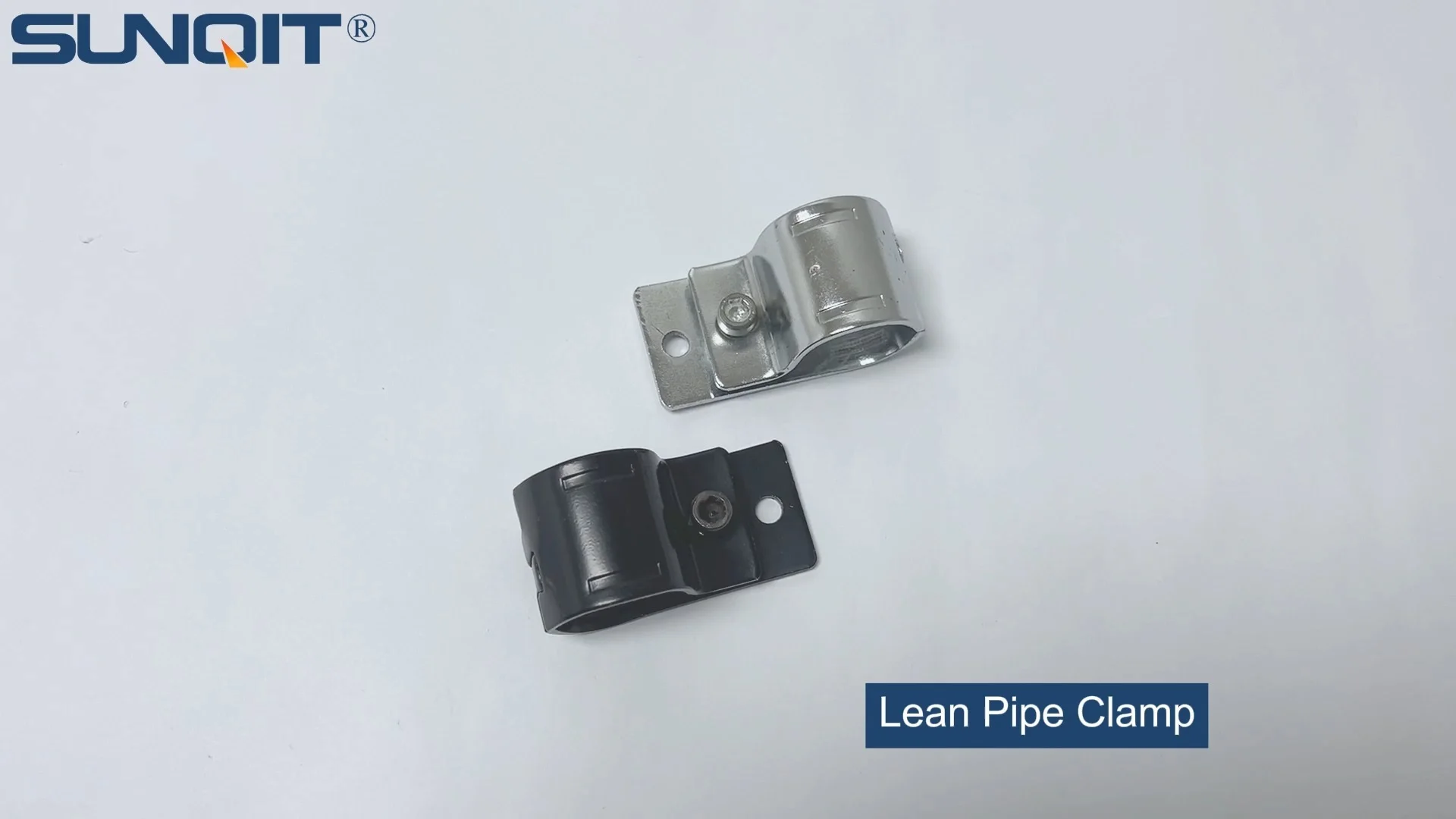
Lean Pipe Clamp
Lean pipe clamp is used for rack system hang monitor or other panel for workbenck, flowrack in production daily use.
In the world of manufacturing, where every second counts and efficiency is the lifeblood of success, the difference between a struggling production line and a thriving one often lies in the tools and systems that keep operations running smoothly. For decades, lean manufacturing has been the gold standard for eliminating waste, streamlining workflows, and boosting productivity—but even the best lean strategies falter without the right components to bring them to life. Enter the unsung hero of modular production: the Lean Pipe Clamp B. This unassuming yet versatile connector has quietly revolutionized how factories, workshops, and assembly plants design their workspaces, proving that sometimes the smallest parts make the biggest impact. In this article, we'll dive into three real-world success stories where Lean Pipe Clamp B became the cornerstone of transformative change, turning inefficiency into opportunity and chaos into clarity.
Case Study 1: Automotive Parts Manufacturer Cuts Assembly Time by 30% with Custom Lean Pipe Workbenches
When John Martinez, production manager at PrecisionDrive Automotive Parts, first walked into his facility's main assembly line in early 2023, he was greeted by a familiar sight: workers stretching to reach tools, parts stacked haphazardly on generic steel tables, and a bottleneck at Station 3 that left half the line waiting idle for hours each day. "We were producing 500 brake calipers daily, but it felt like pushing a boulder uphill," he recalls. "Our workstations were one-size-fits-all, our parts storage was a maze, and every time we switched between product models, setup took 45 minutes—time we couldn't afford to waste."
PrecisionDrive's problem wasn't unique. Like many automotive suppliers, they faced pressure to increase output while reducing costs, all while adapting to frequent design changes. John knew lean manufacturing was the answer, but traditional fixed workbenches and rigid shelving felt too inflexible. That's when his team stumbled on a solution: modular lean pipe systems, anchored by the but powerful Lean Pipe Clamp B.
"At first, I was skeptical," John admits. "How could a simple clamp change our entire line?" But after consulting with a lean system supplier, he realized the potential: Lean Pipe Clamp B's ability to connect steel or aluminum lean pipes in seconds—no welding, no drilling, no specialized tools—meant they could build custom workstations tailored to their exact needs. "We started with Station 3, the bottleneck. Using 28mm steel lean pipes and Lean Pipe Clamp B, we designed a U-shaped workbench with tool holders mounted directly above the assembly area, parts bins within arm's reach, and a built-in flow rack below for incoming components. The clamps let us adjust the height from 75cm to 90cm in 5 minutes to fit taller workers, and we added a small conveyor along the back to move finished parts to the next station without lifting."
The results were immediate. Workers at Station 3 reported spending 70% less time searching for tools, and setup time for model changes dropped from 45 minutes to 15. Encouraged, John's team expanded the project, using Lean Pipe Clamp B to build flow racks for raw materials (each rack holding 30% more parts than the old shelving) and reconfiguring the entire line into a smoother, more ergonomic layout. "By the end of the quarter, we were producing 650 calipers daily—30% more than before—with the same number of workers," John says. "And the best part? When we launched a new caliper model last month, we retooled the entire line in a weekend using the same clamps and pipes. No downtime, no extra costs. That's the power of flexibility."
Case Study 2: Electronics Plant Reduces Static Damage by 82% with ESD Workstations Built on Aluminum Lean Pipe
For Lisa Wong, operations director at TechFlow Electronics, static electricity was more than a nuisance—it was a crisis. Her plant assembles sensitive circuit boards for medical devices, where even a tiny electrostatic discharge (ESD) can fry components and lead to costly defects. "We were seeing a 5% defect rate, which might not sound high until you realize that's 250 faulty boards a week," she explains. "Our old workstations were wooden tables with plastic mats, but they weren't grounded properly, and parts were constantly getting zapped. Plus, our material flow was a disaster—components came in bulk bins, and workers had to walk 20 feet to fetch resistors or capacitors, breaking their focus."
TechFlow needed a solution that addressed two critical issues: ESD protection and workflow efficiency. After researching options, Lisa's team partnered with a supplier specializing in ESD workbenches and aluminum lean pipe systems. "Aluminum was a game-changer," she notes. "Unlike traditional steel pipes, aluminum lean pipe is lightweight but durable, and it conducts electricity, making it perfect for grounding. But the real star was the Lean Pipe Clamp B. It let us build ESD workstations that were both static-safe and completely customizable."
The team replaced all wooden tables with ESD workbenches constructed from aluminum lean pipe and Lean Pipe Clamp B. Each workstation featured a grounded ESD mat, a built-in tool rail with anti-static holders, and a flow rack integrated into the side, using 1-inch swivel roller balls to slide component trays directly to the worker. "The clamps made it easy to add accessories," Lisa says. "We mounted magnifying lamps for inspecting small parts, added adjustable shelves for documentation, and even attached small conveyor sections between workstations using plastic roller track guide rails. Everything was grounded through the aluminum pipes, so static buildup became a thing of the past."
Within three months, the results spoke for themselves: defect rates plummeted from 5% to 0.9%, saving the company over $120,000 annually in scrap and rework. Material handling time dropped by 35%, as workers no longer wasted steps fetching parts. "Our operators love it too," Lisa adds. "The workstations adjust to their height, the tools are right where they need them, and they don't have to worry about ruining a board with static. It's not just about efficiency—it's about pride in their work."

Case Study 3: Small Furniture Workshop Triples Output with Space-Saving Flow Racks and Turnover Trolleys
Not all success stories happen in sprawling factories. For Maria Gonzalez, owner of ArtisanWood Furniture, a 2,000-square-foot workshop in Portland, Oregon, the challenge was simple: how to grow production without expanding her space. "We make custom dining chairs and tables, and demand was picking up, but our workshop was packed," she says. "Lumber was stacked against the walls, finished pieces cluttered the floor, and our workbenches were old kitchen tables—some too low, some too high. My four employees were tripping over tools, and we could barely fit two assembly stations at a time."
Maria knew she needed to go lean, but she assumed modular systems were too expensive for a small business. That changed when a friend in manufacturing mentioned Lean Pipe Clamp B. "I looked it up and was shocked at how affordable it was," she recalls. "A basic kit with pipes, clamps, and a few accessories cost less than a new workbench. We ordered a trial set and started experimenting."
The first project was a set of adjustable lean pipe workbenches. Using basic aluminum tubes and Lean Pipe Clamp B, Maria's team built two workstations that could be raised or lowered by loosening the clamps and sliding the pipes—perfect for switching between chair legs (assembled standing) and table tops (assembled seated). "That alone saved us from buying four different tables," Maria laughs. Next, they tackled storage: using flow racks with roller tracks and Lean Pipe Clamp B, they mounted vertical racks on the walls to hold lumber, freeing up floor space. "We used 0.5-inch swivel roller balls on the racks, so when we need a 2x4, we just slide it down instead of digging through a pile," she explains. "It's like having a lumber vending machine."
Finally, they built turnover trolleys with casters, using Lean Pipe Clamp B to connect the frame and add shelves. "Now, instead of carrying finished chairs one by one to the finishing room, we stack four on a trolley and roll them over," Maria says. "It's cut our material handling time in half."
The transformation was staggering. In six months, ArtisanWood went from producing 15 chairs a week to 45, all in the same 2,000-square-foot space. "We didn't add a single employee—we just stopped wasting time and space," Maria says. "The Lean Pipe Clamp B made it possible to adapt as we grew. Last month, we added a third workstation in the corner we used to store scrap wood. It's not just a clamp; it's a growth tool."
| Customer | Industry | Key Challenge | Solution Components | Before (Metric) | After (Metric) | Improvement |
|---|---|---|---|---|---|---|
| PrecisionDrive Automotive | Automotive Parts | Bottlenecks at assembly stations; long setup times | Lean Pipe Clamp B, lean pipe workbenches, flow racks, conveyor | 500 calipers/day; 45-min setup time | 650 calipers/day; 15-min setup time | 30% higher output; 67% faster setup |
| TechFlow Electronics | Electronics Assembly | 5% static-related defects; inefficient material flow | Lean Pipe Clamp B, ESD workbench, aluminum lean pipe, swivel roller balls | 5% defect rate; 20ft worker travel per hour | 0.9% defect rate; 13ft worker travel per hour | 82% fewer defects; 35% less material handling time |
| ArtisanWood Furniture | Custom Furniture | Limited space; low production capacity | Lean Pipe Clamp B, adjustable lean pipe workbenches, flow racks, turnover trolleys | 15 chairs/week; 2,000 sq ft used for storage | 45 chairs/week; 1,500 sq ft used for storage | 200% higher output; 25% space saved |
What do an automotive plant, an electronics factory, and a small furniture workshop have in common? They all faced unique challenges—bottlenecks, defects, space constraints—and they all found a solution in the same humble component: the Lean Pipe Clamp B. These stories aren't just about tools; they're about empowerment. When teams can design, build, and reconfigure their workspaces in hours instead of weeks, when they can adapt to new products or worker needs on the fly, and when they can turn wasted motion into productive work, something powerful happens: they stop working
around
their environment and start working
with
it.
Lean Pipe Clamp B may be small, but its impact is mighty. It's a reminder that in manufacturing, innovation doesn't always require groundbreaking technology—it requires flexibility, creativity, and the right parts to bring ideas to life. Whether you're running a multinational production line or a family-owned workshop, the lesson is clear: the future of efficient manufacturing isn't rigid. It's modular. It's adaptable. And it all starts with a clamp.