- Company Articles
- Products and Technology
- Application Cases
- Customer Success: Three Way Lean Pipe Joint Implementation Stories

Customer Success: Three Way Lean Pipe Joint Implementation Stories
Related Product
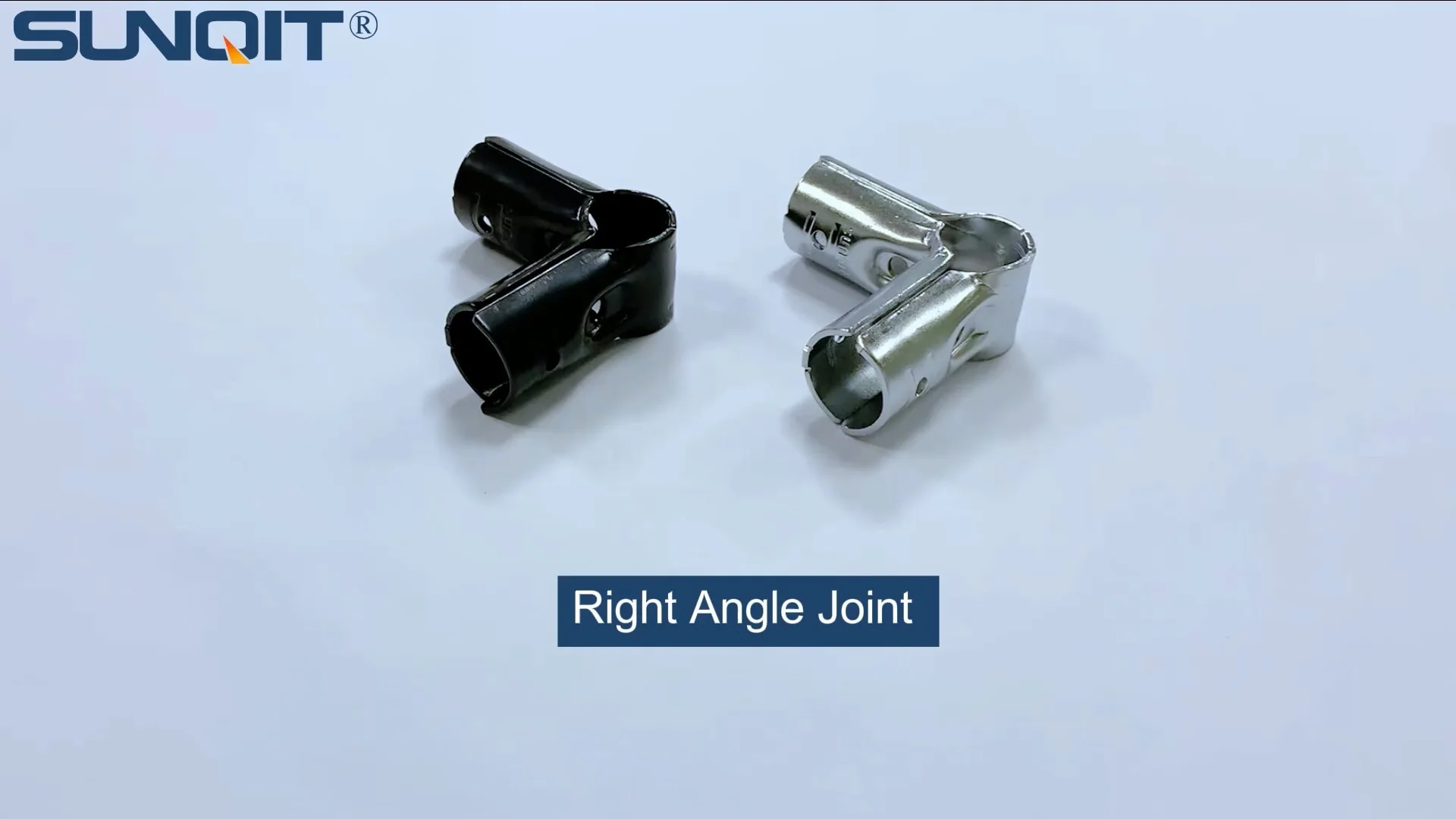
Three Way Lean Pipe Joint
Three way lean pipe joint for 3 pcs 28MM lean pipe connection in straight angle, which used widely in workbench, flow rack, hand trolley frame connection.
In the world of manufacturing, distribution, and assembly, the difference between stagnation and success often lies in the tools that keep operations moving. Rigid, one-size-fits-all systems can leave teams frustrated, workflows tangled, and growth stunted. But what if there was a simple, adaptable solution that could transform chaos into order—without breaking the bank? Enter the three way lean pipe joint : a small but mighty component that's quietly revolutionizing how businesses build, organize, and optimize their workspaces. Below, we dive into real-world stories of companies that turned their operational challenges into triumphs, all thanks to the flexibility of three way lean pipe joints and complementary tools like lean pipe workbenches , flow racks , and aluminum profiles .
From Chaos to Clarity: How Three Way Lean Pipe Joints Solved These 4 Industries' Biggest Headaches
Case Study 1: Streamlining Assembly Lines at PrecisionTech Electronics
Industry: Electronics Manufacturing | Company Size: 250+ Employees | Location: Austin, Texas
PrecisionTech Electronics, a mid-sized manufacturer of circuit boards and small electronic components, was drowning in inefficiency. Their assembly lines, once state-of-the-art, had grown cluttered and rigid. Workers spent 15-20 minutes per shift just searching for tools or adjusting workstations to fit different product sizes. "Our old workbenches were bolted to the floor—great for stability, terrible for adaptability," recalls Maria Gonzalez, PrecisionTech's Operations Manager. "When we launched a new line of miniaturized sensors, we realized our setup was holding us back. We needed something that could grow with us, not against us."
The team considered expensive custom workstations but hesitated at the price tag. Then, during a trade show, they discovered a supplier specializing in lean manufacturing solutions—including three way lean pipe joints. "At first, I was skeptical," Maria admits. "How could a few metal joints and pipes solve our problems? But when the supplier showed us how quickly we could build, modify, and reconfigure workbenches using these joints, I was sold."
PrecisionTech's solution centered on lean pipe workbenches built with three way lean pipe joints. The joints allowed workers to connect pipes at multiple angles, creating shelves, tool holders, and even integrated ESD (Electrostatic Discharge) mats—critical for protecting sensitive electronics. "We built 12 workstations in a week, and each one was tailored to a specific task," Maria says. "The soldering station has a tilted shelf for better visibility; the testing station has extra storage for diagnostic tools. And if we need to add a new component? We just add another pipe and joint—no tools, no contractors."
But the transformation didn't stop at workbenches. The team also used three way lean pipe joints to construct flow racks along the assembly line. These racks, with roller tracks (another key accessory), let components glide from one station to the next, reducing manual lifting and cutting down on bottlenecks. "Before, parts sat in bins on the floor; now they flow seamlessly. Our error rate dropped by 22% in the first month alone," Maria notes. "And the best part? We didn't have to shut down production to install any of it. The joints are so easy to use, our own maintenance team handled the setup during off-hours."
Today, PrecisionTech's assembly line is unrecognizable. "Walk through our facility now, and you'll see a rhythm—workers moving with purpose, tools within arm's reach, parts flowing like water," Maria says with a smile. "We've increased output by 30% and cut training time for new hires by half, because the workstations are intuitive. The three way lean pipe joint wasn't just a purchase; it was an investment in our team's ability to adapt and thrive."
"I used to dread our weekly production meetings because all we talked about was bottlenecks. Now? We're brainstorming new product lines. That's the power of a flexible workspace." — Maria Gonzalez, Operations Manager, PrecisionTech Electronics
Case Study 2: Speeding Up Order Fulfillment at AutoParts Direct
Industry: Automotive Parts Distribution | Company Size: 150 Employees | Location: Detroit, Michigan
AutoParts Direct, a distributor supplying independent repair shops with everything from brake pads to alternators, faced a different kind of challenge: space. Their 40,000-square-foot warehouse was bursting at the seams, with inventory stacked haphazardly and order pickers wasting hours navigating tight aisles. "We were processing 500+ orders a day, but our picking time was through the roof," says James Chen, Warehouse Manager. "Parts for a single order might be in three different corners of the warehouse. Our team was exhausted, and customers were complaining about delays."
James and his team tried reorganizing inventory by popularity, but the fixed metal shelving they'd relied on for years limited their options. "The shelves were either too tall, too short, or too deep—nothing fit our mix of small screws and large engine parts," he explains. "We needed a storage system that could flex with our inventory, not the other way around."
A consultant recommended exploring lean material handling solutions, and James soon connected with a supplier specializing in aluminum profiles and three way lean pipe joints. "The supplier sent a rep who walked our warehouse and asked questions: What parts move fastest? Where are the bottlenecks? Then they sketched out a plan using flow racks and conveyor systems built with three way lean pipe joints and aluminum profiles," James recalls. "I was worried about cost, but they showed us how the modular design would let us start small and expand as needed."
AutoParts Direct started with a pilot project: a 50-foot section of the warehouse dedicated to high-turnover parts. Using three way lean pipe joints, aluminum profiles, and roller tracks, they built flow racks that tilted slightly forward, letting parts "flow" to the front as stock was picked. "It's like a gravity-fed system—no more digging to the back of the shelf," James says. "We also added a small conveyor between the flow racks and packing stations, so picked parts glide directly to the team wrapping orders. No more carrying heavy bins across the warehouse."
The results were immediate. "Picking time for the pilot section dropped by 45%," James reports. "We expanded the system to cover 70% of the warehouse within three months. Now, our fastest-moving parts are in flow racks, medium-movers in adjustable shelving (also built with three way joints), and slow-movers in compact storage. Our order fulfillment time went from 4 hours to 2.5 hours, and we've cut overtime by 30%."
Perhaps the biggest surprise? The system's durability. "We were worried the pipe joints would loosen over time, but they're rock-solid," James says. "We've reconfigured the flow racks twice already—once to accommodate a new line of hybrid car parts—and the joints held up perfectly. It's like having a warehouse that can rearrange itself."
"I used to have team members quitting because the work was so physically draining. Now? They're asking when we'll 'lean-ify' the rest of the warehouse. That's the best feedback I could ask for." — James Chen, Warehouse Manager, AutoParts Direct
Case Study 3: Compliance and Flexibility at MediPro Devices
Industry: Medical Device Assembly | Company Size: 180 Employees | Location: Boston, Massachusetts
MediPro Devices, a manufacturer of surgical tools and diagnostic equipment, operates in one of the most regulated industries on the planet. "Compliance isn't optional—it's our lifeline," says Dr. Elena Patel, Quality Assurance Director. "When we expanded into robotic surgical instruments, we needed workstations that met strict FDA and ISO standards for cleanliness, ESD protection, and traceability. Our old setup was a patchwork of fixed benches and plastic bins, and audits were becoming stressful."
The challenge? MediPro's new instruments came in varying sizes, from tiny scalpels to large robotic arms. "A one-size-fits-all workstation wasn't going to work," Elena explains. "We needed something that could be sanitized easily, adjusted for different tools, and documented as 'validated' for each product line. Custom stainless-steel workstations were quoted at $15,000 each—way beyond our budget."
During a compliance seminar, Elena learned about lean manufacturing in medical settings. "The speaker mentioned three way lean pipe joints as a cost-effective alternative to custom setups," she says. "I was hesitant at first—medical device assembly requires precision, and I worried 'modular' would mean 'unreliable.' But when I researched, I found suppliers offering medical-grade materials, including stainless steel pipe series and ESD-safe components."
MediPro partnered with a supplier to design ESD-compliant workbenches using three way lean pipe joints, stainless steel pipes, and aluminum profile accessories. "The joints are smooth, with no crevices where bacteria can hide—critical for our cleanroom," Elena notes. "We added adjustable shelves with clear acrylic dividers (to prevent cross-contamination) and integrated tool hooks that can be moved without tools. Each workstation has a unique ID, and we keep records of every modification—perfect for audits."
The flexibility paid off when MediPro launched a new line of miniaturized endoscopes. "Instead of buying new workstations, we reconfigured three existing ones in a day," Elena says. "We lowered the height, added smaller shelves, and swapped out standard mats for conductive ones. The FDA inspector who visited last quarter was impressed—she said it was the most organized assembly line she'd seen all year."
Beyond compliance, the new setup boosted morale. "Our technicians used to complain about back pain from hunching over fixed-height benches," Elena adds. "Now, they adjust their workstations to their height—no more straining. Absenteeism is down, and we've had zero injuries related to workstation ergonomics in six months."
Case Study 4: Maximizing Space at ArtisanWood Furniture
Industry: Custom Furniture Manufacturing | Company Size: 12 Employees | Location: Portland, Oregon
Not all success stories involve large corporations. ArtisanWood Furniture, a small workshop specializing in handcrafted tables and chairs, faced a problem familiar to many small businesses: limited space. "Our 1,200-square-foot shop was packed—lumber stacked against walls, tools scattered on tables, finished pieces taking up floor space," says owner Tom Wright. "I could barely walk between stations without tripping over a saw or a stack of oak planks. We were turning down orders because we couldn't keep up with production in such a cramped space."
Tom considered moving to a larger facility but couldn't afford the rent hike. "I started researching 'small-space manufacturing hacks' and stumbled on lean pipe systems," he says. "I'd never heard of three way lean pipe joints, but the idea of building my own storage and workbenches sounded too good to pass up. I ordered a starter kit online—pipes, joints, a few casters—and spent a weekend experimenting."
Tom's first project: a mobile workbench on casters, built with three way lean pipe joints and basic aluminum tubes. "I added a plywood top, tool hooks, and a shelf for clamps. Now, I can roll it to wherever I'm working, then tuck it away when I'm done," he explains. Emboldened, he built a series of turnover trolleys and racks for lumber storage. "The racks are tall but narrow, so they fit along the walls without blocking windows. The trolleys let me move raw materials from the saw to the assembly table without carrying heavy planks."
Perhaps the most impactful addition? A lean pipe workbench with a fold-down extension. "For large tables, I unfold the extension; for small chairs, I fold it up to save space," Tom says. "I even built a small flow rack for finished parts—legs, rails, hardware—so everything is within arm's reach when assembling a chair."
The results? "We've freed up 30% of our floor space," Tom reports. "I can now fit two assembly stations instead of one, and we're taking on 20% more orders. Best of all, the total cost for all the materials was under $2,000—way cheaper than moving. My team jokes that the three way lean pipe joint is our 'secret employee'—it does the heavy lifting without a paycheck."
Success by the Numbers: How Three Way Lean Pipe Joints Delivered ROI Across Industries
| Company | Industry | Key Challenge | Solution Components | Measurable Outcomes |
|---|---|---|---|---|
| PrecisionTech Electronics | Electronics Manufacturing | Rigid workstations; inefficient assembly lines | Three way lean pipe joints, lean pipe workbenches, flow racks, roller tracks | 30% output increase; 22% error reduction; 50% faster training |
| AutoParts Direct | Automotive Distribution | Slow order picking; disorganized inventory | Three way lean pipe joints, aluminum profiles, flow racks, conveyor | 45% faster picking time; 30% overtime reduction; 2.5-hour fulfillment time |
| MediPro Devices | Medical Device Assembly | Compliance risks; non-adjustable workstations | Three way lean pipe joints, stainless steel pipe series, ESD workbenches | FDA audit approval; 0 ergonomic injuries; 1-day reconfiguration time |
| ArtisanWood Furniture | Custom Furniture | Limited space; inefficient material handling | Three way lean pipe joints, turnover trolleys and racks, mobile workbenches | 30% floor space freed; 20% more orders; $2,000 total investment |

The Common Thread: Flexibility That Drives Results
From electronics plants to small woodshops, these stories share a core truth: in today's fast-changing business landscape, flexibility isn't a luxury—it's essential. The three way lean pipe joint, as it may seem, is the backbone of that flexibility. It turns rigid systems into adaptable ecosystems, where workbenches, flow racks, and conveyor lines can evolve with your needs, not against them.
Whether you're struggling with space, inefficiency, compliance, or cost, the lesson is clear: you don't need to overhaul your entire operation to see change. Start small—a single workbench, a section of flow racks—and let the results speak for themselves. As Maria from PrecisionTech puts it: "We didn't just buy pipe joints; we bought a mindset. A mindset that says, 'We can do better, and we can do it ourselves.'"
So, what's your operational headache? Chances are, the solution is simpler than you think—and it might just start with a three way lean pipe joint.