- Company Articles
- Products and Technology
- Product knowledge
- Designing a Flexible Workstation: Role of Parallel Lean Pipe Joint One Side Rotatory

Designing a Flexible Workstation: Role of Parallel Lean Pipe Joint One Side Rotatory
Related Product
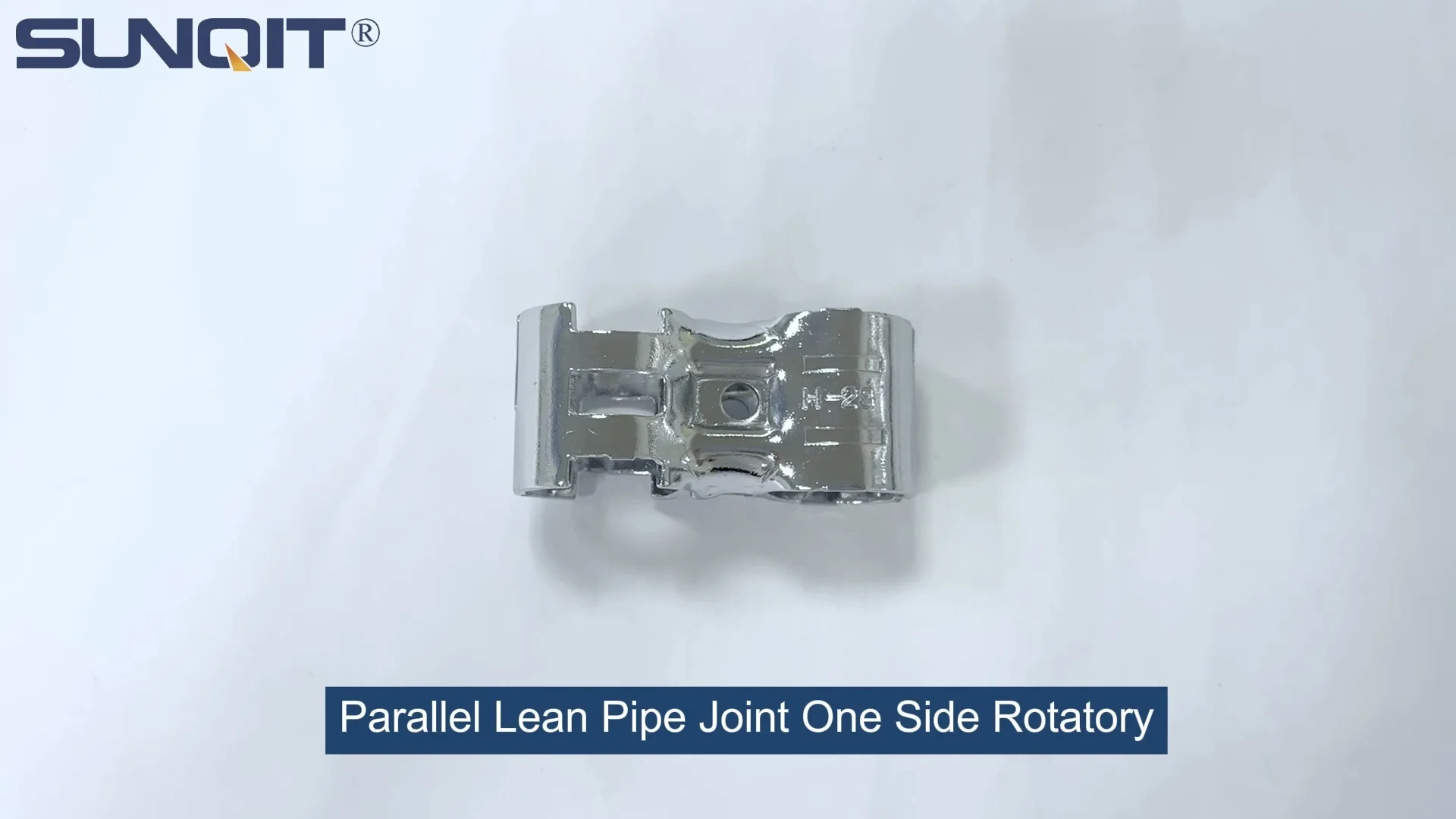
Parallel Lean Pipe Joint One Side Rotatory
Parallel rotatory lean pipe joint, for 2 pcs 28mm pipe conenction in parallel direction with one side rotatory function.
Walk into any modern manufacturing facility, and you'll likely notice a quiet revolution unfolding on the shop floor. Gone are the days of, bolted-down workstations that stay the same for years—if not decades. Today's production lines buzz with adaptability: workbenches that reconfigure in minutes, material racks that adjust to new parts, and tools that move where workers need them most. At the heart of this transformation? Modular components designed to keep pace with the ever-shifting demands of modern manufacturing. And among these components, one small but mighty part stands out: the Parallel Lean Pipe Joint One Side Rotatory. This unassuming joint isn't just a piece of hardware; it's a game-changer for anyone tasked with building workstations that can keep up with change.
In a world where customer demands swing from bulk orders to custom one-offs, and production runs shrink from thousands to dozens, rigidity is the enemy. A workstation that worked perfectly for last month's product might slow things to a crawl today. Workers waste time contorting around fixed shelves, managers scramble to budget for new equipment, and teams fall behind on deadlines—all because the tools they rely on can't adapt. But what if your workstation could evolve as quickly as your needs do? That's the promise of modular lean systems, and the Parallel Lean Pipe Joint One Side Rotatory is a key player in making that promise a reality.
Understanding Lean Pipe and Modular Workstation Basics
Before diving into the specifics of the Parallel Lean Pipe Joint One Side Rotatory, let's take a step back and understand the foundation it's built on: lean pipe systems. If you're not familiar with lean pipe (sometimes called "flexible pipe" or "kitchen pipe" in casual shop talk), think of it as the building block of modular workstations. Traditionally made from steel pipes coated in plastic (often white or black), modern lean pipe systems now also include aluminum variants—lighter, more corrosion-resistant, and just as strong. These pipes, combined with a variety of joints and accessories, let you build everything from simple workbenches to complex assembly lines, all without welding or heavy tools.
The magic of lean pipe lies in its simplicity. Unlike traditional metal fabrication, which requires skilled welders and custom cuts, lean pipe systems use a "build-as-you-go" approach. You cut pipes to length with a basic saw, connect them with joints, and secure accessories like shelves, tool hooks, or roller tracks using clamps. Need to add a shelf? Slide on a joint, tighten a screw, and you're done. Want to move the entire workstation? Swap fixed feet for casters, and roll it to a new location. This modularity isn't just convenient—it's cost-effective. Instead of replacing an entire workstation when needs change, you reconfigure the existing one, saving on materials and labor.
But lean pipe alone isn't enough. The real flexibility comes from the joints that hold the system together. Fixed joints work for static setups, but when you need parts of the workstation to move, rotate, or adjust, specialized joints become essential. That's where the Parallel Lean Pipe Joint One Side Rotatory enters the picture. It's part of a broader family of rotational joints, but its unique design solves a specific problem: how to connect parallel pipes while allowing one side to rotate freely. Imagine a workbench shelf that needs to stay parallel to the main frame but tilt up when you need extra clearance, or a tool holder that swivels out of the way when not in use. That's the kind of movement this joint enables—smooth, controlled, and repeatable.
To put it in perspective, think about a traditional workstation with a fixed shelf. If you need to store taller items underneath, you're out of luck—you either remove the shelf entirely (losing storage space) or buy a new workstation. With a Parallel Lean Pipe Joint One Side Rotatory, you can simply rotate the shelf up, secure it in place, and have all the vertical space you need. When the taller items are gone, rotate it back down. No disassembly, no wasted time, no new equipment. It's adaptability at its most practical.
The Star Player: Parallel Lean Pipe Joint One Side Rotatory
So, what exactly is the Parallel Lean Pipe Joint One Side Rotatory, and what makes it so special? Let's break it down. At first glance, it looks like a typical lean pipe joint—small, metal, with holes for connecting pipes. But flip it over, and you'll notice a key difference: one side of the joint is fixed, while the other can rotate 180 degrees. This rotation isn't just a party trick; it's engineered to be smooth, stable, and load-bearing. The joint uses a combination of bearings and locking mechanisms to let you pivot one pipe relative to the other, then lock it in place with a simple twist of a lever or screw. It's designed to handle the daily wear and tear of a busy shop floor, supporting tools, materials, and even small assemblies without slipping or wobbling.
To understand why this matters, let's consider a common scenario: a workbench used for electronics assembly. On Monday, the team is assembling small circuit boards, so they need a flat surface with tool holders close at hand. On Tuesday, they switch to larger components that require a tilted work surface to avoid straining their necks. With a traditional fixed workbench, they'd need to prop up the surface with blocks or invest in an expensive adjustable table. With a workstation built using Parallel Lean Pipe Joints, though, the solution is simpler: the surface is mounted on rotatory joints. Loosen the locks, tilt the surface to the ideal angle (say, 30 degrees), retighten, and they're ready to go. When Wednesday brings back the small boards? Tilt it flat again. It's that easy.
Another example: material flow. Many workstations include roller tracks to slide parts from one station to the next. But what if the production line needs to switch from left-to-right flow to right-to-left for a special order? With fixed roller tracks, you'd need to disassemble and rebuild the entire rack. With rotatory joints, you can pivot the tracks into the new orientation, lock them, and resume production. The Parallel Lean Pipe Joint One Side Rotatory turns what was once a half-day project into a five-minute task.
But the benefits go beyond speed. These joints also boost ergonomics—a critical factor in reducing worker fatigue and injuries. A study by the Occupational Safety and Health Administration (OSHA) found that poor workstation ergonomics is a leading cause of musculoskeletal disorders in manufacturing. When workers have to reach, bend, or twist to access tools or materials, they're at risk. Rotatory joints let you adjust work surfaces, shelves, and tool holders to fit each worker's height and reach. A tall worker can raise a shelf; a shorter one can lower it. No more one-size-fits-all setups—just workstations that adapt to the people using them.

Designing a Workstation with the Parallel Lean Pipe Joint One Side Rotatory
Now that we understand what the Parallel Lean Pipe Joint One Side Rotatory does, let's talk about how to use it in practice. Designing a flexible workstation isn't about throwing parts together randomly—it's about starting with your specific needs, then choosing components that can grow with you. Let's walk through a real-world example: building a modular assembly workstation for a small automotive parts manufacturer. Their needs? A surface for assembling brake components, storage for tools and fasteners, and a roller track to move finished parts to the next station. Oh, and they need to reconfigure it every few weeks as they switch between different brake models.
Step one: Start with the frame. For stability, we'll use aluminum lean pipe—lightweight but strong enough to support the workstation's weight. We'll build a basic rectangular frame (say, 120cm wide x 80cm deep x 100cm tall) using straight joints for the vertical and horizontal pipes. But here's where the rotatory joints come in: instead of fixing the top shelf directly to the frame, we'll mount it using two Parallel Lean Pipe Joints One Side Rotatory, one on each side. This lets the shelf rotate up (to 90 degrees) when we need extra vertical space, or tilt forward slightly for better access to items stored below.
Step two: Add the work surface. On top of the frame, we'll attach a plywood or aluminum honeycomb panel (durable and lightweight) using clamps. But we'll also add a secondary, smaller surface—let's call it a "tool shelf"—mounted on rotatory joints. This shelf will hold frequently used tools (screwdrivers, wrenches, torque meters) and can swing out over the work surface when needed, then fold back when not in use. No more tools cluttering the main surface or workers reaching across the table to grab what they need.
Step three: Integrate material flow. Along one side of the workstation, we'll install a roller track using aluminum guide rails and plastic roller track guide rails (yellow, to make parts easy to spot). The roller track will connect to the workstation frame via—you guessed it—rotatory joints. This way, if the team needs to switch the direction of the track (from front-to-back to side-to-side), they can pivot it without rebuilding the entire system. We'll also add a small turnover trolley (built with lean pipe, of course) on casters, so finished parts can be wheeled to the next station without lifting.
Step four: Fine-tune with accessories. To keep the workstation organized, we'll add hooks for cables, bins for fasteners, and a small whiteboard for daily task lists—all mounted on adjustable arms connected via rotatory joints. Even the lighting can be adjusted: a flexible gooseneck lamp attached to the frame with a rotatory clamp, so it can shine exactly where the worker needs it.
The result? A workstation that's not just a piece of furniture, but a tool that adapts to the team. When the next brake model comes in with larger parts, they can rotate the top shelf up, tilt the tool shelf out of the way, and adjust the roller track to accommodate the new size—all in under 15 minutes. No new equipment, no downtime, no frustration. That's the power of modular design, and the Parallel Lean Pipe Joint One Side Rotatory is what makes that adaptability possible.
| Feature | Traditional Fixed Workstation | Modular Workstation with Parallel Lean Pipe Joints |
|---|---|---|
| Setup Time | 8–12 hours (requires welding, drilling, or professional installation) | 1–2 hours (no special tools; assemble with basic hand tools) |
| Reconfiguration Time | 4–8 hours (disassemble and rebuild; may require new parts) | 15–30 minutes (loosen locks, adjust, retighten) |
| Ergonomic Adjustability | Limited (fixed height, angle, and layout) | High (adjust height, tilt, and position of surfaces/tools) |
| Cost Over 5 Years | High (initial cost + cost of new workstations for changes) | Low (initial cost + minimal cost for new pipes/joints as needed) |
| Worker Satisfaction | Low (frustration with rigid setup; increased fatigue) | High (reduced strain; tools/space adapt to worker needs) |

Real-World Impact: Case Studies and Applications
It's one thing to talk about the benefits of the Parallel Lean Pipe Joint One Side Rotatory in theory, but let's look at how it performs in real shops. Take the example of a mid-sized automotive parts supplier in Michigan. A few years ago, they were struggling with a common problem: their workstations for assembling door handles were fixed, and every time they switched between models (which happened 3–4 times a month), the team spent half a day reconfiguring. Workers had to remove bolts, swap out shelves, and reposition tools—all while production ground to a halt. The company estimated they were losing 160 hours of production time annually just to workstation changes.
Then they invested in a modular lean system, with a focus on using Parallel Lean Pipe Joints One Side Rotatory for key components. The results were immediate. What used to take 4 hours now took 20 minutes. The team could rotate shelves up to make space for larger door handle assemblies, tilt work surfaces to reduce eye strain, and pivot roller tracks to align with new assembly steps. Within six months, they'd recouped the cost of the new system through saved production time. But the biggest win? Worker satisfaction. "It sounds small, but being able to adjust my workstation without asking for help makes me feel more in control," one assembler noted in a survey. "I don't waste time fighting the setup anymore—I just get the job done."
Another example comes from a electronics manufacturer in California that specializes in custom circuit boards. Their challenge? Each client order was unique, with parts ranging from tiny microchips to large power modules. Traditional workbenches with fixed tool rails meant workers were constantly reaching across the table or getting up to grab tools from a separate rack. The company installed modular workstations with rotatory-jointed tool arms, and the change was dramatic. Tool access time dropped by 40%, and error rates (due to fumbling with hard-to-reach tools) decreased by 15%. "We used to have a saying: 'If you can't reach it, you can't build it,'" the production manager joked. "Now, the tools come to us."
Even small businesses are reaping the rewards. A family-owned furniture workshop in Oregon, for instance, used to build custom cabinets with workstations that hadn't changed since the 1990s. When they started offering smaller, modern pieces (think floating shelves and wall-mounted desks), their old workbenches were too large and rigid. They switched to a lean pipe system with rotatory joints, allowing them to shrink workbench sizes for small projects and expand them for larger cabinets. "We're a small team—just five people—so we can't afford to have separate workstations for every product," the owner explained. "With these joints, one workstation does the job of three. It's like adding an extra pair of hands."

Beyond the Joint: Building a Complete Lean Ecosystem
While the Parallel Lean Pipe Joint One Side Rotatory is a standout component, it's important to remember that it doesn't work alone. To build a truly flexible workstation, you need to pair it with other modular elements that complement its strengths. Let's explore a few key accessories and components that enhance the joint's functionality:
Aluminum Profiles: While traditional lean pipe is great for many applications, aluminum profiles (extruded aluminum with T-slots) add another layer of versatility. The T-slots let you attach accessories (like shelves, bins, or monitors) anywhere along the profile, without drilling. Pair aluminum profiles with rotatory joints, and you've got a system that's both strong and infinitely adjustable. For example, a workbench frame built with aluminum profiles and rotatory joints can support heavier loads (like power tools) while still allowing for height adjustments.
Roller Track and Accessories: As we mentioned earlier, roller tracks are essential for moving materials efficiently. But not all roller tracks are created equal. Look for plastic roller track guide rails (grey or yellow) that are easy to clean and quiet—important for reducing shop floor noise. When combined with rotatory joints, these tracks become even more powerful, letting you create custom material flow paths that adapt to each job.
Casters and Wheels: What good is a reconfigurable workstation if you can't move it? Casters (especially swivel casters with brakes) turn your workstation into a mobile unit. Lock the brakes when you need stability, unlock them to roll the station to a new location, and use rotatory joints to adjust the setup once it's there. It's the ultimate in flexibility—your workstation can be both stationary and mobile, depending on the day's needs.
Workbench Tops: The surface of your workstation matters, too. Options like aluminum honeycomb panels are lightweight but strong, while ESD (electrostatic discharge) tops are a must for electronics assembly. When mounted on rotatory joints, these tops can tilt, rotate, or even be swapped out entirely (say, from an ESD top to a wooden top for heavier tasks) with minimal effort.
Conclusion: The Future of Workstations is Flexible
The Parallel Lean Pipe Joint One Side Rotatory might be small, but its impact is huge. In a manufacturing landscape where adaptability isn't just a nice-to-have but a survival skill, modular components like this joint are no longer optional—they're essential. They turn workstations from static obstacles into dynamic tools that empower workers, reduce waste, and keep production lines moving forward, no matter what the day brings.
But beyond the practical benefits, there's a deeper shift happening here. Flexible workstations aren't just about efficiency—they're about respect for the people who use them. When you give workers the ability to adjust their tools to fit their needs, you're telling them, "Your comfort and productivity matter." And that's a powerful message. It leads to happier teams, lower turnover, and a culture of continuous improvement—all of which are critical in today's competitive market.
So, whether you're building a new workstation from scratch or looking to upgrade an existing one, don't overlook the small components that make big change possible. The Parallel Lean Pipe Joint One Side Rotatory might not be the flashiest part of your setup, but it's the one that will keep your workstation—and your team—ready for whatever comes next. After all, in manufacturing, the only constant is change. Shouldn't your workstation change with it?