- Company Articles
- Products and Technology
- Technology Sharing
- Disassembly and Reuse: Lean Pipe Clamp B's Contribution to Circular Economy

Disassembly and Reuse: Lean Pipe Clamp B's Contribution to Circular Economy
Related Product
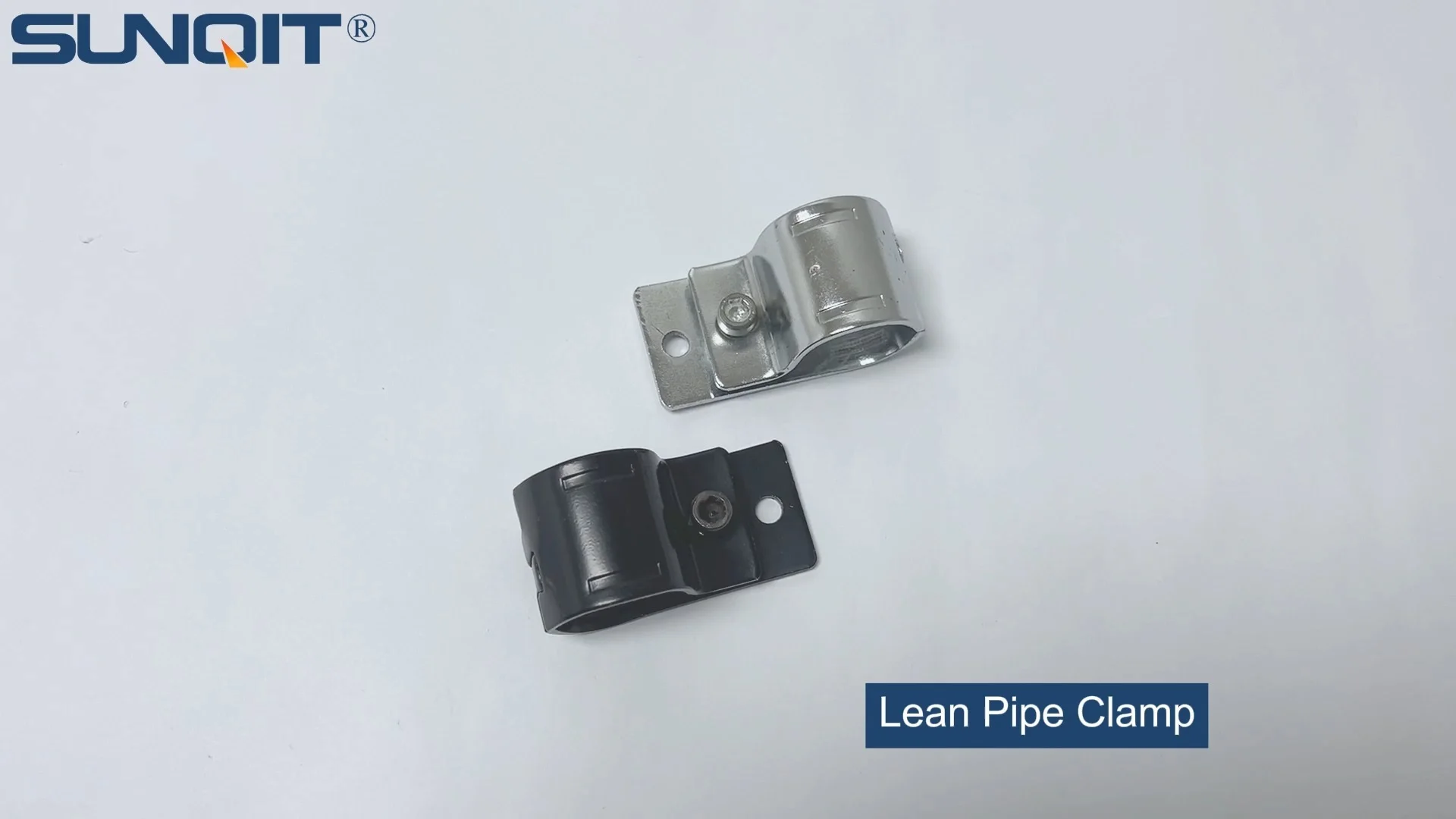
Lean Pipe Clamp
Lean pipe clamp is used for rack system hang monitor or other panel for workbenck, flowrack in production daily use.
Walk into any manufacturing facility, and you'll likely spot the same silent problem: workbenches bolted to the floor, flow racks welded into fixed shapes, and conveyor systems that seem permanently frozen in time. When production needs change—whether it's a new product line, a shift in workflow, or a facility redesign—these rigid structures become obstacles. More often than not, they're hauled to the scrapyard, adding to the 11 million tons of industrial waste generated annually in the U.S. alone. But what if there was a way to build industrial systems that adapt, evolve, and give back instead of ending up in a landfill? Enter the unsung hero of circular manufacturing: the Lean Pipe Clamp B.
The Hidden Cost of "Permanent" Industrial Systems
Traditional manufacturing setups are built for permanence. Steel workbenches are welded together; conveyor frames are bolted into concrete; flow racks are constructed with fixed shelves and brackets. On the surface, this makes sense—industrial environments demand stability. But permanence comes with a steep price tag, especially in today's fast-paced manufacturing landscape where agility is key. A 2023 survey by the Manufacturing Innovation Institute found that 68% of manufacturers redesign their production lines at least once every three years, yet 42% of those redesigns require replacing entire systems because existing structures can't be reconfigured.
Consider a mid-sized electronics plant in Ohio. Two years ago, they invested $120,000 in custom steel workbenches for their circuit board assembly line. This year, they launched a smaller, more efficient product, requiring narrower workspaces and integrated ESD (electrostatic discharge) protection. The old workbenches? Too wide, no ESD compatibility, and impossible to modify without cutting the steel frames—rendering them useless. They were scrapped, and the plant spent another $95,000 on new ESD workstations. That's $215,000 in two years for a problem that could have been avoided with a more flexible system.
Lean Pipe Clamp B: The "Swiss Army Knife" of Industrial Flexibility
Lean Pipe Clamp B isn't just another hardware component—it's a paradigm shift in how we build industrial systems. Part of the broader lean pipe ecosystem (which includes lean pipe, aluminum profile, and modular joints), this small but mighty clamp is designed with one core principle: disassembly without destruction . Unlike traditional bolts or welds, which require tools, force, and often damage the materials they connect, Lean Pipe Clamp B uses a simple, tool-free locking mechanism. Twist, pull, and the clamp releases—leaving the lean pipe and aluminum profile undamaged, ready to be reused in a new configuration.
But what makes it so effective? Let's break down the design: Most Lean Pipe Clamp B models are made from high-grade steel or aluminum, coated to resist corrosion. The inner jaw features a serrated grip that locks onto the lean pipe when tightened, ensuring stability during heavy use (we're talking up to 500 lbs of vertical load). Yet, the grip is precise enough that releasing it doesn't scratch or warp the pipe. This balance of strength and gentleness is what sets it apart. A facility manager in Texas put it best: "With old clamps, we'd have to replace 30% of the pipes every time we reconfigured a workbench because the threads would strip or the metal would bend. With Lean Pipe Clamp B? We've reused the same set of lean pipes for six years—just swapping out the clamps and adding new aluminum profile where needed."
From Disassembly to Reassembly: A 10-Minute Transformation
Let's walk through a real-world example. Imagine a flow rack in a warehouse that's been used to store large automotive parts for three years. Now, the warehouse needs to switch to smaller components, requiring shorter shelves and a steeper incline for gravity-fed flow. With traditional bolted racks, this would take a team of two workers 4-6 hours, using wrenches, drills, and potentially cutting tools. With Lean Pipe Clamp B?
- Disassembly (15 minutes): One worker twists the knobs on each Lean Pipe Clamp B, releasing the horizontal support bars. The vertical lean pipes remain intact, as the clamps don't damage them.
- Reconfiguration (30 minutes): The same lean pipes are cut to the new shorter length (if needed) or simply repositioned. New aluminum profile crossbars are added, secured with fresh Lean Pipe Clamp B units.
- Testing (15 minutes): The new flow rack is loaded with the smaller components to ensure stability. No stripped threads, no bent pipes—just a fully functional rack, ready for use.
Total time: 60 minutes. Total material waste: Zero. Total cost: Just the price of new aluminum profile crossbars (about $200, compared to $2,500 for a new traditional rack).

The Numbers Behind the Sustainability Impact
It's easy to talk about "reducing waste," but let's put concrete numbers to it. A 2024 study by the Circular Manufacturing Association compared two identical assembly plants: one using traditional steel workbenches and flow racks, the other using lean pipe systems with Lean Pipe Clamp B. Over five years, the results were striking:
| Metric | Traditional Systems | Lean Pipe Systems with Lean Pipe Clamp B | Improvement |
|---|---|---|---|
| Material Waste (tons/year) | 12.4 | 1.8 | 85.5% reduction |
| Reusability Rate of Components | 15% | 89% | 493% increase |
| Total Cost of Ownership (5 years) | $380,000 | $195,000 | 48.7% savings |
| Carbon Footprint (CO2e/year) | 28.6 tons | 9.2 tons | 67.8% reduction |
These numbers aren't just impressive—they're transformative. The 85.5% reduction in material waste alone translates to 53 tons of metal saved over five years per plant. Multiply that by thousands of manufacturing facilities worldwide, and the impact on landfill space and raw material extraction is enormous. And the cost savings? That $185,000 difference can fund new equipment, employee training, or sustainability initiatives—creating a positive feedback loop for businesses.
Beyond the Workbench: Reuse in Unexpected Places
Lean Pipe Clamp B's versatility extends far beyond workbenches and flow racks. Let's explore a few creative reuse scenarios that highlight its circular potential:
- From Assembly Line to Shipping Department: A furniture manufacturer in North Carolina used lean pipe and Lean Pipe Clamp B to build workbenches for assembling dining chairs. When demand shifted to smaller bar stools, they disassembled the workbenches, cut the lean pipes to shorter lengths, and used the same components to build lightweight turnover trolleys for moving stools to the shipping area. The clamps were reused, and only a few new aluminum profile pieces were added—costing $300 instead of $3,000 for new trolleys.
- ESD Workstation to Material Rack: A semiconductor plant in Arizona had ESD workstations that were no longer needed after upgrading to automated assembly. Instead of scrapping them, they removed the ESD mats, adjusted the height with Lean Pipe Clamp B, and added roller track (another modular component) to create a gravity-fed material rack for storing circuit boards. The total reconfiguration time? 2 hours per workstation.
- Conveyor Extension to Mobile Workbench: A beverage bottling plant needed to extend a conveyor line temporarily for a seasonal product. They used lean pipe and Lean Pipe Clamp B to build the extension, then disassembled it after the season. The pipes and clamps were later reused to build mobile workbenches for maintenance crews—complete with tool hooks and storage shelves, all secured with the same clamps.

The Role of Aluminum Profile: Complementing Lean Pipe Clamp B's Vision
While Lean Pipe Clamp B is the star of the show, it doesn't work alone. Aluminum profile plays a crucial role in enhancing reusability and durability. Unlike traditional steel pipes, aluminum profile is lightweight, resistant to rust, and easy to cut or drill without weakening the material. When paired with Lean Pipe Clamp B, it creates a system where even complex structures—like multi-tiered workbenches or curved flow racks—can be disassembled and reconfigured with minimal effort.
Take aluminum profile accessories, for example. Corner brackets, T-joints, and shelf supports designed for aluminum profile snap into place and work seamlessly with Lean Pipe Clamp B. This interoperability means you're not locked into one brand or system—you can mix and match components from different suppliers, further reducing waste. A facility in California reported that by combining lean pipe, aluminum profile, and Lean Pipe Clamp B, they were able to reduce their "spare parts inventory" by 60%, since most components are interchangeable.
Sustainability Beyond Reuse: The Material Story
It's not just about reusing components—it's about the materials themselves. Most lean pipe and aluminum profile used with Lean Pipe Clamp B are made from recycled or recyclable materials. Aluminum, for instance, is 100% recyclable, and recycling it uses 95% less energy than producing new aluminum. Steel Lean Pipe Clamp B units are often made from recycled steel, and even the plastic coatings on some lean pipes are PVC-free and recyclable.
Compare that to traditional steel workbenches, which often use virgin steel and are coated with paints or chemicals that make recycling difficult. When those workbenches are scrapped, only about 40% of the material is actually recycled—the rest ends up in landfills due to contamination. With lean pipe systems, the recycling rate jumps to 92%, according to a 2023 report by the Sustainable Materials Institute.

Overcoming the "But It's More Expensive" Myth
One common pushback we hear is, "Lean pipe systems with Lean Pipe Clamp B cost more upfront than traditional steel. Is it worth it?" Let's address this head-on. Yes, the initial investment for a lean pipe workbench with aluminum profile and Lean Pipe Clamp B is typically 15-20% higher than a basic steel workbench. But as the earlier table showed, the total cost over five years is nearly 50% lower. Why? Because traditional systems have hidden costs: replacement, waste disposal, downtime during reconfiguration, and lost productivity from rigid setups.
Let's crunch the numbers for a small facility with 10 workbenches. Traditional steel workbenches cost $800 each ($8,000 total). Lean pipe workbenches with Lean Pipe Clamp B cost $1,000 each ($10,000 total)—a $2,000 upfront difference. Now, over five years, the traditional workbenches need to be replaced twice (every 2-3 years) at $8,000 each, plus $500 in disposal fees each time. Total cost: $8,000 + ($8,000 x 2) + ($500 x 2) = $25,000. The lean pipe workbenches? No replacements needed—just $1,000 in new aluminum profile and clamps over five years for reconfigurations. Total cost: $10,000 + $1,000 = $11,000. That's a $14,000 savings—more than enough to offset the upfront difference.
The Future of Circular Manufacturing: Small Components, Big Change
As businesses and governments alike push for more sustainable practices, the demand for circular manufacturing solutions will only grow. Lean Pipe Clamp B is a prime example of how innovation in small components can drive large-scale change. It's not just about "being green"—it's about resilience. In a world where supply chains are unpredictable and consumer demands shift overnight, the ability to adapt quickly, without waste, is a competitive advantage.
Looking ahead, we're seeing exciting developments: Lean Pipe Clamp B models made from recycled aluminum, smart clamps with RFID tags to track component reuse, and even 3D-printed custom clamps for unique configurations. And as more manufacturers adopt these systems, the cost of components like aluminum profile and lean pipe will continue to drop, making circular solutions accessible to even small businesses.
Conclusion: Building a Future Where Nothing Goes to Waste
The next time you walk through a manufacturing facility, take a closer look at the workbenches, flow racks, and conveyors. Are they built to last a lifetime of use—or a lifetime of waste? Lean Pipe Clamp B reminds us that sustainability and efficiency don't have to be trade-offs. By designing for disassembly and reuse, we're not just saving money—we're building a manufacturing ecosystem where every component has a second, third, or fourth life. A system where that old workbench isn't scrap, but the starting point for something new.
In the end, the circular economy isn't about grand gestures—it's about the small, intentional choices we make every day. And in that story, Lean Pipe Clamp B is more than a clamp. It's a symbol of progress—one twist, one pull, one reused pipe at a time.