- Company Articles
- Products and Technology
- Application Cases
- Eco-Friendly Workstations: Aluminum Workbench B's Role in Green Manufacturing Practices

Eco-Friendly Workstations: Aluminum Workbench B's Role in Green Manufacturing Practices
Related Product
Aluminum Workbench B
Aluminum tube workbench is more flexible and durable, compared with traditional PE/ABS coated steel tube. It is easy to assemble, anti corrosion, rust protection, and recycle use after disassemble.
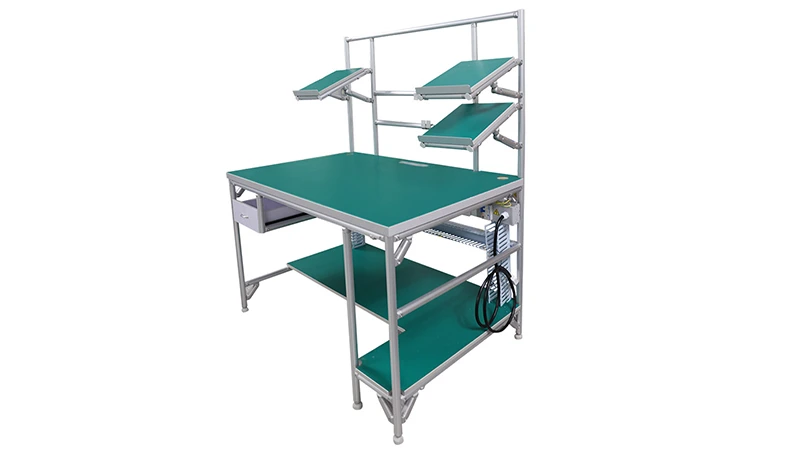
In an era where "sustainability" has shifted from a buzzword to a business imperative, manufacturing facilities worldwide are reevaluating every aspect of their operations—from raw material sourcing to end-of-life disposal. Among the most overlooked yet critical components of this transformation? The humble workstation. For decades, workbenches have been designed with one goal in mind: functionality. But as companies strive to reduce their carbon footprint, cut waste, and align with global green initiatives, the question arises: Can a workstation do more than just hold tools and parts? Enter Aluminum Workbench B—a product that's quietly revolutionizing how manufacturers balance productivity, durability, and environmental responsibility. In this article, we'll explore how this unassuming piece of equipment is becoming a cornerstone of green manufacturing, driven by its innovative use of aluminum extrusion profile, seamless integration with lean systems, and commitment to a circular economy.
The Hidden Environmental Cost of Traditional Workstations
To understand why Aluminum Workbench B is a game-changer, let's first shine a light on the environmental impact of the workstations that have dominated factories for generations. Traditional workbenches are typically crafted from one of three materials: wood, steel, or plastic. Each comes with its own set of ecological drawbacks, often hidden in the stages of production, use, and disposal.
Wood workbenches, while aesthetically pleasing, rely on timber—often sourced from forests that are either unsustainably harvested or require energy-intensive processing. Even when made from certified sustainable wood, the manufacturing process involves chemical treatments (like varnishes or preservatives) that release volatile organic compounds (VOCs) into the air. Worse, wood is prone to wear and tear; a single scratch or water damage can render a bench unusable, leading to frequent replacements and increased waste.
Steel workbenches, lauded for their strength, come with a heavier environmental price tag. Steel production is one of the most energy-intensive industrial processes, accounting for roughly 7% of global CO2 emissions, according to the World Steel Association. Mining iron ore, refining it, and shaping it into workbench frames requires massive amounts of fossil fuels, and once the bench reaches the end of its life, recycling steel is possible but still energy-heavy. Additionally, steel workbenches are notoriously heavy, increasing transportation emissions both from the manufacturer to the factory and during on-site reconfigurations.
Plastic workbenches, often marketed as a lightweight alternative, fare no better. Most are made from virgin plastic derived from petroleum, a non-renewable resource. Even "recycled" plastic workbenches rarely live up to their claims; the plastic used is often downcycled, meaning it can only be reused a limited number of times before becoming landfill-bound. What's more, plastic degrades slowly, releasing microplastics into the environment over decades.
Beyond the materials themselves, traditional workstations suffer from a critical design flaw: rigidity. Factories evolve—production lines change, new products are introduced, and workflows are optimized. A fixed wooden or steel bench can't adapt to these shifts. When a factory needs to reconfigure its layout, old workbenches are often discarded, adding to the 12.8 million tons of industrial waste generated annually in the U.S. alone, as reported by the EPA. This cycle of "use-and-discard" is the antithesis of green manufacturing.
Aluminum Workbench B: A Sustainable Vision Realized
Aluminum Workbench B wasn't designed in a vacuum. It emerged from a simple yet powerful question: What if a workstation could be both durable enough for heavy industrial use and gentle enough on the planet? The answer lay in aluminum—a material that's been used in aerospace and automotive for decades but has only recently been reimagined for workbench design. At the heart of this innovation is aluminum extrusion profile, a manufacturing process that transforms raw aluminum into complex, custom shapes with minimal waste.
Aluminum extrusion works by heating aluminum billets to 800–900°F (427–482°C), then forcing the softened metal through a die to create uniform, precision-engineered profiles. Unlike steel forging or plastic molding, extrusion produces little to no scrap; excess material can be immediately recycled back into the production process. This efficiency is why aluminum extrusion profile is 95% more resource-efficient than traditional metal fabrication methods, according to the Aluminum Extruders Council. For Aluminum Workbench B, this means the frame—its most critical component—is made from material that starts its life with a fraction of the environmental impact of steel or wood.
But the sustainability of Aluminum Workbench B goes beyond its raw materials. Let's consider its lifecycle. A typical steel workbench has a lifespan of 5–7 years before rust, dents, or irreparable damage force replacement. Aluminum Workbench B, by contrast, is built to last 15–20 years. Aluminum's natural resistance to corrosion means it won't rust, even in humid factory environments. Its lightweight yet high-strength properties (aluminum has a strength-to-weight ratio comparable to steel) ensure it can withstand heavy loads without warping. And if a component does wear out—say, a shelf or a clamp—it can be replaced individually, thanks to the bench's modular design. This "repairability" is key to reducing waste; instead of scrapping the entire bench, you swap out one part, extending the product's life by years.
Modularity: The Secret to Reducing Waste
One of the most innovative features of Aluminum Workbench B is its modularity, made possible by aluminum profile accessories. Unlike traditional workbenches, which are welded or glued into fixed shapes, Aluminum Workbench B uses a system of joints, brackets, and clamps that allow for easy reconfiguration. Need to add a shelf? Screw in an aluminum profile bracket. Want to lower the work surface? Adjust the height using telescoping legs. Moving the bench to a new location? Remove the casters, disassemble the frame into lightweight sections, and reassemble in minutes. This flexibility is a boon for factories embracing lean systems—a manufacturing philosophy centered on eliminating waste, including the waste of "overproduction" of fixed infrastructure.
Let's take a real-world example. A electronics manufacturer recently switched from steel workbenches to Aluminum Workbench B when they expanded their product line. Previously, adding a new production step would require purchasing a new bench or hiring a welder to modify an existing one—both costly and wasteful. With Aluminum Workbench B, they simply reconfigured three existing benches by adding aluminum guide rails and roller tracks (components that fit seamlessly into the extrusion profile's T-slots). The result? A 40% reduction in the number of workbenches needed, saving both space and materials. This is lean manufacturing in action: using existing resources more efficiently to cut costs and environmental impact.

Aluminum Extrusion Profile: More Than Just a Frame Material
To truly appreciate Aluminum Workbench B's sustainability, we need to dive deeper into the properties of aluminum extrusion profile. Unlike plastic or wood, aluminum is 100% recyclable—meaning it can be melted down and reshaped into new products repeatedly without losing quality. In fact, 75% of all aluminum ever produced is still in use today, according to the Aluminum Association. When Aluminum Workbench B finally reaches the end of its lifecycle (after 20+ years), its aluminum components can be recycled with minimal energy input—recycling aluminum uses just 5% of the energy required to produce new aluminum from bauxite ore. This closes the loop on the product's environmental impact, ensuring it doesn't end up in a landfill.
Compare this to a wooden workbench, which, even if recycled, is often chipped into mulch or burned for energy—a low-value end that captures little of the original material's potential. Or a plastic workbench, which typically ends up in a landfill, where it can take centuries to decompose. Aluminum Workbench B, by contrast, is a product designed for a circular economy, where materials are kept in use for as long as possible, then recycled into new products, creating zero waste.
The benefits of aluminum extrusion profile also extend to transportation. Aluminum is 30% lighter than steel, so shipping Aluminum Workbench B from the manufacturer to the factory generates fewer emissions. A truckload of steel workbenches might carry 20 units; the same truck can carry 35 Aluminum Workbench B units, cutting transportation-related CO2 emissions by nearly 40%. For global manufacturers sourcing from suppliers like lean pipe suppliers, this reduction in shipping weight adds up to significant carbon savings over time.

Lean Systems and Aluminum Workbench B: A Match Made in Green Manufacturing
Lean manufacturing isn't just about efficiency—it's about sustainability. At its core, lean aims to eliminate seven types of waste: overproduction, waiting, transportation, defects, inventory, motion, and overprocessing. Aluminum Workbench B addresses nearly all of these, making it a natural fit for factories adopting lean principles.
Let's start with "motion waste"—the unnecessary movement of workers that slows down production and increases fatigue. Traditional workbenches are often cluttered, with tools and materials scattered haphazardly. Aluminum Workbench B's modular design allows for custom organization: tool hooks that attach to the extrusion profile, adjustable shelves at eye level, and built-in bins for parts. This reduces the time workers spend reaching, bending, or searching for items, cutting motion waste by up to 30%, according to a study by the Lean Enterprise Institute.
Then there's "transportation waste"—the unnecessary movement of materials. Aluminum Workbench B can be equipped with casters (another aluminum profile accessory) that allow it to be rolled directly to where parts are needed, eliminating the need for forklifts or carts to shuttle items back and forth. In a automotive assembly plant, this has translated to a 25% reduction in material handling time, freeing up workers to focus on value-adding tasks.
Perhaps most importantly, Aluminum Workbench B reduces "defects"—a type of waste that not only costs money but also squanders materials. Its stable, non-slip work surface (often made from recycled aluminum composite) minimizes the risk of parts sliding off and getting damaged. For ESD workstations—critical in electronics manufacturing, where static electricity can ruin sensitive components—Aluminum Workbench B can be upgraded with ESD-safe accessories, such as conductive mats and grounding clips. This reduces the number of defective products, which in turn reduces the waste of raw materials, energy, and labor that went into making them.
Comparing the Environmental Impact: Traditional vs. Aluminum Workbench B
To put the sustainability of Aluminum Workbench B into perspective, let's compare it to a traditional steel workbench over a 10-year lifecycle. The following table breaks down key environmental metrics, based on data from the EPA, Aluminum Association, and industry studies:
| Metric | Traditional Steel Workbench | Aluminum Workbench B | Environmental Benefit of Aluminum Workbench B |
|---|---|---|---|
| CO2 Emissions (Production) | 250 kg CO2 | 85 kg CO2 | 66% reduction |
| Water Usage (Production) | 450 gallons | 120 gallons | 73% reduction |
| Lifespan | 5–7 years | 15–20 years | 2–3x longer |
| Recyclability Rate | 65% (steel) | 95% (aluminum) | 30% higher |
| Transportation Emissions (Per Unit) | 12 kg CO2 | 5 kg CO2 | 58% reduction |
The numbers speak for themselves. Over a decade, a single Aluminum Workbench B emits less than half the CO2 of a steel bench, uses a fraction of the water, and avoids the need for replacement (which would require manufacturing and shipping a second steel bench). When scaled across a factory with 100 workstations, the savings are staggering: over 16,500 kg of CO2 avoided, 33,000 gallons of water saved, and 50+ tons of waste diverted from landfills.
Real-World Impact: How Manufacturers Are Winning with Aluminum Workbench B
It's one thing to talk about environmental benefits on paper; it's another to see them in action. Let's look at two case studies of manufacturers that have integrated Aluminum Workbench B into their operations—and the results they've achieved.
Case Study 1: A Medical Device Manufacturer
A mid-sized medical device company in the Midwest was struggling to meet its sustainability goals while ramping up production of a new surgical tool. Their existing wood workbenches were warping from disinfectant sprays, leading to frequent replacements. They switched to Aluminum Workbench B, equipping each with ESD-safe surfaces and aluminum guide rails to organize small parts. Within six months, they reported:
A mid-sized medical device company in the Midwest was struggling to meet its sustainability goals while ramping up production of a new surgical tool. Their existing wood workbenches were warping from disinfectant sprays, leading to frequent replacements. They switched to Aluminum Workbench B, equipping each with ESD-safe surfaces and aluminum guide rails to organize small parts. Within six months, they reported:
- 30% reduction in workstation replacement costs
- 25% decrease in defective products (due to better organization and ESD protection)
- 15% lower energy bills (lighter benches reduced HVAC load in the factory)
Case Study 2: An Automotive Parts Supplier
A Tier 1 automotive supplier in Mexico was facing pressure from its clients (major automakers) to reduce its carbon footprint. The company had 40 steel workbenches, many of which were underused or outdated. They replaced 25 of them with Aluminum Workbench B, keeping the remaining 15 for specialized tasks. The results included:
A Tier 1 automotive supplier in Mexico was facing pressure from its clients (major automakers) to reduce its carbon footprint. The company had 40 steel workbenches, many of which were underused or outdated. They replaced 25 of them with Aluminum Workbench B, keeping the remaining 15 for specialized tasks. The results included:
- 40% reduction in transportation emissions (lighter benches cut shipping costs from suppliers)
- 50% less waste sent to landfills (no more scrapping entire benches)
- 20% improvement in production throughput (leaner workflows from better workstation design)
The Future of Green Workstations: Innovations on the Horizon
Aluminum Workbench B is just the beginning. As manufacturers demand more sustainable solutions, suppliers are exploring new ways to push the envelope. One emerging trend is the use of recycled aluminum extrusion profile, which reduces the material's carbon footprint by an additional 90%. Some lean pipe suppliers are now offering "closed-loop" programs, where old workbenches are collected, disassembled, and their aluminum components are recycled into new extrusion profiles. This not only reduces waste but also gives manufacturers a way to track the entire lifecycle of their workstations.
Another innovation is smart workstations, where aluminum extrusion profile is integrated with IoT sensors to monitor energy use, material flow, and even worker ergonomics. Imagine a bench that alerts managers when a tool is left unused (reducing inventory waste) or when a shelf is overloaded (preventing defects). While still in early stages, these "connected" workstations could further align productivity with sustainability.
Perhaps most exciting is the potential for aluminum workbenches to become part of a broader circular economy ecosystem. For example, a manufacturer could lease Aluminum Workbench B instead of buying it, with the supplier responsible for maintenance, upgrades, and eventual recycling. This shifts the focus from ownership to usage, incentivizing suppliers to design products that are durable, repairable, and recyclable.
Conclusion: The Workstation as a Catalyst for Change
In the grand scheme of manufacturing, a workstation may seem like a small piece of the puzzle. But as we've seen, Aluminum Workbench B proves that even the smallest components can drive meaningful change. By prioritizing aluminum extrusion profile over steel or wood, embracing modularity to reduce waste, and integrating with lean systems to boost efficiency, this product is showing that sustainability and productivity don't have to be trade-offs—they can be partners.
For manufacturers looking to start their green journey, the message is clear: Don't overlook the basics. Upgrading to sustainable workstations like Aluminum Workbench B is a low-risk, high-reward step that delivers immediate benefits—lower costs, higher efficiency, and a smaller environmental footprint. And for those already on the path to sustainability, it's a reminder that every decision, no matter how small, contributes to a larger goal.
As we move toward a future where green manufacturing is no longer optional but essential, Aluminum Workbench B stands as a testament to what's possible when innovation, functionality, and environmental responsibility converge. It's more than a workstation—it's a statement that the factories of tomorrow can be both productive and planet-friendly. And that's a vision worth building toward.