- Company Articles
- Products and Technology
- Product knowledge
- Five Way Straight Lean Pipe Joint Applications in Workbench E Assembly

Five Way Straight Lean Pipe Joint Applications in Workbench E Assembly
Related Product
Five Way Straight Lean Pipe Joint
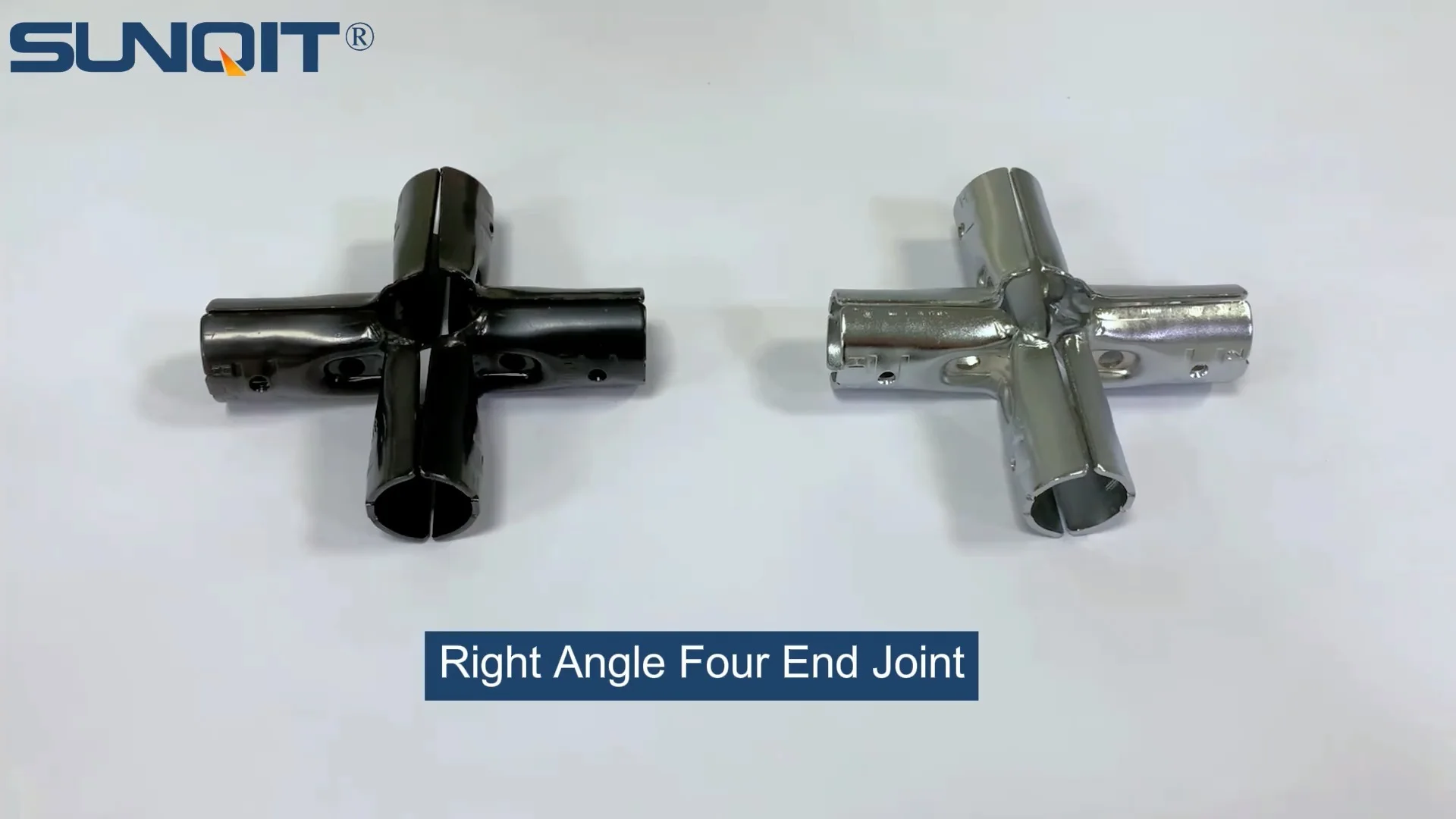
Five way straight lean pipe joint, for 5 pcs 28mm lean pipe connect in straight angle,which used widely in workbench, flow rack, hand trolley frame connection.
In the bustling world of manufacturing, where every second counts and efficiency is the cornerstone of success, the tools and components that keep production lines moving often go unnoticed—until they make or break a workflow. Among these unsung heroes are workbenches: the silent workhorses where assembly, inspection, and innovation come to life. Today, we're diving deep into one specific workbench model that's become a staple in factories worldwide: Workbench E (single deck-without caster) . But more importantly, we're shining a spotlight on the small yet mighty component that holds its structure together, ensures flexibility, and adapts to evolving production needs: the five way straight lean pipe joint . This unassuming connector isn't just a piece of hardware; it's the backbone of modularity, a key player in lean manufacturing systems, and a testament to how thoughtful design can transform ordinary workspaces into hubs of productivity.
1. The Unsung Hero of Workbench Design: Why Workbench E Matters
Before we dissect the role of the five way straight lean pipe joint, let's first understand why Workbench E has become a go-to choice for manufacturers. Picture a typical production floor: workers huddled over cluttered tables, tools scattered, materials stacked haphazardly, and bottlenecks forming as teams wait for access to shared workspaces. Now, imagine the opposite: a clean, organized area where every tool has a place, materials flow seamlessly, and the workspace itself can adapt to new tasks overnight. That's the promise of Workbench E.
Designed as a single-deck workbench without casters, Workbench E prioritizes stability and simplicity. Its fixed structure makes it ideal for tasks that require precision—think electronics assembly, small-part inspection, or quality control checks—where even the slightest movement could compromise accuracy. But what truly sets it apart is its modularity. Unlike traditional fixed workbenches, which are built to last "forever" (and often outlive their usefulness), Workbench E is constructed using lean pipe systems, which means it can be reconfigured, extended, or repurposed as production needs change. Need to add a shelf for tools? Done. Want to integrate a roller track for material flow? No problem. And at the heart of this adaptability lies the lean pipe joint—specifically, the five way straight lean pipe joint.
1.1 What Makes Workbench E a Lean Manufacturing Star?
Lean manufacturing isn't just a buzzword; it's a philosophy centered on eliminating waste, optimizing flow, and continuous improvement. Workbench E embodies this philosophy in several ways:
- Space Efficiency: With a single deck and no unnecessary frills, it maximizes usable workspace without occupying excess floor area—a critical advantage in crowded factories.
- Durability: Constructed from high-quality materials like aluminum profile and steel, it withstands the wear and tear of daily use, from heavy tool placement to repeated assembly tasks.
- Customizability: Thanks to its modular lean pipe structure, it can be outfitted with accessories like tool hooks, bin holders, or lighting—all without requiring a complete overhaul.
- Cost-Effectiveness: By using standardized components (like lean pipe joints and aluminum profiles), manufacturers avoid the expense of custom-built furniture, reducing both upfront and long-term costs.
But none of these benefits would be possible without the right connectors. Enter the five way straight lean pipe joint—a component so integral to Workbench E's design that it's hard to imagine the workbench without it.
2. The Five Way Straight Lean Pipe Joint: A Connector with a Purpose
At first glance, a lean pipe joint might seem like little more than a metal fitting with holes. But the five way straight lean pipe joint is far from ordinary. Let's break down its design: a central hub with five equally spaced ports, each designed to (accept) a lean pipe or aluminum profile. Unlike two-way joints (which connect two pipes in a straight line) or three-way joints (which form corners), the five way joint allows for connections in five directions—typically four horizontal and one vertical, though configurations can vary. This means it can anchor a vertical support, attach horizontal rails for shelving, and even integrate diagonal braces for added stability—all in one compact component.
2.1 Key Features of the Five Way Straight Lean Pipe Joint
What makes this joint so indispensable for Workbench E assembly? Let's dive into its standout features:
- Multi-Directional Connectivity: With five ports, it eliminates the need for multiple joints at a single connection point. For example, if you want to add a vertical leg, two horizontal rails, and a diagonal brace to a corner of Workbench E, a five way joint can handle all five connections—no extra fittings required.
- Strength and Stability: Made from high-grade steel with a chrome finish (as seen in many industrial-grade lean pipe joints), it resists corrosion and can support heavy loads. This is crucial for Workbench E, which often holds tools, materials, and even semi-assembled products without sagging or wobbling.
- Tool-Free Assembly (Mostly): Unlike welded joints, which require specialized equipment and permanent connections, the five way lean pipe joint uses set screws or locking bolts to secure pipes. This means assembly and disassembly can be done with basic hand tools, reducing downtime and making reconfiguration a breeze.
- Compatibility: It works seamlessly with standard lean pipes (often 28mm in diameter), aluminum profiles, and even accessories like roller track guides. This universality ensures that Workbench E can grow with a factory's needs—whether that means adding a material rack, integrating an ESD mat for electronics work, or attaching a small conveyor for parts delivery.
To put this in perspective, let's compare the five way straight lean pipe joint to other common connectors used in workbench assembly. The table below highlights how it stacks up against two-way, three-way, and four-way joints:
| Joint Type | Number of Connections | Best For | Load Capacity (Approx.) | Flexibility for Reconfiguration |
|---|---|---|---|---|
| Two-Way Straight | 2 (straight line) | Extending pipes horizontally/vertically | Medium (up to 50kg per joint) | Low (only extends in one direction) |
| Three-Way (L-Shaped) | 3 (two perpendicular, one straight) | Corners or simple shelves | Medium-High (up to 80kg per joint) | Moderate (adds right-angle connections) |
| Four-Way (T-Shaped) | 4 (three perpendicular, one straight) | Adding cross-braces or multi-level shelves | High (up to 100kg per joint) | High (supports multiple directions) |
| Five Way Straight | 5 (four horizontal/vertical, one central) | Complex structures, multi-access workbenches | Very High (up to 120kg per joint) | Very High (handles 5 directions; minimizes joint clutter) |
As the table shows, the five way joint isn't just about "more connections"—it's about smart connections. By reducing the number of joints needed at a single node, it minimizes weak points in the structure, streamlines assembly, and makes future modifications faster and easier. For Workbench E, which often serves as a central hub for multiple tasks, this is a game-changer.

3. Step-by-Step: How the Five Way Joint Brings Workbench E to Life
Now that we understand the "why" behind the five way straight lean pipe joint, let's walk through the "how." How does this joint transform a pile of aluminum profiles, lean pipes, and accessories into a fully functional Workbench E? Let's break down the assembly process, step by step, and highlight where the five way joint shines.
3.1 Pre-Assembly: Gathering the Right Components
Before any bolts are tightened, assembly teams start with a (list) of components. For a standard Workbench E, this includes:
- Lean pipes (typically 28mm diameter, either steel with PE coating or aluminum for lighter weight)
- Aluminum profiles (for added rigidity, often 40x40mm or 30x30mm, depending on load requirements)
- Five way straight lean pipe joints (the star of the show!)
- Three way and four way joints (for simpler connections)
- Workbench top (usually a plywood, MDF, or aluminum honeycomb panel for durability)
- Leveling feet (to stabilize the workbench on uneven floors)
- Optional accessories: tool hooks, bin rails, or a roller track for material flow
The key here is that all components are standardized. A five way joint from one supplier will fit a lean pipe from another, ensuring manufacturers aren't locked into a single brand—a critical factor for cost control and supply chain resilience.
3.2 Building the Frame: The Five Way Joint as the Structural Core
The first step in assembling Workbench E is building the frame. Imagine a rectangular base with four vertical legs—this is the foundation. But to add stability and functionality, assembly teams need more than just vertical and horizontal pipes. They need to connect cross-braces (to prevent wobbling), add lower shelves (for tool storage), and maybe integrate a back rail (for hanging tools). This is where the five way joint becomes irreplaceable.
Let's take the corner of the frame as an example. A typical corner might need:
- One vertical leg (connecting the base to the top frame)
- Two horizontal pipes (one along the length, one along the width of the base)
- One diagonal cross-brace (to reinforce the corner)
- One lower shelf rail (to support a storage shelf halfway up the leg)
That's five connections at a single point. A two-way joint could handle two, a three-way joint three—but the five way joint handles all five in one go. This not only reduces the number of parts needed (fewer joints mean lower costs and faster assembly) but also creates a stronger connection. Instead of multiple joints stacked on top of each other (which can loosen over time), a single five way joint distributes stress evenly across all connected pipes, minimizing the risk of failure.
Here's how it works in practice: The vertical leg is inserted into the central port of the five way joint. The two horizontal base pipes go into the side ports (aligned with the length and width of the workbench). The diagonal cross-brace is inserted into an angled port, and the lower shelf rail into the remaining port. A quick tighten of the set screws with an Allen wrench, and the corner is rock-solid. Repeat this at all four corners, and the frame starts to take shape—stable, square, and ready for the next step.
3.3 Adding the Workbench Top: Ensuring Level and Secure Support
Once the frame is built, the next step is attaching the workbench top. This (seemingly simple) task requires precision—an uneven top can lead to errors in assembly or inspection tasks. The five way joint plays a subtle but important role here, too. By ensuring the vertical legs are perfectly aligned (thanks to the joint's consistent port spacing), the frame remains square, making it easy to mount the top evenly.
Some assembly teams even use five way joints to add additional support rails across the top frame, creating a grid that prevents the workbench top from sagging under heavy loads. For example, a 1.5m long workbench might have a central support rail running lengthwise, connected to the side rails via five way joints. This distributes the weight of the top (and whatever's placed on it) across the entire frame, rather than just the edges.
3.4 Integrating Accessories: From Roller Tracks to Tool Hooks
Workbench E isn't just a flat surface—it's a complete workspace. That means adding accessories that make workers' lives easier. One common addition is a roller track along the back edge, which allows materials (like circuit boards, small parts bins, or finished products) to glide smoothly from one end of the workbench to the other. Installing a roller track requires mounting it to the frame, which again calls for the five way joint.
For example, to attach a roller track, assembly teams might add a horizontal rail above the workbench top. This rail needs to connect to the vertical legs at both ends, but it also might need supports in the middle to prevent bending. A five way joint at the midpoint can connect the roller track rail to a vertical support pipe, which in turn connects to the lower frame—all without disrupting the existing structure.
The same logic applies to tool hooks or bin rails. Want to add a row of hooks for screwdrivers and pliers? Use a five way joint to attach a horizontal rail to the vertical legs, then clip the hooks onto the rail. Need to reposition the hooks later? Loosen the joint, move the rail, and retighten—no drilling, no welding, no hassle.

4. Real-World Impact: How the Five Way Joint Solves Common Workbench Headaches
To truly appreciate the five way straight lean pipe joint, let's look at real-world scenarios where it has transformed Workbench E from a "good" workbench to a "great" one. These examples come from factories across industries—electronics, automotive, and medical device manufacturing—where adaptability and efficiency are non-negotiable.
4.1 Case Study: Electronics Assembly Line Adapts to New Product Launch
A mid-sized electronics manufacturer in Vietnam specialized in smartphone chargers. When they landed a contract to produce wireless earbuds—a smaller, more intricate product—their existing workbenches were too cluttered. Workers needed more table space for microscopes and precision tools, but they also needed to keep components organized. The solution? Reconfigure their Workbench E units using five way joints.
By adding a second tier (using five way joints to connect vertical supports and horizontal rails), they doubled their usable space without expanding the workbench's footprint. The lower deck held tools and bins, while the upper deck was reserved for assembly. The five way joints made it possible to add cross-braces between the tiers, ensuring stability even when workers leaned on the structure. The result? A 30% increase in assembly speed and a 50% reduction in errors—all achieved in a single weekend of reconfiguration.
4.2 Case Study: Automotive Supplier Eliminates Downtime During Line Restructuring
A Tier 1 automotive supplier in Germany produces door handles for luxury cars. When their client updated the handle design, the supplier needed to add a new inspection station to check for paint defects. Building a new fixed workbench would have taken weeks and cost thousands of euros. Instead, they repurposed an old Workbench E using five way joints.
They removed the lower shelf, added a roller track (using five way joints to mount it to the frame), and integrated a small LED light bar above the work surface. The entire process took two hours, and the reconfigured workbench was ready for use the same day. Best of all, when the next design change comes (and it will), they can reconfigure it again—no waste, no delays, no added cost.

5. Beyond Assembly: Maintaining and Upgrading Workbench E with Five Way Joints
A workbench is only as good as its ability to evolve, and the five way straight lean pipe joint makes maintenance and upgrades surprisingly simple. Unlike welded frames, which require cutting and re-welding to modify, lean pipe systems with five way joints can be adjusted with basic tools. Here's how:
5.1 Tightening Loose Joints: A 5-Minute Fix
Over time, vibrations from daily use can loosen the set screws in lean pipe joints. A wobbly workbench isn't just annoying—it's a safety hazard. With five way joints, fixing this is easy: grab an Allen wrench, tighten the screws, and the joint is as good as new. No need for a maintenance crew or specialized equipment; even line workers can do it during a break.
5.2 Upgrading for Heavy Loads: Reinforcing with Aluminum Profiles
If a Workbench E needs to support heavier loads (say, from 50kg to 150kg), assembly teams can reinforce the frame by replacing steel lean pipes with aluminum profiles. The five way joint's ports are wide enough to accommodate both pipes and profiles, so the upgrade involves simply swapping out components and re-tightening the joints. This flexibility ensures the workbench can grow with the business, rather than being replaced.
5.3 Repurposing for New Tasks: From Assembly to Packaging
When a production line is retired or repurposed, fixed workbenches often end up in storage (or the scrap heap). Not Workbench E. A manufacturer in the U.S. recently shifted from producing small parts to packaging finished goods. They disassembled their old Workbench E units, removed the worktops, and used five way joints to build material racks—perfect for storing boxes of products. The entire transformation cost less than $200 per unit, compared to $1,500 for new racks.
6. The Future of Workbench Design: Where Five Way Joints and Lean Systems Collide
As manufacturing continues to evolve—driven by automation, customization, and the need for sustainability—the role of components like the five way straight lean pipe joint will only grow. Here's what we can expect to see in the years ahead:
6.1 Smarter Materials: Lightweight, Stronger, and Eco-Friendly
Lean pipe joints are already moving beyond steel. Aluminum joints, which are lighter and resistant to corrosion, are gaining popularity, especially in industries like food processing or pharmaceuticals where hygiene is critical. We're also seeing joints made from recycled materials, aligning with manufacturers' sustainability goals. The five way joint's design is adaptable to these new materials, ensuring it remains relevant.
6.2 Integration with Industry 4.0: Connected Workbenches
Imagine a Workbench E equipped with sensors that monitor load, track usage, and alert maintenance when joints need tightening. With the five way joint's modular design, adding smart components (like IoT sensors mounted via accessory rails) is straightforward. For example, a sensor could detect when the workbench top is overloaded and send an alert to a supervisor's phone—preventing structural damage before it occurs.
6.3 Customization at Scale: 3D-Printed Joints for Niche Needs
While standardized joints will always dominate, 3D printing could allow manufacturers to create custom five way joints for unique applications—say, a joint with built-in cable management for robotics workbenches or a heat-resistant version for welding stations. This blend of standardization and customization will keep the five way joint at the forefront of workbench design.
7. Conclusion: The Five Way Joint—Small Component, Big Impact
In the grand scheme of manufacturing, the five way straight lean pipe joint might seem (insignificant). It's small, often overlooked, and rarely mentioned in boardroom discussions about productivity. But to the workers on the factory floor, to the engineers designing lean systems, and to the businesses trying to stay competitive in a fast-changing world, it's anything but. It's a symbol of adaptability, a tool for innovation, and a reminder that great things often come in small packages.
Workbench E, with its single deck and fixed structure, is a blank canvas for manufacturing creativity. And the five way straight lean pipe joint is the brush that turns that canvas into a masterpiece of efficiency. Whether it's supporting a new product launch, adapting to a line restructuring, or simply making a worker's day a little easier, this unassuming connector plays a role that's far greater than the sum of its parts.
So the next time you walk through a factory, take a moment to look at the workbenches. Notice the joints that hold them together. And remember: behind every smooth workflow, every satisfied worker, and every successful production run, there's likely a five way straight lean pipe joint quietly doing its job—proving that in manufacturing, as in life, the smallest components often have the biggest impact.