
Walk into any modern manufacturing facility, and you'll likely notice a common challenge: workstations that feel stuck in time. Production lines evolve, product designs shift, and team needs change—but too often, the physical structures supporting these operations remain rigid, clunky, and frustratingly hard to adapt. Whether it's a lean pipe workbench that can't accommodate a new tool layout, a material rack that struggles to hold heavier components, or an ESD workstation that lacks the flexibility to reconfigure for smaller batches, these inefficiencies add up. They slow down workflows, increase downtime, and even demotivate teams forced to work around outdated setups. But what if there was a single component that could unlock a new level of adaptability? Enter the five way straight lean pipe joint chrome —a small but mighty connector that's quietly revolutionizing how factories build, modify, and optimize their workspaces.
The Problem: Rigidity in a World That Demands Flexibility
To understand why the five way straight lean pipe joint chrome matters, let's start with the problem it solves: rigidity. Traditional workstation setups often rely on welded metal frames, fixed wooden benches, or one-size-fits-all plastic structures. These might work initially, but they're nightmares to adjust. Need to add a shelf to your workbench? You'll probably need a welder or power tools. Want to reposition a roller track to speed up material flow? Prepare to disassemble half the rack. And if your team switches from assembling small electronics to larger machinery? You might as well start from scratch.
In today's fast-paced manufacturing environment, where "lean" principles and rapid iteration are king, this rigidity isn't just inconvenient—it's costly. A 2023 study by the Manufacturing Performance Institute found that factories with rigid workstations spend 37% more time on setup and reconfiguration compared to those with modular systems. That's time that could be spent producing goods, training staff, or innovating. Worse, rigid setups often lead to wasted space: a workstation designed for last year's product might have unused gaps or overcrowded zones, reducing overall efficiency.
Enter modular lean systems, built around components like lean pipes, aluminum profiles, and adjustable joints. These systems promise flexibility, but not all components are created equal. Many joints—like basic two-way or three-way connectors—limit how you can arrange pipes and profiles. They force you into linear or L-shaped configurations, leaving little room for the custom, multi-directional setups modern teams need. That's where the five way straight lean pipe joint chrome steps in: it's not just a connector, but a gateway to truly limitless adaptability.
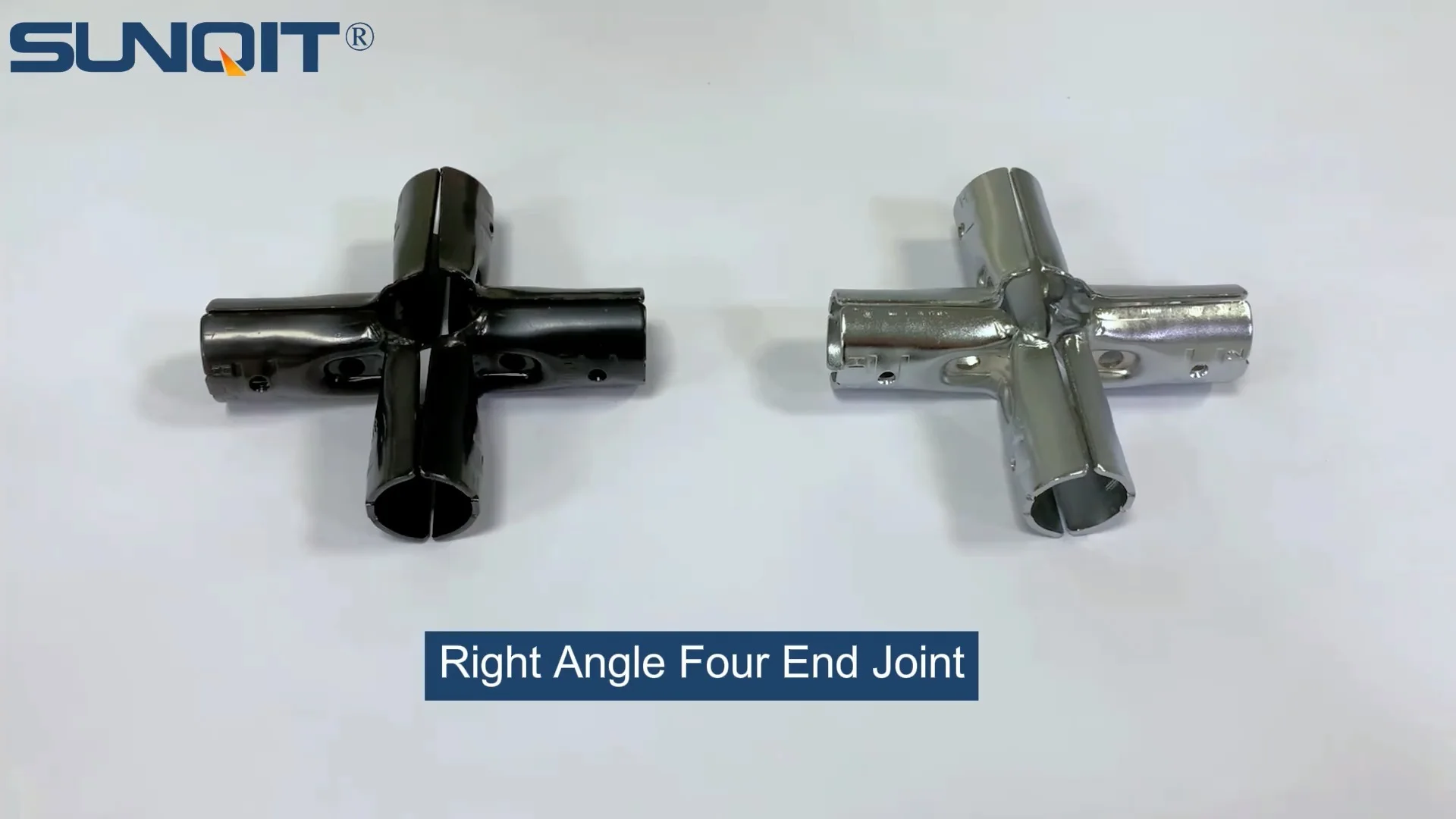
What Is the Five Way Straight Lean Pipe Joint Chrome, Anyway?
At first glance, the five way straight lean pipe joint chrome might seem unassuming—a small, metallic component with five openings arranged in a straight line. But don't let its size fool you. This joint is engineered to be the backbone of modular workstation design. Let's break it down:
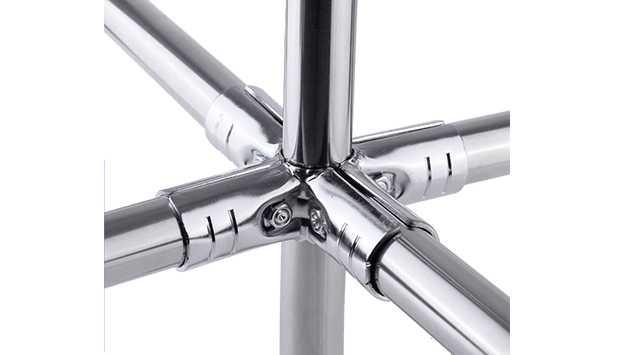
- Five-Way Connectivity: As the name suggests, this joint features five connection points, all aligned in a straight line. Think of it as a "central hub" that lets you attach lean pipes, aluminum profiles, or roller track sections in five directions: left, right, front, back, and straight through. This is a game-changer for building complex structures—like a workbench with integrated shelving, tool hooks, and a roller track for material delivery—without needing multiple different joints.
- Chrome-Plated Durability: The "chrome" in its name isn't just for looks. Chrome plating adds a hard, corrosion-resistant layer to the joint's steel core, protecting it from rust, scratches, and the wear and tear of daily factory life. This isn't just about longevity; it's about maintaining a professional, clean appearance even in dusty or humid environments—critical for industries like electronics manufacturing, where debris can compromise sensitive components.
- Tool-Free Assembly: Unlike welded joints or bolt-heavy connectors, the five way straight lean pipe joint chrome is designed for quick, tool-free setup. Most models use a set-screw mechanism: simply slide a lean pipe or aluminum profile into one of the five openings, tighten the screw with a hex key (included in most kits), and you're done. No welding, no drilling, no complicated instructions. Even someone with minimal technical experience can assemble a basic structure in minutes.
- High Load Capacity: Don't let its modular design fool you—this joint is tough. Made from high-grade steel with reinforced stress points, it can support loads of up to 200kg per connection point (depending on the pipe or profile used). That means you can confidently mount heavy tools, stacks of materials, or even small machinery on structures built with these joints without worrying about collapse or wobble.
Why It Stands Out: Comparing Lean Pipe Joints
To appreciate the five way joint's versatility, it helps to see how it stacks up against other common lean pipe connectors. Below is a comparison of popular joint types, highlighting their strengths, limitations, and ideal use cases:
| Joint Type | Number of Connections | Primary Use Case | Max Load Capacity (per connection) | Flexibility Rating (1-5) |
|---|---|---|---|---|
| Two-Way Straight Joint | 2 (straight line) | Extending pipes in a single direction (e.g., long roller tracks) | 150kg | ★★☆☆☆ |
| Three-Way T-Joint | 3 (T-shape) | Adding branches to a main pipe (e.g., shelves on a workbench) | 180kg | ★★★☆☆ |
| Four-Way Cross Joint | 4 (cross shape) | Building grids or multi-directional frames (e.g., small material racks) | 190kg | ★★★★☆ |
| Five Way Straight Lean Pipe Joint Chrome | 5 (straight line with 3 perpendicular) | Complex, custom setups (e.g., ESD workstations with integrated tool holders, multi-level roller tracks) | 200kg | ★★★★★ |
The table tells the story: while two-way and three-way joints have their place, they're limited to simple configurations. The five way joint, with its five connection points, unlocks a level of flexibility that's hard to match. It's the difference between building a straight bookshelf and a custom-built entertainment center—one-size-fits-all vs. tailored to your exact needs.

Compatibility: Working in Harmony with Your Existing Tools
A great connector is only as good as its ability to work with the tools you already have. The five way straight lean pipe joint chrome shines here, too, thanks to its compatibility with some of the most common components in modern manufacturing:
Lean Pipes and Aluminum Profiles
At its core, the five way joint is designed to work with standard lean pipes (often 28mm in diameter) and aluminum profiles (like the popular 4040 or 3030 series). This means you don't have to replace your entire setup to start using it—just swap out old joints for these new ones. For example, if you have a fleet of lean pipe workbenches, you can use the five way joint to add side extensions, overhead tool racks, or under-bench storage without buying new pipes. The joint's openings are precision-machined to fit both steel lean pipes and aluminum profiles, ensuring a snug, wobble-free connection every time.
Aluminum profiles, in particular, pair beautifully with the five way joint. Their T-slot design allows for even more customization: you can attach accessories like cable management clips, label holders, or LED work lights directly to the profile, while the joint handles the structural connections. This combination—five way joints + aluminum profiles—is a favorite among electronics manufacturers, who often need ESD-safe workstations with multiple tool mounts and static-dissipative surfaces.
Roller Tracks
Material flow is the lifeblood of any production line, and roller tracks are the veins that keep it moving. The five way straight lean pipe joint chrome makes it easy to integrate roller tracks into your workstation design, whether you're building a gravity-fed flow rack or a conveyor extension. Here's how it works: mount the joint to a vertical lean pipe, attach a horizontal aluminum profile to one of the joint's openings, then secure the roller track to the profile using brackets (like the roller track placon mount for aluminum profile flat, a common accessory). This setup lets you position the roller track at any angle—horizontal, sloped, or even vertical—depending on your material flow needs.
Take, for example, a small electronics assembly line. The team needs components to flow from a storage rack to their ESD workbench, then finished products to a packaging station. With the five way joint, they can build a custom roller track system: one track feeds components to the bench (sloped at 5° for gravity flow), another carries finished products out (sloped at 3° to prevent damage), and a third smaller track delivers tools from a nearby cabinet. All three tracks connect to the workbench via a single five way joint, keeping the setup compact and efficient.
ESD Workstations
For industries like semiconductor manufacturing or medical device assembly, ESD (electrostatic discharge) protection is non-negotiable. ESD workstations must dissipate static electricity to prevent damage to sensitive components, and they often require specialized features like grounding mats, wrist strap holders, and ionizer mounts. The five way straight lean pipe joint chrome is a natural fit here, thanks to its conductive chrome finish (which can be grounded) and ability to support ESD-safe accessories.
Imagine building an ESD workstation with the five way joint: the main frame uses grounded lean pipes and aluminum profiles, with the joint connecting the work surface, a overhead ionizer arm, a side-mounted wrist strap holder, and a lower shelf for ESD-safe storage bins. Because the joint allows for precise positioning, you can place each component exactly where the operator needs it—no stretching, no reaching, no fumbling with tools. And if the team switches to a new product that requires a larger work surface? Simply loosen the joint's set screws, add a longer aluminum profile, and reposition the ionizer arm. Done.
Real-World Applications: How Factories Are Using the Five Way Joint
Theory is great, but nothing beats real-world examples. Let's look at how three different factories are using the five way straight lean pipe joint chrome to transform their operations:
Case Study 1: Automotive Parts Manufacturer
A mid-sized automotive parts factory in Michigan was struggling with its assembly line workstations. Their old setup used welded steel benches, which were heavy, hard to clean, and impossible to adjust. When the factory started producing a new line of electric vehicle (EV) components—smaller, lighter, and more delicate than their traditional parts—the workstations felt oversized and inefficient. Operators were wasting time reaching for tools, and the fixed shelves left no room for new testing equipment.
The solution? A switch to modular lean systems built with five way straight lean pipe joint chrome. The factory replaced their welded benches with custom lean pipe workbenches, using the five way joints to add: (1) adjustable-height tool rails above the work surface, (2) under-bench roller tracks for component bins, and (3) side-mounted monitor arms for digital work instructions. The result? Setup time for new product runs dropped by 45%, and operator satisfaction scores (measured via monthly surveys) increased by 32%. "We used to need a maintenance crew for hours to reconfigure a workstation," says the factory's production manager. "Now, two operators can do it in 20 minutes with just a hex key."
Case Study 2: Electronics Assembly Plant
A contract electronics manufacturer in Singapore specializes in small-batch, high-mix production—meaning they might assemble 10 different products in a single day. Their biggest challenge? ESD workstations that couldn't keep up with changing requirements. One hour, they'd need a workstation for circuit board assembly (with anti-static mats and magnifying lamps); the next, for packaging (with larger work surfaces and tape dispensers). Their old ESD workstations were fixed, so they ended up with a closet full of unused "specialty" benches—wasting space and money.
The five way straight lean pipe joint chrome changed that. The plant invested in a set of modular ESD workstations, using the joints to create "base units" that could be customized with snap-on accessories. For circuit board assembly, they add a magnifying lamp arm and ESD wrist strap holder to the joint. For packaging, they swap those out for a larger aluminum profile work surface and a roller track for boxes. The joints' chrome finish also helps maintain ESD compliance: the conductive surface is grounded via the lean pipes, ensuring static never builds up. "We've reduced our workstation count by 60%," says the plant's operations director. "And because the setups are so quick, we can take on smaller batches without eating into profits."
Case Study 3: Pharmaceutical Packaging Facility
A pharmaceutical packaging facility in Germany has strict GMP (Good Manufacturing Practice) requirements, including clean, organized workspaces and easy-to-sanitize surfaces. Their old material racks were made of wood, which harbored bacteria, and their roller tracks were fixed in place, making deep cleaning a hassle. The facility needed a solution that was durable, easy to clean, and flexible enough to accommodate different package sizes (from small pill bottles to large vaccine vials).
They turned to the five way straight lean pipe joint chrome, paired with stainless steel lean pipes and aluminum profiles. The chrome-plated joints are smooth and non-porous, so they can be wiped down with disinfectant without rusting. The modular design also makes cleaning easier: workers can quickly disassemble sections of the roller track (using the joints) to reach hidden corners, then reassemble in minutes. "GMP inspections used to take all day because of our old racks," says the facility's quality manager. "Now, inspectors comment on how organized and clean our workspaces are. The five way joints are a big part of that—they let us design racks that are both functional and easy to maintain."
Installation Tips: Getting the Most Out of Your Five Way Joints
Ready to start using the five way straight lean pipe joint chrome? Here are some pro tips to ensure a smooth setup and maximum longevity:
- Measure Twice, Tighten Once: Before assembling, sketch out your design and measure the distances between connections. This might seem obvious, but it's easy to rush and end up with pipes that are too short or too long. Most lean pipe and aluminum profile suppliers sell pre-cut lengths, so having accurate measurements will save you time (and money on returns).
- Use the Right Tools: While the joints are tool-free, a high-quality hex key (Allen wrench) will make tightening the set screws easier and more precise. Avoid using power tools—over-tightening can strip the screws or damage the pipe. Hand-tighten until the joint feels secure, then give it a small extra turn for peace of mind.
- Ground ESD Setups Properly: If you're using the joint in an ESD workstation, make sure the chrome finish is grounded. Most lean pipes are conductive, so connecting the setup to a grounding mat or floor strap will dissipate static. Test the grounding with a multimeter to ensure resistance is between 10^6 and 10^9 ohms (the industry standard for ESD protection).
- Check Load Limits: While the joint can handle up to 200kg per connection, remember that the total load depends on the pipes or profiles you use. A thin aluminum profile might bend under heavy weight, even if the joint is strong enough. Always check the load capacity of your pipes/profiles and distribute weight evenly across multiple joints.
- Maintain Regularly: Chrome plating is durable, but it's not invincible. Wipe down joints with a dry cloth weekly to remove dust and debris. If you notice scratches or rust (unlikely, but possible in very humid environments), touch up the chrome with a metal polish to prevent further damage.
Why It's a Must-Have: The Bottom Line
At the end of the day, the five way straight lean pipe joint chrome isn't just a component—it's an investment in flexibility, efficiency, and adaptability. In a manufacturing world that demands constant change, it's the tool that lets you build workstations that grow with your business, rather than hold it back. Whether you're running a small workshop or a large factory, this joint can help you:
- Save Time: Reconfigure workstations in minutes, not hours.
- Reduce Costs: Avoid buying new workstations for every product change.
- Improve Morale: Give operators workspaces that fit their needs, not the other way around.
- Boost Quality: Organized, efficient workspaces reduce errors and improve consistency.
So, if you're tired of rigid workstations holding your team back, it's time to give the five way straight lean pipe joint chrome a try. It's small, it's simple, and it just might be the key to unlocking the flexible, lean manufacturing setup you've been dreaming of.
Conclusion: Building the Future of Manufacturing—One Joint at a Time
Manufacturing has come a long way from the days of fixed assembly lines and one-size-fits-all workbenches. Today, success depends on agility—on your ability to pivot quickly, adapt to new technologies, and meet changing customer demands. The five way straight lean pipe joint chrome is more than just a connector; it's a symbol of that agility. It's proof that even the smallest components can have a big impact on how we build, create, and innovate.
Whether you're assembling cars, circuit boards, or pharmaceuticals, this joint gives you the power to design workspaces that work for you—not against you. It's time to stop working around rigid structures and start building with flexibility in mind. After all, in manufacturing, the future belongs to those who can adapt—and the five way straight lean pipe joint chrome is here to help you do just that.