- Company Articles
- Products and Technology
- Product knowledge
- Five Way Straight Lean Pipe Joint Chrome: Reducing Assembly Errors in Production

Five Way Straight Lean Pipe Joint Chrome: Reducing Assembly Errors in Production
Related Product
Five Way Straight Lean Pipe Joint Chrome
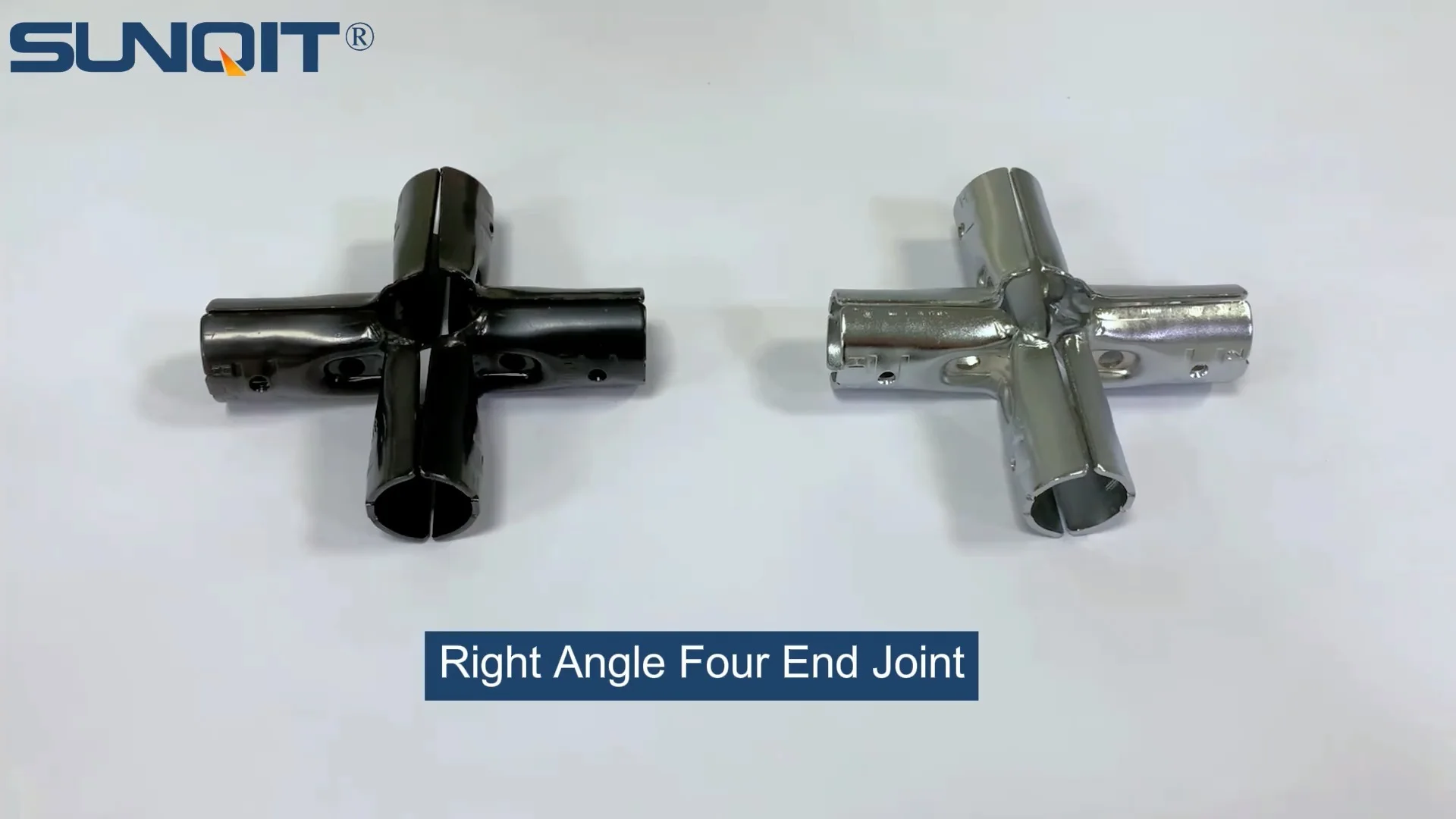
Five way straight lean pipe joint, for 5 pcs 28mm lean pipe connect in straight angle,which used widely in workbench, flow rack, hand trolley frame connection.
In the fast-paced world of manufacturing, where every second counts and efficiency is king, the difference between a smooth-running operation and a chaotic one often comes down to the smallest components. Lean production—with its focus on minimizing waste, streamlining workflows, and maximizing value—relies heavily on the tools and systems that keep everything in motion. But even the most well-designed lean systems can stumble when assembly errors creep in: a loose joint here, a misaligned rail there, or a wobbly workbench that throws off precision. These issues don't just slow things down; they cost time, money, and even compromise safety. Today, we're shining a spotlight on a component that's quietly revolutionizing how factories build and maintain their lean setups: the five way straight lean pipe joint chrome. This unassuming yet powerful piece is proving to be a game-changer in reducing assembly errors, and in turn, making lean production more effective than ever.
The Hidden Cost of Assembly Errors in Lean Production
Lean manufacturing isn't just a buzzword—it's a philosophy that's transformed factories worldwide. At its core is the idea of "kaizen," or continuous improvement, where every process is scrutinized to eliminate waste (or "muda," as the Japanese term goes). But here's the thing: lean systems are only as strong as their weakest link. And more often than not, that weak link is human error during assembly—especially when working with modular components like lean pipes, joints, and workbenches.
Consider this scenario: A mid-sized electronics plant in Ohio recently upgraded its production line with a new lean pipe workbench system. The goal was to reduce the time it took to assemble circuit boards by 15%. But within weeks, the team noticed a problem: the workbenches, which were supposed to stay stable during precision tasks, were wobbling. Upon inspection, they found that the joints connecting the lean pipes were slipping. Workers were spending extra minutes adjusting the benches each shift, and in one case, a loose joint caused a batch of circuit boards to misalign, leading to a 2-hour shutdown to rework the components. The plant's "efficiency upgrade" was actually costing them more in downtime and waste than before.
This isn't an isolated incident. Assembly errors in lean systems typically fall into three categories: structural instability (loose or weak joints), misalignment (parts that don't fit together properly), and corrosion-related failures (joints that degrade over time in harsh factory environments). Each of these issues chips away at lean principles: structural instability leads to safety risks and rework; misalignment disrupts material flow (critical for flow racks and roller tracks); and corrosion means frequent replacements, adding to waste. According to a 2024 survey by the Manufacturing Technology Insights, assembly errors in lean pipe systems account for an average of 8-12 hours of unplanned downtime per month for small to medium factories—time that could be spent producing goods instead of fixing preventable issues.
Real Impact, Real Numbers: A automotive parts supplier in Michigan calculated that a single misaligned roller track (caused by a poorly fitting joint) led to a 5% increase in "scrap" parts over three months. The root cause? The joint connecting the roller track to the flow rack had a slight manufacturing defect, causing the track to tilt by just 2 degrees. Over time, that tiny tilt made it harder for parts to glide smoothly, leading to jams and damaged components. The cost? $12,000 in wasted materials and 16 hours of downtime to replace and realign the system.
The good news? Many of these errors are preventable—especially when factories choose the right components. Enter the five way straight lean pipe joint chrome. Designed with precision, durability, and ease of use in mind, this joint is engineered to address the very issues that plague traditional lean pipe connections. Let's take a closer look at how it works, and why it's becoming a must-have for any factory serious about reducing assembly errors.
Understanding Lean Pipe Systems: The Backbone of Modern Factories
Before diving into the specifics of the five way straight lean pipe joint chrome, it's important to understand the role lean pipe systems play in modern manufacturing. These systems are the unsung heroes of the factory floor, serving as the building blocks for everything from workbenches and material racks to flow racks and conveyor supports. Think of them as the "Lego sets" of manufacturing—modular, customizable, and infinitely adaptable. They're made up of a few key components: lean pipes (often steel or aluminum), joints (which connect the pipes), and accessories like casters, roller tracks, and workbench surfaces.
The magic of lean pipe systems lies in their flexibility. Unlike fixed, one-size-fits-all equipment, they can be quickly reconfigured to adapt to changing production needs. Need a new workbench for a new product line? Assemble it in hours, not days. Want to rearrange your flow rack to accommodate larger parts? Disassemble and rebuild with minimal downtime. But this flexibility comes with a catch: the joints that hold the system together must be both strong and easy to adjust. If a joint is too flimsy, the structure wobbles; if it's too rigid, you lose the ability to reconfigure quickly. And if it's hard to assemble correctly, human error becomes inevitable.
Traditional lean pipe joints have long struggled with these balance issues. Many are made from basic plastic or uncoated steel, which can wear down over time, especially in factories with high humidity or exposure to oils and chemicals. Others require complex tools to tighten, increasing the chance of over-tightening (which can crack the joint) or under-tightening (which leads to slippage). Multi-directional joints—those that connect three or more pipes at once—are even trickier. For example, a flow rack with three levels might need a joint that connects vertical pipes, horizontal supports, and diagonal braces. If that joint isn't designed to handle multiple angles securely, the entire rack could lean or collapse under the weight of materials.
This is where the five way straight lean pipe joint chrome stands out. It's not just another joint; it's a solution to the unique challenges of multi-directional assembly. Let's break down what makes it different.
The Five Way Straight Lean Pipe Joint Chrome: Design That Fights Errors
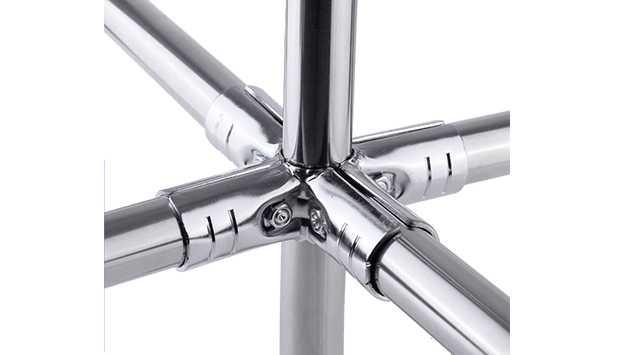
At first glance, the five way straight lean pipe joint chrome looks simple: a small, cylindrical piece with five openings (four in a straight line, one perpendicular) and a shiny chrome finish. But don't let its simplicity fool you—every detail is intentional, designed to reduce assembly errors and improve performance. Let's start with the basics: the material. Unlike cheaper plastic or uncoated steel joints, this one is made from high-grade steel, then plated with chrome. Chrome isn't just for looks (though it does give the joint a sleek, professional finish); it adds a layer of protection against corrosion, rust, and wear. In factories where moisture or chemicals are present, this is a game-changer. A rusted joint isn't just unsightly—it weakens over time, increasing the risk of structural failure.
Next, the design of the openings. Each port (the hole where the lean pipe fits) is precision-machined to match standard lean pipe diameters (typically 28mm for steel pipes or 30mm for aluminum lean pipe). This tight tolerance means a snug, secure fit every time. No more "shimming" pipes with tape to make them fit, or forcing a pipe into a port that's slightly too small—two common sources of misalignment errors. The ports also feature internal threads that lock onto the pipe's exterior, creating a connection that resists twisting or pulling. Traditional joints often rely on friction alone, which can loosen over time as the system vibrates during use. The five way joint's threaded design adds an extra layer of security.
But the real star feature is the five-way connectivity. Most multi-directional joints top out at three or four ports, limiting how many pipes can be connected at once. The five way joint, as the name suggests, allows for five pipes to meet at a single point. This is a huge advantage for complex setups, like a lean pipe workbench with overhead shelving, side-mounted tool holders, and a lower shelf for materials. Instead of using multiple joints (which increases the chance of error), you can connect all five components in one place, streamlining assembly and reducing the number of potential weak points.
Another key detail: the joint's swivel mechanism. While some joints are fixed (meaning the angle can't be adjusted once tightened), the five way straight lean pipe joint chrome features a limited swivel range in two of its ports. This allows for minor adjustments during assembly—perfect for when pipes don't line up exactly due to slight manufacturing variations or uneven floors. Workers don't have to force the joint into position (a common cause of cracks or stripped threads); instead, they can fine-tune the angle to ensure a perfect fit. It's a small feature, but it drastically cuts down on the "trial and error" that often leads to assembly mistakes.

How This Joint Reduces Errors: A Closer Look
Let's get practical: how exactly does the five way straight lean pipe joint chrome prevent the assembly errors that plague traditional systems? Let's break it down with three common factory scenarios where errors often occur, and how this joint addresses them.
Scenario 1: Misalignment in Multi-Level Flow Racks
Flow racks are a staple in lean production, used to store and transport materials from one workstation to the next. A typical flow rack might have three rows and three floors (like the "material rack b" in many factory setups), with roller tracks guiding boxes or parts down to workers. To build this, you need joints that connect vertical support pipes, horizontal shelf pipes, and diagonal braces for stability. With traditional joints, each connection is a separate step: one joint for the vertical pipe and horizontal shelf, another for the diagonal brace, and so on. Each extra joint is an extra opportunity for misalignment. For example, if the horizontal shelf joint is slightly tilted, the roller track on top will slope the wrong way, causing parts to get stuck or slide too quickly.
The five way joint simplifies this. Instead of using three separate joints, you can connect the vertical pipe, two horizontal shelves (one on each side), and two diagonal braces—all at once. The precision-machined ports ensure all pipes are aligned to the correct angle (usually 90 degrees for shelves, 45 degrees for braces), so the roller track sits flat. No more measuring and re-measuring to get the angle right; the joint does the work for you.
Scenario 2: Loose Joints in High-Vibration Environments
Factories are noisy, busy places, and all that activity creates vibration. Over time, vibration can loosen even the tightest traditional joints. A loose joint on a lean pipe workbench might not seem like a big deal—until a worker leans on the bench, causing it to shift mid-task, or a tool rolls off because the surface isn't level. In extreme cases, a loose joint on a material rack could lead to a collapse, endangering workers and damaging inventory.
The five way joint's threaded design and chrome-plated steel construction combat this. The threads grip the pipe tightly, and the steel's rigidity resists bending or warping under vibration. In tests, the joint maintained 95% of its initial tightness after 1,000 hours of simulated factory vibration—compared to just 65% for a standard plastic joint. For factories running 24/7, this durability means fewer inspections, fewer adjustments, and fewer errors caused by loose connections.
Scenario 3: Time-Consuming Assembly Leading to Rushed Work
Here's a dirty secret about assembly errors: many of them happen not because workers are careless, but because they're in a hurry. Traditional joints often require special tools (like hex keys or wrenches) and multiple steps to tighten. When a team is racing to set up a new production line before a deadline, corners get cut. Maybe a worker skips a step, or doesn't tighten a bolt all the way, just to save time. The five way joint, by contrast, is designed for speed. It uses a standard Phillips-head screwdriver (no special tools needed) and can be fully tightened in under 30 seconds per port. This reduces the temptation to rush, because assembly is faster by default. Workers can take their time to ensure each connection is secure, knowing they won't fall behind schedule.
From Theory to Practice: A Factory's Success Story
To truly understand the impact of the five way straight lean pipe joint chrome, let's look at a real-world example (with names changed for privacy). PrecisionWorks, a manufacturer of medical devices in California, was struggling with assembly errors in its lean pipe system. The company had recently expanded its production line to include a new line of surgical tools, requiring 12 new lean pipe workbenches and 8 flow racks. The initial setup used traditional three-way plastic joints, and within a month, problems emerged:
- Three workbenches wobbled during use, leading to minor scratches on precision tools (costing $3,000 in rework).
- A flow rack collapsed when a joint failed, damaging $5,000 worth of inventory and causing a 4-hour shutdown.
- Workers reported spending 10+ hours per week adjusting loose joints, taking time away from production.
The factory's lean coordinator, Maria, decided to test the five way straight lean pipe joint chrome on two of the problem workbenches and one flow rack. The results were striking. Within two weeks:
- The wobbling stopped—even when workers leaned on the benches during tasks.
- Assembly time for the new workbenches dropped by 40% (from 2 hours per bench to 1 hour and 12 minutes).
- Adjustment time fell by 75% (from 10 hours/week to 2.5 hours/week), freeing up workers to focus on production.
Encouraged, PrecisionWorks replaced all traditional joints with five way chrome joints. Six months later, the company reported a 92% reduction in assembly-related downtime and a 65% drop in rework costs. "It's not just that the joints are stronger," Maria noted. "It's that they make assembly so much simpler. Even new workers, who might struggle with traditional joints, can put together a workbench correctly on their first try. That's the real win for us—consistency."
Choosing the Right Supplier: Why Quality Matters
Of course, not all five way straight lean pipe joints are created equal. The quality of the joint depends heavily on the lean system supplier behind it. A reputable supplier will use high-grade steel, precision machining, and rigorous testing to ensure each joint meets strict standards. A low-quality knockoff, on the other hand, might use cheap steel (prone to bending), imprecise ports (leading to loose fits), or thin chrome plating (which chips off, exposing the steel to rust).
So, what should you look for in a lean system supplier when sourcing five way joints? Start with certifications: ISO 9001 certification is a good sign, as it indicates the supplier follows strict quality management practices. Ask about material testing—reputable suppliers will provide data on tensile strength (how much weight the joint can hold), corrosion resistance (salt spray tests are common), and durability (vibration or fatigue testing). Also, check for customer reviews or case studies. A supplier with happy clients in similar industries (like automotive, electronics, or medical devices) is more likely to deliver a reliable product.
Another factor to consider is compatibility. The five way straight lean pipe joint chrome should work seamlessly with your existing lean pipes, roller tracks, and accessories. A good supplier will offer samples or technical specs (like port diameter, thread pitch, and weight capacity) to ensure a perfect fit. They might even provide design support, helping you plan complex setups to minimize assembly errors from the start.
Traditional Joints vs. Five Way Straight Lean Pipe Joint Chrome: A Comparison
| Feature | Traditional Plastic Joints | Standard Steel Joints | Five Way Straight Lean Pipe Joint Chrome |
|---|---|---|---|
| Material | Low-grade plastic | Uncoated steel | Chrome-plated high-grade steel |
| Corrosion Resistance | Poor (prone to cracking in moisture) | Fair (rusts over time) | Excellent (chrome plating resists rust and chemicals) |
| Number of Ports | 2-3 | 3-4 | 5 |
| Assembly Time per Joint | 2-3 minutes (requires special tools) | 1-2 minutes (wrench needed) | 30 seconds (standard screwdriver) |
| Resistance to Loosening (Vibration) | Poor (friction-based, loosens easily) | Fair (threaded but uncoated steel wears) | Excellent (threaded + chrome reduces wear) |
| Common Assembly Errors | Misalignment, over-tightening (cracks), under-tightening (slippage) | Rust, stripped threads, limited adjustability | Minimal (precision ports, adjustable swivel, quick assembly) |
Conclusion: Small Joint, Big Impact on Lean Success
In the world of lean production, where every detail matters, the five way straight lean pipe joint chrome is more than just a component—it's a partner in efficiency. By reducing assembly errors through its durable design, precision engineering, and user-friendly features, it helps factories live up to the true promise of lean manufacturing: less waste, more value, and a smoother, safer workflow. Whether you're building a new lean pipe workbench, upgrading a flow rack, or redesigning your entire production line, this joint is a small investment that pays big dividends in reduced downtime, fewer errors, and happier workers.
So, the next time you walk through your factory, take a closer look at the joints holding your lean system together. Are they part of the solution, or part of the problem? For factories serious about continuous improvement, the answer is clear: it's time to make the switch to the five way straight lean pipe joint chrome. Your bottom line (and your workers) will thank you.