- Company Articles
- Products and Technology
- Product knowledge
- Five Way Straight Lean Pipe Joint for Custom Lean Solutions in 3C Industry

Five Way Straight Lean Pipe Joint for Custom Lean Solutions in 3C Industry
Related Product
Five Way Straight Lean Pipe Joint
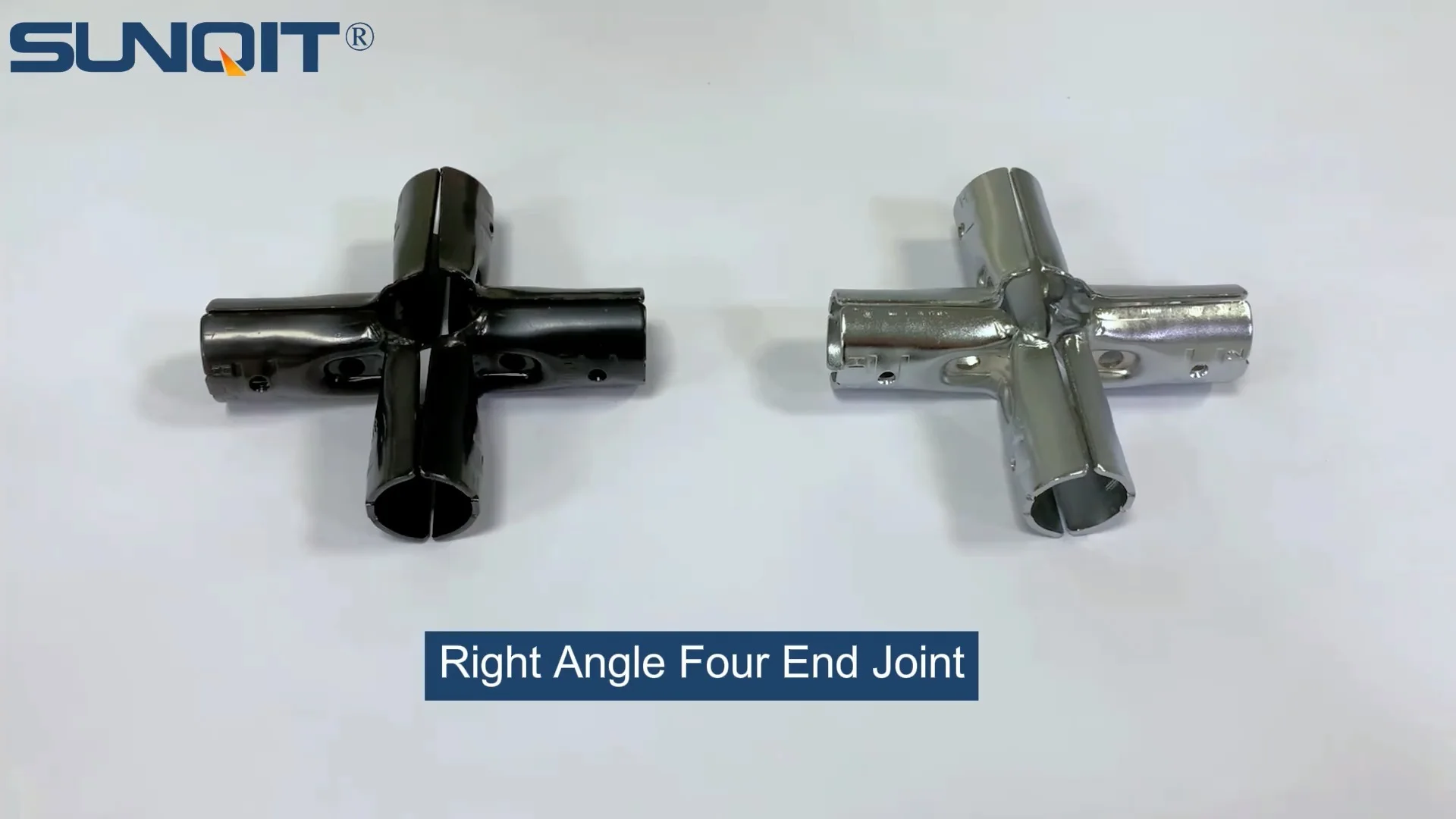
Five way straight lean pipe joint, for 5 pcs 28mm lean pipe connect in straight angle,which used widely in workbench, flow rack, hand trolley frame connection.
The 3C Industry's Race for Agility: Why Lean Solutions Can't Afford to Cut Corners
Walk into any 3C manufacturing facility—whether it's churning out the latest smartphones, sleek laptops, or cutting-edge wearables—and you'll feel the energy of an industry that never sleeps. In 3C (computers, communications, consumer electronics), product lifecycles are measured in months, not years. A new phone model hits the market, and within weeks, customers are already clamoring for the next upgrade. For manufacturers, this pace isn't just a challenge—it's a make-or-break reality. To keep up, production lines can't be rigid, wasteful, or slow. They need to twist, turn, and adapt like a well-choreographed dance. That's where lean systems step in—and at the heart of those systems lie yet critical components: lean pipe joints.
Think about the last time you tried to assemble furniture with mismatched screws or flimsy brackets. Frustrating, right? Now multiply that frustration by a hundred, and you'll get a sense of what happens when a 3C production line relies on subpar lean components. A wobbly workbench, a flow rack that jams, or a conveyor that stalls can throw an entire shift off track, delaying orders and draining team morale. In an industry where seconds count, every loose joint or inefficient connection is a bottleneck waiting to happen. That's why forward-thinking 3C manufacturers aren't just buying "lean products"—they're investing in solutions built on precision, flexibility, and durability. And when it comes to building those solutions, few components are as quietly powerful as the five way straight lean pipe joint.
Beyond the Basics: What Makes the Five Way Straight Lean Pipe Joint a Game-Changer?
It's Not Just a Connector—It's a Swiss Army Knife for Lean Systems
Let's start with the basics: What even is a five way straight lean pipe joint? At first glance, it looks like a small, unassuming metal piece with multiple ports. But don't let its size fool you. This joint is designed to connect five lean pipes in a straight configuration, creating a central hub that can branch out in multiple directions. Picture a spider's web, but instead of silk, it's made of sturdy aluminum or steel pipes, and instead of random threads, every connection serves a purpose. That's the power of the five way joint: it turns simple pipes into a flexible framework that can be shaped into workbenches, flow racks, conveyors, or material trolleys—all without a single weld.
What sets it apart from other joints (like the three way or 90-degree crossing joint)? Versatility, plain and simple. In 3C production, where workstations often need to handle multiple tasks—say, assembling circuit boards on one side and testing components on the other—a five way joint lets you build a lean pipe workbench with integrated shelving, tool holders, and even a mini flow rack attachment. No need for separate structures cluttering the floor; everything connects seamlessly through that central joint. And when the product line switches to a new model? You don't tear everything down. Loosen a few bolts, reposition the pipes, and the same joint becomes the backbone of a whole new setup. It's like having a production line that can rearrange itself while the team keeps working—no downtime, no headaches.
But it's not just about flexibility. Durability matters, too. 3C manufacturing floors are busy places: workers move quickly, carts roll back and forth, and components (some heavy, like metal chassis or battery packs) are constantly loaded and unloaded. A cheap joint might hold up for a week, maybe a month, but under that kind of stress, it'll start to bend, slip, or crack. The five way straight lean pipe joint, when made from high-grade materials like aluminum or coated steel, is built to take a beating. Its precision-engineered ports grip pipes tightly, even when vibrations from nearby machinery rattle the line. For workers, that means one less thing to worry about. They can focus on assembling products, not fixing wobbly racks or re-tightening loose joints.

From Blueprints to Reality: How the Five Way Joint Transforms 3C Production Lines
Case in Point: A Smartphone Assembly Line's Lean Makeover
Let's zoom in on a real-world scenario: a mid-sized 3C manufacturer that specialize in smartphone assembly. Before adopting lean systems, their production line was a patchwork of fixed workbenches, static shelves, and manual material carts. When a new phone model with a larger screen came in, they had to spend three days disassembling old workstations, welding new frames, and reconfiguring shelving. During that time, the line was dead in the water. Workers stood idle, and deadlines loomed. Morale? It hit rock bottom.
Then they partnered with a lean pipe supplier that recommended a system built around five way straight lean pipe joints, aluminum profile, and flow rack components. The difference was night and day. Let's break down how the five way joint became the unsung hero:
1. The Lean Pipe Workbench Redesign: The old workbenches were one-size-fits-all, with no room for customization. Using five way joints, the team built modular workstations where each station could be adjusted for the task at hand. For example, the soldering station needed extra shelving for tools and a heat-resistant surface; the five way joint connected the main bench frame to side shelves and a overhead tool rail, all in one solid structure. When the new phone model arrived, workers simply unbolted the shelves, repositioned the pipes, and added a wider surface—done in two hours instead of three days.
2. Flow Racks That Keep Up with Demand: Before, material handlers spent hours pushing heavy carts from the warehouse to the line, often leaving assemblers waiting for parts. The solution? A network of flow racks built with five way joints and roller track components. The joints connected horizontal and vertical pipes to create multi-tiered racks, where component trays glide smoothly from the back (where materials are loaded) to the front (where assemblers pick them up). No more waiting—parts arrive exactly when needed, and handlers focus on restocking instead of pushing carts. One assembler joked, "It's like having a butler for parts—except the butler never takes a break."
3. Conveyors That Bend Without Breaking: Moving fragile components (like glass screens or delicate circuit boards) from one station to the next used to be a nerve-wracking process. A single jolt could crack a screen, costing time and money. By integrating five way joints into the conveyor system, the team created gentle, curved paths that slowed the flow just enough to prevent damage. The joints connected the conveyor rails to support brackets, ensuring the entire structure stayed stable even when loaded with hundreds of parts. "I used to hold my breath every time a screen came down the line," said a quality control technician. "Now? I barely notice it—it just works."

The Hidden Benefits: How the Right Joints Make Work Feel Less Like "Work"
It's easy to talk about lean systems in terms of "waste reduction" or "process optimization"—buzzwords that sound great in boardrooms. But on the factory floor, the real impact is personal. A well-designed lean setup with the right components doesn't just make production lines faster; it makes them kinder to the people who use them every day.
Take Maria, an assembler with 10 years of experience in 3C manufacturing. She remembers when her workstation had a rickety wooden shelf bolted to the side, held together with duct tape and hope. "I'd reach for a screwdriver, and the whole shelf would wobble. Once, a box of screws fell on my foot," she said. After the lean upgrade, her new workbench—built with five way joints and aluminum profile—has sturdy, adjustable shelves at exactly the right height. "Now I don't have to stretch or bend. The tools are right where I need them, and the shelf doesn't budge. It sounds small, but it makes my day feel lighter. I'm not fighting the workstation anymore—I'm working with it."
Then there's Raj, a material handler responsible for restocking flow racks. Before the five way joint-based system, he had to climb ladders to reach the top shelves of old, fixed racks, risking slips and strains. "My back used to ache by lunchtime," he recalled. Now, the flow racks are built with multiple levels at waist height, connected by five way joints that keep the structure stable without adding extra height. "I can restock three racks in the time it used to take me to do one. And my back? It actually feels good at the end of the day. Who knew a metal joint could be a game-changer for my health?"
These stories aren't just heartwarming—they're proof that lean systems done right don't just boost productivity; they boost morale. When workers feel like their tools and workspaces are designed for them , not against them, they show up more engaged, make fewer mistakes, and stay with the company longer. In 3C, where turnover can be high, that's not just a nice-to-have—it's a competitive advantage.

Not All Joints Are Created Equal: Why Choosing the Right Supplier Matters
So, you're convinced: the five way straight lean pipe joint is a must-have for your 3C lean system. Now comes the next question: where do you get it? It's tempting to opt for the cheapest option online—after all, a joint is a joint, right? Wrong. In lean systems, the difference between a "good" joint and a "great" joint is the difference between a production line that hums and one that sputters.
A reliable lean pipe supplier doesn't just sell parts—they sell peace of mind. Here's what to look for:
1. Material Quality: Aluminum joints should be made from high-grade aluminum extrusion profile to resist corrosion (critical in 3C facilities where cleaning chemicals are common). Steel joints need durable coatings to prevent rust. A supplier that skimps on materials might offer lower prices, but you'll pay for it later in replacements and downtime.
2. Consistency: Ever tried to connect two pipes with a joint that's slightly off-center? It's like trying to fit a square peg in a round hole. The best suppliers use precision machining to ensure every joint's ports are perfectly aligned, so assembly is quick and frustration-free. One production manager put it this way: "With cheap joints, you're always 'fighting' the system. With good ones, you barely notice you're assembling anything."
3. Technical Support: Even the most experienced teams run into questions. Maybe you need to build a custom rack that requires a specific joint configuration, or you're unsure how much weight a five way joint can handle. A good supplier offers more than a catalog—they offer engineers who can walk you through designs, suggest modifications, and even troubleshoot issues over the phone. "We once called our supplier at 7 a.m. with a problem," said a plant supervisor. "By 9 a.m., their engineer had sent a diagram and a list of parts. That's the kind of support that turns a crisis into a minor speed bump."
4. Customization Options: 3C production lines are rarely "one-size-fits-all." A supplier that offers custom joints (like specialized coatings for ESD protection, or modified port sizes for unique pipes) can help you build a system that fits your exact needs. For example, if your line handles sensitive electronics, ESD workbench components and ESD-safe joints are non-negotiable. A supplier that understands ESD requirements won't just sell you a joint—they'll ensure it meets industry standards to protect your products.
Don't just take our word for it. A recent survey of 3C manufacturers found that those who partnered with specialized lean pipe suppliers reported 30% fewer production delays and 25% higher team satisfaction than those who bought generic parts. As one operations director put it: "We used to think saving $5 on a joint was smart. Now we know: the best 'savings' are the ones you never see—no downtime, no rework, no frustrated workers."
Comparing the Contenders: How the Five Way Joint Stacks Up Against Other Lean Pipe Joints
Still on the fence about whether the five way straight lean pipe joint is right for your line? Let's put it head-to-head with two common alternatives: the three way joint and the 90-degree crossing joint. The table below breaks down their strengths, weaknesses, and best uses in 3C manufacturing.
| Joint Type | Number of Pipe Connections | Best For | Load Capacity (Avg.) | Assembly Time (Per Joint) | Flexibility for Reconfiguration |
| Five Way Straight Lean Pipe Joint | 5 (straight configuration) | Multi-task workbenches, complex flow racks, conveyor hubs | 150-200 kg (evenly distributed) | 5-7 minutes (with basic tools) | High—easily reposition pipes without disassembly |
| Three Way Joint | 3 (T-shape or Y-shape) | Simple shelving, basic workbenches, straight flow racks | 100-150 kg (evenly distributed) | 3-5 minutes (with basic tools) | Medium—limited to 3 directions, may require extra joints for complex setups |
| 90-Degree Crossing Joint | 4 (2 horizontal, 2 vertical) | Cross-shaped structures, vertical storage racks | 80-120 kg (evenly distributed) | 4-6 minutes (with basic tools) | Low—fixed 90-degree angles make reconfiguration tricky |
As you can see, the five way joint shines when flexibility and complexity are key. For simple setups (like a basic shelf), a three way joint might be enough. But in 3C manufacturing, where lines need to do more with less space, the five way joint's ability to connect five pipes in one hub reduces the need for extra joints, saving space and cutting down on assembly time. It's like using a single puzzle piece that connects five others, instead of five separate pieces that barely fit together.
Conclusion: Building Lean Systems That Grow With Your Ambition
In the 3C industry, standing still is the same as falling behind. To stay competitive, you need production lines that can adapt to new products, new demands, and new challenges—all while keeping waste to a minimum and morale to a maximum. Lean systems are the foundation of that adaptability, and lean pipe joints are the building blocks. The five way straight lean pipe joint, in particular, is more than just a component; it's a tool for innovation. It lets you turn a blank production floor into a customized ecosystem where every workbench, flow rack, and conveyor works in harmony—for your products, your team, and your bottom line.
So, the next time you're planning a lean upgrade, don't overlook the small stuff. A well-chosen joint might not make headlines, but it will make a difference—one smooth workflow, one happy worker, and one on-time order at a time. After all, in 3C manufacturing, the race isn't just about building better products. It's about building better ways to build them. And with the right lean components, that race becomes a whole lot easier to win.