- Company Articles
- Products and Technology
- Product knowledge
- Five Way Straight Lean Pipe Joint for Modular Material Rack Design

Five Way Straight Lean Pipe Joint for Modular Material Rack Design
Related Product
Five Way Straight Lean Pipe Joint
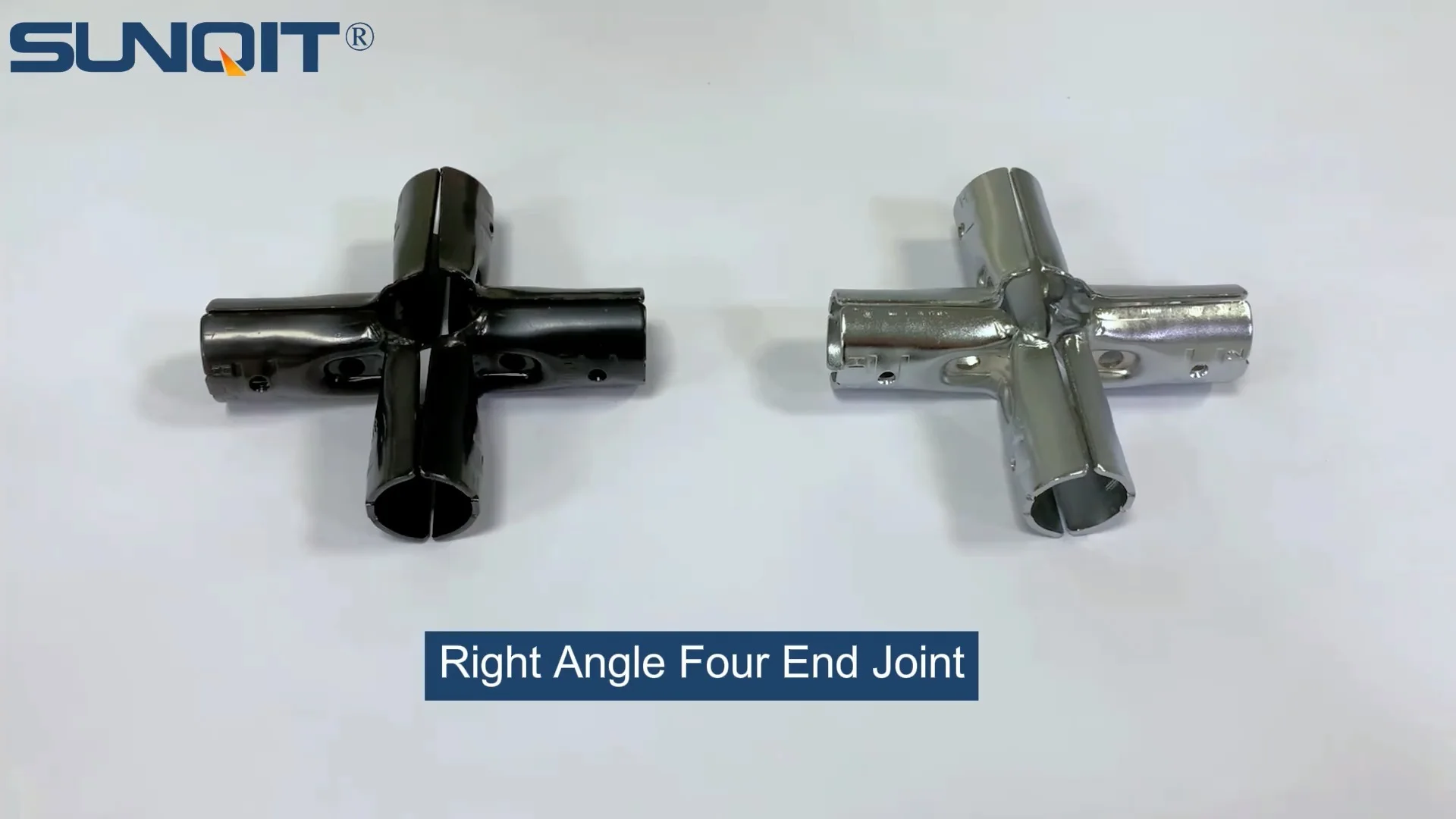
Five way straight lean pipe joint, for 5 pcs 28mm lean pipe connect in straight angle,which used widely in workbench, flow rack, hand trolley frame connection.
Picture this: A bustling production floor where workers weave between stacks of materials, pausing every few minutes to search for the right component. Tools lie scattered across workbenches, and a half-assembled product sits idle because the necessary parts are trapped in a rigid, one-size-fits-all storage rack. Sound familiar? For many manufacturers, this chaos isn't just a daily hassle—it's a silent killer of productivity, eating into profits and leaving teams frustrated. But what if there was a way to transform that chaos into calm? Enter modular material racks, the unsung heroes of lean manufacturing systems. And at the heart of these adaptable workhorses? The five way straight lean pipe joint—a small but mighty component that turns generic pipes into custom, flexible solutions.
In the world of lean manufacturing, where the goal is to eliminate waste and streamline every process, rigidity is the enemy. Traditional fixed racks might work for a static production line, but today's factories need to pivot quickly—whether it's scaling up for a new order, reconfiguring workflows for a product redesign, or simply making space for a new machine. That's where modular systems shine, and why the right joints matter so much. The five way straight lean pipe joint isn't just another piece of hardware; it's the linchpin that lets you build, adapt, and rebuild material racks, flow racks, and workstations to fit your exact needs. Let's dive into how this unassuming component is revolutionizing modular design, one joint at a time.
Understanding Modular Material Racks in Lean Systems
Before we zoom in on the five way straight lean pipe joint, let's take a step back to understand the bigger picture: modular material racks and their role in lean systems. Lean manufacturing, a philosophy born from Toyota's legendary production system, is all about maximizing value while minimizing waste—whether that waste is time, materials, or space. At its core, lean is about adaptability : the ability to respond to changes in demand, product design, or workflow without overhauling entire systems.
Modular material racks are a physical manifestation of this philosophy. Unlike traditional welded racks or fixed shelving units, which are built to a single specification and impossible to modify without cutting or welding, modular racks are constructed from interchangeable components—think lean pipes, joints, casters, and accessories—that can be assembled, disassembled, and reconfigured in minutes. Need a taller rack for bulkier materials next month? Swap out shorter pipes for longer ones. Want to add a shelf halfway up? Just attach a few more joints. It's like building with industrial-grade Legos, but for grown-ups who mean business.
These racks aren't just about storage—they're about creating a flow . In lean terms, "flow" refers to the smooth, uninterrupted movement of materials from one stage of production to the next. A well-designed modular rack ensures that components are exactly where workers need them, when they need them, reducing the time spent walking, searching, or waiting. This is especially critical in high-volume environments, where even a 30-second delay per worker per hour can add up to thousands of lost minutes annually.
Of course, none of this flexibility would be possible without the right building blocks. The key components of a modular system include lean pipes (often coated in plastic or made of aluminum for durability), casters for mobility, workbench tops for assembly stations, and—most importantly—joints. Joints are the "glue" that holds the system together, dictating how pipes connect, how much weight the structure can bear, and how easy it is to reconfigure. And among all the joints available, the five way straight lean pipe joint stands out for its unique ability to connect multiple pipes in a single, sturdy point—opening up a world of design possibilities.
The Role of Joints in Modular Design: Why "One Size" Never Fits All
Imagine trying to build a house with only one type of nail. Sure, you could hammer it into place, but would it hold up a roof? Or secure a window frame? Probably not. The same logic applies to modular material racks: not all joints are created equal, and the right joint for the job depends on what you're building. Let's break down the basics: joints are the connectors that attach lean pipes (or aluminum profiles) to each other, allowing you to create angles, T-junctions, crosses, and more. Without them, you'd just have a pile of pipes—useful for little more than rolling around the floor.
Most modular systems start with simple two-way joints, which connect two pipes in a straight line, or three-way joints, which add a perpendicular branch (think of a "T" shape). Four-way joints take it a step further, allowing connections in four directions (like a "+" sign). These are great for basic racks—say, a simple two-shelf unit or a straight flow rack for moving materials from point A to B. But what if you need more? What if you want to build a multi-tiered rack with horizontal shelves, vertical supports, and diagonal bracing? Or a workbench with integrated tool holders on three sides and a flow rack attachment on the fourth? That's where the five way straight lean pipe joint enters the fray.
The five way straight lean pipe joint, as the name suggests, offers five connection points. Typically, four of these points are arranged in a cross (north, south, east, west), and the fifth is a straight extension along the vertical axis (up or down). This means you can connect five pipes in a single joint: four in a horizontal plane and one vertically, or vice versa. Suddenly, the design possibilities explode. You can build a cube-shaped rack with a center support, add side branches to a main beam, or even create a grid-like structure for storing small parts. For manufacturers dealing with diverse materials—from tiny electronic components to bulky automotive parts—this versatility is a game-changer.
But why does this matter in practice? Let's take a real-world example: a small electronics assembly plant that produces both smartphones and tablets. Smartphones require small, delicate parts (screws, microchips, screens), while tablets need larger components (batteries, casings). A one-size-fits-all rack might have shelves spaced too far apart for phone parts (wasting space) or too close together for tablet batteries (making them hard to access). With a five way joint, the plant can build a custom rack: shorter vertical pipes for the phone section (with more shelves) and taller vertical pipes for the tablet section (with fewer, wider shelves). And if next month they start producing smartwatches? No problem—just disassemble the top section, add shorter pipes, and reattach the shelves. No welding, no cutting, no waiting for a custom fabrication shop. That's the power of modularity, and it all starts with the joint.

The Five Way Straight Lean Pipe Joint: Design, Materials, and Functionality
Now that we understand why the five way joint matters, let's take a closer look at what makes it tick. At first glance, it might seem like a simple metal piece with holes, but there's more engineering here than meets the eye. Let's break down its design, materials, and how it actually works.
Design: More Than Just Holes in Metal
The five way straight lean pipe joint is typically made from die-cast zinc alloy or steel, both known for their strength and durability. Its shape is engineered to distribute weight evenly across all connected pipes, preventing stress points that could lead to bending or breaking. The joint itself is roughly cylindrical or cubic, with five threaded holes (one for each connection point) spaced at precise angles. Each hole is designed to fit standard lean pipe diameters—most commonly 28mm (the industry standard for lean pipes) or 30mm for heavier-duty applications. Some joints also feature a central hollow core, reducing weight without sacrificing strength.
What sets the five way joint apart is its precision. The holes are machined to tight tolerances, ensuring a snug fit with the pipes. This isn't just about stability—it also prevents the pipes from wobbling, which could damage materials or create safety hazards. Many joints also include a locking mechanism, like a set screw or a hex bolt, that tightens against the pipe to hold it securely in place. This is crucial: imagine a rack full of heavy materials suddenly coming loose because a joint wasn't tight enough. The locking feature ensures that once assembled, the joint stays put—even under vibration from nearby machinery or constant use.
Materials: Built to Last in Tough Environments
When it comes to manufacturing environments, durability is non-negotiable. Floors are oily, chemicals might be present, and racks are often bumped by forklifts or trolleys. That's why most five way straight lean pipe joints are made from zinc-plated steel or stainless steel. Zinc plating adds a layer of corrosion resistance, protecting the joint from rust and extending its lifespan. For environments with high moisture or chemical exposure (like food processing or pharmaceutical plants), stainless steel joints are available—though they come at a slightly higher cost.
Some manufacturers also offer plastic-coated joints, which add an extra layer of protection against scratches and reduce noise when assembling or reconfiguring racks. This might seem like a small detail, but in a busy factory, every decibel counts toward creating a more pleasant (and less stressful) work environment. The key takeaway? The materials used in the five way joint aren't just chosen for cost—they're selected to withstand the daily grind of industrial use, ensuring your racks stay sturdy for years.
Functionality: How It All Comes Together
So, how do you actually use a five way straight lean pipe joint? It's surprisingly simple. Here's a step-by-step breakdown:
- Plan your design: Sketch out your rack (or use a modular design tool) to determine where the five way joints will go. Mark the positions of vertical supports, horizontal shelves, and any cross-bracing.
- Cut pipes to length: Using a pipe cutter or hacksaw, cut your lean pipes to the required lengths. Most lean pipe suppliers sell pre-cut pipes, but cutting your own gives you full control over dimensions.
- insert pipes into the joint: Slide the end of each pipe into one of the joint's holes. The fit should be snug—if it's too loose, the joint may not hold; if it's too tight, you could damage the pipe or joint.
- Tighten the set screws: Using an Allen wrench (most joints use hex screws), tighten the set screws in each hole. This compresses the pipe against the joint, creating a secure connection. Be careful not to over-tighten—this can strip the threads or crack the joint.
- Test for stability: Gently shake the structure to ensure it doesn't wobble. If it does, check that all screws are tight and pipes are cut straight.
The beauty of this process is that it's reversible. Need to shorten a shelf? Loosen the screws, slide the pipe out, cut it to the new length, and reinsert. Want to add a new branch? Just attach a new pipe to the unused connection point. This simplicity is what makes modular systems so appealing—even workers with no specialized training can assemble or modify racks in minutes.

Comparing Joint Types: Why Five Way Stands Out
To truly appreciate the five way straight lean pipe joint, it helps to see how it stacks up against other common joint types. Let's compare it to three of the most popular options: two way, three way, and four way joints. The table below highlights key differences in connection points, best uses, load capacity, and assembly time.
| Joint Type | Connection Points | Best For | Max Load Capacity (Per Joint) | Assembly Time (Per Joint) | Key Limitation |
|---|---|---|---|---|---|
| Two Way Straight | 2 (straight line) | Extending pipes, straight rails | 200 kg | 1–2 minutes | Only connects two pipes; no branching |
| Three Way (T-Shaped) | 3 (2 straight, 1 perpendicular) | Basic shelves, T-junctions | 150 kg | 2–3 minutes | Limited to three directions; can't create complex structures |
| Four Way (Cross-Shaped) | 4 (2 horizontal, 2 vertical) | Simple cubes, square frames | 180 kg | 3–4 minutes | No diagonal connections; limited vertical/horizontal flexibility |
| Five Way Straight | 5 (4 in cross, 1 straight) | Multi-tier racks, complex grids, workbench attachments | 220 kg | 4–5 minutes | Slightly higher cost than basic joints |
As the table shows, the five way joint offers the most connection points, making it ideal for complex designs. Its load capacity is also higher than three way and four way joints, thanks to its reinforced design. The tradeoff? It takes a minute or two longer to assemble, and it's slightly more expensive. But for manufacturers that value flexibility and durability, the extra cost is negligible compared to the benefits of a system that can adapt to changing needs.
Let's take a closer look at the "best for" category. Two way joints are great for straight lines—think of a conveyor belt or a long flow rack. Three way joints work well for simple shelves, like a two-shelf unit in a warehouse. Four way joints are useful for square frames, such as the base of a turnover trolley. But when you need to build something more intricate—a multi-tier material rack with shelves on three sides, or a workbench with integrated tool hooks and a flow rack attachment—the five way joint is the only option that can handle all those connections in a single point. This reduces the number of joints needed overall, simplifying the design and making the structure sturdier (fewer joints mean fewer potential weak points).
Another advantage of the five way joint is its compatibility with other components. Most lean pipe suppliers design their joints to work with standard accessories like casters, roller tracks, and workbench tops. For example, you can attach a caster wheel to the bottom of a vertical pipe (connected via a five way joint) to make the entire rack mobile. Or add a roller track to a horizontal pipe (via a bracket) to create a flow rack for moving materials along the assembly line. This compatibility ensures that your modular system isn't limited to just storage—you can build workstations, trolleys, and even production lines using the same components.

Applications in Material Rack Design: From Simple to Complex
The five way straight lean pipe joint isn't just a theoretical improvement—it solves real problems on the factory floor. Let's explore some of its most common applications, from basic storage racks to advanced integrated workstations.
Multi-Tier Material Racks
One of the most popular uses for five way joints is building multi-tier material racks—think of a vertical shelving unit with shelves on multiple levels, each accessible from different sides. For example, a material rack B (3 row and 3 floor) (a common design in many factories) requires joints that can connect vertical supports to horizontal shelves on three levels. With a five way joint, you can attach the vertical support pipe, two horizontal shelf pipes (one on each side), and two cross-bracing pipes (front and back) in a single point. This creates a sturdy, stable shelf that can hold heavy materials without sagging.
What makes this design so effective? It maximizes vertical space, which is often underutilized in factories. Instead of spreading materials across the floor, you stack them vertically, freeing up space for other equipment. And because the shelves are adjustable, you can space them to fit everything from small bins to large boxes. A manufacturer of automotive parts, for instance, might use a 3-row, 3-floor rack to store brake pads (small, heavy boxes) on the bottom shelf, axles (long, cylindrical parts) on the middle shelf, and air filters (light, bulky boxes) on the top shelf. Each shelf can be customized with dividers (connected via five way joints) to separate different part numbers, making it easy for workers to grab what they need at a glance.
Integrated Workstations
Another powerful application is integrated workstations—combining a workbench with storage, tool holders, and flow racks in one cohesive unit. Imagine a workbench E (single deck-without caster) with a flat surface for assembly, a flow rack attached to the left side (for incoming materials), a tool rack on the right side (for screwdrivers, pliers, etc.), and a shelf underneath (for finished products). To build this, you'd use five way joints at the corners of the workbench: one joint connects the vertical leg, the workbench top frame, the flow rack support, and the tool rack support. This creates a single, stable structure where everything the worker needs is within arm's reach—no more walking back and forth to grab tools or materials.
For example, a furniture manufacturer assembling chairs might use such a workstation. The flow rack on the left holds chair legs (delivered via roller track), the tool rack on the right holds drills and screws, and the shelf underneath holds completed chair frames. The worker stands at the workbench, takes legs from the flow rack, drills them into the frame, and places the finished chair on the shelf. The entire process is streamlined, with no wasted movement—a textbook example of lean manufacturing in action.
Mobile Trolleys and Turnover Racks
Five way joints also shine in mobile applications, like turnover trolleys and racks. These are essentially portable material racks with caster wheels, used to transport materials from one part of the factory to another. To build a stable trolley, you need joints that can connect vertical supports, horizontal shelves, and caster mounts in a single point. A five way joint at each corner of the trolley's base connects the vertical leg, two horizontal base pipes (front and back), and the caster mount. This ensures the trolley can carry heavy loads (up to 500 kg in some cases) without tipping over, even when moving over uneven floors.
A warehouse that ships small parts might use such a trolley to collect orders: shelves on the trolley are divided into bins (using five way joints and dividers), each labeled with a customer's order number. Pickers fill the bins as they walk through the warehouse, then push the trolley to the packing station. Because the trolley is modular, it can be reconfigured for different order sizes—adding more shelves during peak season or removing them for large, bulky items.
Benefits of Using Five Way Straight Lean Pipe Joints in Your Facility
By now, you might be wondering: Is the five way joint worth the investment? The short answer is yes—and here's why. From cost savings to improved productivity, the benefits add up quickly.
Flexibility to Adapt to Change
In today's fast-paced manufacturing world, change is constant. New products are launched, customer demands shift, and production volumes fluctuate. A rigid storage system can't keep up—you either waste space (when volumes are low) or run out of space (when volumes are high). Modular systems with five way joints, however, adapt with you. Need to add a shelf? Just attach a pipe. Need to move a rack? Disassemble it and rebuild elsewhere. This flexibility means you'll never have to buy a brand-new rack because your old one no longer fits—saving you thousands of dollars over time.
Consider a clothing manufacturer that produces seasonal items: winter coats in Q4, swimwear in Q2. In winter, they need racks for bulky coats (tall shelves, wide spacing). In summer, they need racks for small swimwear (short shelves, narrow spacing). With five way joints, they can reconfigure the same racks instead of storing (or discarding) old racks and buying new ones. This not only saves money but also reduces waste—a core principle of lean manufacturing.
Durability That Stands the Test of Time
Unlike plastic or flimsy metal joints that bend or break under load, five way straight lean pipe joints are built to last. Made from zinc-plated steel or stainless steel, they resist rust, corrosion, and impact—even in harsh industrial environments. This durability means your racks will stay sturdy for years, reducing the need for replacements. And because the joints are reusable, you can disassemble a rack and rebuild it elsewhere without losing any functionality. A well-maintained five way joint can last a decade or more, making it a smart long-term investment.
Improved Productivity and Worker Satisfaction
A disorganized workspace isn't just frustrating—it's a productivity killer. Workers spend up to 20% of their time searching for tools or materials, according to industry studies. Modular racks built with five way joints put everything in its place, reducing search time and letting workers focus on what they do best: building products. When tools and materials are easy to find, morale improves too—happy workers are more engaged, leading to higher quality and fewer errors.
A study by the Lean Enterprise Institute found that factories with organized, modular workstations reported a 15–20% increase in productivity. That's not just a statistic—it translates to more products built, more orders shipped, and more revenue for your business.
Cost Savings Over Time
At first glance, modular systems might seem more expensive than traditional fixed racks. After all, a basic welded rack can be cheaper upfront. But when you factor in the long-term costs—replacement, storage, customization—modular systems win hands down. Let's do the math: A fixed rack costs $500 and lasts 5 years, but can't be modified. A modular rack with five way joints costs $800 but can be reconfigured 10 times over 10 years, eliminating the need to buy 10 new fixed racks ($5,000 total). The modular system saves $4,200 over a decade—not including the labor costs of installing new racks.
Plus, modular systems are easy to install and reconfigure, reducing labor costs. A team of two workers can assemble a 10-foot rack in under an hour, compared to half a day for a welded rack (which requires a skilled welder). This means less downtime and faster deployment of new storage solutions.
Choosing the Right Lean Pipe Supplier for Your Five Way Joints
Not all five way straight lean pipe joints are created equal. The quality of the joint depends on the manufacturer—poorly made joints can bend, strip, or break, compromising the safety and stability of your racks. That's why choosing the right lean pipe supplier is critical. Here's what to look for:
Material Quality
Ask about the materials used in the joints. Zinc-plated steel is standard for most industrial applications, but if you need corrosion resistance, look for stainless steel. Avoid joints made from cheap alloys—they're prone to cracking under load. A reputable supplier will provide material certificates and test reports, proving their joints meet industry standards (like ISO 9001).
Precision Machining
The holes in the joint must be precisely machined to ensure a snug fit with the pipes. Even a 1mm difference in hole diameter can lead to loose connections. Ask the supplier about their machining tolerances—look for joints with tolerances of ±0.1mm or better. You can also request a sample joint to test: insert a pipe and see if it wobbles (it shouldn't) and if the set screw tightens securely.
Range of Accessories
A good supplier won't just sell joints—they'll offer a full range of accessories, including lean pipes, casters, roller tracks, and workbench tops. This ensures all components are compatible, reducing the risk of mismatched parts. For example, if you buy five way joints from one supplier and pipes from another, the pipes might be slightly larger or smaller than the joint holes, leading to loose connections.
Customer Support
Modular design can be intimidating at first, especially if you're new to lean systems. Look for a supplier that offers design support—whether it's free CAD templates, phone consultations, or on-site design services. Some suppliers even provide training for your team, teaching them how to assemble and reconfigure racks safely and efficiently.
Don't be afraid to ask for references. A reputable supplier will have a list of satisfied customers who can vouch for the quality of their products and service. And remember: the cheapest supplier isn't always the best. Saving a few dollars on a joint isn't worth risking a rack collapse that damages materials or injures workers.
Maintenance Tips to Keep Your Five Way Joints (and Racks) in Top Shape
Even the best five way joints need a little care to stay in top condition. With proper maintenance, your joints can last for decades, ensuring your racks remain safe and stable. Here are some simple tips:
Regularly Inspect and Tighten Screws
Vibration from machinery, frequent use, and temperature changes can loosen set screws over time. Inspect your racks monthly and tighten any loose screws with an Allen wrench. This is especially important for racks that hold heavy loads or are moved frequently (like mobile trolleys).
Clean Joints to Prevent Corrosion
Dust, oil, and moisture can build up on joints, leading to rust (especially on zinc-plated joints). Wipe down joints with a dry cloth every few months, and use a mild detergent for greasy or oily joints. For stainless steel joints, avoid abrasive cleaners (they can scratch the surface and reduce corrosion resistance).
replace Damaged Joints Promptly
If a joint is cracked, bent, or has stripped threads, replace it immediately. A damaged joint is a safety hazard—even a small crack can cause the rack to collapse under load. Keep a few spare joints on hand so you can replace them quickly without disrupting production.
Avoid Overloading Racks
Every joint has a maximum load capacity (typically 200–300 kg per joint). Exceeding this can bend or break the joint. Label racks with their maximum load capacity and train workers to respect these limits. If you need to store heavier materials, use reinforced joints or add extra supports (connected via five way joints) to distribute the weight.
The Future of Modular Material Racks: Where Five Way Joints Fit In
As manufacturing continues to evolve—with trends like Industry 4.0, automation, and sustainability taking center stage—modular material racks will only grow in importance. And the five way straight lean pipe joint will play a key role in this evolution. Here's what to watch for:
Integration with Smart Technologies
Future racks may include sensors that monitor load levels, track inventory, or alert managers when a shelf is overloaded. Five way joints could serve as mounting points for these sensors, turning passive racks into active data-collection tools. For example, a sensor in a five way joint could detect when a shelf is empty and automatically trigger a restocking alert, reducing downtime.
Sustainability and Recyclability
As companies focus on reducing their environmental footprint, modular systems will become even more appealing. Five way joints made from recycled steel or aluminum, and designed for easy disassembly and recycling, will lead the way. Lean pipe suppliers may also offer take-back programs, ensuring old joints are recycled rather than ending up in landfills.
Lightweight Materials
Aluminum lean pipes are gaining popularity due to their lightweight (easier to handle) and corrosion-resistant properties. Five way joints designed for aluminum pipes (which have slightly different diameters than steel pipes) will become more common, offering the same flexibility with less weight. This is especially useful for mobile racks, where reducing weight improves maneuverability.
Conclusion: Small Joint, Big Impact
The five way straight lean pipe joint might be small, but its impact on your facility's productivity, flexibility, and bottom line is huge. By allowing you to build custom, adaptable material racks, flow racks, and workstations, it transforms chaos into order, waste into efficiency, and frustration into satisfaction. Whether you're a small workshop or a large manufacturing plant, modular systems built with five way joints are an investment that pays dividends for years to come.
So, the next time you walk through your production floor, take a look at your racks. Are they rigid and outdated, holding your team back? Or are they flexible and adaptable, supporting your lean goals? If it's the former, it might be time to talk to a lean pipe supplier about upgrading to five way joints. Your workers (and your profits) will thank you.