- Company Articles
- Products and Technology
- Product knowledge
- Five Way Straight Lean Pipe Joint for Sustainable Lean Manufacturing Practices

Five Way Straight Lean Pipe Joint for Sustainable Lean Manufacturing Practices
Related Product
Five Way Straight Lean Pipe Joint
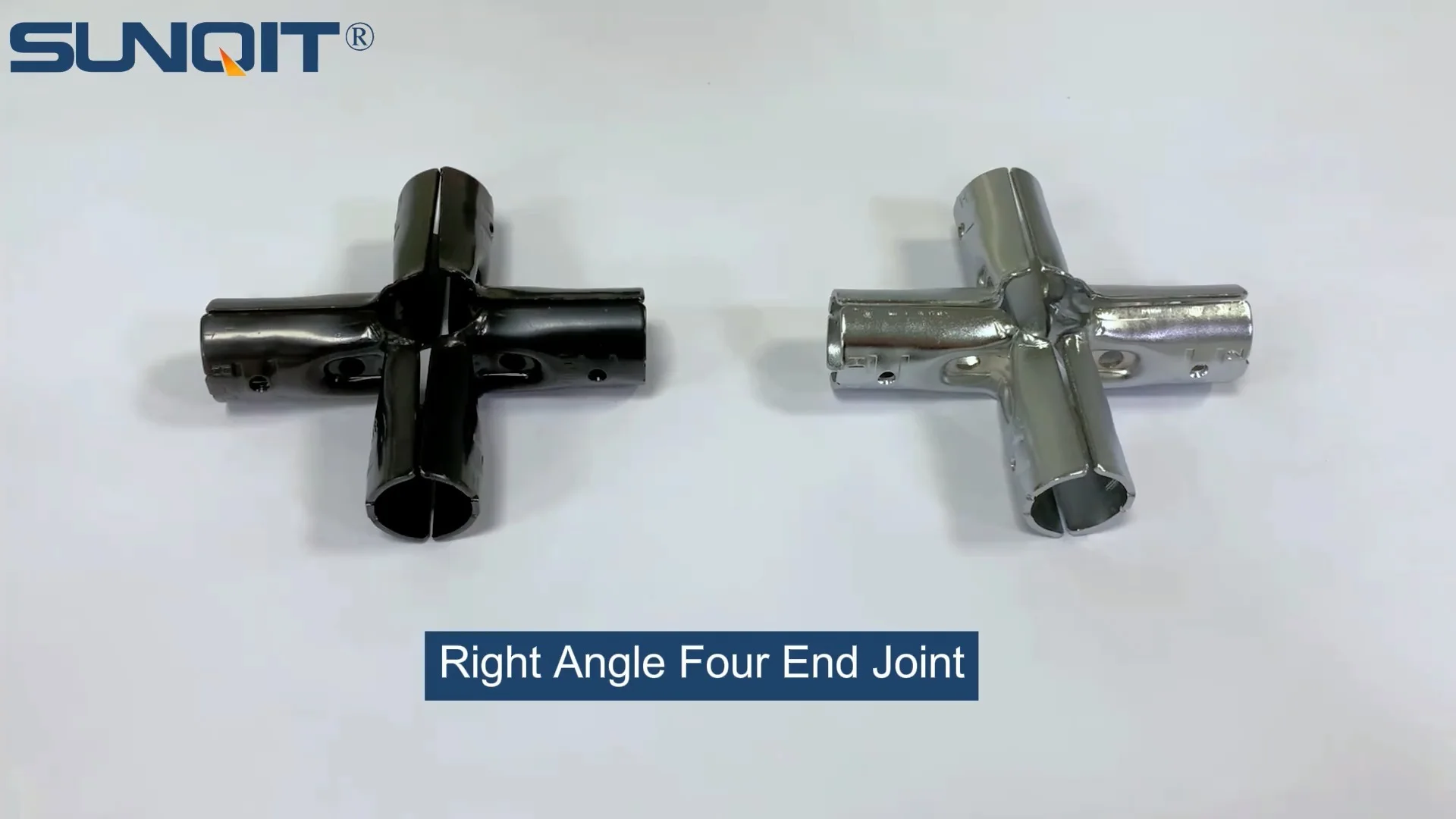
Five way straight lean pipe joint, for 5 pcs 28mm lean pipe connect in straight angle,which used widely in workbench, flow rack, hand trolley frame connection.
Walk into any modern manufacturing facility today, and you'll likely notice a shift—gone are the days of rigid, one-size-fits-all production lines. Instead, floors are organized with sleek, adaptable structures: workbenches that adjust to new product sizes overnight, flow racks that move materials seamlessly to assembly stations, and conveyors that reroute with minimal hassle. This transformation isn't just about aesthetics; it's the result of lean manufacturing principles in action. And at the center of this flexibility? The humble yet powerful lean pipe joint . Among these, the five way straight lean pipe joint stands out as a quiet game-changer, enabling factories to build sustainable, efficient systems that grow with their needs.
In a world where manufacturers face mounting pressure to reduce waste, cut costs, and meet ever-changing customer demands, sustainability and efficiency are no longer optional—they're essential. Lean manufacturing has long been the gold standard for streamlining operations, but its success hinges on the tools used to implement it. Lean pipe systems , built from modular pipes and joints, have become the backbone of this approach. And within these systems, the five way straight lean pipe joint is the unsung hero that turns basic components into dynamic, future-ready workspaces.
The Basics: What is Lean Manufacturing, Anyway?
Before diving into the specifics of joints and pipes, let's ground ourselves in what lean manufacturing really means. At its core, lean is about eliminating waste—whether that's wasted time, materials, or effort—while maximizing value for the customer. It's a philosophy that originated in Toyota's production system decades ago, but today, it's evolved to include sustainability as a key pillar. Modern lean isn't just about making things faster; it's about making them smarter, with less impact on the planet.
Think about a typical factory floor without lean principles: materials pile up in unused corners, workers spend hours searching for tools, and reconfiguring a production line to make a new product takes weeks (and a small fortune). Lean flips that script by designing systems that are responsive . Need to ramp up production for a sudden order? The system adapts. Want to reduce energy use? Streamline workflows to cut unnecessary movement. And none of this is possible without flexible infrastructure—and that's where lean pipe comes in.
Lean Pipe Systems: The Building Blocks of Flexible Manufacturing
At first glance, a lean pipe system might look simple: metal or aluminum pipes connected by joints, forming structures like workbenches, racks, or trolleys. But don't let the simplicity fool you. These systems are engineered for adaptability. Unlike traditional fixed structures—welded metal racks or wooden workbenches that are permanent and hard to modify—lean pipe systems are modular. That means you can disassemble, rearrange, and rebuild them as your needs change. A workbench today can become a material cart tomorrow, and a flow rack can expand from two levels to five with just a few new pipes and joints.
The magic of these systems lies in their components: the pipes, the joints, and the accessories. Lean pipe itself is typically made of steel, aluminum, or stainless steel, coated in plastic or left bare for durability. Aluminum lean pipe, for example, is lightweight yet strong, making it ideal for applications where mobility and corrosion resistance matter. Then there are the accessories: casters for moving trolleys, roller tracks for sliding materials, and end caps to protect workers from sharp edges. But none of these components matter without the right joints.

Joints: The Unsung Heroes of Lean Systems
If lean pipe is the "bones" of a lean system, joints are the "muscles" that hold everything together and allow movement. Without high-quality joints, even the sturdiest pipes would fail to create a stable structure. Joints come in all shapes and sizes, each designed for specific needs: two-way joints for straight lines, three-way joints for corners, swivel joints for angled connections. But when it comes to building complex, multi-functional structures, the five way straight lean pipe joint is in a league of its own.
So, what makes the five way straight joint special? Let's break it down. As the name suggests, this joint has five connection points—four in a straight line (two on each end) and one perpendicular, usually in the center. This design lets you connect multiple pipes in different directions, creating branches, layers, or cross-sections with a single joint. Imagine building a flow rack that needs three vertical supports and two horizontal shelves on each level; a five way joint can anchor all those pipes in one spot, reducing the number of components needed and increasing stability.

Five Way Straight Lean Pipe Joint: Design, Function, and Benefits
To truly appreciate the five way straight lean pipe joint, let's get into the details. Most modern versions are made from die-cast aluminum or steel, chosen for their strength-to-weight ratio. Aluminum joints, in particular, are popular because they're lightweight (making assembly easier) and resistant to rust, which is crucial in factories with moisture or chemicals. The joint itself is designed with precision: each connection point has a hollow core that fits snugly over the end of a lean pipe , and a set screw or clamp secures the pipe in place. No welding, no drilling—just a simple twist of a wrench, and the joint holds firm.
One of the biggest advantages of this design is its load capacity. A well-made five way joint can support hundreds of pounds, depending on the pipe material and diameter. For example, when paired with 2.0mm thick aluminum lean pipe, it can easily hold the weight of heavy components on a workbench or stacked materials in a flow rack. This strength is critical in manufacturing, where safety and reliability are non-negotiable.
But strength alone isn't enough. The five way joint's real power is in its versatility. Let's say you run a electronics assembly line and need a workbench with integrated tool storage, a material shelf, and a small conveyor for moving PCBs. With a five way joint, you can connect the bench's main frame (vertical pipes), the tool rack (horizontal pipes off one side), and the conveyor track (another horizontal pipe off the opposite side)—all from a single joint. This reduces the number of joints needed, simplifies assembly, and creates a cleaner, more organized structure.
Another key benefit is reusability. In traditional manufacturing setups, if you need to change a workbench's height or a flow rack's width, you'd likely have to cut new metal or build a new structure from scratch. With a five way joint, you just loosen the set screws, adjust the pipes, and retighten. The joint itself can be reused dozens of times, making it a sustainable choice that reduces waste. A lean pipe supplier will often highlight this reusability as a selling point, and for good reason: it lowers long-term costs and aligns with circular economy principles.

A Closer Look: How Five Way Joints Compare to Other Types
To understand why the five way straight joint is so valuable, let's compare it to other common lean pipe joint types. The table below breaks down key differences in connection points, typical uses, and flexibility:
| Joint Type | Connection Points | Typical Uses | Flexibility Level |
|---|---|---|---|
| Two-way straight | 2 (straight line) | Extending pipes in a single direction (e.g., long conveyor rails) | Low—only straight lines |
| Three-way (T-shaped) | 3 (one straight, one perpendicular) | Adding a single branch (e.g., a shelf on a workbench) | Medium—limited to one branch |
| Four-way (cross-shaped) | 4 (two perpendicular straight lines) | Building grids or frames (e.g., the base of a trolley) | High—two axes, but no vertical/horizontal mix |
| Five way straight | 5 (four in a line, one perpendicular) | Multi-level structures, branching conveyors, complex workbenches | Very high—combines straight lines and perpendicular branches |
As the table shows, the five way joint's ability to connect pipes in multiple directions makes it uniquely suited for complex, multi-functional systems. It's like the Swiss Army knife of lean pipe joints —one tool that can do the job of several others, simplifying both assembly and maintenance.
Real-World Applications: Five Way Joints in Action
To see the five way straight lean pipe joint in action, let's walk through a few common scenarios where it shines. These examples show how this joint transforms basic lean pipe into systems that solve real manufacturing challenges.
1. Multi-Level Flow Racks
Flow racks are a staple in lean manufacturing, designed to move materials from the back (where they're stocked) to the front (where workers pick them) using gravity. A typical flow rack has several levels, each with roller tracks for sliding bins or boxes. To build a rack with three levels and three vertical supports per side, you'd traditionally need multiple three-way joints at each vertical support: one for the top shelf, one for the middle, and one for the bottom. That's three joints per support, adding up quickly.
With a five way joint, you can connect all three shelves (top, middle, bottom) and the vertical support pipe using a single joint. The joint sits at the intersection of the vertical pipe and the three horizontal shelf pipes, reducing the number of joints by two-thirds. This not only speeds up assembly but also creates a sturdier structure, as there are fewer points of potential weakness. The result? A flow rack that's faster to build, easier to adjust, and more reliable.
2. Ergonomic Workbenches with Integrated Features
Workbenches are where the rubber meets the road in manufacturing—they need to be sturdy, adjustable, and tailored to the task. For example, a workbench for assembling small appliances might need a flat top, a shelf for tools below, a rack for manuals above, and a side rail for hanging cables. Without a five way joint, you'd need separate joints for each feature: a three-way joint for the shelf, another for the manual rack, and a two-way joint for the cable rail.
A five way joint simplifies this by connecting all these elements to the bench's main vertical support. The vertical pipe runs through the center of the joint, while the bench top, tool shelf, manual rack, and cable rail each connect to one of the joint's horizontal points. This creates a clean, integrated design where everything is within arm's reach, reducing worker movement and fatigue. Plus, if the worker needs the shelf higher or the manual rack lower, you can adjust each component individually by loosening the joint's set screws—no need to rebuild the entire bench.
3. Branching Conveyor Systems
Conveyors are essential for moving materials between stations, but not all production lines are straight. Sometimes, you need to split a conveyor into two paths—for example, sending defective products to a rework station while good products continue to packaging. This is where the five way joint excels. By attaching a perpendicular roller track to the main conveyor line using a five way joint, you can create a branch that diverts materials without stopping the entire line.
The joint's strength ensures the branch can handle the weight of materials, while its modular design means you can add or remove branches as production needs change. If you later need a third branch for a new product line, just add another five way joint and pipe—no need to replace the entire conveyor system.
Sustainability: How Five Way Joints Drive Greener Manufacturing
Sustainability is no longer a buzzword in manufacturing—it's a business imperative. Customers, regulators, and investors all demand that companies reduce their environmental footprint, and lean manufacturing is a natural ally in this effort. The five way straight lean pipe joint, as part of a lean system , plays a key role in making manufacturing more sustainable in three critical ways: reducing waste, lowering energy use, and extending the lifecycle of equipment.
Reducing Material Waste
Traditional manufacturing structures are often built to last "forever," even if they're only needed for a few years. When production needs change, these structures are often scrapped, sending tons of metal or wood to landfills. Lean pipe systems , by contrast, are designed for disassembly and reuse. The five way joint is central to this: because it connects pipes without permanent bonds (like welding), you can take apart a workbench or flow rack and rebuild it into something else. A 2023 study by the Lean Enterprise Institute found that companies using modular lean systems reduced material waste by 42% compared to those using fixed structures, largely due to component reusability.
Additionally, the five way joint's design reduces the number of components needed. As we saw with the flow rack example, using one five way joint instead of three three-way joints cuts down on the total number of joints purchased and manufactured. This not only saves money but also reduces the raw materials (aluminum, steel) and energy used to produce those extra joints.
Lowering Energy Consumption
Time is money in manufacturing, and time spent on reconfiguring production lines translates to energy wasted on idle equipment and labor. The five way joint speeds up assembly and reconfiguration, reducing downtime. For example, a team of two workers can assemble a basic five-level flow rack with five way joints in about two hours, compared to six hours with traditional welded structures. Less time assembling means less energy used for lighting, heating, or powering tools during setup. Over time, these savings add up—especially for factories that reconfigure lines frequently.
Aluminum lean pipe, often paired with five way joints, further boosts energy efficiency. Aluminum is lighter than steel, so structures built with it are easier to move (reducing the need for forklifts or heavy machinery) and require less energy to transport from the lean pipe supplier to the factory floor.
Extending Equipment Lifespan
A well-maintained five way joint can last for decades, outliving multiple production lines. Unlike plastic components that degrade or welded joints that weaken over time, metal joints are durable and can be repaired if needed (e.g., replacing a worn set screw). This longevity means fewer replacements, less frequent purchasing, and a smaller environmental footprint overall. When a factory can use the same joints for 10+ years, it drastically reduces the resources needed to keep operations running.
Choosing the Right Five Way Joint: What to Look for in a Lean Pipe Supplier
Not all five way straight lean pipe joints are created equal. To get the most out of your lean system , you need high-quality joints that can withstand the rigors of daily manufacturing. Here's what to look for when choosing a lean pipe supplier :
Material Quality
The best joints are made from high-grade aluminum or steel. Aluminum is ideal for most applications due to its light weight and corrosion resistance, but steel may be better for extremely heavy loads. Avoid joints made from cheap alloys, which can bend or crack under stress.
Load Capacity Ratings
A reputable supplier will provide clear load capacity data for each joint. For example, a five way joint paired with 30mm diameter aluminum pipe might support up to 300 lbs per horizontal arm. Always choose a joint with a load rating higher than your expected needs to account for unexpected stress.
Precision Machining
The connection points (where the pipe fits into the joint) should be machined to tight tolerances. A loose fit can lead to wobbling structures, while an overly tight fit makes assembly frustrating. Look for joints with smooth, consistent inner diameters that match standard lean pipe sizes.
Customer Support
A good lean pipe supplier doesn't just sell products—they offer expertise. They should be able to help you design systems that use five way joints effectively, answer questions about load capacity, and provide replacement parts if needed. Avoid suppliers that treat you like a transaction; look for partners invested in your success.
The Future of Lean Pipe Systems: Where Five Way Joints Fit In
As manufacturing evolves, so too will lean pipe systems , and the five way straight lean pipe joint will continue to adapt. Here are three trends shaping the future of these systems—and how the five way joint will play a role:
Smarter Materials
We're already seeing advances in pipe materials, like carbon fiber-reinforced aluminum that's stronger and lighter than traditional aluminum. Five way joints will likely evolve to pair with these new materials, with designs optimized for even higher load capacities and durability.
Integration with Industry 4.0
Industry 4.0—smart factories with connected equipment—is transforming manufacturing. Future lean pipe systems may include joints with built-in sensors that monitor load, temperature, or vibration, alerting managers to potential issues before they cause downtime. Imagine a five way joint that sends a notification to your phone when a shelf is overloaded—preventing accidents and extending equipment life.
Customization at Scale
As customer demands become more niche, manufacturers need systems that can be customized quickly. Five way joints will likely become more modular, with interchangeable components (e.g., swappable connection points for different pipe diameters) that let factories build one-of-a-kind structures without special tools or parts.
Conclusion: The Five Way Joint—Small Component, Big Impact
In the grand scheme of manufacturing, the five way straight lean pipe joint might seem like a small component. But as we've explored, its impact is anything but small. It's the reason a lean system can go from a simple workbench to a complex, multi-functional production line in hours. It's the key to reducing waste, cutting costs, and building sustainable operations that stand the test of time.
For manufacturers looking to thrive in today's fast-paced, eco-conscious world, investing in high-quality lean pipe systems—with reliable five way joints—is a no-brainer. It's not just about building better structures; it's about building a better future. A future where factories are flexible enough to adapt to change, efficient enough to compete globally, and sustainable enough to protect the planet for generations to come.
So the next time you walk through a lean manufacturing facility, take a closer look at those unassuming joints holding everything together. Chances are, you'll spot a five way straight lean pipe joint—and now you'll know: that's where the magic happens.