- Company Articles
- Products and Technology
- Product knowledge
- Five Way Straight Lean Pipe Joint: Key Component of Lean Pipe Accessories

Five Way Straight Lean Pipe Joint: Key Component of Lean Pipe Accessories
Related Product
Five Way Straight Lean Pipe Joint
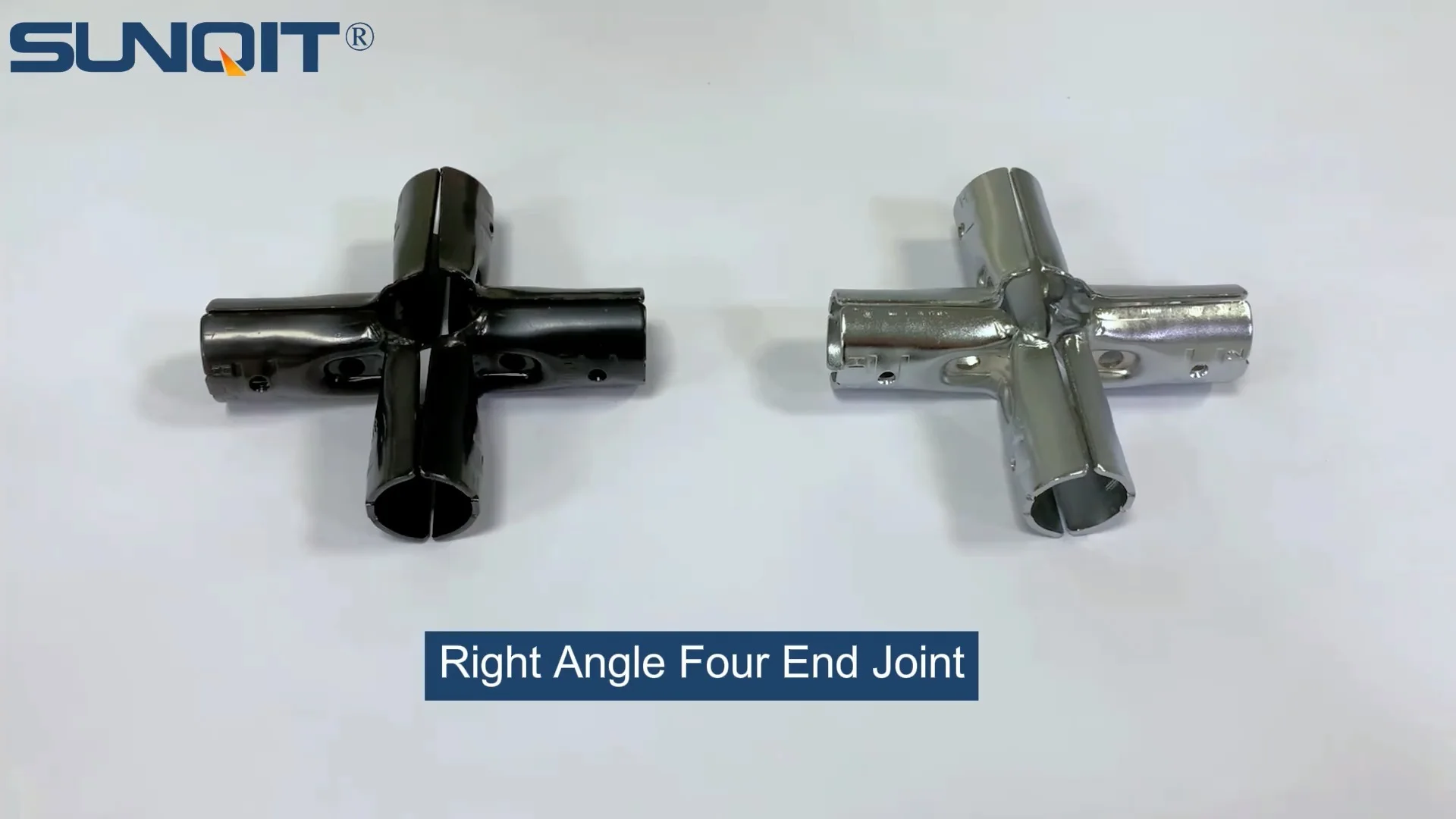
Five way straight lean pipe joint, for 5 pcs 28mm lean pipe connect in straight angle,which used widely in workbench, flow rack, hand trolley frame connection.
Lean Manufacturing: Where Efficiency Meets Precision
Walk into any modern factory, warehouse, or assembly plant, and you'll notice a quiet revolution happening on the floor. It's not just about machines whirring or workers bustling—it's about
flow
. Materials glide from station to station without bottlenecks, tools are within arm's reach, and every square inch of space works as hard as the team using it. This is the promise of lean manufacturing: a system built on eliminating waste, optimizing processes, and empowering teams to do more with less. At the heart of this revolution? Lean pipe systems—and the unsung heroes that hold them together: lean pipe joints.
Lean pipe systems, often called "flexible pipe systems," have become the backbone of lean operations worldwide. Made from durable materials like steel, aluminum, or stainless steel, these systems use pipes and joints to create everything from workbenches and material racks to conveyors and turnover trolleys. What makes them indispensable? Their adaptability. Unlike fixed, one-size-fits-all equipment, lean pipe systems can be reconfigured in hours (not weeks) to match shifting production needs. A assembly line for smartphones today? Repurpose it for tablets tomorrow. A parts rack for automotive components? Rearrange it to store electronics parts next month. This flexibility isn't just convenient—it's a game-changer for businesses competing in fast-paced markets.
But here's the thing: a lean pipe system is only as strong as its weakest link. And when it comes to building stable, versatile structures, few components matter more than the joints. These small, unassuming connectors are what turn simple pipes into robust workbenches, agile trolleys, and efficient flow racks. Among the many types of joints available, one stands out for its ability to unlock complex, multi-directional designs: the
five way straight lean pipe joint
. In this article, we'll dive deep into what makes this joint a cornerstone of lean pipe accessories, how it elevates system design, and why it's become a must-have for manufacturers, suppliers, and facility managers alike.
Beyond Pipes and Dreams: The Role of Lean Pipe Accessories
Let's start with the basics: a lean pipe system isn't just pipes. It's a ecosystem of components working in harmony. Think of it like building with Lego blocks—you need the right "bricks" (pipes), "connectors" (joints), and "extras" (accessories) to bring your vision to life.
Lean pipe accessories
encompass everything from joints and casters to roller tracks and end caps, each playing a unique role in system functionality. Without them, a pile of pipes is just… a pile of pipes.
Take
lean pipe workbench
as an example. A basic workbench needs a stable frame, a flat surface, and maybe shelves for tools. To build that, you'll use straight pipes for the legs and rails, but you'll also need joints to connect the vertical legs to the horizontal rails (90-degree joints), joints to add cross-braces for stability (45-degree joints), and maybe even casters (those swiveling wheels) to make the bench mobile. Now, imagine you want to add a
roller track
to the back of the workbench, so parts can slide directly from a shelf to the work surface. Suddenly, you need a way to attach the roller track to the bench frame—and that's where specialized joints come in.
This is where the five way straight lean pipe joint shines. While most joints connect 2-3 pipes (like a T-joint or L-joint), the five way joint does more: it connects
five
pipes in a straight line, with four outlets perpendicular to the main pipe. Picture a central hub with one pipe running through the middle (the "straight" part) and four pipes branching out at 90-degree angles—up, down, left, right. This design isn't just about adding more pipes; it's about creating structures that maximize space, support heavier loads, and integrate multiple functions into one unit.

Anatomy of a Hero: What Makes the Five Way Straight Lean Pipe Joint Unique?
Let's get up close with the five way straight lean pipe joint. At first glance, it might look like a small, metallic cube with holes drilled into five sides. But that simplicity is deceptive. Every detail—from the material it's made of to the precision of its threading—is engineered for strength and versatility.
Most five way straight joints are made from high-quality steel, then coated with chrome for extra durability. Chrome plating isn't just for shine; it resists rust, corrosion, and wear, ensuring the joint holds up in dusty factory environments or humid warehouses. Inside each hole, you'll find threads that lock tightly onto the pipes, often with a setscrew or Allen key to secure the connection. This "lock and load" design means you don't need welding or specialized tools to assemble it—just a wrench or hex key, and you're good to go.
The real magic, though, is in the geometry. The five way joint's central pipe runs straight through the hub, while the other four outlets are positioned at 90-degree angles to it, spaced evenly around the central axis. This symmetry allows for balanced weight distribution, which is critical for building stable structures. Whether you're adding a shelf above a workbench, a tool holder to the side, or a roller track below, the five way joint ensures the load is spread evenly across the frame, reducing stress on individual pipes and joints.
Let's put this into perspective: suppose you're building a
lean pipe workbench
for an electronics assembly line. The bench needs a flat surface for workers to assemble circuit boards, a shelf below for storing components, a rack above for tools, and a roller track on one side to slide finished boards to the next station. With a standard 3-way joint, you might need multiple connectors to attach the shelf, rack, and roller track—each adding bulk and potential weak points. With a five way joint, you can connect the bench's vertical legs (central pipe), the horizontal rails for the work surface (left/right outlets), the shelf supports (down outlet), and the tool rack (up outlet) all in one go. Fewer joints mean a cleaner design, faster assembly, and a sturdier structure.

From Blueprints to Reality: Practical Applications of the Five Way Joint
Talk is cheap—let's look at how the five way straight lean pipe joint transforms ideas into real-world solutions. Here are three common scenarios where this joint proves its worth:
1. Building Multi-Tiered Material Racks
Warehouses and factories live and die by their ability to store materials efficiently. A multi-tiered material rack—with shelves at different heights—maximizes vertical space, but building one with standard joints can be tricky. You need vertical posts, horizontal shelf rails, and cross-braces to keep it from wobbling. Enter the five way joint. By placing five way joints along the vertical posts, you can connect shelf rails (left/right), cross-braces (front/back), and even additional vertical extensions (up/down) in one connection point. The result? A rack that's not just tall, but rock-solid—capable of holding heavy boxes of parts without sagging or shifting.
Warehouses and factories live and die by their ability to store materials efficiently. A multi-tiered material rack—with shelves at different heights—maximizes vertical space, but building one with standard joints can be tricky. You need vertical posts, horizontal shelf rails, and cross-braces to keep it from wobbling. Enter the five way joint. By placing five way joints along the vertical posts, you can connect shelf rails (left/right), cross-braces (front/back), and even additional vertical extensions (up/down) in one connection point. The result? A rack that's not just tall, but rock-solid—capable of holding heavy boxes of parts without sagging or shifting.
2. Designing Mobile Workstations with Integrated Roller Tracks
Mobile workstations are a staple of lean manufacturing—they let workers bring tools and materials directly to the production line, reducing walking time and wasted motion. But a great mobile workstation isn't just a cart with wheels; it's a mini factory on the move. Imagine a workstation with a workbench top, a tool tray, a bin for scraps, and a roller track on the front to slide finished products onto a conveyor. To build this, you'll need to attach the roller track to the cart's frame. With a five way joint, you can connect the cart's vertical legs, the workbench rails, the tool tray supports, and the roller track brackets—all in one joint. Add a few caster wheels to the bottom, and you've got a workstation that's as mobile as it is functional.
Mobile workstations are a staple of lean manufacturing—they let workers bring tools and materials directly to the production line, reducing walking time and wasted motion. But a great mobile workstation isn't just a cart with wheels; it's a mini factory on the move. Imagine a workstation with a workbench top, a tool tray, a bin for scraps, and a roller track on the front to slide finished products onto a conveyor. To build this, you'll need to attach the roller track to the cart's frame. With a five way joint, you can connect the cart's vertical legs, the workbench rails, the tool tray supports, and the roller track brackets—all in one joint. Add a few caster wheels to the bottom, and you've got a workstation that's as mobile as it is functional.
3. Creating Custom Flow Racks for Asynchronous Production
Flow racks (also called gravity racks) use inclined roller tracks to let materials "flow" from the back to the front, ensuring first-in, first-out (FIFO) inventory management. But not all flow racks are created equal. Some need multiple lanes for different parts, or shelves at varying angles to control flow speed. The five way joint excels here, too. By mounting five way joints along the rack's uprights, you can connect multiple roller tracks (left/right), support braces (front/back), and even dividers to separate lanes—all without overcomplicating the design. This flexibility means you can build a flow rack that handles small electronic components one day and large automotive parts the next.
Flow racks (also called gravity racks) use inclined roller tracks to let materials "flow" from the back to the front, ensuring first-in, first-out (FIFO) inventory management. But not all flow racks are created equal. Some need multiple lanes for different parts, or shelves at varying angles to control flow speed. The five way joint excels here, too. By mounting five way joints along the rack's uprights, you can connect multiple roller tracks (left/right), support braces (front/back), and even dividers to separate lanes—all without overcomplicating the design. This flexibility means you can build a flow rack that handles small electronic components one day and large automotive parts the next.

How Does It Stack Up? Comparing Lean Pipe Joints
The five way straight joint is impressive, but how does it compare to other common lean pipe joints? Let's break it down with a quick comparison:
| Joint Type | Number of Connections | Primary Use Case | Best For | Limitations |
|---|---|---|---|---|
| Five Way Straight | 5 (1 straight, 4 perpendicular) | Multi-directional structures (e.g., workbenches with shelves, multi-tier racks) | Maximizing connections in one point; integrating multiple functions | Bulkier than simpler joints; overkill for basic 2-3 pipe connections |
| Three Way T-Joint | 3 (1 straight, 1 perpendicular) | Adding a single branch (e.g., a shelf to a vertical post) | Simple, linear structures; basic T-shapes | Can't connect multiple branches at one point |
| 90-Degree Fixed Joint | 2 (perpendicular to each other) | Right-angle connections (e.g., workbench legs to rails) | Basic frames and corners | Only 2 connections; no branching |
| Parallel Rotatory Joint | 2 (parallel, with rotation) | Adjustable shelves or tool holders | Components that need to swivel or tilt | Limited to parallel pipes; not for heavy loads |
| Four Way Cross Joint | 4 (all perpendicular, no straight-through) | Cross-shaped structures (e.g., dividing a rack into sections) | Creating grids or partitions | No straight-through pipe; limits vertical/horizontal extension |
The takeaway? The five way straight joint isn't meant to replace other joints—it's meant to complement them. For simple frames, a 90-degree joint works fine. For swiveling shelves, a parallel rotatory joint is better. But when you need to build something complex, multi-functional, and space-efficient, the five way joint is the clear choice. It's the Swiss Army knife of lean pipe accessories—versatile, reliable, and ready to tackle the toughest design challenges.
Durability Meets Compatibility: Why Material and Design Matter
A joint is only useful if it can handle the demands of the job. Let's talk about two key factors that make the five way straight lean pipe joint a workhorse: material quality and compatibility with other components.
Most five way joints are made from cold-rolled steel, a material known for its strength and rigidity. Cold-rolling compresses the steel, making it denser and more resistant to bending or warping under load. Add a chrome plating, and you've got a joint that resists scratches, rust, and corrosion—even in environments where oil, coolant, or moisture is present. Some manufacturers also offer stainless steel versions for cleanrooms or food processing facilities, where hygiene is critical.
Compatibility is another big win. The five way straight joint is designed to work with standard lean pipe sizes (often 28mm or 30mm diameter pipes), but it also plays well with other materials like
aluminum profile
. Aluminum profiles, with their T-slots and modular accessories, are increasingly popular for building lightweight yet strong structures. By combining five way steel joints with aluminum pipes, you can create hybrid systems that leverage the best of both worlds: steel's strength for load-bearing components and aluminum's lightness for mobile structures.
Let's not forget about accessories. The five way joint pairs seamlessly with everything from roller track brackets and caster mounts to tool hooks and bin holders. Need to add a label holder to a material rack? Screw it into the joint's unused outlet. Want to attach a LED light above a workbench? Use the top outlet of a five way joint to mount the light bar. This compatibility means you're not locked into one brand or system—you can mix and match components to create exactly what you need.
Real-World Impact: How One Joint Boosts Productivity
Let's hear from a real user. Maria, a production manager at a mid-sized electronics manufacturer, recently switched to using five way straight joints in her assembly line workbenches. "Before, we had workbenches with separate shelves, tool racks, and roller tracks—each built with 3-way and 90-degree joints," she explains. "They worked, but they were clunky. If we needed to adjust the shelf height or move the roller track, we'd have to disassemble half the bench. Now, with five way joints, everything connects at one point. Last month, we reconfigured three workbenches in an afternoon to handle a new product line. That used to take two days. Plus, the benches feel sturdier—no more wobbling when workers lean on them."
Maria's experience isn't unique. Across industries, companies report similar benefits: faster setup times, reduced downtime during reconfigurations, and fewer maintenance issues thanks to the five way joint's robust design. For high-volume manufacturers, these savings add up quickly. A study by the Lean Manufacturing Institute found that companies using flexible pipe systems with multi-directional joints reduced setup time for new production lines by up to 40% compared to fixed equipment. That's not just time saved—it's money, too.
Caring for Your Joints: Maintenance Tips for Longevity
Like any tool, your five way straight lean pipe joints will last longer with a little care. Here are a few simple maintenance tips:
1. Tighten Connections Regularly
Over time, vibrations from machinery or daily use can loosen the setscrews in your joints. Check them monthly (or more often for high-use structures) and tighten with a hex key if needed. A loose joint isn't just wobbly—it can put extra stress on other components.
Over time, vibrations from machinery or daily use can loosen the setscrews in your joints. Check them monthly (or more often for high-use structures) and tighten with a hex key if needed. A loose joint isn't just wobbly—it can put extra stress on other components.
2. Keep Them Clean
Dust, grease, and debris can wear down the threads and plating. Wipe joints with a damp cloth occasionally, and use a small brush to clean out thread holes if they get clogged. For chrome-plated joints, a light coat of machine oil (applied sparingly) can help prevent rust.
Dust, grease, and debris can wear down the threads and plating. Wipe joints with a damp cloth occasionally, and use a small brush to clean out thread holes if they get clogged. For chrome-plated joints, a light coat of machine oil (applied sparingly) can help prevent rust.
3. replace Worn Joints Promptly
If you notice cracks, stripped threads, or bent outlets, replace the joint immediately. A damaged joint is a safety hazard—don't risk it to save a few dollars. Most suppliers offer replacement joints at affordable prices, and the cost of downtime from a failed joint far outweighs the cost of a new one.
If you notice cracks, stripped threads, or bent outlets, replace the joint immediately. A damaged joint is a safety hazard—don't risk it to save a few dollars. Most suppliers offer replacement joints at affordable prices, and the cost of downtime from a failed joint far outweighs the cost of a new one.
Choosing the Right Supplier: Quality Matters
Not all five way straight lean pipe joints are created equal. To ensure you're getting a quality product, look for a
lean pipe supplier
that:
- Uses high-grade steel or stainless steel (ask for material certifications).
- Offers chrome plating or other corrosion-resistant finishes.
- Provides clear specifications (load capacity, pipe size compatibility, thread type).
- Has positive reviews from other manufacturers in your industry.
- Offers technical support—because even the best products need backup when you're designing a complex structure.
- Offers chrome plating or other corrosion-resistant finishes.
- Provides clear specifications (load capacity, pipe size compatibility, thread type).
- Has positive reviews from other manufacturers in your industry.
- Offers technical support—because even the best products need backup when you're designing a complex structure.
Remember, a cheap joint might save you a few dollars upfront, but it could cost you in downtime, repairs, or even workplace accidents down the line. Invest in quality—your team (and your bottom line) will thank you.
The Bottom Line: Why the Five Way Joint Is a Lean Game-Changer
Lean manufacturing isn't just a buzzword—it's a mindset. It's about seeing possibilities where others see limitations, and building systems that grow with your business. The five way straight lean pipe joint embodies this mindset. It's a small component, but it enables big ideas: workbenches that do more, racks that store smarter, and lines that adapt faster.
Whether you're a seasoned lean practitioner or just starting your journey, don't overlook the power of the right joint. The next time you're designing a workbench, material rack, or conveyor, ask yourself: Could a five way straight joint make this better? The answer, more often than not, is yes. After all, in lean manufacturing, success isn't about doing more with more—it's about doing more with the right tools. And when it comes to lean pipe accessories, the five way straight joint is one tool you won't want to work without.