- Company Articles
- Products and Technology
- Product knowledge
- Five Way Straight Lean Pipe Joint Load Capacity: What You Need to Know

Five Way Straight Lean Pipe Joint Load Capacity: What You Need to Know
Related Product
Five Way Straight Lean Pipe Joint
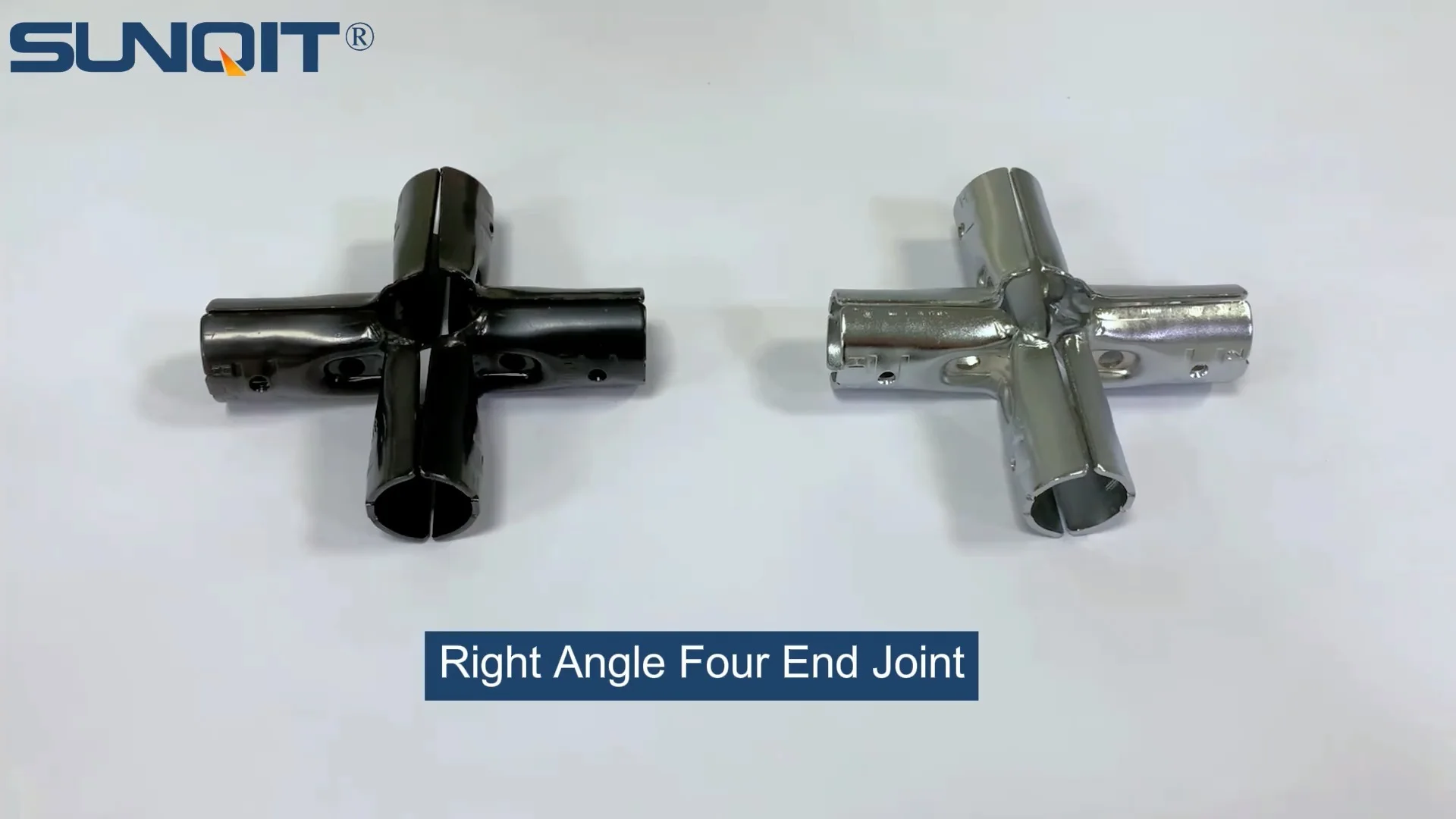
Five way straight lean pipe joint, for 5 pcs 28mm lean pipe connect in straight angle,which used widely in workbench, flow rack, hand trolley frame connection.
Introduction: The Unsung Hero of Lean Manufacturing
Walk into any modern manufacturing facility, and you'll likely see a symphony of moving parts: conveyor belts gliding with precision, workbenches organized to the millimeter, and flow racks keeping materials within arm's reach. Behind this orchestration lies a silent workhorse: the lean pipe system. These modular setups, built from simple pipes and joints, are the backbone of lean manufacturing—streamlining workflows, reducing waste, and boosting productivity. But within this system, one component often flies under the radar while carrying immense responsibility: the five way straight lean pipe joint.
At first glance, it might seem like just another metal connector. But for production managers, facility engineers, and operations teams, this joint is a critical link between efficiency and chaos. Imagine a busy automotive assembly line where a single joint failure causes a material rack to collapse, halting production for hours. Or a pharmaceutical warehouse where uneven load distribution on a flow rack leads to damaged inventory. In these scenarios, understanding the load capacity of a five way straight lean pipe joint isn't just a technical detail—it's the difference between smooth operations and costly disruptions.
In this article, we'll dive deep into the world of five way straight lean pipe joints. We'll explore what they are, how they work, and why their load capacity matters. We'll break down the factors that influence their strength, from materials to design, and discuss how to test and maintain them. Whether you're a seasoned lean system designer or new to the world of modular manufacturing, this guide will equip you with the knowledge to make informed decisions—ensuring your lean pipe systems are not just efficient, but also safe and reliable.
What Is a Five Way Straight Lean Pipe Joint?
Before we jump into load capacity, let's start with the basics: What exactly is a five way straight lean pipe joint? In simple terms, it's a connector designed to join multiple lean pipes at once, creating sturdy, customizable structures like workbenches, material racks, and assembly lines. Unlike standard two-way or three-way joints, a five way joint allows for connections in five directions—typically four horizontal and one vertical, or some variation depending on the design. This versatility makes it ideal for building complex, multi-tiered systems where space is limited and flexibility is key.
Most five way straight lean pipe joints, like the five way straight lean pipe joint chrome variant, are made from metal (often steel or aluminum) and feature threaded holes or sockets to secure pipes in place. Some are coated with chrome for added durability and corrosion resistance, making them suitable for harsh industrial environments. Others, like plastic or nylon-coated versions, are used in settings where conductivity or chemical resistance is a concern—think electronics manufacturing, where static discharge can damage sensitive components.
What sets the five way joint apart from its counterparts is its ability to distribute weight across multiple connection points. In a typical lean system, pipes carry loads vertically (from shelves or work surfaces) and horizontally (from materials sliding along flow racks). A five way joint must handle both types of stress, often simultaneously. For example, a material rack B (3 row and 3 floor) might use five way joints to connect vertical support pipes with horizontal crossbars and diagonal bracings. Each joint in this setup bears a portion of the total load, from the weight of the rack itself to the boxes of components stacked on it.
But here's the catch: Not all five way joints are created equal. A poorly made joint, or one used beyond its load capacity, can fail—leading to bent pipes, collapsed structures, or worse. That's why understanding load capacity isn't just about numbers; it's about matching the right joint to the right application.

Materials Matter: How Composition Affects Load Capacity
The first factor that determines a five way straight lean pipe joint's load capacity is its material. Just as a wooden beam can't support the same weight as a steel one, the material of your joint directly impacts how much force it can withstand before bending, cracking, or breaking. Let's explore the most common materials used in these joints and how they stack up.
Steel: The Heavyweight Champion
Steel is the go-to material for heavy-duty applications. Known for its high tensile strength and durability, steel joints are often used in environments where loads are large or constant. For example, stainless steel pipe series joints are popular in food processing or pharmaceutical facilities, where corrosion resistance is critical. Steel joints can handle higher static and dynamic loads than their aluminum or plastic counterparts, making them ideal for material racks, conveyor systems, and other structures that bear significant weight.
But steel has a downside: weight. A steel five way joint is heavier than an aluminum one, which can add up in large systems, increasing the overall load on the structure's base. Additionally, uncoated steel is prone to rust in humid environments, which is why many steel joints come with a chrome plating (like the five way straight lean pipe joint chrome ) or a powder coating to protect against corrosion.
Aluminum: Lightweight and Versatile
Aluminum is another popular choice, especially in industries where weight savings and portability matter. Aluminum lean pipe systems, including their joints, are lighter than steel, making them easier to assemble, reconfigure, and move. This is a big advantage in lean manufacturing, where adaptability is key—if a production line needs to be rearranged, aluminum structures can be disassembled and rebuilt with minimal effort.
But aluminum's lighter weight comes with a trade-off in strength. While high-grade aluminum alloys (like those used in aluminum extrusion profiles ) can still support substantial loads, they generally have lower load capacities than steel. For example, a 2.0mm thick aluminum joint might handle 70-80% of the load of a steel joint of the same dimensions. This makes aluminum joints better suited for lighter applications, such as workbenches, small parts storage, or temporary structures.
Plastic and Composite Joints: Specialized Solutions
Plastic or composite joints are less common but still have their place. Made from materials like nylon or polypropylene, these joints are lightweight, corrosion-resistant, and non-conductive—making them ideal for electronics manufacturing, where static electricity can damage components (think esd workbench setups). However, their load capacity is significantly lower than metal joints, so they're typically used for light-duty tasks, such as holding tools or small parts bins.
The Role of Pipe Thickness
It's not just the joint material that matters—the pipes themselves play a role in overall load capacity. Most lean pipes come in varying thicknesses, from 0.8mm to 2.0mm (as seen in keywords like 1.2mm pe coated lean pipe , 1.5mm pe coated lean pipe , and 2.0mm pe coated lean pipe ). Thicker pipes are stronger, but they also add weight and cost. When paired with a five way joint, a thicker pipe can distribute the load more evenly across the joint, reducing stress on individual connection points. For example, a 2.0mm PE coated lean pipe used with a steel five way joint will likely support more weight than a 1.0mm pipe with the same joint.
| Joint Material | Typical Load Capacity (Static, kg) | Best For | Key Considerations |
|---|---|---|---|
| Chrome-Plated Steel | 200-350 | Heavy material racks, conveyor systems | High strength, corrosion-resistant, heavier weight |
| Stainless Steel | 180-300 | Food/pharmaceutical facilities, wet environments | Excellent corrosion resistance, slightly lower strength than chrome steel |
| Aluminum Alloy | 100-200 | Workbenches, light-duty flow racks | Lightweight, easy to assemble, lower load capacity than steel |
| Nylon/Plastic | 30-80 | ESD workstations, small parts storage | Non-conductive, lightweight, low load capacity |
Note: Load capacities are approximate and vary by manufacturer, design, and pipe thickness. Always consult the supplier's specifications for exact values.

Design Factors: How Geometry Impacts Strength
Material is just one piece of the puzzle. The design of a five way straight lean pipe joint—its shape, connection points, and load distribution—plays an equally critical role in determining how much weight it can handle. Let's break down the key design elements that influence load capacity.
Number of Connection Points
A five way joint, by definition, has five connection points (hence the name). But not all connection points are created equal. Some joints are designed with four horizontal ports and one vertical port, while others might have three horizontal and two vertical. The arrangement affects how load is distributed. For example, a joint with vertical ports will bear more downward force (compression), while horizontal ports handle lateral stress (tension). A well-designed joint balances these forces, ensuring no single port is overloaded.
Compare this to a three way joint, which has fewer connection points. With only three ports, the load is concentrated on fewer areas, which can increase stress on each connection. Five way joints, with more ports, spread the load across more points—but this also means more potential weak spots if the design is flawed. A poorly engineered five way joint might have thin walls at the intersection of ports, leading to cracking under heavy loads.
Wall Thickness and Reinforcement
The thickness of the joint's walls is another critical factor. Thicker walls mean more material to resist bending or breaking. For example, a joint with 3mm thick walls will generally support more load than one with 2mm walls, assuming the same material. Some manufacturers reinforce critical areas, like the intersection of ports, with extra material or internal ribs. These reinforcements act like gussets in a building, strengthening the joint where stress is highest.
Take the five way straight lean pipe joint chrome as an example. High-quality versions of this joint often have reinforced corners and thicker walls at the base, where the vertical port meets the horizontal ones. This design choice helps distribute the weight of vertical pipes (and the loads they carry) more evenly, reducing the risk of cracking.
Thread Quality and Fit
Even the strongest joint will fail if the pipes aren't secured properly. Most lean pipe joints use threaded connections, where pipes are screwed into the joint or secured with set screws. The quality of these threads—their depth, pitch, and precision—directly impacts how well the joint can hold the pipes. Loose or poorly fitting threads allow pipes to wiggle under load, creating stress concentrations that weaken the joint over time.
Some joints use friction-fit designs, relying on clamping mechanisms (like aluminum pipe clamps ) to hold pipes in place. While these are easier to assemble, they depend on proper tightening. A clamp that's too loose won't grip the pipe, while one that's over-tightened can strip the threads or warp the joint. In either case, the load capacity is compromised.
Load Distribution: Static vs. Dynamic Loads
Load capacity isn't a one-size-fits-all number. It depends on whether the load is static (stationary) or dynamic (moving). A joint might handle 300kg of static load (like a stack of boxes sitting on a rack) but only 200kg of dynamic load (like materials sliding down a flow rack ). Why the difference? Dynamic loads create additional forces—like impact or vibration—that stress the joint more than a static load.
For example, imagine a conveyor system using roller tracks to move heavy components. As each component hits the joint, it creates a sudden impact load. Over time, these impacts can fatigue the joint, leading to cracks or loosening. A well-designed five way joint will account for both static and dynamic loads, with features like rounded edges to reduce stress concentration and flexible connections to absorb vibrations.

Testing Load Capacity: How Manufacturers Ensure Reliability
You've probably seen load capacity numbers in product specs—"300kg static load," "200kg dynamic load"—but how do manufacturers arrive at these figures? The answer lies in rigorous testing. Reputable lean pipe suppliers subject their five way joints to a battery of tests to ensure they meet safety and performance standards. Let's take a look at the most common tests.
Static Load Testing
Static load testing is the most basic and common test. It involves placing a constant weight on the joint and measuring how much it deforms (bends or stretches) over time. The goal is to determine the maximum load the joint can support without permanent damage. For example, a joint might be tested with 200kg, 250kg, 300kg, etc., until it deforms beyond an acceptable limit (typically 0.2% of its length) or breaks. The highest load it can handle without failure is its static load capacity.
During testing, sensors measure strain and deformation, while cameras record any visible cracks or warping. This data helps manufacturers refine their designs—if a joint fails at 280kg, they might add reinforcement to increase its capacity to 300kg.
Dynamic Load Testing
Dynamic load testing simulates real-world conditions where loads are moving or changing. This might involve repeatedly applying and removing a load (fatigue testing) or dropping a weight onto the joint (impact testing). Fatigue testing is especially important for joints used in conveyor systems or material handling, where loads are constantly moving.
For example, a joint might be tested with 150kg applied and removed 10,000 times. If it survives without cracking or loosening, it's deemed suitable for dynamic applications. Impact testing, on the other hand, involves dropping a weight (say, 50kg) from a height onto the joint to simulate a sudden load—like a box being accidentally dropped on a rack. The joint must absorb this impact without failing.
Environmental Testing
Joints don't exist in a vacuum—they're exposed to heat, cold, moisture, and chemicals. Environmental testing ensures they can withstand these conditions without losing strength. For example, a stainless steel pipe series joint might be tested in a salt spray chamber to simulate coastal or humid environments, ensuring it doesn't rust. Chrome-plated joints might undergo corrosion testing to check if the plating holds up over time.
Temperature testing is another key area. Joints used in freezers or high-temperature manufacturing (like foundries) must maintain their load capacity in extreme heat or cold. A joint that becomes brittle in sub-zero temperatures or softens in high heat is a safety hazard, so manufacturers test these scenarios rigorously.
Real-World Applications: When Load Capacity Matters Most
Understanding load capacity is one thing; applying that knowledge to real-world scenarios is another. Let's explore a few common applications where the load capacity of a five way straight lean pipe joint is critical—and what can happen if it's overlooked.
Material Racks and Flow Racks
Material racks, like the material rack b (3 row and 3 floor) , are workhorses in warehouses and manufacturing facilities. These racks hold everything from raw materials to finished products, and their weight can add up quickly. A single shelf might hold 50kg of components, and with three rows and three floors, that's 450kg per rack—all supported by joints, including five way ones.
If a five way joint in the rack is underrated for the load, the consequences can be severe. A shelf might sag, causing materials to slide off, or the entire rack could collapse. In one electronics plant, a poorly chosen five way joint failed under the weight of heavy circuit boards, leading to $10,000 in damaged inventory and a two-hour production delay while the rack was repaired.
Workbenches and Assembly Stations
Lean pipe workbenches are another common application. These workstations often support tools, equipment, and ongoing assemblies. For example, an automotive assembly workbench might have a torque wrench (10kg), a parts bin (15kg), and a partially assembled engine component (50kg)—totaling 75kg on the bench top. The legs of the bench, connected by five way joints, must support this load plus the weight of the bench itself.
A joint with insufficient load capacity can cause the bench to wobble, making precise work difficult. Over time, the legs might bend, leading to uneven surfaces or even collapse. In a medical device factory, a wobbly workbench due to weak joints resulted in a batch of pacemakers with misaligned components—costing the company millions in recalls.
Conveyor Systems and Roller Tracks
Conveyor systems, built with roller tracks and lean pipe frames, rely on joints to maintain alignment and support moving loads. A five way joint in a conveyor frame might support the weight of the roller track, the materials being transported, and the tension from the moving belt or rollers. Dynamic loads here are a major factor—if a heavy box (20kg) slides down a roller track and hits a joint, the impact can momentarily double the load on that joint.
In a distribution center, a conveyor system using underrated five way joints began to fail after six months. The joints couldn't handle the repeated impact of packages, leading to bent frames and misaligned rollers. Packages started jamming, slowing down the entire shipping process and increasing labor costs as workers unclogged the system.
Choosing the Right Lean Pipe Supplier: Why Quality Matters
Now that you understand the importance of load capacity, the next step is choosing a lean pipe supplier you can trust. Not all suppliers are created equal—some cut corners on materials or testing to offer lower prices, but these savings often come at the cost of reliability. Here's what to look for when selecting a supplier for five way straight lean pipe joints.
Certifications and Testing
Reputable suppliers will provide documentation of their testing processes and results. Look for certifications like ISO 9001 (quality management) or CE marking (safety compliance). Ask for test reports on load capacity, including static, dynamic, and fatigue testing. A supplier that can't provide this data is a red flag—they may not have rigorously tested their products.
Material Sourcing
The best suppliers use high-quality materials, like cold-rolled steel for chrome-plated joints or 6061 aluminum for aluminum joints. Ask where they source their raw materials—reputable suppliers will use certified materials from trusted mills. Avoid suppliers that use recycled or low-grade materials, as these can have inconsistent strength and durability.
Customer Support and Expertise
A good supplier isn't just a vendor—they're a partner. Look for suppliers with knowledgeable staff who can help you select the right joint for your application. They should ask questions about your load requirements, environment, and intended use, then recommend products accordingly. For example, if you're building a flow rack for heavy automotive parts, they should steer you toward a high-capacity steel joint, not a lightweight aluminum one.
In one case, a manufacturer worked with a supplier to design a custom five way joint for a unique material handling system. The supplier's engineers analyzed the load requirements and suggested a reinforced design with thicker walls, ensuring the joint could handle the specific dynamic loads of the application. This collaboration prevented potential failures and improved the system's overall efficiency.
Maintenance Tips: Extending the Life of Your Five Way Joints
Even the best five way straight lean pipe joint will fail prematurely without proper maintenance. Regular inspections and upkeep can extend the life of your joints and ensure they continue to perform at their rated load capacity. Here are some practical tips:
Inspect Regularly
Schedule monthly inspections of your lean pipe systems. Look for signs of wear, like cracks in the joint, bent pipes, or loose connections. Pay special attention to joints in high-stress areas, like the base of material racks or the corners of workbenches. If you notice any damage, replace the joint immediately—don't wait for it to fail.
Tighten Connections
Vibration from moving loads can loosen threaded connections over time. Use a torque wrench to tighten set screws or bolts to the manufacturer's recommended torque. Be careful not to over-tighten, as this can strip threads or warp the joint.
Clean and Protect
Keep joints clean and free of debris, which can trap moisture and cause corrosion. For steel joints, wipe away rust with a wire brush and apply a rust inhibitor if needed. For aluminum joints, avoid harsh chemicals that can damage the finish. In humid environments, consider using stainless steel pipe series joints to prevent corrosion.
Avoid Overloading
This might seem obvious, but it's worth repeating: Never exceed the rated load capacity of a joint. Post load limits on racks and workbenches as a reminder to employees. If you need to increase capacity, upgrade to a higher-rated joint or reinforce the structure with additional supports.
Conclusion: The Foundation of Lean Success
The five way straight lean pipe joint may be small, but its role in lean manufacturing is enormous. From supporting heavy material racks to keeping assembly lines running smoothly, its load capacity directly impacts efficiency, safety, and profitability. By understanding the factors that influence load capacity—materials, design, testing—and choosing the right lean pipe supplier , you can ensure your lean pipe systems are built to last.
Remember, a lean system is only as strong as its weakest link. Invest in high-quality five way joints, maintain them properly, and never cut corners on load capacity. In the world of lean manufacturing, where every second and every dollar counts, this small investment can save you from costly failures and keep your operations running like clockwork.
So the next time you walk through your facility, take a moment to look at those unassuming metal joints. They're not just connectors—they're the silent guardians of your lean success.