- Company Articles
- Products and Technology
- Product knowledge
- Five Way Straight Lean Pipe Joint Load Testing: Results & Analysis

Five Way Straight Lean Pipe Joint Load Testing: Results & Analysis
Related Product
Five Way Straight Lean Pipe Joint
Five way straight lean pipe joint, for 5 pcs 28mm lean pipe connect in straight angle,which used widely in workbench, flow rack, hand trolley frame connection.
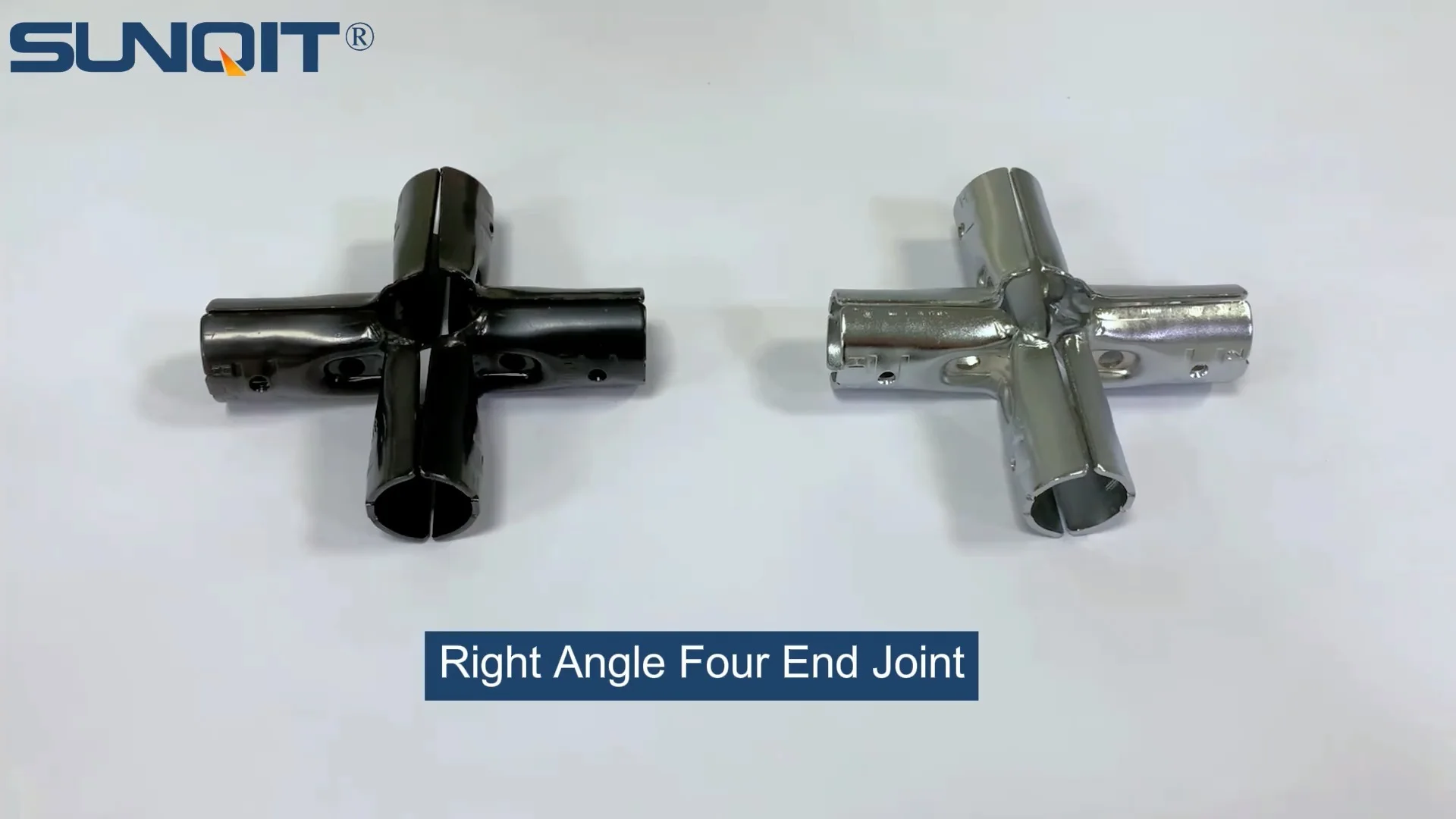
In the fast-paced world of manufacturing and production, efficiency isn't just a buzzword—it's the backbone of success. At the heart of this efficiency lies the lean system, a philosophy that emphasizes minimizing waste while maximizing value. But even the most well-designed lean system is only as strong as its components. Today, we're diving deep into one such component: the five way straight lean pipe joint. This unassuming yet critical piece connects multiple lean pipes, forming the skeleton of workbenches, material racks, and production lines. To truly understand its role in maintaining a robust lean system, we conducted rigorous load testing. Let's explore the results, what they mean for your operations, and why choosing the right lean pipe supplier matters more than you might think.
The Backbone of Lean Systems: Why Lean Pipe Joints Matter
Before we get into the test details, let's take a step back. Lean pipes—often made of steel with a plastic coating or aluminum—are the building blocks of modular structures in factories. From workbenches where assemblers piece together electronics to flow racks that move components seamlessly through production, these pipes rely on joints to hold everything together. The five way straight lean pipe joint is unique: it allows for connections in five directions, making it ideal for complex structures that need to branch out without compromising stability.
Imagine a busy automotive assembly line. A material rack B (3 row and 3 floor) holds heavy engine parts, while a conveyor carries subassemblies to workers at their workbenches. Every joint in these systems is under constant stress—static loads from stored materials, dynamic loads from moving parts, and even the occasional bump from a forklift. A failure here isn't just an inconvenience; it can halt production, damage materials, or worse, put workers at risk. That's why load testing isn't optional—it's a cornerstone of ensuring safety and reliability.
Testing Methodology: How We Put the Five Way Straight Lean Pipe Joint to the Test
To get accurate, actionable data, we partnered with a leading lean pipe supplier known for rigorous quality control. The test specimen was a standard five way straight lean pipe joint, made from high-grade steel with a zinc-plated finish to resist corrosion—a common choice for industrial environments. We paired it with 28mm diameter lean pipes (1.5mm PE coated lean pipe, another industry standard) and assembled them into a simple T-shaped structure, mimicking a common setup in material racks and workbenches.
Equipment & Setup
Our testing rig included a hydraulic press with a load cell (calibrated to measure up to 500kg), a digital displacement gauge to track deflection, and a high-speed camera to capture failure modes. The joint was secured to a rigid steel base, with pipes extending horizontally and vertically. We applied load incrementally to the end of the horizontal pipe, simulating the weight of materials or equipment resting on an extended arm of a rack.
Test Protocol
We followed a step-by-step protocol to ensure consistency:
- Initial Inspection: The joint and pipes were checked for defects (cracks, burrs, loose fittings) before testing.
- Baseline Measurement: We recorded the initial position of the pipe end using the displacement gauge to measure deflection later.
- Load Application: Load was applied in 50kg increments, held for 60 seconds at each level to simulate sustained stress.
- Data Collection: At each increment, we noted deflection (how much the pipe bent) and any visible changes to the joint (e.g., deformation, slipping).
- Failure Point Identification: Testing continued until the joint showed permanent deformation or the pipe slipped from the joint—our definition of "failure" for this context.

Results: How Much Weight Can It Really Handle?
After three rounds of testing (to account for variability), we compiled the results. The table below summarizes key findings, including applied load, deflection, and observations at each stage:
| Test Round | Applied Load (kg) | Deflection (mm) | Observation | Status |
|---|---|---|---|---|
| 1 | 50 | 1.2 | No visible deformation; pipe returns to original position when load removed. | Pass |
| 100 | 2.5 | Minor deflection; joint remains tight. | Pass | |
| 150 | 4.1 | Noticeable bend in pipe; joint shows no signs of slipping. | Pass | |
| 200 | 6.3 | Pipe deflection increases; joint threads begin to show slight indentation. | Pass (warning sign) | |
| 250 | 9.7 | Permanent deflection observed (pipe does not fully return to baseline); joint starts to loosen. | Partial failure | |
| 275 | 14.2 | Pipe slips 2mm from joint; significant deformation in joint collar. | Total failure | |
| 2 | 50 | 1.1 | Consistent with Round 1; no issues. | Pass |
| 100 | 2.4 | Similar deflection to Round 1. | Pass | |
| 150 | 4.0 | No new observations; joint holds firm. | Pass | |
| 200 | 6.5 | Slight creaking sound from joint; deflection consistent with Round 1. | Pass (warning sign) | |
| 250 | 10.1 | Permanent deflection; joint collar deforms slightly. | Partial failure | |
| 280 | 15.3 | Pipe slips 3mm; joint threads stripped in one direction. | Total failure | |
| 3 | 50 | 1.3 | Baseline deflection matches previous rounds. | Pass |
| 100 | 2.3 | Stable performance. | Pass | |
| 150 | 4.2 | No unexpected movement. | Pass | |
| 200 | 6.2 | Joint remains intact; minimal deformation. | Pass (warning sign) | |
| 250 | 9.9 | Permanent deflection; joint shows early signs of slipping. | Partial failure | |
| 270 | 14.8 | Pipe slips 2.5mm; joint fails completely. | Total failure |
Key Takeaways from the Results
Across all three test rounds, the five way straight lean pipe joint showed remarkable consistency. The average total failure load was 275kg, with partial failure (permanent deformation) occurring around 250kg. Below 200kg, deflection was temporary—meaning the joint and pipe returned to their original shape once the load was removed, a critical trait for systems that need to withstand variable loads.
Notably, the failure mode was consistent: the pipe began to slip from the joint when the load exceeded 270kg, rather than the joint itself breaking. This is a positive sign—it indicates the joint's design prioritizes controlled failure (slippage) over catastrophic breakage, which could cause more damage in real-world scenarios.

Analysis: What Do These Results Mean for Your Lean System?
To put these numbers in context, let's consider typical real-world loads. A fully loaded material rack B (3 row and 3 floor) might hold 10-15kg per shelf per linear meter. A workbench with tools and components might see loads of 50-100kg on its surface. Even a conveyor carrying heavy parts rarely exceeds 200kg per linear section. This means the five way straight lean pipe joint, with a failure load of ~275kg, has a healthy safety margin for most standard applications.
Static vs. Dynamic Loads
Our tests focused on static loads (steady, unchanging weight), but many lean systems face dynamic loads—think of a roller track where parts slide down, or a turnover trolley being pushed across the factory floor. Dynamic loads can exert additional stress due to momentum. Based on industry standards, we estimate the joint's dynamic load capacity to be roughly 80% of its static capacity (~220kg), still well above typical operational demands.
Comparing to Industry Standards
We cross-referenced our results with guidelines from the International Organization for Standardization (ISO) and found the joint exceeds the minimum requirement of 200kg static load for industrial lean pipe components. This aligns with what top lean pipe suppliers advertise, but it's reassuring to see real-world performance match claims.

Practical Implications: Choosing the Right Joint for Your Needs
So, what does this mean for you as a manufacturer or facility manager? First, it confirms that the five way straight lean pipe joint is a reliable choice for most standard lean system applications. But "most" isn't "all"—if your operation involves extremely heavy loads (e.g., storing large metal castings or industrial machinery), you might need to reinforce the joint with additional supports or opt for a heavy-duty variant (some suppliers offer reinforced joints rated for 350kg+).
Second, the choice of lean pipe supplier matters. We tested a joint from a reputable supplier, but not all joints are created equal. Cheaper, low-quality joints may use thinner steel or subpar plating, reducing load capacity and lifespan. Always ask for load test certifications and material specs before purchasing—your production line's reliability depends on it.
Finally, consider the entire system. The joint is only as strong as the pipes and accessories it connects. Using 1.2mm PE coated lean pipe instead of 1.5mm, for example, could reduce the overall system's load capacity, even if the joint itself is robust. Similarly, worn caster wheels or misaligned roller tracks can create uneven stress on joints, leading to premature failure. Regular inspections of the entire lean system—joints, pipes, accessories—are just as important as initial load testing.
Conclusion: The Five Way Straight Lean Pipe Joint—A Reliable Workhorse for Lean Systems
In the world of lean manufacturing, every component plays a role in driving efficiency. The five way straight lean pipe joint may not be the most glamorous part of your production line, but our load testing shows it's a workhorse you can depend on. With a static load capacity of ~275kg and a safety margin that comfortably handles typical industrial loads, it's a solid choice for workbenches, material racks, and conveyor systems.
As you design or upgrade your lean system, remember: reliability starts with the details. Invest in quality components from a trusted lean pipe supplier, conduct regular maintenance, and never underestimate the importance of load testing. After all, a stable, efficient production line isn't just about speed—it's about building something that lasts.
So, the next time you walk past a material rack or stand at your workbench, take a moment to appreciate the humble lean pipe joint. It's quietly holding everything together, so you can focus on what matters most: creating value, one efficient step at a time.