- Company Articles
- Products and Technology
- Product knowledge
- Five Way Straight Lean Pipe Joint vs. Internal Rotation Joints: When to Use Each

Five Way Straight Lean Pipe Joint vs. Internal Rotation Joints: When to Use Each
Related Product
Five Way Straight Lean Pipe Joint
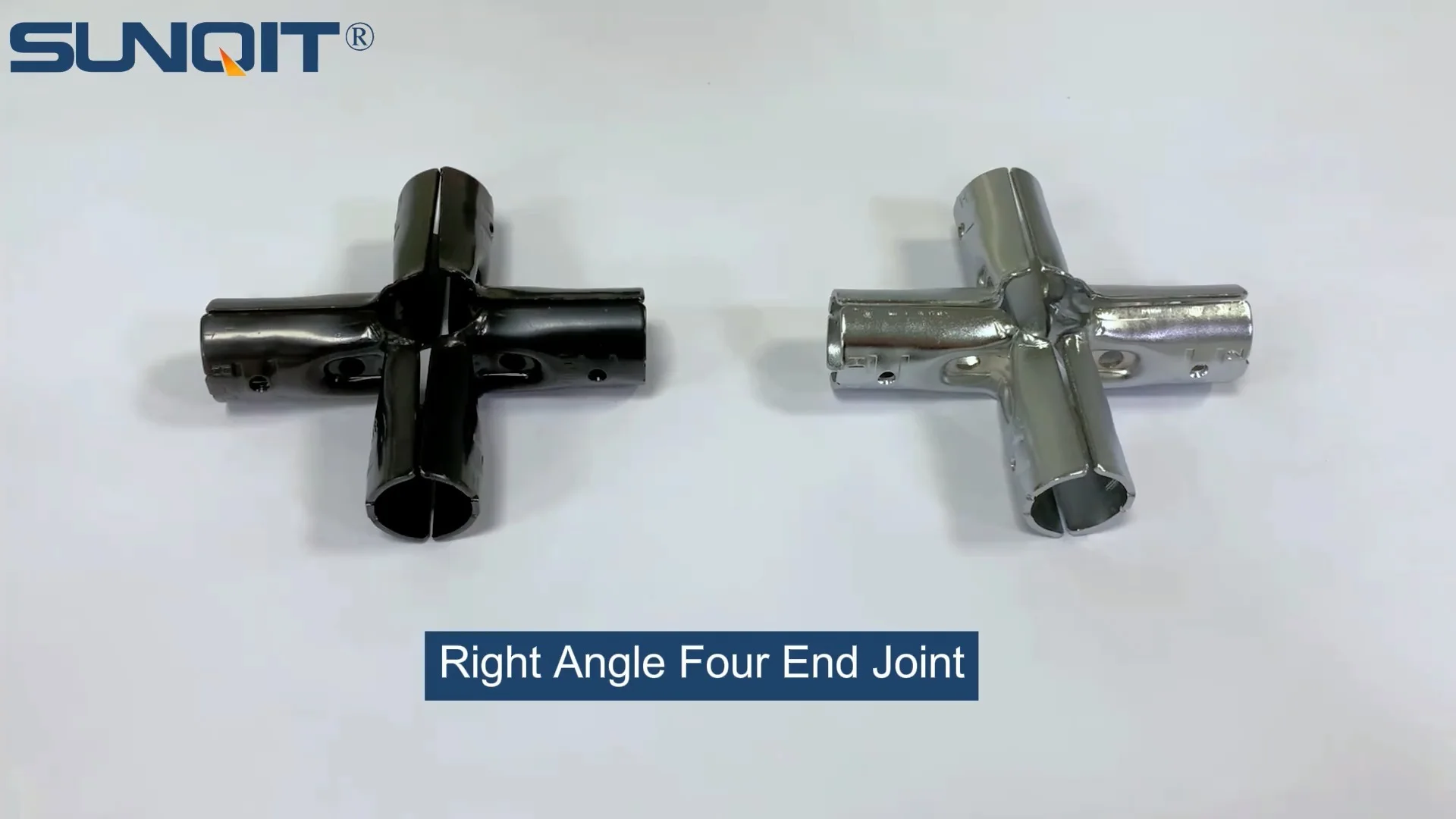
Five way straight lean pipe joint, for 5 pcs 28mm lean pipe connect in straight angle,which used widely in workbench, flow rack, hand trolley frame connection.
In the world of lean manufacturing, where every second and every square inch of space counts, the difference between a smooth operation and a bottleneck often comes down to the smallest components. Take lean pipe joints, for example—those unassuming connectors that hold together workbenches, flow racks, and assembly lines. While they might seem like afterthoughts, choosing the right joint can mean the difference between a rigid structure that slows down adaptation and a flexible system that grows with your needs. Today, we're zeroing in on two workhorses of the lean pipe world: the Five Way Straight Lean Pipe Joint and Internal Rotation Joints . Let's break down how they work, where they shine, and how to pick the perfect one for your next project.
Why Joints Matter in a Lean System
Before diving into the specifics, let's take a step back. A lean system thrives on efficiency, adaptability, and waste reduction. Whether you're building a workstation for electronics assembly or a flow rack for automotive parts, the joints you choose dictate three critical factors: stability, flexibility, and scalability. A poorly matched joint can lead to wobbly workbenches that compromise safety, rigid structures that can't adapt to new product lines, or frequent breakdowns that eat into production time. So, while it's tempting to grab the first joint you see, taking the time to understand your options will pay off in smoother operations and fewer headaches down the line.
Meet the Contenders: What Are These Joints, Anyway?
Five Way Straight Lean Pipe Joint: The Workhorse of Stability
Imagine a central hub with five connection points, all aligned in fixed, straight directions—up, down, left, right, and forward. That's the Five Way Straight Lean Pipe Joint in a nutshell. Designed for rigidity, this joint is all about creating strong, immovable connections between lean pipes. It's the kind of joint you'd use when you need a structure to stay put, no matter how much weight or stress is applied. Think of it as the backbone of high-stability setups, where movement isn't just unnecessary—it's a liability.
Visually, it looks like a small, sturdy cube or cylinder with threaded holes or slots at precise angles (usually 90° or 180° apart). Made from materials like steel or heavy-duty plastic, it's built to handle heavy loads without flexing. Installation typically involves tightening bolts or screws to lock pipes into place, creating a connection that won't shift over time. Once secured, it's as solid as the pipes themselves—great for static structures, but not so much if you need to adjust angles later.
Internal Rotation Joints: The Chameleon of Flexibility
If the Five Way Straight Joint is the rock, Internal Rotation Joints are the acrobats. These joints are engineered to move—and move they do. Unlike their fixed counterparts, internal rotation joints have a rotating mechanism (often a ball-and-socket or hinge design) that lets connected pipes swivel, pivot, or tilt along one or more axes. This means you can adjust the angle of a shelf, the height of a workbench, or the slope of a flow rack without disassembling the entire structure.
Picture this: You're running a small electronics workshop, and your team needs to switch between assembling smartphones (which require a low, flat workspace) and laptops (which need a tilted surface for better access to ports). With internal rotation joints, you can adjust the angle of the workbench top in minutes, no tools required. That's the power of these joints—they turn static structures into dynamic tools that adapt to changing tasks.

A Side-by-Side Comparison: Features That Matter
To really understand how these joints stack up, let's put them head-to-head. The table below breaks down their key features, from design to ideal use cases.
| Feature | Five Way Straight Lean Pipe Joint | Internal Rotation Joint |
|---|---|---|
| Design | Fixed, 5-point hub with straight, rigid connections | Rotating mechanism (ball-and-socket/hinge) for swiveling/pivoting |
| Movement | No rotation; connections stay locked in place | 360° swivel or 180° pivot (varies by model) |
| Load Capacity | High (up to 200kg per joint, depending on material) | Moderate to high (50-150kg, lower when fully rotated) |
| Best For | Static structures, high-weight applications, linear setups | Adjustable workbenches, ergonomic stations, dynamic flow paths |
| Installation Complexity | Simple: Align pipes, tighten bolts, done | Slightly more complex: Requires proper alignment of rotating parts |
| Compatibility | Works with standard lean pipes, aluminum profiles, and steel tubes | Best with lightweight to medium pipes; some models pair with aluminum profile accessories |
| Wear and Tear | Low (no moving parts to degrade) | Higher (rotating components may need lubrication over time) |

Real-World Applications: When to Pick Which Joint
Numbers and specs tell part of the story, but nothing beats seeing these joints in action. Let's walk through a few common scenarios where one joint clearly outperforms the other.
Scenario 1: Building a Heavy-Duty Flow Rack for Automotive Parts
Imagine you're setting up a flow rack in an automotive plant, tasked with holding transmission components that weigh 30-40kg each. The rack needs to span 6 meters, with 5 levels, and feed parts directly to an assembly line that runs 3 shifts a day. Stability here is non-negotiable—any wobble could lead to parts falling, delays, or even injuries.
This is where the Five Way Straight Joint shines. Its fixed, multi-directional connections create a grid-like structure that distributes weight evenly across the entire rack. With five connection points, you can add cross-braces horizontally and vertically, reinforcing the rack against the constant vibration of the factory floor. Since the parts move in a straight line from the top shelf to the assembly line, there's no need for adjustable angles—just a solid, unyielding framework that can handle the daily grind.
Scenario 2: Designing an Ergonomic Workbench for Assembly Line Workers
Now, let's shift to a electronics manufacturing facility where workers assemble small circuit boards. The team here is diverse: some are tall, some are short; some prefer standing, others sit. The workbench needs to adapt to each worker's height and posture to reduce fatigue and boost productivity. Oh, and next month, they'll be switching to a new board design that requires a tilted surface for better access to tiny components.
Enter Internal Rotation Joints. By using these joints at the base of the workbench legs and under the tabletop, you can create a setup where height adjusts with a simple twist and angle tilts with a gentle push. A worker who prefers standing can raise the bench to waist height; a seated operator can lower it to knee level. When the new circuit boards arrive, a quick adjustment to the tabletop angle (thanks to the rotating joints) ensures no one has to hunch over or strain their neck. It's flexibility that keeps workers comfortable and focused—exactly what a lean system is all about.
Scenario 3: Setting Up a Mixed-Use Material Handling System
What if you need a system that does both? Let's say you're running a warehouse that handles two types of products: heavy, bulky boxes (static storage) and small, frequently accessed components (dynamic retrieval). You need a single structure that can store the boxes on the bottom and feed components to a pick station on top.
Here's where hybrid thinking comes in. Use Five Way Straight Joints for the lower section, where the heavy boxes sit—their rigidity ensures the base won't buckle under the weight. For the upper section, where components need to slide down to the pick station, pair Internal Rotation Joints with roller tracks. Adjust the angle of the roller track (using the rotating joints) to control how fast components flow—steeper for lightweight parts, gentler for fragile items. It's the best of both worlds: stability where you need it, flexibility where you don't.

Key Factors to Consider When Choosing
Still on the fence? Ask yourself these four questions to narrow it down:
1. Will the structure need to move or adjust over time?
If you're building something that's set-it-and-forget-it (like a permanent storage rack for rarely used tools), go with Five Way Straight Joints. They're reliable and low-maintenance. But if you anticipate changing workflows, new products, or ergonomic adjustments (hello, future-proofing!), Internal Rotation Joints are worth the investment.
2. What's the maximum weight the joint will need to support?
Five Way Straight Joints are the heavy lifters here. If you're dealing with loads over 150kg, they're the safer bet. Internal Rotation Joints can handle moderate weights, but their load capacity drops when fully rotated—keep that in mind if your setup involves angled or pivoting pipes under stress.
3. How much time do you have for installation and maintenance?
Five Way Straight Joints are quick to install—align the pipes, tighten the bolts, and you're done. Internal Rotation Joints take a bit more care; you'll need to ensure the rotating parts are properly lubricated and aligned to avoid jamming. Over time, the moving components may need occasional cleaning or part replacements, but the trade-off is adaptability.
4. What materials are you using?
Both joints work with standard lean pipes, but if you're using aluminum profile or lightweight aluminum pipes, check compatibility. Some Internal Rotation Joints are specifically designed to pair with aluminum profile accessories, making them a better fit for lighter, corrosion-resistant setups. Five Way Straight Joints, on the other hand, often pair well with steel pipes for maximum strength.
The Bottom Line: It's About Balance
At the end of the day, there's no "better" joint—only the right joint for the job. The Five Way Straight Lean Pipe Joint is your go-to for stability, heavy loads, and static structures. It's the backbone that keeps your lean system grounded. Internal Rotation Joints, meanwhile, are the innovators—they bring flexibility and adaptability, letting your system evolve with your needs.
And remember, lean manufacturing isn't about rigid rules—it's about finding what works for your operation. Sometimes that means mixing and matching joints, or even adding other components like caster wheels or roller tracks to enhance functionality. The next time you're planning a workbench, flow rack, or assembly line, take a moment to think about the joints. Those small connectors might just be the key to unlocking a smoother, more efficient, and more adaptable lean system.