- Company Articles
- Products and Technology
- Product knowledge
- Five Way Straight Lean Pipe Joint vs. Swivel Joints: Application Comparison

Five Way Straight Lean Pipe Joint vs. Swivel Joints: Application Comparison
Related Product
Five Way Straight Lean Pipe Joint
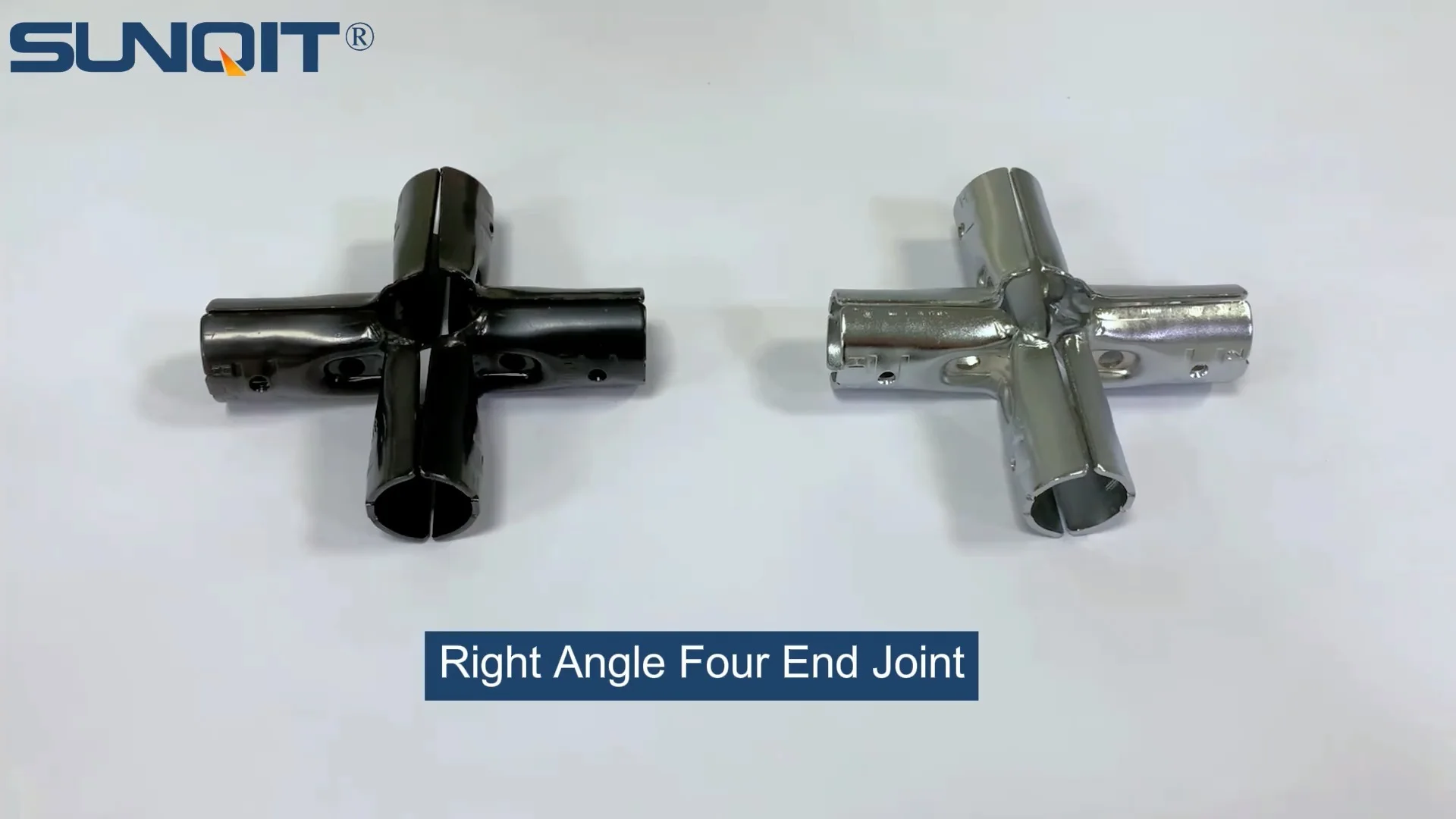
Five way straight lean pipe joint, for 5 pcs 28mm lean pipe connect in straight angle,which used widely in workbench, flow rack, hand trolley frame connection.
In the bustling world of manufacturing and assembly, where every second counts and efficiency is the name of the game, the smallest components often make the biggest difference. Enter lean pipe systems—those unassuming yet indispensable frameworks that form the backbone of workbenches, flow racks, conveyors, and countless other setups in factories worldwide. At the heart of these systems lie the joints: the quiet connectors that hold everything together, dictating how smoothly your workflow runs, how much weight your structures can bear, and even how adaptable your workspace remains. Today, we're zeroing in on two heavyweights in the joint family: the five way straight lean pipe joint and the swivel joint. Let's break down their roles, strengths, and how to choose the right one for your operation.
The Basics: What Are Lean Pipe Joints, Anyway?
Before we dive into the specifics, let's take a step back. Lean pipe systems—often made from steel, aluminum, or stainless steel pipe series—are modular setups used to build custom workstations, material handling equipment, and storage solutions. They're the chameleons of the factory floor, adaptable to almost any need, thanks in large part to their joints. These joints are the "glue" that lets you connect pipes, add shelves, attach casters, or build multi-level structures. Without the right joint, even the sturdiest pipes become little more than a pile of metal.
Now, within this family, two joint types stand out for their unique roles: the five way straight joint (the "steady anchor") and the swivel joint (the "flexible mover"). Let's meet them up close.
Meet the Five Way Straight Lean Pipe Joint: The Stability Expert
Picture this: You're building a workbench where precision is non-negotiable—maybe for assembling delicate electronics or testing small parts. You need the surface to stay rock-solid, no wobbling, no shifting, even when tools, components, and workers lean on it. That's where the five way straight lean pipe joint shines.
What It Is
As the name suggests, a five way straight joint is a fixed connector with five ports (think of it as a central hub) that allows you to attach pipes in straight lines—typically four in one plane (like north, south, east, west) and one perpendicular (up or down). Made from durable materials like zinc-plated steel or aluminum, it's designed for rigidity. Once locked in place with a setscrew or bolt, it doesn't budge. No rotation, no swiveling—just unyielding stability.
Key Features
- Stability First: No movement means zero play in the structure. Ideal for static setups where (shaking) could ruin work or damage parts.
- Multi-Directional Strength: With five connection points, it's a workhorse for building complex, multi-level structures like material racks or heavy-duty workbenches.
- High Load Capacity: Thanks to its fixed design, it distributes weight evenly across connected pipes, making it a go-to for holding heavy tools or bulk materials.
Best For: Static, Heavy-Duty Setups
Five way straight joints thrive in environments where stability is king. Think:
- Workbenches: Especially those used for assembly, inspection, or manual labor. A workbench built with five way joints won't shift when a worker leans on it, ensuring precise, consistent results.
- Material Racks: Multi-tiered racks holding boxes, bins, or raw materials. The fixed joints prevent shelves from sagging under weight, even with full loads.
- Turnover Trolleys (Static Loads): Trolleys used to store tools or components (not constantly rolling) benefit from the joint's rigidity, keeping contents secure during transport.

Introducing the Swivel Joint: The Flexibility Champion
Now, let's flip the script. Imagine a flow rack where materials need to glide from one workstation to the next—say, automotive parts moving from welding to painting, or packages sliding down to a packing station. You need the rollers on that rack to adjust slightly, to accommodate uneven loads or change direction smoothly. Enter the swivel joint: the joint that bends, rotates, and adapts to keep things moving.
What It Is
Swivel joints (sometimes called rotating joints) are designed for movement. Unlike their five way counterparts, they feature a rotating mechanism that allows connected pipes or rollers to pivot—often 180° or even 360°—around a central axis. Made from materials like plastic (for lightweight, low-friction movement) or metal (for heavier loads), they're all about flexibility. Think of them as the "ball-and-socket" of the lean pipe world.
Key Features
- Movement Matters: Rotation allows for adjustable angles, making them perfect for sloped surfaces (like flow racks) or components that need to tilt, turn, or glide.
- Smooth Material Flow: When paired with roller track and accessories (like swivel roller balls 1 inch or 0.5 inch), swivel joints let materials slide with minimal friction—reducing manual effort and speeding up workflows.
- Adaptability: Need to reconfigure a conveyor mid-shift? Swivel joints make it easy to adjust angles or add/remove sections without rebuilding the entire structure.
Best For: Dynamic, Flowing Workflows
Swivel joints are the MVPs of setups where movement is key. Common uses include:
- Flow Racks: These are all about gravity-fed material flow. Swivel joints allow roller tracks to tilt slightly, ensuring boxes or parts slide smoothly from the top shelf to the picking area—no pushing, no pulling.
- Conveyors: Whether it's a roller conveyor moving packages or a belt conveyor transporting assemblies, swivel joints help align rollers or adjust angles to keep items centered and moving steadily.
- Adjustable Workstations: Think of a workbench where the height or angle of a shelf needs to change (e.g., for workers of different heights or tasks like soldering vs. packaging). Swivel joints let you tweak these setups on the fly.

Head-to-Head: Five Way Straight vs. Swivel Joints in Action
To make this concrete, let's put these two joints side by side in the scenarios they're most likely to encounter. The table below breaks down their performance in key areas:
| Scenario | Five Way Straight Joint | Swivel Joint |
|---|---|---|
| Workbench Assembly | Perfect. Provides a rigid, wobble-free surface for precise tasks. Can support heavy tools and multi-level shelves. | Not ideal. Too much movement would make the workbench unstable, risking errors or accidents. |
| Flow Rack for Box Storage | Possible, but limited. Fixed angles mean boxes might get stuck if the slope isn't perfect. No adaptability if load sizes change. | Excellent. Swivel joints allow rollers to adjust, ensuring boxes glide smoothly even with varying weights or sizes. |
| Conveyor for Irregularly Shaped Parts | Poor fit. Fixed rollers can't adjust to odd shapes, leading to jams or damaged parts. | Great choice. Swivel joints let rollers pivot, accommodating curves or uneven surfaces without halting the line. |
| Multi-Tier Material Rack (Heavy Loads) | Top pick. Distributes weight evenly across all connections, preventing sagging or collapse under bulk materials. | Risky. Movement under heavy loads could lead to instability or structural failure over time. |

How to Choose: 3 Questions to Ask
Still on the fence? Let's simplify. When deciding between a five way straight joint and a swivel joint, ask yourself these three questions:
1. "Do I Need Movement or Stability?"
Start here. If your setup is static (e.g., a workbench that stays in one place, a rack holding stored materials), go with the five way joint. If materials need to move, tilt, or glide (e.g., a flow rack, a conveyor), swivel is the way to go.
2. "What's the Load?"
Five way joints are built for heavy lifting. If you're supporting 50kg+ (think metal parts, tool chests), their rigid design is safer. Swivel joints work best with lighter to medium loads (up to 30kg typically), where flexibility matters more than brute strength.
3. "Will My Needs Change Over Time?"
Swivel joints add adaptability. If you anticipate reconfiguring your setup (e.g., changing a flow rack's angle seasonally, adjusting a conveyor's path), their flexibility will save you time and money. Five way joints are more "set it and forget it"—great if your workflow is steady and predictable.
Real-World Example: The Auto Parts Plant That Switched to Swivel
A mid-sized automotive parts manufacturer recently faced a problem: their old flow racks, built with fixed five way joints, were causing bottlenecks. Workers had to manually push heavy boxes of engine components down the racks, leading to fatigue and slowdowns. After consulting with their lean pipe supplier, they swapped out fixed joints for swivel joints on the roller tracks. The result? Boxes now glide smoothly with minimal effort, cutting material handling time by 25% and reducing worker strain. Sometimes, the right joint is all it takes to turn a frustrating workflow into a seamless one.
The Bottom Line: It's All About Balance
At the end of the day, there's no "better" joint—only the right joint for the job. The five way straight lean pipe joint is your anchor, keeping static setups stable and strong. The swivel joint is your dancer, adding fluidity and adaptability to moving workflows. And here's the secret: Many factories use both! A typical setup might have a workbench with five way joints for stability, connected to a flow rack with swivel joints for material delivery, all feeding into a conveyor with a mix of both to handle turns and straightaways.
So, whether you're building a new lean system from scratch or upgrading an existing one, take a moment to think about the joints. They may be small, but they're the difference between a workflow that sputters and one that soars. And when in doubt? Reach out to a trusted lean pipe supplier—they'll help you mix and match joints to create a setup that's tailor-made for your factory's unique rhythm.
After all, in lean manufacturing, it's the little things—like the right joint—that keep the big picture moving forward.