- Company Articles
- Products and Technology
- Product knowledge
- Flat Adjustable Swivel Castor Wheels for 3C Product Testing Workbenches

Flat Adjustable Swivel Castor Wheels for 3C Product Testing Workbenches
Related Product
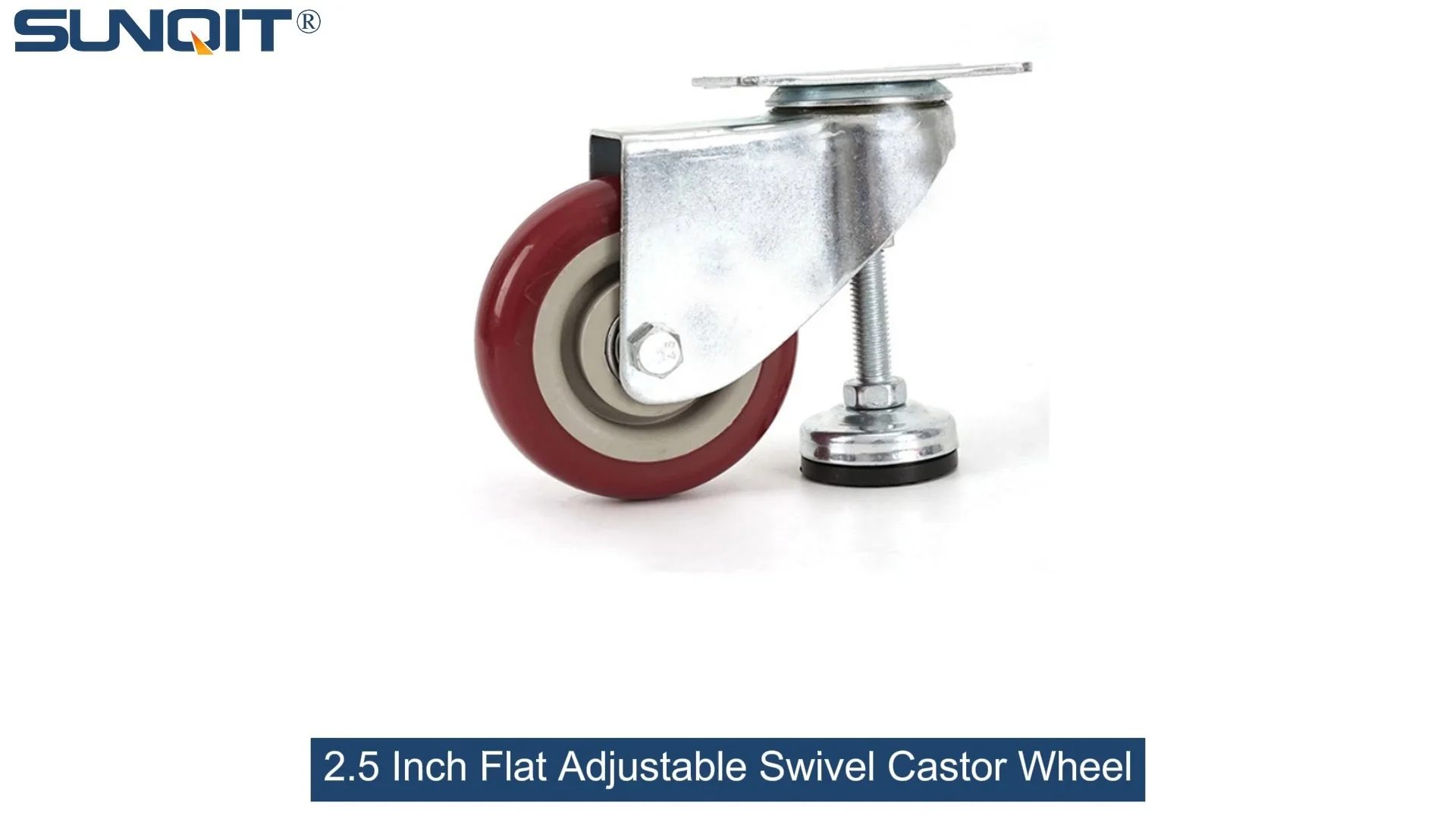
Flat Adjustable Swivel Castor Wheel
Swivel Chair Casters Ball Bearing Wheels Rubber Base with adjustable height function. Resistant to abrasion, impact and corrosion. Heavy payload can hold 80Kgs per pcs,which can make it works at a stable and smooth status.
Walk into any 3C product testing lab, and you'll likely be met with a symphony of soft hums—oscilloscopes tracing waveforms, thermal chambers cycling through extreme temperatures, and engineers hunched over workbenches, squinting at circuit boards under magnification. In this world, precision isn't just a buzzword; it's the difference between a product launch that succeeds and one that stalls. Every component, from the smallest resistor to the largest testing rig, plays a role in ensuring that smartphones, laptops, and wearables meet the rigorous standards of modern consumers. But there's one element that often flies under the radar, quietly keeping the entire operation moving (literally): the castor wheels beneath the workbench.
Testing 3C products demands more than just accurate equipment; it requires flexibility. A single workbench might host a battery lifespan test in the morning, a drop-test simulation in the afternoon, and a static discharge check by evening. Each of these tasks needs the workbench to be in a specific spot—sometimes near a power source, sometimes under a fume hood, sometimes inches away from a calibration station. And in a lab where space is often at a premium, moving heavy workbenches without disrupting delicate setups can feel like solving a puzzle with oversized pieces. That's where flat adjustable swivel castor wheels step in, turning rigid workstations into nimble, adaptable tools that keep pace with the chaos of 3C testing.
The Unsung Hero: Why Mobility Matters in Testing Workbenches
Let's start with the basics: a typical 3C testing workbench isn't just a table. It's a command center. It might hold a $10,000 spectrum analyzer, a clamp securing a prototype phone, and a laptop running specialized testing software—all while an engineer leans on its edge, adjusting knobs with surgical precision. The idea of "moving" this setup might sound risky, but in reality, labs can't afford to have dedicated workbenches for every single test. Budgets and square footage limit that luxury. Instead, labs rely on multi-purpose workstations that need to shift positions quickly, safely, and without compromising the integrity of the tests.
Consider a scenario: A team is testing a new smartwatch's water resistance. The workbench needs to be wheeled into a humidity chamber for a 24-hour soak test, then out to a benchtop for post-test inspection. Without reliable castors, moving that workbench would require two people, risk jostling the watch (invalidating the test), and eat up precious time. Now multiply that by a dozen tests a day, across multiple workbenches, and the inefficiency adds up. Mobility isn't just about convenience here—it's about maintaining the speed and accuracy that 3C testing demands.
But mobility alone isn't enough. Testing workbenches also need stability. Imagine trying to measure microvolt-level signals on a circuit board while the workbench wobbles with every footstep nearby. Or worse, a castor that locks unpredictably mid-movement, sending a calibration tool sliding off the edge. That's why the "adjustable" part of flat adjustable swivel castor wheels is just as critical as the "swivel." These castors don't just let you move the workbench—they let you lock it down, level it on uneven floors, and even tweak its height to match an engineer's seated or standing posture. In a field where a fraction of a millimeter can change a test result, that stability is non-negotiable.
Meet Flat Adjustable Swivel Castor Wheels: What Makes Them Unique
At first glance, a castor wheel might seem like a simple contraption: a wheel, a bracket, and a locking mechanism. But flat adjustable swivel castor wheels are engineered with the unique demands of 3C testing in mind. Let's break down what sets them apart.
Flat Adjustable Design: Unlike traditional castors that bolt onto the bottom of a workbench leg with a protruding bracket, flat adjustable castors are designed to sit flush (or nearly flush) with the workbench's base. This "flat" profile lowers the workbench's center of gravity, reducing the risk of tipping when heavy equipment is placed on one side. It also means the workbench sits closer to the floor, which is a boon for ergonomics—engineers spend less time hunching over, and fine motor tasks (like soldering a test point) become easier when the work surface is at a natural height.
The "adjustable" part is where things get really clever. Most models feature a threaded stem or a ratcheting mechanism that lets you tweak the height of the castor by a few centimeters. Why does this matter? Labs are rarely perfectly level. A concrete floor might have a slight slope, or a section near a window might dip from years of foot traffic. With adjustable castors, you can level the workbench precisely, ensuring that sensitive equipment stays balanced and test samples don't roll off. Some models even include a built-in bubble level, taking the guesswork out of setup.
Swivel Without the Sway: Swivel castors are nothing new, but the ones designed for testing workbenches are built to handle the lab's unique stressors. A good swivel mechanism should rotate 360 degrees smoothly, even when the workbench is loaded with 500+ pounds of equipment. But it should also lock firmly when needed. Look for castors with dual-locking mechanisms: one to lock the wheel (preventing rolling) and another to lock the swivel (keeping the wheel facing a fixed direction). This dual lock is a game-changer when you need the workbench to stay put during a vibration test or a delicate soldering job.
Materials matter too. 3C labs can be harsh environments: some have chemical cleaners, others have high humidity, and many require static control. That's why quality castors use materials like stainless steel for the brackets (resisting rust), and non-marking rubber or polyurethane for the wheels (preventing floor scratches and reducing noise). For ESD workstations—critical for testing circuit boards that are sensitive to static discharge—there are even conductive castor options that ground the workbench, channeling static away from delicate components.

Compatibility: Fitting into Your Workbench Setup
Not all workbenches are created equal, and neither are their castor needs. Two of the most common setups in 3C labs are lean pipe workbenches and ESD workstations. Let's see how flat adjustable swivel castors integrate with each.
Lean Pipe Workbenches: Modularity Meets Mobility
Lean pipe workbenches have exploded in popularity in recent years, thanks to their modular design. Made from lightweight aluminum or steel pipes (often called "lean tubes") and connecting joints, these workbenches can be customized in minutes—adding shelves, tool hooks, or even a laptop tray with just a few adjustments. They're the Swiss Army knives of labs, adapting to whatever test comes next. But their modularity only works if the entire setup can move when needed. Flat adjustable swivel castors are a natural fit here because they're designed to bolt directly onto the lean pipe frame without requiring complex modifications.
Imagine a lean pipe workbench configured for battery testing: it has a shelf for a power supply, a rail for cable management, and a non-slip top to hold battery packs. At the end of the week, the team needs to reconfigure it for camera lens testing, which requires a different shelf layout and a light box. With castors, you can wheel the entire workbench to an open area, take it apart, reassemble it, and roll it back—all without having to empty the shelves first. Some lean pipe suppliers even offer castor brackets specifically designed to fit their pipe diameters, ensuring a secure, wobble-free connection.
ESD Workstations: Protecting Sensitive Electronics
For workbenches handling printed circuit boards (PCBs), microchips, or other static-sensitive components, ESD compliance is mandatory. Static electricity can damage semiconductors at voltages as low as 250 volts—far below what a human can feel. ESD workstations are designed to prevent this: they have conductive surfaces, grounding straps for engineers, and sometimes ionizers to neutralize static in the air. But if the castors aren't ESD-compliant, all that protection goes out the window. A non-conductive castor wheel could act as an insulator, trapping static on the workbench and releasing it when it touches a component.
That's why ESD workbench suppliers often pair their stations with conductive castors. These castors use wheels made from conductive rubber or have metal hubs that connect to the workstation's grounding system, ensuring that any static buildup is safely channeled to the floor. When shopping for castors for an ESD setup, look for a surface resistance rating between 10^4 and 10^9 ohms—the industry standard for static control. It's a small detail, but it can save thousands of dollars in damaged components.

Beyond Mobility: Hidden Benefits for Testing Efficiency
We've talked about moving workbenches and stability, but flat adjustable swivel castors offer perks that go beyond the obvious. Let's dive into the less-talked-about ways they boost lab efficiency.
Ergonomics: Keeping Engineers Comfortable (and Accurate)
Testing 3C products is a sedentary job—engineers might spend hours bent over a workbench, focusing on tiny components. Poor ergonomics leads to fatigue, which leads to mistakes. Adjustable castors let engineers tweak the workbench height to match their seated or standing position. A taller engineer can raise the castors by an inch, while a shorter colleague can lower them, ensuring the work surface is always at elbow height. This small adjustment reduces strain on the neck, shoulders, and back, keeping the team fresh and focused during long test runs.
Space Optimization: Making the Most of Every Inch
Labs are often a jumble of equipment: large testing machines (like thermal chambers), storage racks for prototypes, and workbenches. When a workbench is fixed in place, it creates dead space around it—areas too small for another workstation but too large to ignore. With castors, you can tuck the workbench into a corner when it's not in use, then roll it out when needed. Some labs even use this to create "mobile testing stations" that can be wheeled between departments, eliminating the need for duplicate equipment. For example, a single ESD workbench can service the R&D team in the morning and the quality control team in the afternoon, just by rolling it down the hall.
Quick Reconfiguration: Adapting to the Unexpected
3C testing is full of surprises. A last-minute client request might require adding a new test to the schedule, or a faulty batch of components might mean re-testing an entire lot. In these cases, the lab needs to pivot fast. With castor-equipped workbenches, reconfiguring the space takes minutes, not hours. Need to set up a temporary testing line? Roll three workbenches into a U-shape, connect them with power strips, and you're ready. Finished? Break them down and return them to their original spots. This flexibility is a lifesaver in fast-paced environments where downtime equals lost opportunities.

Choosing the Right Castor: A Practical Guide
Not all flat adjustable swivel castors are created equal. To find the right fit for your 3C testing workbench, you'll need to consider a few key factors. Use the table below to compare features and narrow down your options:
| Castor Type | Load Capacity (per castor) | Adjustment Range | Swivel Lock | ESD Compliant? | Best For |
|---|---|---|---|---|---|
| Standard Flat Adjustable Swivel | 300–500 lbs | 1–3 inches | Wheel lock only | No | General testing workbenches with moderate loads |
| Heavy-Duty Flat Adjustable Swivel | 800–1200 lbs | 2–4 inches | Dual lock (wheel + swivel) | Optional (conductive version) | Workbenches with large equipment (e.g., oscilloscopes, thermal chambers) |
| ESD-Specific Flat Adjustable Swivel | 400–600 lbs | 1–3 inches | Dual lock | Yes (10^4–10^9 ohms) | ESD workstations, circuit board testing |
| Low-Profile Flat Adjustable Swivel | 200–400 lbs | 0.5–2 inches | Wheel lock only | No | Compact workbenches, tight spaces |
Start with load capacity: calculate the total weight your workbench will hold (equipment + tools + prototypes) and divide by four (since most workbenches have four castors). Add 20% to that number to account for uneven weight distribution—better to overestimate than risk a castor failure. For example, a workbench with 800 lbs of equipment needs castors rated for at least 200 lbs each (800 / 4 = 200; +20% = 240 lbs per castor). Heavy-duty options are worth the investment if you're testing large devices like laptops or tablets.
Adjustment range depends on your lab's floor conditions. If your lab has uneven floors, look for castors with a wider adjustment range (3–4 inches). For ESD workstations, prioritize the ESD-compliant models, even if they cost a bit more—replacing a fried microchip is far more expensive than upgrading castors.
Installation & Maintenance: Keeping Your Castors Rolling Smoothly
Installing flat adjustable swivel castors is usually a straightforward DIY job, but a few tips will ensure a secure fit. First, check the workbench's leg design: some have pre-drilled holes for castors, while others may need pilot holes drilled. Use bolts that are long enough to thread into the leg (at least 1 inch of engagement) but not so long that they protrude through the top of the workbench. If you're attaching castors to a lean pipe workbench, use the manufacturer's recommended brackets—these are designed to fit the pipe diameter and prevent bending under load.
Once installed, take the time to level the workbench. Place a spirit level on the surface and adjust each castor's height until the bubble is centered. This step is critical for equipment accuracy—an unlevel workbench can throw off measurements in vibration tests or balance-dependent setups. Don't forget to lock the castors once leveling is done; even a slight roll can undo your hard work.
Maintenance is minimal but important. Every few months, wipe the wheels with a damp cloth to remove dust and debris (which can cause squeaking or uneven rolling). Lubricate the swivel mechanism with a silicone-based lubricant (avoid oil-based lubricants, which attract dust). Check the bolts regularly to ensure they're tight—vibration from testing can loosen them over time. If a wheel starts to wobble or the lock mechanism sticks, replace the castor immediately. A faulty castor isn't just an annoyance; it's a safety risk in a lab with heavy equipment.
Real-World Impact: Stories from 3C Testing Floors
Still not convinced that castors are worth the investment? Let's hear from a few labs that made the switch. Take, for example, a mid-sized 3C testing facility in Shenzhen that was struggling with space constraints. Their engineers were spending 15–20 minutes per day just moving workbenches to access equipment, and drop-test simulations often had to be rescheduled because the workbench couldn't be positioned close enough to the high-speed camera. After upgrading to heavy-duty flat adjustable swivel castors, they cut setup time by 70%. "We used to need two people to move a workbench with our spectrum analyzer," says the lab manager. "Now, one person can wheel it into place in 2 minutes, and the dual locks keep it steady during tests. We've doubled the number of daily tests we can run—all because of better castors."
Another example comes from an ESD lab testing smartphone PCBs. Before switching to conductive castors, they were seeing a 5% failure rate in static discharge tests—mysterious damage that couldn't be traced to equipment or operator error. An ESD audit revealed that static was building up on the workbench and discharging through the PCBs during handling. After installing ESD-compliant castors, the failure rate dropped to 0.5%. "It was a small change, but it saved us thousands in reworked prototypes," the lead engineer notes. "Now, we specify conductive castors on all new ESD workstations."
Conclusion: Investing in the Right Foundation
In the high-stakes world of 3C product testing, every detail counts. From the precision of the equipment to the expertise of the engineers, success hinges on a thousand small choices. Flat adjustable swivel castor wheels might not be the most glamorous of those choices, but they're among the most impactful. They turn static workbenches into dynamic tools, letting labs adapt to changing tests, optimize space, and protect sensitive equipment—all while keeping engineers comfortable and efficient.
So the next time you walk into a 3C testing lab, take a moment to look down. The wheels beneath the workbench might be small, but they're carrying the weight of innovation. And in a industry where speed, accuracy, and flexibility are everything, that's a load worth investing in.