- Company Articles
- Products and Technology
- Product knowledge
- Flat Adjustable Swivel Castor Wheels for Mobile Workstations: Flexibility Redefined

Flat Adjustable Swivel Castor Wheels for Mobile Workstations: Flexibility Redefined
Related Product
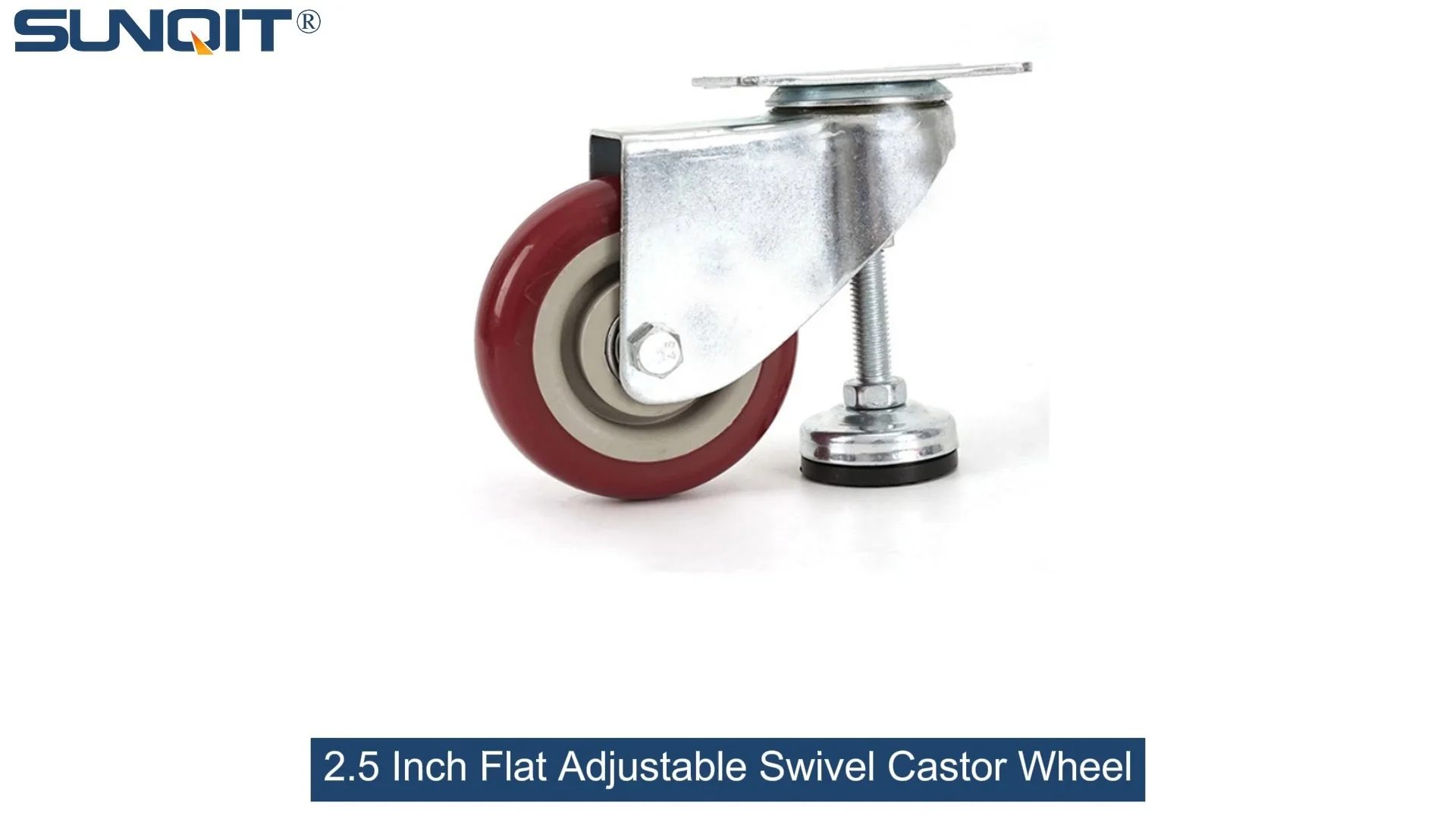
Flat Adjustable Swivel Castor Wheel
Swivel Chair Casters Ball Bearing Wheels Rubber Base with adjustable height function. Resistant to abrasion, impact and corrosion. Heavy payload can hold 80Kgs per pcs,which can make it works at a stable and smooth status.
How a single component transforms static workspaces into dynamic hubs of productivity
The Evolution of Workspace Mobility: From Static to Dynamic
Walk into any modern factory, lab, or warehouse today, and you'll notice a subtle but powerful shift: workspaces are no longer fixed. Tables glide, tools relocate, and entire production lines reconfigure at the push of a hand. This isn't just about convenience—it's about survival in an era where agility and efficiency are the keys to staying competitive. At the heart of this transformation lies a humble yet revolutionary component: the flat adjustable swivel castor wheel.
For decades, workbenches, material racks, and equipment were bolted to the floor or heavy enough to require forklifts to move. This rigidity made it nearly impossible to adapt to sudden changes in demand, new product lines, or even simple workflow optimizations. A factory floor designed for one product would become a maze of inefficiencies when tasked with another. Workers wasted time navigating around static obstacles, and reconfiguring spaces meant days of downtime and heavy labor.
Enter the flat adjustable swivel castor wheel—a small component that has rewritten the rules of workspace design. By combining smooth mobility, precise height adjustment, and robust stability, these castors turn any stationary structure into a mobile workstation that adapts to your needs, not the other way around. Whether you're running a lean manufacturing operation, a busy laboratory, or a high-volume warehouse, these wheels are the unsung heroes that keep work flowing, workers comfortable, and productivity soaring.
What Are Flat Adjustable Swivel Castor Wheels? Breaking Down the Design
At first glance, a castor wheel might seem like a simple piece of hardware—but the flat adjustable swivel castor wheel is a marvel of engineering, designed to solve specific challenges in dynamic work environments. Let's break down its core components and what makes it stand out from standard castors.
1. The Swivel Mechanism: 360 Degrees of Freedom
Unlike fixed castors, which only roll forward and backward, swivel castors feature a rotating head that allows the wheel to turn 360 degrees. This maneuverability is game-changing in tight spaces—think of a workbench that needs to pivot around a conveyor belt or a lab cart that must squeeze through a narrow aisle. The best swivel mechanisms use precision ball bearings to ensure smooth rotation, even under heavy loads, so you won't struggle with sticky or jerky movement when repositioning your workstation.
2. Height Adjustment: Tailored to Every Task (and Every Worker)
The "adjustable" in flat adjustable swivel castor wheels refers to their ability to modify the height of the workstation they're attached to. This is typically done via a threaded stem or a lever that raises or lowers the wheel relative to the mounting plate. Why does this matter? In a single workspace, you might have workers of different heights—some preferring to stand, others sitting. With adjustable castors, a workbench can be raised to standing height for assembly tasks, then lowered for detailed inspection work, all without tools. It's ergonomics in action, reducing strain on backs, shoulders, and wrists, and cutting down on workplace injuries.
3. The "Flat" Design: Stability Without Sacrificing Ground Clearance
The "flat" in the name refers to the mounting plate, which sits flush against the bottom of the workstation. This low-profile design keeps the center of gravity low, preventing tipping even when the workstation is loaded with heavy tools or materials. Unlike bulky castors that add unnecessary height, flat mounting plates ensure the workstation stays stable while still providing enough ground clearance to roll over small obstacles like cables or uneven floor tiles.
4. Wheel Materials: Grip, Durability, and Floor Protection
The wheel itself is a critical component, and manufacturers offer a range of materials to suit different environments:
- Polyurethane (PU): A popular choice for general use, PU wheels offer a balance of grip, durability, and floor protection. They're quiet, shock-absorbent, and work well on both hard floors (like concrete) and sensitive surfaces (like lab tiles).
- Rubber: Ideal for environments where noise reduction is key, rubber wheels provide excellent traction and are gentle on floors. They're often used in healthcare or office settings.
- Nylon: Best for heavy-duty applications, nylon wheels have high load capacities and resist wear and tear. They're common in warehouses and manufacturing plants where equipment is moved frequently.
- ESD-Safe Options: For electronics manufacturing or labs handling sensitive components, ESD (electrostatic discharge) wheels prevent static buildup, protecting delicate equipment from damage.

Why Flexibility Matters: The Benefits of Flat Adjustable Swivel Castor Wheels
So, what makes these castors worth investing in? Let's dive into the tangible benefits they bring to workspaces of all kinds.
| Benefit | Impact on Workspace | Example Scenario |
|---|---|---|
| Enhanced Mobility | Workstations can be repositioned in minutes, not hours. | A manufacturing team needs to shift from producing Product A to Product B. With castor-equipped workbenches, they rearrange the line in 20 minutes instead of a full day. |
| Ergonomic Customization | Work height adjusts to fit individual workers, reducing strain. | A tall worker raises their workbench by 4 inches to avoid hunching; a shorter colleague lowers it by 2 inches the next shift—no tools required. |
| Space Optimization | Workstations can be moved aside when not in use, freeing up floor space. | A warehouse clears space for a large incoming shipment by rolling idle workbenches into a storage area, then brings them back once the shipment is processed. |
| Safety Features | Brakes and locks prevent unintended movement during use. | A lab technician engages the total-lock brake on their mobile workstation to ensure it stays steady while handling fragile glassware. |
Supporting Lean Systems: From Waste to Workflow
Lean manufacturing principles focus on eliminating waste—whether it's time, movement, or resources. Flat adjustable swivel castor wheels are a lean manager's best friend, directly addressing two of the biggest waste categories: motion (unnecessary movement of workers) and waiting (delays caused by inefficient processes).
Consider a typical assembly line without mobile workstations: workers might walk 50 steps per hour to fetch tools or components. Multiply that by 8 hours and 10 workers, and you're looking at 4,000 unnecessary steps a day—time that could be spent building products. With a mobile workbench on flat adjustable swivel castor wheels, the tools come to the worker. Suddenly, those 4,000 steps vanish, and productivity spikes.
Lean systems also thrive on continuous improvement, which often requires reconfiguring workflows based on new data. A static workspace resists change; a mobile one embraces it. Need to test a new layout? Roll your workstations into place, run a trial, and adjust again—all without disrupting production for days. It's flexibility that turns "maybe" into "let's try it now."

Real-World Applications: Where These Castors Shine
Flat adjustable swivel castor wheels aren't just for factories—they're transforming workspaces across industries. Let's explore a few key applications.
Electronics Manufacturing: Precision and ESD Safety
In electronics manufacturing, even the smallest static charge can ruin a circuit board. ESD-safe workstations are a must, and flat adjustable swivel castor wheels with ESD-compliant wheels ensure that mobility doesn't compromise safety. These wheels dissipate static electricity, protecting sensitive components while allowing workers to reposition their workbenches to align with conveyors or testing stations. Height adjustment is also critical here—assembling tiny components requires precise eye-level alignment, and adjustable castors let each worker set their station to the perfect height.
Laboratories: Adaptability for Research
Labs are dynamic environments where experiments change daily. A mobile lab bench on flat adjustable swivel castor wheels can be moved from a fume hood to a microscope station in seconds, then adjusted in height to accommodate a centrifuge or a pipetting robot. The swivel wheels make it easy to navigate around fixed equipment like fridges or incubators, while brakes ensure the bench stays rock-steady during delicate procedures.
Warehousing and Distribution: Material Handling Made Simple
In warehouses, time is money—and every second spent moving materials counts. Flat adjustable swivel castor wheels turn ordinary racks into mobile storage units, making it easy to restock shelves or reorganize inventory. When paired with conveyors, these mobile racks can be rolled right up to the conveyor belt, eliminating the need for forklifts or manual lifting. The adjustable height also helps workers avoid bending or reaching, reducing the risk of back injuries.
Healthcare: Sterility and Maneuverability
Hospitals and clinics demand both sterility and flexibility. Mobile medical carts equipped with flat adjustable swivel castor wheels can carry supplies from storage to patient rooms, then be adjusted in height for nurses of different heights to access easily. The smooth-rolling wheels minimize noise in quiet environments, while non-marking materials ensure floors stay clean. In operating rooms, specialized carts with these castors can be positioned with pinpoint accuracy, then locked in place to keep tools within arm's reach during procedures.

Choosing the Right Castor: Key Considerations
Not all flat adjustable swivel castor wheels are created equal. To find the best fit for your workspace, ask yourself these questions:
1. What's the Load Capacity?
Start with the basics: how much weight will the workstation carry? This includes the weight of the workstation itself, plus tools, materials, and any equipment. Castors are rated for specific load capacities (e.g., 200 lbs per wheel, 800 lbs total for a four-wheel setup), so always choose a castor that exceeds your expected load to avoid premature wear or failure.
2. What's the Floor Type?
Concrete floors can handle tough nylon wheels, but hardwood or tile might require softer polyurethane to prevent scratches. If your space has carpet, look for larger wheels with a firm tread to avoid sinking.
3. Do You Need Brakes?
Most applications require brakes to keep the workstation stable during use. Options include:
- Swivel locks: Prevent the wheel from turning, keeping the workstation moving in a straight line.
- Total locks: Lock both the wheel and the swivel, immobilizing the workstation completely—ideal for tasks requiring precision or safety.
4. Is ESD Protection Needed?
If you work with electronics, medical devices, or other static-sensitive equipment, opt for ESD-safe castors. These wheels are made with conductive materials that dissipate static charge, protecting your products from damage.
The Future of Work: Mobility as Standard
As workplaces evolve—driven by trends like hybrid work, automation, and mass customization—the demand for flexible, mobile workspaces will only grow. Flat adjustable swivel castor wheels are no longer a "nice-to-have" but a foundational element of modern work design. They empower teams to adapt quickly, work comfortably, and focus on what matters: creating value, not navigating obstacles.
Imagine a world where every workstation is as adaptable as the people using it—a world where reconfiguring a factory floor takes minutes, where ergonomic comfort is standard for every employee, and where waste is a thing of the past. That world isn't coming—it's here, and it's rolling on flat adjustable swivel castor wheels.
So, whether you're upgrading a single workbench or redesigning an entire facility, remember: the right wheels don't just move things—they move your business forward.