- Company Articles
- Products and Technology
- Product knowledge
- Flat Adjustable Swivel Castor Wheels for Small-Part Handling Trolleys in 3C Industry

Flat Adjustable Swivel Castor Wheels for Small-Part Handling Trolleys in 3C Industry
Related Product
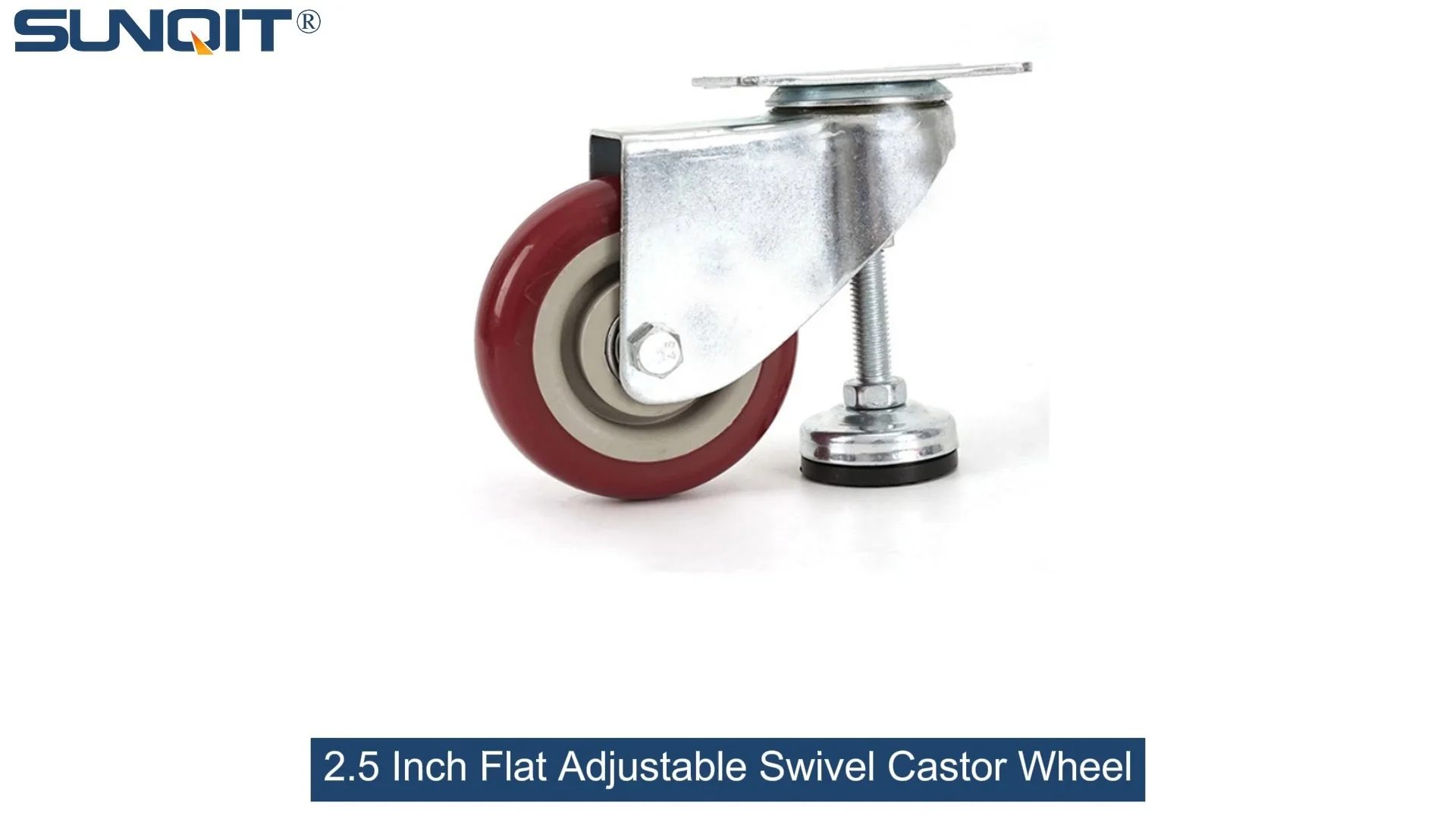
Flat Adjustable Swivel Castor Wheel
Swivel Chair Casters Ball Bearing Wheels Rubber Base with adjustable height function. Resistant to abrasion, impact and corrosion. Heavy payload can hold 80Kgs per pcs,which can make it works at a stable and smooth status.
Walk into any 3C manufacturing plant—whether it's churning out the latest smartphones, sleek laptops, or tiny wearable devices—and you'll immediately notice a quiet but relentless rhythm. Conveyor belts hum, robotic arms glide, and workers in (ESD protective clothing) move with precision, passing trays of microchips, connectors, and circuit boards between stations. In this world of minuscule components and high-stakes production, every detail matters. But if there's one unsung hero keeping this rhythm intact, it's often the small, unassuming wheels beneath the trolleys that carry these critical parts. Today, we're diving into the world of flat adjustable swivel castor wheels —and why they've become indispensable for small-part handling trolleys in the 3C industry.
The 3C Industry: Where Small Parts Mean Big Challenges
First, let's set the stage. The 3C industry—covering Computers, Communications, and Consumer Electronics—is a beast of precision and pace. A single smartphone, for example, contains over 1,000 individual components, many no larger than a grain of rice. These parts need to move from storage to assembly lines, from quality checks to packaging, and everywhere in between—without a scratch, a static charge, or a single second wasted.
Here's the kicker: 3C factories are rarely spacious. To maximize production density, workstations are packed closely together, leaving narrow aisles for material transport. Floors might be smooth concrete in some areas, uneven in others, or even coated with anti-static tiles. Add in the need for cleanroom environments (to prevent dust from ruining sensitive electronics) and strict ESD (Electrostatic Discharge) protocols, and suddenly, moving small parts around becomes a logistical puzzle.
Enter the humble handling trolley. These trolleys—often lightweight, with shelves or bins to organize parts—are the workhorses of 3C factories. But a trolley is only as reliable as its wheels. A stuck caster, a wobbly base, or a wheel that leaves scratches on the floor can throw off an entire production line. That's where flat adjustable swivel castor wheels step in: designed to tackle tight spaces, uneven floors, and the unique demands of 3C manufacturing.
Why Castor Wheels Are the "Make or Break" of Trolley Design
Let's be honest: when you think about a trolley, you probably focus on its shelves, its load capacity, or how easy it is to clean. But ask any factory floor manager, and they'll tell you the wheels are where the magic (or the chaos) happens. In 3C manufacturing, here's why castor wheels matter more than you might think:
- Precision Maneuverability: With aisles barely wider than the trolleys themselves, a caster that can swivel 360° without jerking is non-negotiable. A stuck swivel joint means workers waste time navigating, or worse, risk bumping into equipment and damaging parts.
- Floor Protection: Many 3C factories use expensive anti-static or epoxy floors. A hard plastic or metal wheel can scratch these surfaces, creating trip hazards or compromising floor integrity. Soft, non-marking wheels are a must.
- Stability at Rest: When a trolley is parked at a workstation, it needs to stay put. A flimsy brake or a wheel that rolls unexpectedly can lead to spills, damaged components, or even worker injuries.
- Adjustability for Uneven Floors: Even the best factory floors have slight dips or bumps. A trolley that wobbles because its wheels aren't level can cause parts to shift, fall, or get misaligned—costing time and money in rework.
Traditional fixed castors or basic swivel wheels often fall short here. Fixed wheels limit movement to straight lines, making tight turns impossible. Standard swivel castors might lack the precision needed for 3C's cramped spaces. And most non-adjustable wheels can't compensate for uneven floors, leaving trolleys teetering. That's why flat adjustable swivel castor wheels have become the gold standard: they address all these pain points in one compact design.

Flat Adjustable Swivel Castor Wheels: What Makes Them Unique?
Let's break down the name first: "flat adjustable swivel castor wheel." Each part of that label hints at a key feature tailored to 3C's needs:
Flat Design
Unlike bulky castors with tall brackets, "flat" castors sit close to the trolley base. This lowers the trolley's center of gravity, reducing the risk of tipping—critical when carrying stacks of small, heavy components like batteries or circuit boards. The low profile also makes them ideal for under-shelf mounting, saving space in tight areas.
Adjustable Height
A built-in adjustment mechanism (often a threaded stem or a screw) lets operators tweak the wheel height by a few millimeters. This levels the trolley on uneven floors, ensuring stability and preventing parts from sliding. No more shimming with cardboard or wasting time hunting for level spots—just a quick twist to get the trolley steady.
Swivel Functionality
These castors rotate 360° smoothly, thanks to precision ball bearings in the swivel head. This allows trolleys to pivot on a dime, navigating around workbenches, conveyor belts, and other obstacles without stopping. Some models even have a "soft start" swivel design to prevent sudden jerks that could dislodge parts.
But the real genius is in the details. Let's dive deeper into the features that make these castors a 3C factory favorite:
Wheel Materials: More Than Just Rubber
In 3C manufacturing, wheel material isn't just about durability—it's about safety and compatibility. Common options include:
- Polyurethane (PU): The top choice for 3C. PU wheels are soft enough to protect floors from scratches, non-marking (no black streaks on white cleanroom floors), and offer excellent grip. They also absorb shock, reducing vibration that could damage delicate parts.
- ESD-Safe PU: For electronics assembly, static is the enemy. ESD-safe PU wheels conduct static electricity away from the trolley, preventing it from building up and zapping sensitive microchips. Look for wheels rated to meet ANSI/ESD S20.20 standards.
- Nylon: More rigid than PU, nylon wheels handle heavier loads and resist chemicals—useful in factories that use cleaning agents. They're less ideal for uneven floors, though, as they don't absorb shock as well.
Brakes: Locking In Safety
A good brake is just as important as the wheel itself. Most flat adjustable swivel castors come with two types of brakes:
- Total Lock Brakes: Lock both the wheel (preventing rolling) and the swivel joint (preventing turning). This keeps the trolley fully immobilized, even on inclines or when bumped.
- Wheel-Only Brakes: Stop the wheel from rolling but let the swivel joint move. Useful for repositioning the trolley slightly without unlocking completely.
In 3C, total lock brakes are preferred at workstations, where precision and safety are paramount. Imagine a worker carefully loading tiny SMD components onto a tray—they can't afford the trolley to shift mid-task.

How Do They Stack Up? A Comparison of Castor Types for 3C Trolleys
To see why flat adjustable swivel castors stand out, let's compare them to other common castor types used in manufacturing:
| Castor Type | Maneuverability in Tight Spaces | Stability on Uneven Floors | Floor Protection | Best For |
|---|---|---|---|---|
| Fixed Castors | Poor (only straight lines) | Poor (no adjustability) | Depends on wheel material | Heavy, straight-line transport (e.g., loading docks) |
| Basic Swivel Castors | Good (360° swivel) | Poor (no adjustability) | Good (with PU wheels) | General-purpose trolleys in open spaces |
| Heavy-Duty Industrial Castors | Fair (bulky design limits tight turns) | Fair (some adjustability) | Fair (often metal wheels) | Heavy machinery transport |
| Flat Adjustable Swivel Castors | Excellent (low profile + smooth swivel) | Excellent (height-adjustable) | Excellent (non-marking PU/ESD wheels) | Small-part handling in 3C factories, cleanrooms, tight aisles |
The table speaks for itself: for 3C's unique mix of tight spaces, uneven floors, and delicate components, flat adjustable swivel castors are the clear winner. They're not just a "nice-to-have"—they're a "need-to-have" for maintaining efficiency and quality.

Real-World Impact: How 3C Factories Benefit from These Castors
Numbers and specs tell part of the story, but real-world examples show the true value. Let's look at two case studies from 3C manufacturers that switched to flat adjustable swivel castor wheels:
Case Study 1: Smartphone Assembly Plant in Shenzhen
Before: A factory producing mid-range smartphones was using trolleys with basic swivel castors. Workers complained about difficulty maneuvering trolleys between assembly lines (aisles were just 1.2 meters wide), and parts occasionally fell off due to trolley wobble on uneven floor sections. Material transport time between stations averaged 8 minutes per trolley.
After: The plant upgraded to flat adjustable swivel castors with ESD-safe PU wheels. The results were immediate: trolleys could now make 90° turns in under 1 meter, cutting transport time to 5 minutes. The adjustable height feature eliminated wobble, reducing part damage by 40%. Workers reported less fatigue from pushing, and floor scratches (a frequent complaint from maintenance) dropped by 75%.
Case Study 2: PCB Manufacturer in Taiwan
Before: A printed circuit board (PCB) factory used fixed castor trolleys to move sensitive PCBs between etching and soldering stations. The fixed wheels required workers to backtrack repeatedly to navigate corners, and static buildup from plastic wheels occasionally caused tiny solder defects (visible only during final testing).
After: Switching to flat adjustable swivel castors with conductive ESD wheels solved both issues. The 360° swivel eliminated backtracking, saving 2 hours of labor per shift. The conductive wheels dissipated static, reducing solder defects by 35%. The factory also noted that the flat design made it easier to clean under trolleys—critical for maintaining ISO 14644-1 cleanroom standards.
These aren't isolated incidents. Across the 3C industry, factories that invest in quality castors report measurable improvements in efficiency, product quality, and worker satisfaction. As one plant manager put it: "We used to think of wheels as an afterthought. Now, we see them as a tool to boost our lean system goals—cutting waste, reducing defects, and keeping our lines moving."
Beyond Trolleys: Other 3C Applications for Flat Adjustable Swivel Castors
While small-part handling trolleys are their most common use, flat adjustable swivel castor wheels shine in other 3C applications too:
Mobile Workbenches
Many 3C factories use mobile workbenches for flexible assembly lines. Adding flat adjustable castors lets workers reposition benches quickly to adapt to changing production needs—say, shifting from assembling phone screens to camera modules. The adjustability ensures the bench stays level, even when moved to different floor areas.
Turnover Trolleys and Racks
Turnover trolley and rack systems are used to store and transport bulk components like screws, nuts, or plastic casings. Flat adjustable castors make these racks easy to rotate in warehouses, ensuring first-in-first-out (FIFO) inventory management—a key part of lean manufacturing. The low profile also maximizes vertical storage space.
Testing Stations
Electronic testing equipment (e.g., oscilloscopes, signal analyzers) is often mounted on wheeled carts. Flat adjustable castors keep these carts stable during delicate testing procedures, and the non-marking wheels protect lab floors from scratches.
Choosing the Right Supplier: What to Look For
Not all flat adjustable swivel castors are created equal. To get the best results for your 3C operation, here's what to look for in a supplier:
- Experience in 3C: Suppliers who specialize in electronics manufacturing understand ESD requirements, cleanroom standards, and the need for precision. Ask for case studies or references from other 3C clients.
- Customization Options: Every factory is different. Look for suppliers who offer custom wheel materials (ESD, non-marking, chemical-resistant), brake types, and load capacities. For example, if you're transporting heavy battery packs, you'll need higher load ratings than for plastic casings.
- Quality Certifications: Certifications like ISO 9001 (quality management) and RoHS (restriction of hazardous substances) ensure the castors meet global standards—critical if you export products. For ESD applications, look for compliance with ANSI/ESD S20.20.
- After-Sales Support: Even the best castors need maintenance. A supplier that offers caster accessories (replacement wheels, brakes, lubricants) and responsive technical support can save you downtime when issues arise.
Don't skimp on cost here. A cheap castor might save money upfront, but frequent replacements, repairs, and productivity losses will cost far more in the long run. As the saying goes: "Buy well, buy once."
Future Trends: What's Next for Castor Wheels in 3C?
The 3C industry is always evolving—with smaller components, faster production cycles, and smarter factories. Castor wheel technology is keeping pace:
Smart Castors with Sensors
Imagine castors that monitor wheel wear, track trolley location via RFID, or alert maintenance when brakes need adjustment. Early prototypes are already being tested in smart factories, promising to reduce unplanned downtime.
Lightweight, High-Strength Materials
New alloys and composite materials are making castors lighter without sacrificing strength. This is critical as 3C factories adopt more automated guided vehicles (AGVs), where every gram of weight affects energy efficiency.
Self-Cleaning Wheels
For cleanroom environments, wheels that repel dust and debris (via special coatings or designs) could reduce cleaning time and contamination risks.Even with these innovations, the core principles of flat adjustable swivel castors—precision, adjustability, and reliability—will remain foundational. After all, no matter how smart factories get, they'll always need a steady, maneuverable way to move the small parts that power our devices.
Final Thoughts: Small Wheels, Big Impact
In the fast-paced world of 3C manufacturing, it's easy to get dazzled by the latest robots, AI-powered quality checks, or cutting-edge materials. But sometimes, the most critical innovations are the ones you barely notice—like the flat adjustable swivel castor wheels quietly keeping your trolleys moving, your parts safe, and your lines efficient.
These unassuming wheels are more than just components; they're partners in precision. They turn cramped aisles into navigable paths, uneven floors into stable workspaces, and frustrating delays into smooth workflows. For 3C manufacturers looking to stay competitive, investing in quality castors isn't just a choice—it's a necessity. After all, in an industry where every second and every component counts, the right wheels can make all the difference.