- Company Articles
- Products and Technology
- Product knowledge
- Flat Adjustable Swivel Castor Wheels vs. Ball Transfer Units: Which to Use?

Flat Adjustable Swivel Castor Wheels vs. Ball Transfer Units: Which to Use?
Related Product
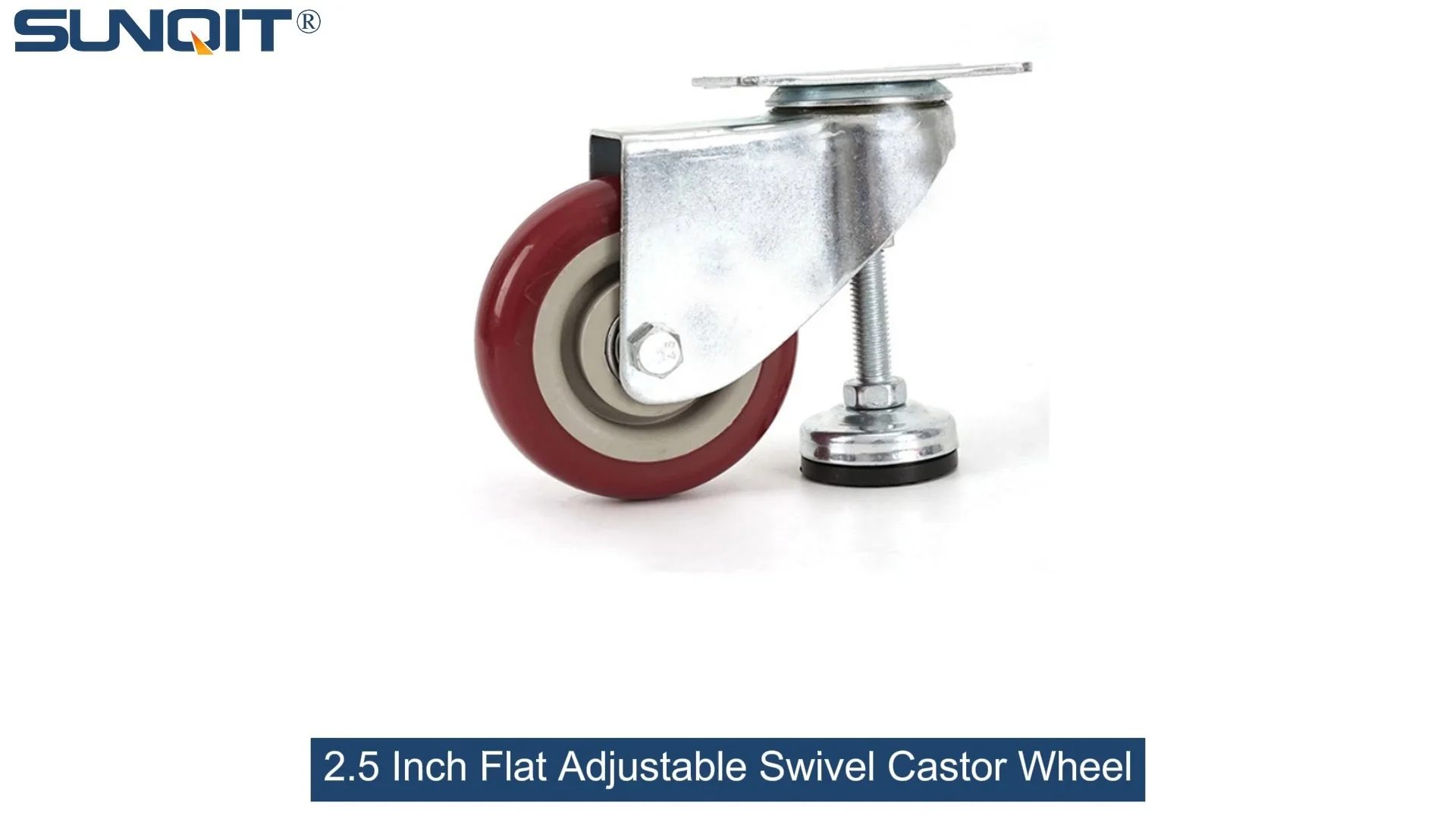
Flat Adjustable Swivel Castor Wheel
Swivel Chair Casters Ball Bearing Wheels Rubber Base with adjustable height function. Resistant to abrasion, impact and corrosion. Heavy payload can hold 80Kgs per pcs,which can make it works at a stable and smooth status.
Walk into any manufacturing plant, warehouse, or distribution center, and you'll notice a quiet but relentless rhythm: materials moving. Pallets glide across floors, components slide onto assembly lines, and tools shift from station to station. Behind this seamless flow are unsung heroes—small, often overlooked components that keep operations running smoothly. Two such workhorses are flat adjustable swivel castor wheels and ball transfer units . While they might seem similar at first glance—both help move things—their designs, strengths, and ideal uses couldn't be more different. Choosing between them isn't just about "what moves stuff"; it's about matching the tool to the task, ensuring efficiency, safety, and long-term cost-effectiveness. Let's dive into their world, unpack their differences, and figure out which one deserves a spot in your workflow.
What Are Flat Adjustable Swivel Castor Wheels?
If you've ever pushed a shopping cart, rolled a tool chest, or maneuvered a storage trolley, you're already familiar with castor wheels. But flat adjustable swivel castor wheels are a step up—engineered for precision, adaptability, and heavy-duty use. Let's break down their anatomy and how they work.
Design: More Than Just a Wheel
At their core, these castors have three key parts: the wheel, the swivel mechanism, and the adjustable height base. The wheel itself comes in various materials—rubber for quiet operation, polyurethane for durability, or steel for heavy loads—each tailored to different floor types (smooth concrete, uneven asphalt, or sensitive warehouse floors). The swivel mechanism, usually a ball bearing raceway, lets the wheel rotate 360 degrees, making tight turns and precise positioning possible. Then there's the "adjustable" part: a threaded stem or lever that raises or lowers the castor, allowing users to level equipment on uneven surfaces or align heights with workbenches, conveyors, or racks.
Add in caster accessories like brake levers (to lock the wheel in place), swivel locks (to fix direction for straight-line movement), or shock-absorbing springs, and you've got a versatile tool that adapts to almost any task. Imagine a maintenance cart in a factory: its flat adjustable swivel castor wheels let it glide around machinery, adjust to match the height of a workbench when repairs are needed, and lock securely to prevent rolling while tools are in use. That's adaptability in action.
How They Work: Maneuverability Meets Stability
The magic of these castors lies in balance. The swivel mechanism makes them highly maneuverable—perfect for tight spaces like assembly lines or crowded warehouses. But when the job calls for stability, the adjustable height feature shines. Uneven floors? Crank the adjustment lever to raise one castor slightly, leveling the trolley and preventing wobbling. Need to load materials onto a raised conveyor? Lower the castors to bridge the gap, reducing the risk of back strain from lifting. It's this combination of movement and stability that makes them a favorite in settings where tasks change by the hour.
What Are Ball Transfer Units?
Now, picture a tabletop covered in tiny, free-spinning balls. That's the essence of a ball transfer unit (BTU). These units are all about omnidirectional movement—allowing loads to glide, rotate, and change direction with minimal effort. Let's explore their design and functionality.
Design: A Sea of Swivel Roller Balls
A typical BTU is a compact housing (usually metal or plastic) containing a cluster of small swivel roller balls —often 0.5 inch or 1 inch in diameter—arranged in a circle or grid. The balls are recessed slightly into the housing, so only their tops protrude. When a load is placed on the unit, the weight distributes across the balls, and each ball spins independently, letting the load move in any direction: forward, backward, left, right, or even diagonally. Some units have a larger central ball for added load capacity, while others use all identical balls for uniform movement.
These units are rarely used alone; they're usually installed in arrays. A conveyor section might have dozens of BTUs embedded in its surface, creating a "floating" platform where boxes, panels, or components seem to glide on air. Think of a packaging station: a worker places a box on a BTU-equipped table, spins it to align labels, and pushes it gently onto a nearby conveyor—all without lifting or straining. That's the BTU advantage: effortless, multidirectional movement.
How They Work: Low Friction, High Precision
Unlike castors, which move the entire object by rolling, BTUs let the load "float" over the surface. The secret is low friction: each swivel roller ball spins with minimal resistance, so even heavy loads (up to several hundred pounds per unit) require little force to move. This makes them ideal for tasks where precision is key—like positioning delicate electronics on an assembly line or aligning parts for welding. Since there's no swivel mechanism or wheel axle, there's also less wear and tear, though the balls themselves can get jammed if debris (like dust, grit, or small parts) gets trapped in the housing.

Head-to-Head: Design & Mechanics
To really understand the difference, let's put these two side by side. Here's how they stack up in design, movement, and functionality:
| Feature | Flat Adjustable Swivel Castor Wheels | Ball Transfer Units |
|---|---|---|
| Core Design | Single wheel with swivel mechanism and adjustable height base | Array of small swivel roller balls in a fixed housing |
| Movement Type | Directional (forward/backward) with 360° swivel for turns | Omnidirectional (any direction) with no fixed path |
| Adjustability | Height-adjustable (levels on uneven surfaces, aligns with workstations) | Fixed height (no adjustment; requires level mounting surface) |
| Load Distribution | Concentrated on the wheel (needs sturdy, even contact with floor) | Distributed across multiple balls (spreads weight over a larger area) |
| Surface Interaction | Rolls on the floor; depends on wheel material for grip/traction | Load glides over balls; minimal contact with underlying surface |
The table tells a clear story: castors are about mobility and adaptability, while BTUs are about precision and omnidirectional movement. But how does this play out in real-world scenarios?

Applications: Where Each Shines
The best way to understand their strengths is to see them in action. Let's walk through common work environments and see which tool takes the lead.
Flat Adjustable Swivel Castor Wheels: The Go-To for Mobility
These castors thrive when you need to move entire objects —trolleys, racks, workbenches, or machinery—across varying surfaces. Here are their sweet spots:
- Heavy-Duty Trolleys: Imagine a warehouse trolley loaded with 500-pound pallets. Its flat adjustable swivel castor wheels (with steel or polyurethane wheels) handle the weight, swivel to navigate narrow aisles, and adjust to keep the load level on cracked concrete floors.
- Mobile Workstations: In a auto repair shop, a tool cart needs to roll to the car, adjust to the mechanic's height, and lock in place. Castors with brakes and height adjustment make this possible.
- Outdoor or Rough Surfaces: Unlike BTUs (which need smooth, clean surfaces), these castors work on gravel, asphalt, or uneven concrete—thanks to their rugged wheels and adjustable bases.
Ball Transfer Units: The Star of Precision Movement
BTUs excel when you need to move loads on a fixed surface —sliding, rotating, or repositioning with minimal effort. Their ideal uses include:
- Assembly Lines: A smartphone assembly line uses BTU-equipped tables to slide circuit boards between stations. Workers can rotate the board 180° to solder components on both sides, all without lifting.
- Packaging Stations: At a fulfillment center, boxes glide across a BTU table, allowing workers to spin them for labeling, stack them neatly, or push them onto a conveyor—no heavy lifting required.
- Material Transfer Tables: In a woodworking shop, large plywood sheets need to move from the saw to the sander. BTUs let one person reposition the sheet with a gentle push, even though it weighs 100 pounds.
The key takeaway? If you're moving the container (trolley, cart), go with castors. If you're moving the content (boxes, parts, sheets) on a fixed surface, BTUs are your friend.

Pros & Cons: The Fine Print
No tool is perfect. Let's weigh the upsides and downsides of each to avoid costly mistakes.
Flat Adjustable Swivel Castor Wheels: The Good and the Gritty
Pros:
- Maneuverable: 360° swivel makes tight turns easy—critical in crowded spaces.
- Adjustable: Level uneven loads, align heights with workstations, or adapt to sloped floors.
- Durable: Thick wheels and sturdy swivel mechanisms handle heavy loads (up to 1,000+ pounds per castor).
- Versatile Surfaces: Work on concrete, asphalt, tile, or carpet (with the right wheel material).
Cons:
- Limited Directionality: While they swivel, moving sideways or diagonally requires "walking" the trolley in a zigzag—cumbersome for large objects.
- Floor Wear: Hard wheels (like steel) can scratch sensitive floors; soft wheels (like rubber) pick up debris.
- Maintenance: Swivel mechanisms and bearings need regular lubrication to prevent squeaking or jamming.
Ball Transfer Units: Smooth Moves, But With Caveats
Pros:
- Omnidirectional: Loads move in any direction with a light push—no more struggling to rotate heavy objects.
- Low Effort: Minimal force required; reduces worker fatigue and injury risk.
- Compact: Small profile fits into tables, conveyors, or work surfaces without adding bulk.
- Quiet: No squeaky wheels—just the soft hum of rolling balls.
Cons:
- Smooth Surface Required: Debris (dust, screws, or gravel) jams the swivel roller balls, halting movement.
- Fixed Height: Can't adjust for uneven surfaces—installing them on a warped table makes movement choppy.
- Lower Load Capacity: Each unit handles 50–200 pounds; you need multiple units for heavy loads, increasing cost.
- Delicate Loads: Small or irregularly shaped items (like bolts or tools) can get stuck between balls.
How to Choose: 5 Key Questions
Still on the fence? Ask yourself these questions to narrow it down:
1. What Are You Moving?
If it's a mobile object (trolley, cart, workbench), go with flat adjustable swivel castor wheels. If it's a load on a fixed surface (box, panel, part), ball transfer units are better.
2. How Heavy Is the Load?
For loads over 500 pounds, castors (with heavy-duty wheels) are more reliable—they distribute weight on a single, sturdy wheel. BTUs work for lighter loads (under 300 pounds per unit) but require multiple units for heavier items, which can get expensive.
3. What's the Floor Like?
Rough, uneven, or outdoor surfaces? Castors with adjustable heights and rugged wheels win. Smooth, indoor, debris-free surfaces? BTUs shine here.
4. Do You Need Directional Flexibility?
If you need to spin, rotate, or move in all directions (like a packaging table), BTUs are a must. If you mostly move forward/backward with occasional turns (like a warehouse trolley), castors suffice.
5. What's Your Maintenance Budget?
Castors need regular lubrication and wheel checks (for wear or debris). BTUs need frequent cleaning (to keep swivel roller balls unjammed) but have fewer moving parts. If you're short on maintenance staff, castors might be easier to manage.
Real-World Example: A Day in the Life
Let's wrap up with a scenario that brings it all together. Meet Maria, a production manager at a small electronics factory. Her team assembles circuit boards, and she's upgrading their workflow. Here's how she chooses between the two:
Morning Shift: Raw components (resistors, capacitors) arrive in bulk on pallets. Maria needs to move these pallets from the loading dock to storage racks. For this, she picks trolleys with flat adjustable swivel castor wheels —they handle heavy pallets, swivel through narrow warehouse aisles, and adjust to the dock's uneven concrete.
Afternoon Shift: On the assembly line, workers need to slide circuit boards between stations. The boards are light (5–10 pounds) but need precise rotation to solder components on both sides. Maria installs a table with swivel roller balls (0.5 inch) embedded in the surface—workers glide, spin, and position the boards effortlessly, cutting assembly time by 20%.
By matching the tool to the task, Maria boosts efficiency without overspending—proof that the right choice isn't about "either/or" but "both, when needed."
Conclusion: The Right Tool for the Job
Flat adjustable swivel castor wheels and ball transfer units are both champions of movement, but they dance to different tunes. Castors are the workhorses—tough, adaptable, and ready to roll anywhere. Ball transfer units are the ballerinas—graceful, precise, and perfect for smooth, multidirectional moves. The next time you're setting up a workflow, don't just ask "what moves?" Ask "how, where, and how much?" The answer will point you to the right partner.
And remember: sometimes, they work best together. A trolley with castors to move materials to the line, and a BTU table to position them once they're there. In the end, it's not about choosing one over the other—it's about building a workflow that makes every move count.