- Company Articles
- Products and Technology
- Product knowledge
- Flat Adjustable Swivel Castor Wheels vs. Locking Castors: When to Choose Which?

Flat Adjustable Swivel Castor Wheels vs. Locking Castors: When to Choose Which?
Related Product
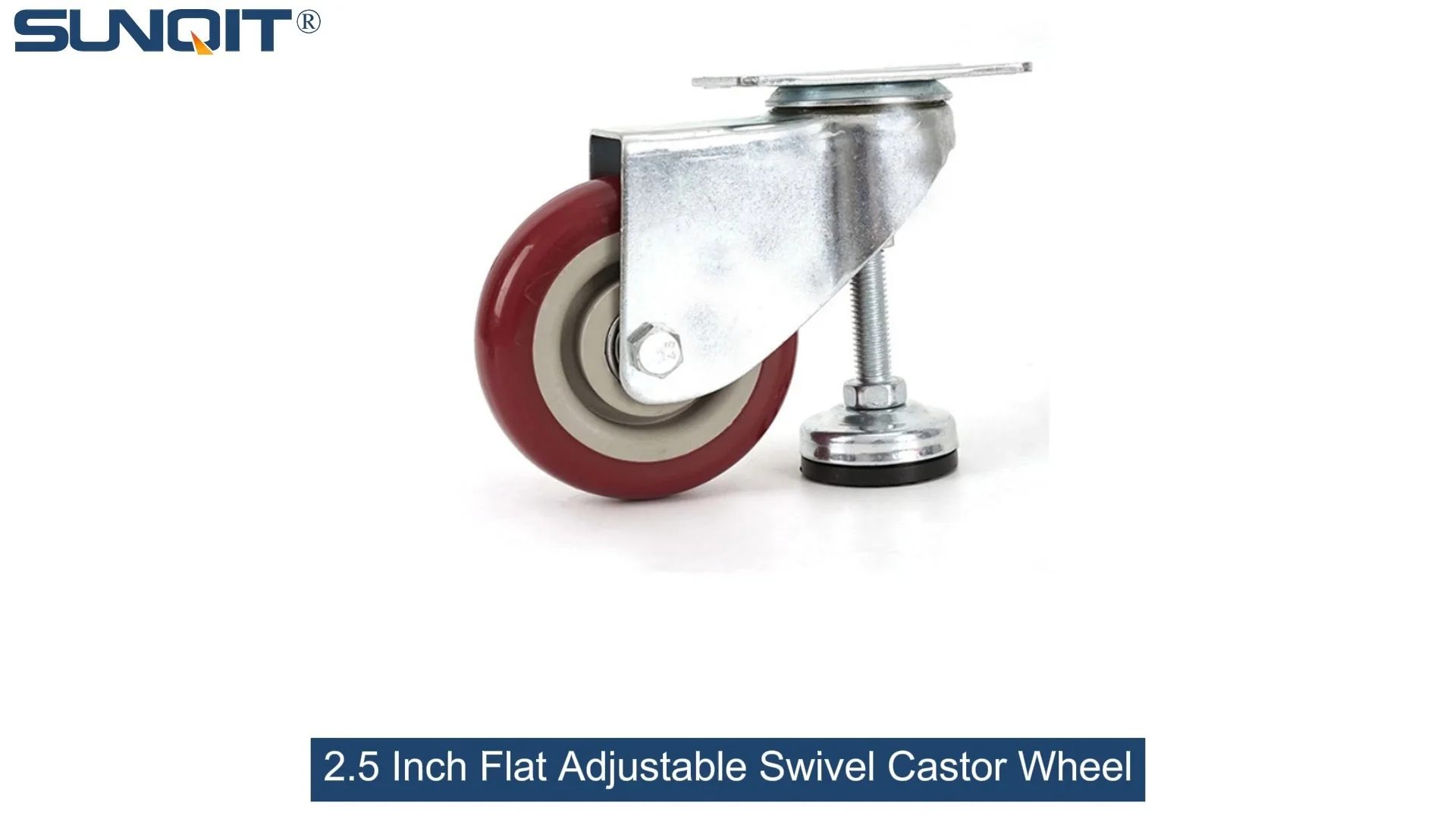
Flat Adjustable Swivel Castor Wheel
Swivel Chair Casters Ball Bearing Wheels Rubber Base with adjustable height function. Resistant to abrasion, impact and corrosion. Heavy payload can hold 80Kgs per pcs,which can make it works at a stable and smooth status.
Walk into any busy workshop, warehouse, or even a home garage, and you'll likely spot them: those small, unassuming components that quietly keep things moving (or standing still). We're talking about castor wheels—the unsung heroes of mobility and stability in workspaces. Whether it's a heavy workbench that needs repositioning, a material trolley gliding through a factory floor, or a medical cart that must stay locked during procedures, the right caster wheel can make or break efficiency, safety, and even productivity. But with so many options out there, how do you decide between two of the most popular types: flat adjustable swivel castor wheels and locking castors? Let's dive in.
In this article, we'll break down what makes each type unique, their key benefits, and the scenarios where one outshines the other. By the end, you'll have a clear roadmap to choosing the perfect castor for your needs—no technical jargon, just practical insights for anyone who wants their workspace to work for them, not against them.
First Things First: What Are Flat Adjustable Swivel Castor Wheels?
Let's start with the flat adjustable swivel castor wheel. If you've ever struggled with a wobbly workbench or a trolley that tilts on uneven floors, this might be the solution you didn't know you needed. These castors are designed with two standout features: adjustability and smooth, 360-degree movement.
Design Breakdown: More Than Just a Wheel
At first glance, a flat adjustable swivel castor wheel looks similar to a standard plate-mount castor, but there's a clever twist. Instead of a fixed height, it has a built-in adjustment mechanism—usually a threaded stem or a screw-based system— that lets you tweak the height of the wheel by a few centimeters. This might not sound like much, but on a workshop floor with cracks, bumps, or even a slight slope, those centimeters make all the difference.
The "flat" part refers to the mounting plate: a sturdy, flat metal plate that attaches directly to the bottom of your equipment (think workbenches, tool cabinets, or heavy shelving units). The "swivel" part is where the mobility comes in: the wheel mount rotates 360 degrees, so you can maneuver tight corners or pivot smoothly without having to lift or drag the entire load. Most models use double-ball bearings here to ensure the swivel action stays smooth, even under heavy weights.
Materials matter too. The wheels themselves are often made of rubber, polyurethane, or nylon. Rubber wheels are great for indoor use, as they're quiet and gentle on floors (no scuff marks on concrete or tile). Polyurethane, on the other hand, is a workhorse—durable, resistant to oils and chemicals, and ideal for both indoor and outdoor use. Nylon wheels are lightweight and affordable, though they can be noisier on hard surfaces.
The Real Benefit: Adaptability
So why choose an adjustable castor over a fixed one? Let's say you run a small electronics assembly line. Your workbench needs to stay level to ensure precise soldering and component placement, but your workshop floor has a tiny dip near the window (thanks to years of foot traffic). A standard castor would leave the bench wobbling, making delicate work frustrating. With a flat adjustable swivel castor wheel, you'd simply twist the adjustment screw on the problematic wheel until the bench sits perfectly level. Problem solved.
Another scenario: loading docks. Floors here are often rough, with gaps between concrete slabs. A trolley fitted with adjustable castors can glide over these imperfections without jostling the contents—critical if you're transporting fragile parts or finished products. And because they swivel, you can easily navigate around pallet jacks or stacks of inventory without breaking a sweat.
Load capacity is another plus. Most flat adjustable models can handle anywhere from 50kg to 300kg per wheel, depending on size and materials. That means they're not just for light-duty tasks—they can hold their own with heavy machinery, too.
Now, Let's Talk About Locking Castors: When Stability Trumps Mobility
If flat adjustable castors are all about adaptability and movement, locking castors are the opposite side of the coin: they're designed to stop movement when you need them to. And when we say "locking," we're often referring to models like the swivel stem caster wheel with brake —a popular type that combines swivel mobility with a built-in brake mechanism.
Design Breakdown: The Brake Makes the Difference
Locking castors come in two main mounting styles: stem and plate. Stem-mounted castors have a metal rod (the stem) that inserts into a hole or socket on the equipment, while plate-mounted ones use a flat plate (like the adjustable castors we discussed). The "swivel stem caster wheel with brake" typically uses a stem mount, making it easy to install on lightweight to medium-duty equipment like trolleys, medical carts, or small workbenches.
The star feature, of course, is the brake. There are a few common brake types:
- Side-lock brakes: A lever on the side of the castor that, when flipped down, presses a pad against the wheel to stop rotation. Simple, affordable, and great for light loads.
- Total-lock brakes: These lock both the wheel and the swivel motion. Flip the lever, and the castor becomes completely fixed—no rolling, no turning. Perfect for when you need maximum stability.
- Foot-operated brakes: A pedal you step on to engage the brake, your hands for other tasks (think hospital beds or food service carts).
Like adjustable castors, locking castors come in various wheel materials: rubber for quiet operation, polyurethane for durability, and even steel for heavy industrial use. The brake mechanism itself is usually made of metal (often zinc-plated for rust resistance) to withstand frequent use.
The Real Benefit: Control When It Counts
Imagine this: you're in a warehouse, loading a trolley with boxes of inventory. You wheel it to the storage rack, but just as you lean in to stack the boxes, the trolley starts rolling backward. Not only is this annoying, but it's also a safety hazard—you could strain your back or drop the boxes. With a swivel stem caster wheel with brake, you'd tap the brake lever with your foot, and the trolley stays put. No rolling, no stress, just secure loading.
Locking castors are also non-negotiable in environments where safety is critical. Take a laboratory, for example: a cart holding chemicals or delicate glassware can't afford to move accidentally. Engaging the brakes ensures the cart stays exactly where you left it, even if someone bumps into it. In manufacturing, assembly lines often use locking castors on workstations to keep them aligned—if a station shifts, the entire production flow gets disrupted. Brakes prevent that.
Another scenario: home garages. If you have a tool chest on castors, you want it to roll easily when you're rearranging, but stay locked when you're yanking out a heavy wrench. A quick flip of the brake lever, and it's solid as a rock.

Flat Adjustable vs. Locking Castors: A Side-by-Side Comparison
To make it easier to see which castor fits your needs, let's put them head-to-head in a table. We'll compare key features, benefits, and ideal use cases:
| Feature | Flat Adjustable Swivel Castor Wheels | Locking Castors (e.g., Swivel Stem with Brake) |
|---|---|---|
| Mounting Type | Flat plate (attaches with screws to equipment base) | Stem (inserts into socket) or plate |
| Adjustability | Height-adjustable (via screw mechanism) to level equipment on uneven floors | No height adjustment, but brake locks wheel/swivel motion |
| Movement | 360° swivel for easy maneuvering; smooth rolling on most surfaces | 360° swivel when unlocked; movement stops when brake is engaged |
| Best For Surfaces | Uneven floors, rough surfaces (garages, workshops, loading docks) | Smooth, flat surfaces (warehouses, labs, offices) where stability is key |
| Key Benefit | Adaptability to terrain; keeps equipment level and mobile | Safety and stability; prevents accidental movement |
| Typical Applications | Workbenches, heavy machinery, trolleys on rough floors | Medical carts, assembly line stations, tool chests, loading trolleys |
| Load Capacity | 50kg–300kg per wheel (varies by size/material) | 30kg–200kg per wheel (varies by size/material) |

When to Choose Flat Adjustable Swivel Castor Wheels
Now that we've covered the basics, let's zero in on the scenarios where flat adjustable swivel castor wheels are the clear winner:
1. Your Floors Are Less Than Perfect
If your workspace has uneven floors—think old concrete with cracks, sloped garage floors, or outdoor areas with gravel—adjustable castors are a must. They'll keep your equipment level, preventing wobbling and making tasks like cutting, assembling, or writing (yes, even office furniture!) much easier.
2. You Need to Reposition Equipment Frequently
Workshops and studios often need to rearrange layouts based on projects. A workbench with flat adjustable swivel castors can be rolled into a new spot, then adjusted to level on the new floor—no need for shims or wedges. It's like having a portable, customizable workspace.
3. Precision Matters
In fields like electronics assembly, woodworking, or lab research, even a slight tilt can ruin precision work. Adjustable castors ensure your tools, tables, or instruments stay perfectly horizontal, so you can focus on the task, not the wobble.
4. You're Dealing With Heavy Loads
With higher load capacities (up to 300kg per wheel), these castors are built for heavy-duty work. Whether you're moving a metalworking lathe or a stack of steel sheets, they'll handle the weight without compromising movement.

When to Choose Locking Castors (Like the Swivel Stem Caster Wheel with Brake)
On the flip side, here are the situations where locking castors shine brightest:
1. Safety Is Non-Negotiable
If there's a risk of equipment rolling away—say, in a busy warehouse with forklifts or a hospital corridor with foot traffic—locking castors are essential. The brake adds a layer of protection, preventing accidents and injuries.
2. You Need Stability During Use
Ever tried using a standing desk that rolls when you lean on it? Frustrating, right? Locking castors solve that. When you engage the brake, the desk (or workbench, or cart) stays put, even under pressure. This is crucial for tasks that require force, like sawing, drilling, or packaging.
3. You're Working on Sloped Surfaces
Even a slight slope can cause a trolley to roll on its own. Locking castors act as a "parking brake," keeping equipment stationary until you're ready to move it. This is common in loading ramps or delivery areas.
4. You Want Control Over Movement
Sometimes you need mobility and stability in one. For example, a catering cart in a restaurant needs to roll smoothly between kitchen and dining room, then lock in place while serving. A swivel stem caster wheel with brake lets you switch between modes in seconds.
What About Caster Accessories? Don't Overlook the Extras
No matter which type of castor you choose, there's one more thing to consider: caster accessories . These small add-ons can extend the life of your castors, improve performance, or make installation easier. For example:
- Replacement wheels: Over time, wheels wear down. Having spare rubber or polyurethane wheels on hand means you can swap them out without replacing the entire castor.
- Brake pads: For locking castors, brake pads can wear thin with frequent use. Replacement pads are affordable and easy to install.
- Lubricants: Keeping swivel joints and wheel bearings lubricated ensures smooth movement and prevents rust.
- Mounting hardware: Extra screws, nuts, or stem adapters can save you a trip to the hardware store if you need to reinstall or adjust your castors.
Investing in caster accessories might seem like a small step, but it can save you time and money in the long run. After all, a castor is only as good as its parts—and keeping those parts in top shape ensures your workspace stays functional.
Final Thoughts: It's All About Your Needs
At the end of the day, choosing between flat adjustable swivel castor wheels and locking castors (like the swivel stem caster wheel with brake) comes down to one question: What do you need your equipment to do? If you need adaptability, smooth movement, and the ability to level on uneven floors, go with adjustable. If stability, safety, and control are your top priorities, locking castors are the way to go.
And remember: there's no rule that says you can't mix and match. Many workbenches, for example, use two adjustable castors and two locking castors—giving you mobility, adjustability, and stability all in one. It's about finding the balance that works for your unique space.
So next time you're shopping for castors, don't just grab the first pair you see. Think about your floors, your tasks, and what matters most: movement, stability, or a little bit of both. Your back (and your productivity) will thank you.