- Company Articles
- Products and Technology
- Product knowledge
- Flat Adjustable Swivel Castor Wheels: Weight Distribution & Stability Testing

Flat Adjustable Swivel Castor Wheels: Weight Distribution & Stability Testing
Related Product
Flat Adjustable Swivel Castor Wheel
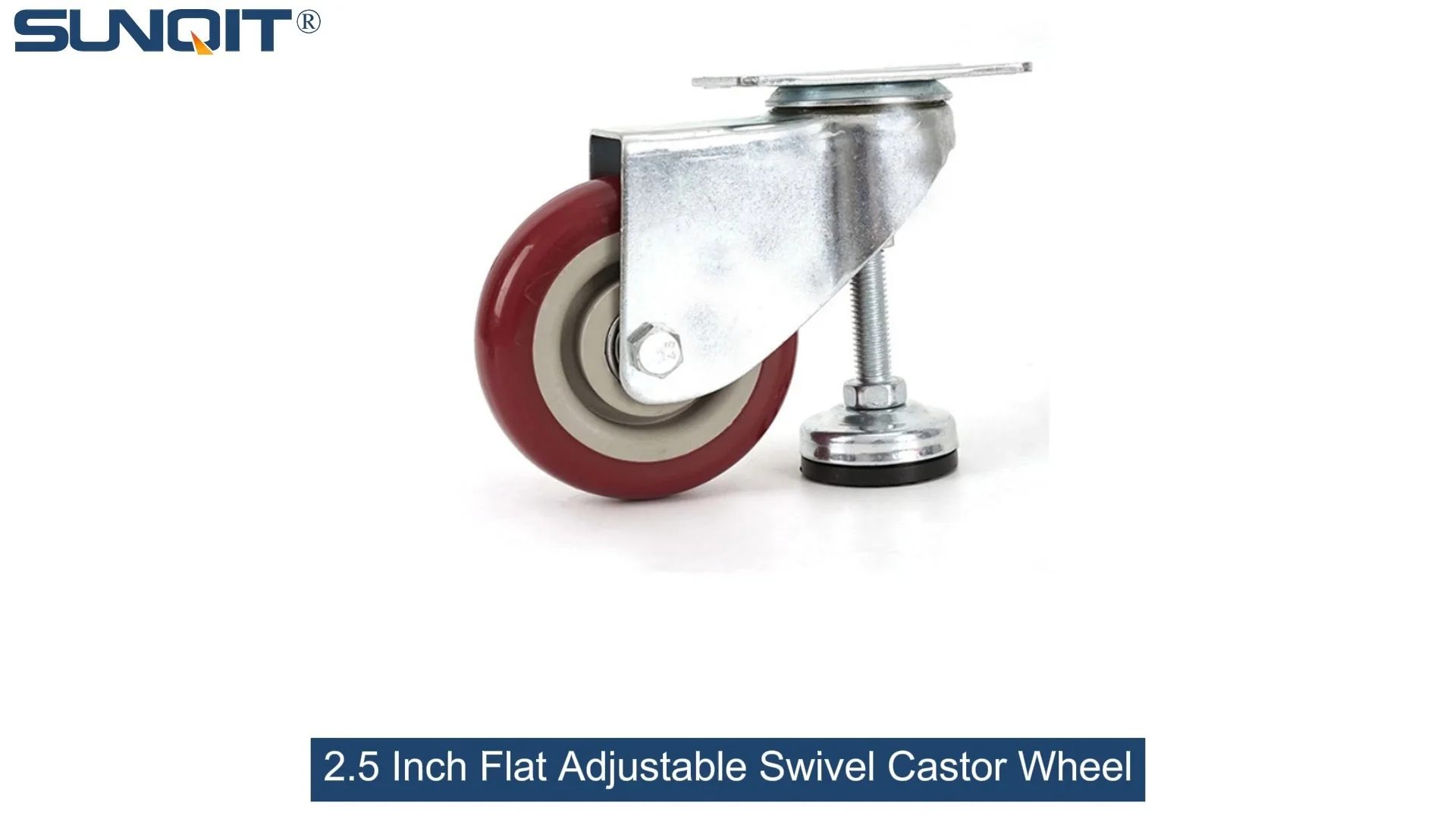
Swivel Chair Casters Ball Bearing Wheels Rubber Base with adjustable height function. Resistant to abrasion, impact and corrosion. Heavy payload can hold 80Kgs per pcs,which can make it works at a stable and smooth status.
Picture this: It's a busy Tuesday morning in a manufacturing plant. Maria, a line operator, is wheeling a loaded turnover trolley stacked with circuit boards toward the assembly station. Halfway there, the trolley suddenly lurches to the left, spilling its contents. She grits her teeth, adjusts her grip, and mutters, "Not again." Sound familiar? For anyone who works with material handling equipment—whether in warehouses, workshops, or factories—unstable castor wheels are more than just a nuisance; they're a daily obstacle to efficiency, safety, and peace of mind. That's where flat adjustable swivel castor wheels come in. These unassuming but critical components are quietly revolutionizing how we move, support, and stabilize equipment. In this article, we'll dive into what makes these castors unique, why weight distribution is make-or-break for their performance, how stability is rigorously tested, and why they've become a go-to solution for businesses aiming to smooth out their operations.
What Are Flat Adjustable Swivel Castor Wheels?
Let's start with the basics. Castor wheels, or "caster wheels" as they're often called, are the unsung heroes of material handling. They attach to the bottom of carts, workbenches, racks, and trolleys, allowing them to roll smoothly across floors. But not all castors are created equal. Flat adjustable swivel castor wheels stand out for two key features: their "flat" mounting plate (which sits flush against the equipment base for stability) and their "adjustable" design (which lets users tweak height, swivel tension, or wheel alignment to suit specific needs).
At first glance, you might mistake them for standard swivel castors, but a closer look reveals their clever engineering. The flat mounting plate distributes weight evenly across the base of the equipment, reducing stress on individual bolts or welds. Meanwhile, the adjustability mechanism—often a threaded stem or a set screw—lets operators fine-tune the castor's height by a few millimeters. This might not sound like much, but in a workshop where a workbench needs to align perfectly with a conveyor, or a trolley must sit level on uneven concrete, those millimeters make all the difference.
These castors also come with a range of caster accessories to boost functionality: brakes to lock wheels in place, different wheel materials (rubber for quiet operation, polyurethane for durability), and even swivel locks to prevent unwanted rotation. Think of them as a customizable toolkit for stability—designed to adapt to the chaos of real-world work environments.
The Critical Role of Weight Distribution
If there's one golden rule in castor design, it's this: weight distribution is everything. Imagine stacking a tower of books on a flimsy table with one short leg. Sooner or later, the table will wobble, and the books will topple. The same principle applies to equipment on castors. When weight isn't spread evenly across all four (or more) castors, the loads on one or two wheels, causing stress, uneven wear, and instability.
Poor weight distribution doesn't just lead to wobbly trolleys. Over time, it can bend frames, crack mounting plates, or even snap axles—costing businesses in repairs, downtime, and replacement parts. Worse, it creates safety hazards: a top-heavy cart with unevenly distributed weight is far more likely to tip over, putting workers at risk of injury. In warehouses where loads can weigh hundreds of kilograms, this isn't a minor concern.
Flat adjustable swivel castor wheels tackle this problem head-on. Their flat mounting plates ensure that the equipment's base makes full contact with the castor, spreading weight across a larger surface area. The adjustable height feature then lets operators level the equipment, even if the floor is uneven. For example, if a workshop floor has a slight slope, you can raise the castors on the lower side to keep the workbench perfectly horizontal. This not only stabilizes the equipment but also prevents items from sliding off—whether it's a batch of delicate electronics on a workbench or heavy tooling on a turnover trolley and rack.

Stability Testing: Putting Castors Through Their Paces
You wouldn't buy a car without test-driving it, right? The same logic applies to flat adjustable swivel castor wheels. To ensure they live up to their promise of stability, manufacturers subject them to rigorous testing. Let's pull back the curtain on what these tests entail and why they matter.
First, there's static load testing. This is the "sit and hold" test: the castor is mounted to a test rig, loaded with a specified weight (say, 500kg), and left untouched for hours or even days. The goal? To check if the castor deforms, cracks, or loses adjustability under constant pressure. If a castor bends or the height adjustment slips during this test, it's a red flag—under real-world conditions, that could mean a sudden collapse mid-operation.
Then there's dynamic load testing, which mimics real-world movement. The castor is attached to a trolley, loaded to capacity, and rolled back and forth across different surfaces (concrete, tile, even rough asphalt) for thousands of cycles. Testers measure swivel resistance (how easily the wheel turns), rolling friction (how much force is needed to push the trolley), and wear on the wheel and bearings. A good flat adjustable swivel castor should maintain smooth movement even after miles of rolling—no squeaking, no sticking, and no uneven wear.
Perhaps most importantly, there's stability testing itself. This involves tilting the equipment at increasing angles to see when it tips over. For example, a castor rated for use on a workbench might need to withstand a 15-degree tilt without toppling when loaded to 200kg. Testers also check swivel lock effectiveness: if the lock is engaged, the castor shouldn't rotate, even when pushed or pulled. This is crucial for safety—imagine a trolley rolling away because the swivel lock failed!
| Test Type | What It Measures | Pass/Fail Criteria |
|---|---|---|
| Static Load Test | Ability to support weight without deformation | No cracks, bending, or height adjustment slippage after 72 hours at max load |
| Dynamic Load Test | Durability during movement | Smooth rolling and swivel action after 10,000 cycles; <5% wear on wheel tread |
| Stability Tilt Test | Resistance to tipping | No tipping at angles up to 15 degrees (loaded to max capacity) |
| Swivel Lock Test | Effectiveness of swivel lock mechanism | Lock holds under 500N of lateral force; no unintended rotation |
These tests aren't just box-ticking exercises. They ensure that when you install flat adjustable swivel castor wheels on a workbench or a turnover trolley, you're not gambling with safety or efficiency. Reputable suppliers will even share test reports with customers, so you can see exactly how their castors perform under pressure.

Factors That Affect Performance: It's Not Just About the Castor
Even the best flat adjustable swivel castor wheels can underperform if they're not paired with the right setup. Let's break down the key factors that influence how well these castors distribute weight and maintain stability.
First, wheel material. Rubber wheels are great for smooth floors and quiet operation, but they can wear quickly on rough concrete. Polyurethane wheels, on the other hand, are tough and resistant to abrasion—ideal for warehouses. Then there's the wheel diameter: larger wheels roll more easily over cracks or debris, reducing the risk of the trolley getting stuck (and destabilizing the load). For example, a 5-inch wheel will handle a bumpy floor better than a 3-inch one, even if both are part of a flat adjustable design.
Floor type matters too. A castor that works flawlessly on polished factory floors might struggle on gravel or outdoor surfaces. That's why some manufacturers offer tread patterns tailored to specific environments—think deep grooves for wet floors or soft rubber for hardwood to prevent scratches. It's also why adjustability is so valuable: if the floor slopes, you can tweak the castor height to compensate, even if the wheel material is fixed.
Maintenance is another hidden factor. Like any moving part, castors need love: regular lubrication of swivel joints, checking for loose bolts, and replacing worn wheels or brakes. Caster accessories like lubricating oil or replacement brake pads might seem trivial, but they're essential for keeping castors performing at their best. A well-maintained castor will distribute weight evenly for years, while a neglected one might start to seize or wobble—undoing all the benefits of its design.

Practical Applications: Where These Castors Shine
So, where do flat adjustable swivel castor wheels make the biggest difference? The answer is: just about anywhere equipment needs to be mobile, stable, and adaptable. Let's look at a few real-world scenarios.
Take the humble workbench. In a workshop, a workbench is the command center—where tools are laid out, parts are assembled, and precision matters. A wobbly workbench isn't just annoying; it can ruin a delicate soldering job or cause a measuring error. Enter the Workbench E (single deck, without caster) retrofitted with flat adjustable swivel castors. Suddenly, the workbench can be moved to wherever it's needed—next to a conveyor for assembly, or near a window for better light—then locked in place with brakes. The adjustable height ensures the surface stays level, even if the floor is uneven, so tools and parts stay put. It's a small change that turns a static workbench into a flexible, stable workstation.
Then there are turnover trolleys and racks—those workhorses of warehouses and distribution centers. Loaded with boxes, pallets, or raw materials, these trolleys need to be easy to push but rock-solid when stopped. Flat adjustable swivel castors make them both mobile and stable: the swivel function lets operators maneuver tight corners, while the adjustability ensures the trolley sits level when loading or unloading. No more struggling to keep the trolley from rolling away mid-load, or worrying about it tipping over when stacked high with goods.
Material racks are another key application. A material rack B (3 row and 3 floor) filled with heavy components needs to distribute its weight evenly to avoid collapsing. By mounting it on flat adjustable castors, warehouse managers can level the rack, even if the concrete floor has settled over time. This not only protects the rack from damage but also makes it easier to access items on all shelves—no more stretching or straining to reach the back row because the rack is tilted.
Case Study: How One Warehouse Solved Its Stability Woes
Let's wrap up with a story about a mid-sized electronics warehouse that was struggling with instability. The warehouse used a fleet of turnover trolleys to move circuit boards between assembly lines. The problem? The standard fixed castors on the trolleys couldn't handle the uneven concrete floor, leading to wobbly rides and frequent near-misses with spills. Workers were spending extra time maneuvering the trolleys, and the warehouse manager was worried about damaged inventory (not to mention worker safety).
After researching solutions, the manager decided to switch to flat adjustable swivel castor wheels. The results were dramatic: within a week, trolley accidents dropped by 80%. Workers reported that the trolleys felt "solid" and "predictable," even when loaded to capacity. The adjustability feature let them level the trolleys on the uneven floor, so circuit boards stayed put during transport. Best of all, the time saved from fewer spills and easier maneuvering translated to a 15% increase in daily throughput. As the warehouse manager put it: "We didn't realize how much time we were wasting fighting with unstable trolleys until we switched. These castors paid for themselves in a month."
Conclusion: Stability as a Foundation for Success
Flat adjustable swivel castor wheels might not grab headlines, but they're the kind of innovation that makes daily work easier, safer, and more efficient. By prioritizing weight distribution and stability, they turn frustrating, wobbly equipment into reliable tools that workers can trust. Whether it's a workbench in a small workshop or a fleet of turnover trolleys in a busy warehouse, these castors prove that sometimes, the smallest components have the biggest impact.
So, the next time you're pushing a trolley, adjusting a workbench, or setting up a material rack, take a moment to look down at the castors. Are they just "good enough," or are they flat, adjustable, and tested for stability? Investing in quality castor wheels and caster accessories isn't just about avoiding spills or repairs—it's about building a foundation for productivity. After all, when your equipment moves smoothly and stays stable, your team can focus on what really matters: getting the job done right.