- Company Articles
- Products and Technology
- Application Cases
- Flat Rigid Castor Wheel Applications in Automotive Manufacturing Assembly Lines

Flat Rigid Castor Wheel Applications in Automotive Manufacturing Assembly Lines
Related Product
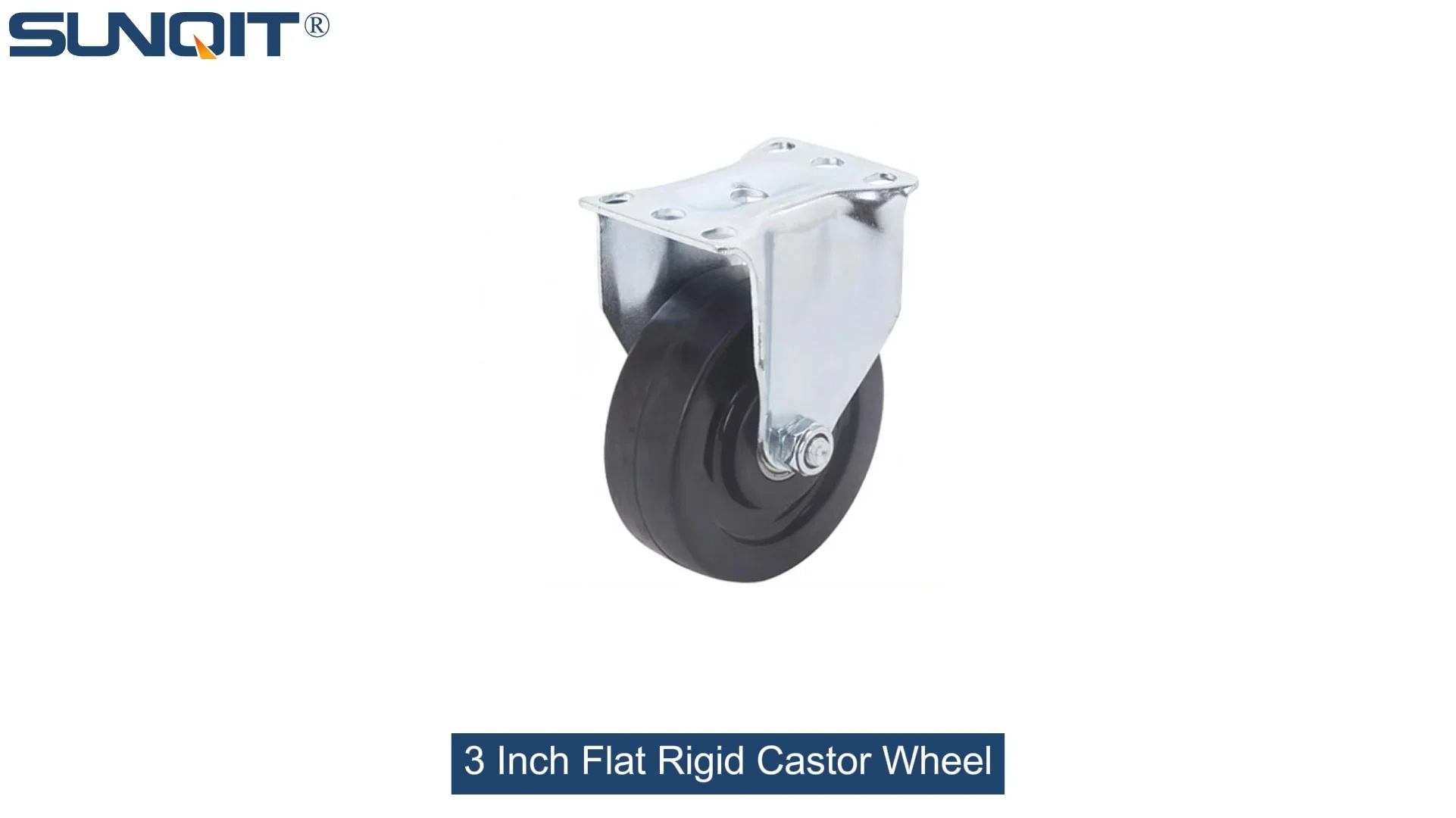
Flat Rigid Castor Wheel
Chair Casters Ball Bearing Wheels Rubber Base. Resistant to abrasion, impact and corrosion. Heavy payload can hold 70Kgs per pcs,which can make it works at a stable and smooth status.
Walk into any automotive manufacturing plant, and you'll be met with a symphony of precision: robots welding frames, workers assembling dashboards, and conveyor belts carrying half-built cars toward the finish line. But behind this orchestration of machinery and manpower lies a quieter, equally critical component: the tools that move parts, tools, and workstations where they need to be, exactly when they need to be there. Among these unsung heroes are flat rigid castor wheels—simple in design, but indispensable in keeping the wheels of production turning (pun intended).
In an industry where every second counts and even the smallest inefficiency can cost thousands of dollars, the choice of castor wheels isn't arbitrary. Flat rigid castor wheels, with their fixed direction and unyielding stability, have become a staple in automotive assembly lines. They're the reason a heavy workbench stays put during delicate wiring work, why a trolley loaded with engine parts glides straight to its destination without veering off course, and how material racks maintain alignment in tight production spaces. Let's dive into why these unassuming components are so vital, and how they shape the future of automotive manufacturing.
What Are Flat Rigid Castor Wheels, Anyway?
Before we jump into their applications, let's get clear on what makes flat rigid castor wheels unique. Unlike swivel castors, which can rotate 360 degrees, rigid castors are fixed in direction—they only move forward or backward, like the wheels on a shopping cart that's been locked straight. The "flat" in their name refers to their mounting plate, which sits flush against the bottom of the equipment they're attached to, distributing weight evenly and reducing the risk of tipping.
Most flat rigid castor wheels are built with durability in mind. They typically feature a steel or aluminum frame, with wheels made from rubber, polyurethane, or cast iron—materials chosen for their ability to handle heavy loads (often up to 1,000 pounds or more per wheel) and resist wear from constant use on concrete or factory floors. Some even come with treaded surfaces to grip slick floors, ensuring stability even when carrying oily or greasy parts common in automotive settings.
But why would a manufacturer opt for fixed-direction wheels over swivel ones? Think about it: in an assembly line, predictability is key. When you're moving a 500-pound transmission from a storage rack to an assembly station, the last thing you want is for the trolley to suddenly swivel and crash into a nearby robot. Flat rigid castors eliminate that risk by keeping the equipment on a straight path, making them ideal for tasks where precision movement and stability matter most.
Why Automotive Plants Can't Live Without Them: The Core Benefits
Automotive manufacturing is a high-stakes game, and every tool in the plant needs to pull its weight. Flat rigid castor wheels do more than just "pull"—they deliver three critical benefits that make them irreplaceable:
1. Unmatched Stability for Heavy Loads
Car parts aren't light. A single engine block can weigh over 400 pounds, and a fully loaded trolley of body panels can tip the scales at 1,500 pounds or more. Swivel castors, while versatile, can wobble under heavy loads, increasing the risk of spills or damage. Flat rigid castors, with their fixed axles and wide mounting plates, distribute weight evenly across the wheelbase, keeping even the heaviest loads steady. This stability is especially crucial in automotive plants, where a dropped part could delay production or, worse, injure a worker.
2. Predictable Movement for Tight Workflows
Assembly lines are designed with millimeter precision. Workstations are spaced to allow workers to reach parts without stretching, and conveyor systems follow strict paths to keep cars moving at the right pace. Flat rigid castors thrive in this environment because they move only in the direction they're pointed. There's no guesswork: push a trolley with rigid castors forward, and it goes forward—no unexpected swivels, no veering into adjacent work areas. This predictability reduces the risk of collisions and ensures that parts arrive exactly where they need to be, when they need to be there.
3. Durability That Stands Up to Factory Conditions
Automotive plants are tough on equipment. Floors are often covered in oil, grease, or metal shavings; temperatures can fluctuate; and wheels are constantly rolling over uneven surfaces. Flat rigid castors are built to withstand this abuse. Many are made with sealed bearings to keep out debris, and their solid rubber or polyurethane wheels resist cracking or flattening under constant pressure. Unlike cheaper casters that might need replacement every few months, a quality flat rigid castor can last years in a busy plant—saving maintenance time and reducing downtime.

Where They Shine: Real-World Applications in Automotive Assembly Lines
Now that we understand why flat rigid castors are valued, let's look at how they're actually used on the factory floor. From workbenches to material racks, these wheels are everywhere—often in places you might not even notice.
Workbenches: The Heart of Manual Assembly
Walk through any assembly line, and you'll see workbenches stationed at every step—where workers bolt on wheels, install wiring harnesses, or attach door handles. These workbenches need to be sturdy enough to support tools and parts, but also mobile enough to reposition when the line is reconfigured (a common occurrence as automakers roll out new models).
Flat rigid castors are the perfect fit here. When a workbench is in use, the fixed-direction wheels keep it steady, so a worker can lean into a task without the bench shifting. When it's time to move the bench—say, to make space for a new robot or adjust the line layout—two workers can easily push it along a pre-marked path, confident it won't veer off course. Many workbenches in automotive plants even come with a mix of rigid and swivel castors (two rigid, two swivel with locks) for added flexibility, but the rigid ones are the anchors that ensure stability during use.
Take, for example, a workbench used to assemble car doors. The door itself might weigh 80 pounds, and the worker needs to rotate it, drill holes, and attach hinges—tasks that require the bench to stay perfectly still. With flat rigid castors locked in place (or simply relying on their fixed direction), the bench acts like a solid table, letting the worker focus on precision rather than keeping the bench steady.
Turnover Trolleys and Racks: Moving Parts Efficiently
In automotive manufacturing, parts don't just appear at assembly stations by magic. They're stored in warehouses or "supermarkets" (a term from lean manufacturing) and then transported to the line via turnover trolleys and racks. These trolleys might carry anything from small bins of screws to large pallets of windshields, and they need to move quickly and safely across the plant.
Flat rigid castors are the go-to choice for these trolleys, especially when moving in straight lines between fixed points. For example, a trolley that shuttles between a tire storage rack and the wheel-mounting station will follow the same path dozens of times a day. Rigid castors ensure that the trolley stays on that path, even when loaded with four heavy tires. This predictability reduces the risk of collisions with other trolleys or workers and makes it easier to automate the process (some plants now use automated guided vehicles, or AGVs, which often rely on rigid castor-like wheels for straight-line movement).
Material racks, too, benefit from flat rigid castors. These racks—used to store everything from engine components to interior trim—are often stacked high, making them prone to tipping. Rigid castors keep the rack stable when being moved, preventing the contents from shifting and falling. In one plant I visited, a material rack loaded with 20 car seats (each weighing 30 pounds) was moved daily using four flat rigid castors. The plant manager noted that in five years, they'd never had a single incident of the rack tipping, thanks to the castors' stability.
Conveyor Systems: The Backbone of Automated Production
Conveyor belts are the most visible part of material handling in automotive plants, but they're not the only players. Many plants use "auxiliary" conveyor systems—smaller, mobile conveyors that feed parts to the main line or move finished subassemblies (like dashboards or seats) to the final assembly area. These auxiliary conveyors often sit on flat rigid castors, allowing workers to position them exactly where they're needed relative to the main line.
For example, a small roller conveyor might be used to move instrument panels from a subassembly station to the main line. The conveyor itself is mounted on four flat rigid castors, so workers can align it with the main conveyor's height and angle. Once in place, the rigid castors keep it steady, ensuring panels glide smoothly onto the main line without jamming. If the main line is reconfigured, the auxiliary conveyor can be wheeled to a new position in minutes—no need for heavy machinery or complicated adjustments.
Rigid castors also play a role in "buffer" conveyors—systems that temporarily store parts when the main line is paused (e.g., for maintenance). These conveyors need to be mobile enough to move out of the way when not in use, but stable enough to hold dozens of parts without sagging. Flat rigid castors provide the best of both worlds, letting the conveyor act as a temporary storage unit one day and a mobile feeder the next.
Lean Manufacturing: Reducing Waste, Boosting Efficiency
Automakers worldwide have embraced lean manufacturing—a philosophy focused on minimizing waste (known as "muda" in Japanese) while maximizing value. Flat rigid castor wheels align perfectly with this ethos, as they reduce three common types of waste: motion, defects, and downtime.
First, motion waste: when workers have to chase a swiveling trolley or reposition a wobbly workbench, they're wasting time that could be spent assembling parts. Flat rigid castors eliminate this by keeping equipment on predictable paths, so workers spend less time moving things and more time building cars. Second, defects: a trolley that swerves might drop a part, leading to scrap or rework. Rigid castors reduce this risk by keeping loads stable. Third, downtime: flimsy castors that break or get stuck can halt production while they're replaced. The durability of flat rigid castors means fewer breakdowns and more uptime.
One automaker I spoke with estimated that switching to flat rigid castors on their material trolleys reduced "motion waste" by 15% in their door assembly area alone. Workers no longer had to steady the trolley while loading parts, and the trolleys arrived at the assembly station in half the time, since they didn't veer off course. That might not sound like much, but multiplied across a 2,000-worker plant, it added up to hundreds of hours in saved labor each year.

How They Compare: Flat Rigid vs. Other Castor Types
Of course, flat rigid castors aren't the only option. Swivel castors, locking swivel castors, and heavy-duty industrial castors all have their place. To understand why automotive plants favor flat rigid castors for certain tasks, let's compare them side by side:
| Feature | Flat Rigid Castor Wheel | Swivel Castor Wheel | Locking Swivel Castor Wheel |
|---|---|---|---|
| Movement Direction | Fixed (only forward/backward) | 360° rotation | 360° rotation (can be locked to fixed direction) |
| Load Capacity (Average) | 500–2,000 lbs per wheel | 300–1,500 lbs per wheel | 400–1,800 lbs per wheel |
| Stability | High (no lateral movement) | Medium (can swivel unexpectedly under load) | High when locked, medium when unlocked |
| Best For | Straight-path movement, heavy loads, stable workstations | Low-weight loads, tight spaces, frequent direction changes | Combination of flexibility and stability (e.g., mobile workbenches) |
| Pros | Durable, predictable, low maintenance, high weight capacity | High maneuverability, ideal for tight turns | Versatile (swivel for movement, lock for stability) |
| Cons | Can't swivel—requires more space to turn | Less stable under heavy loads; more prone to wear | More complex (locks can fail); higher cost than rigid castors |
As the table shows, flat rigid castors excel in scenarios where stability and predictability are non-negotiable—exactly the demands of automotive assembly lines. Swivel castors have their place (e.g., in small tool carts that need to navigate around tight corners), but for heavy loads and straight-line movement, rigid castors are the clear winner.

Maintenance 101: Keeping Flat Rigid Castors Rolling
Like any piece of equipment, flat rigid castors need regular care to perform their best. Fortunately, they're low-maintenance compared to swivel castors (no complicated bearings or locking mechanisms to fuss with), but a little attention goes a long way.
Daily Checks: Quick and Easy
Plant workers should inspect castors daily as part of their pre-shift routine. Look for:
•
Debris in the wheels:
Metal shavings, bolts, or pieces of plastic can get stuck in the wheel tread, causing uneven movement or scratches on the floor. A quick sweep with a brush or a blast of compressed air will clear them out.
•
Loose mounting bolts:
Over time, the bolts that attach the castor to the equipment can loosen from vibration. Tighten them with a wrench if they're wobbly—this prevents the castor from shifting and reduces stress on the frame.
•
Worn tread:
Check if the wheel's rubber or polyurethane tread is cracked, flattened, or peeling. Worn treads reduce grip and increase noise; replace the wheel if you notice significant wear.
Monthly Maintenance: Deep Dive
Once a month, maintenance teams should give castors a more thorough check:
•
Lubrication:
Even sealed bearings need occasional lubrication to reduce friction. Use a lithium-based grease (avoid oil, which can attract dust) and apply a small amount to the axle and bearing housing.
•
Axle alignment:
If a castor is "tracking" to one side (even though it's rigid), the axle might be bent. This is rare but can happen if the equipment is overloaded or hits a large obstacle. replace the axle or the entire castor if misalignment is severe.
•
Mounting plate inspection:
The plate that attaches the castor to the equipment should be free of cracks or bends. A damaged plate can cause the castor to fail under load, so replace it immediately if you spot issues.
Replacement: When to Let Go
Even with proper care, castors eventually wear out. replace flat rigid castors if:
• The wheel no longer rolls smoothly (sign of bearing failure).
• The tread is less than 1/8 inch thick (for rubber/polyurethane wheels).
• The mounting plate is cracked or deformed.
• The axle is bent or broken.
Most automotive plants keep a stock of replacement castors on hand to minimize downtime. A good rule of thumb: if a castor is more than five years old and sees daily use, start planning for replacement—even if it still seems to be working. Proactive replacement is cheaper than waiting for a failure that could halt production.
The Future: Innovations in Flat Rigid Castor Technology
Automotive manufacturing is evolving fast, with electric vehicles (EVs), autonomous robots, and smart factories reshaping the industry. Flat rigid castors are evolving, too, to keep up with these changes.
Lighter, Stronger Materials
EVs are heavier than traditional cars (thanks to their batteries), so equipment in EV plants needs to handle even more weight. Castor manufacturers are responding by using high-strength aluminum alloys for frames and heat-resistant polyurethane for wheels, reducing weight while increasing load capacity. Some new rigid castors can handle up to 3,000 pounds per wheel—perfect for moving battery packs that weigh 1,000 pounds or more.
Smart Castors: IoT Integration
The rise of Industry 4.0 (smart manufacturing) is bringing sensors to everything—including castors. Some manufacturers are testing rigid castors with built-in sensors that monitor temperature, vibration, and load. If a castor is overloaded or its bearings are failing, the sensor sends an alert to the plant's maintenance system, allowing for proactive replacement before a breakdown. Imagine a material trolley that "tells" you it needs new castors before it even starts to wobble—that's the future.
Sustainable Design
Automakers are under pressure to reduce their environmental footprint, and that includes the tools they use. New flat rigid castors are being made with recycled materials (e.g., reclaimed rubber for wheels) and designed for easy disassembly, so components can be recycled at the end of their life. Some manufacturers even offer "take-back" programs, where old castors are refurbished or recycled instead of ending up in landfills.
Final Thoughts: The Quiet Power of Flat Rigid Castors
In the grand scheme of automotive manufacturing, flat rigid castor wheels might seem (tiny). But as we've seen, they're the glue that holds the assembly line together—providing stability for workbenches, predictability for material transport, and durability for the tough factory environment. They're a testament to the idea that great engineering often lies in the details—the small, unsung components that make the big, impressive machines work.
As automakers push toward faster production, smarter factories, and more sustainable practices, flat rigid castors will continue to evolve. But their core mission will remain the same: to keep the line moving, one steady roll at a time. The next time you see a car on the road, take a moment to appreciate not just the engine or the design, but the humble castor wheels that helped build it. They might not get the glory, but they're essential to putting every car on the road.