- Company Articles
- Products and Technology
- Product knowledge
- Flat Rigid Castor Wheel for Flexible Production Lines: Fixed Position Support

Flat Rigid Castor Wheel for Flexible Production Lines: Fixed Position Support
Related Product
Flat Rigid Castor Wheel
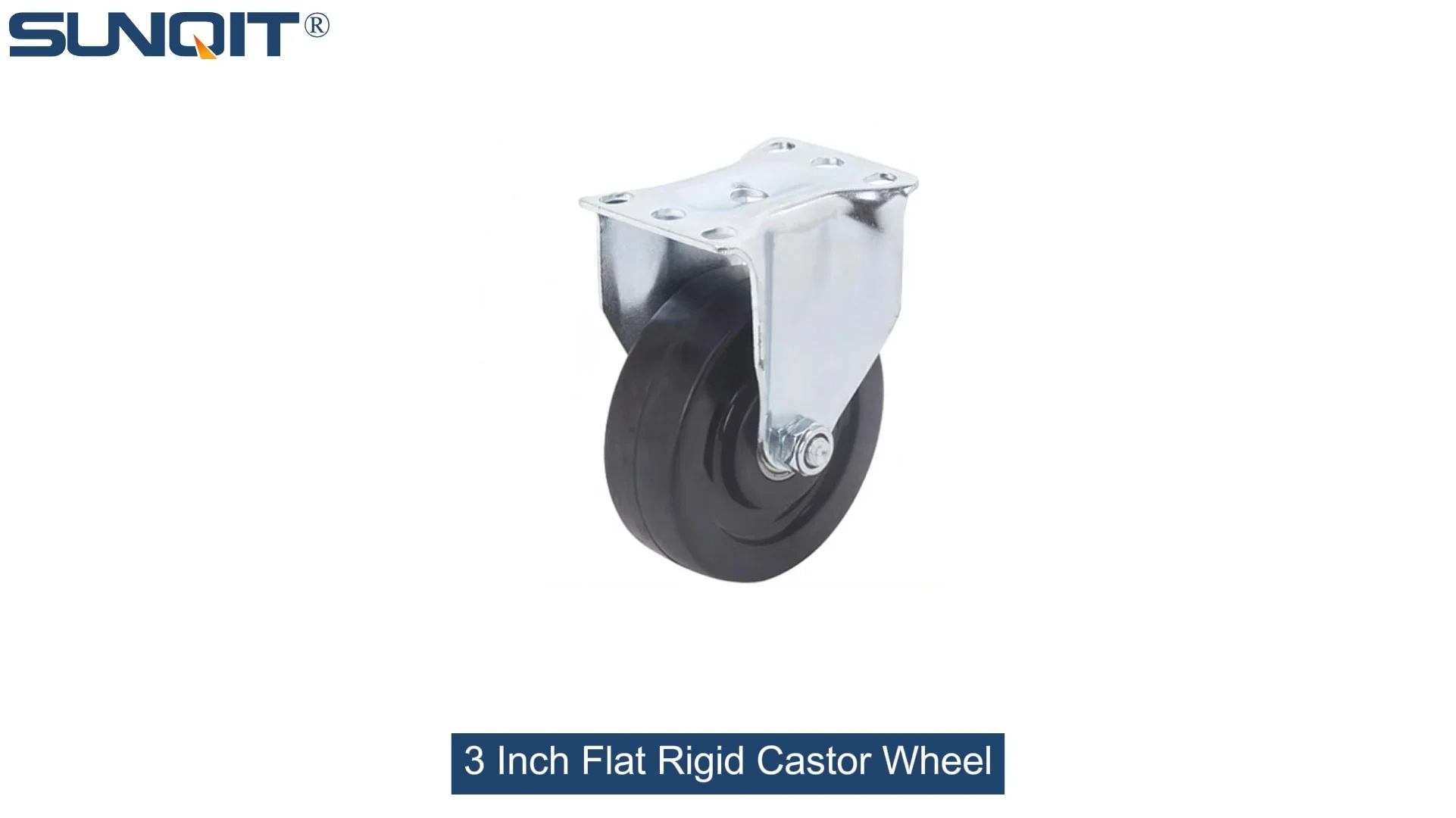
Chair Casters Ball Bearing Wheels Rubber Base. Resistant to abrasion, impact and corrosion. Heavy payload can hold 70Kgs per pcs,which can make it works at a stable and smooth status.
In the fast-paced world of manufacturing, where every second counts and precision is non-negotiable, the smallest components often play the biggest roles. Walk through any busy production floor, and you'll notice a symphony of moving parts—conveyors hum, workbenches brim with tools, and materials glide across flow racks. But beneath this orchestrated chaos lies a quiet hero: the flat rigid castor wheel. It's not flashy, and it rarely gets the spotlight, but without it, the delicate balance between flexibility and stability in modern production lines would crumble. Today, we're diving deep into how these unassuming wheels provide the fixed position support that keeps flexible production lines running smoothly, efficiently, and safely—especially when paired with lean systems, workbenches, and flow racks that form the backbone of smart manufacturing.
What Are Flat Rigid Castor Wheels, Anyway?
Let's start with the basics. A flat rigid castor wheel is exactly what it sounds like: a wheel mounted on a fixed, non-swiveling frame, designed to roll in a straight line. Unlike their swivel counterparts, which can pivot 360 degrees, these wheels lock into a single direction, offering unwavering stability once positioned. But don't let their simplicity fool you—their design is a masterclass in practical engineering. The "flat" in their name refers to the mounting plate, which sits flush against the bottom of equipment like workbenches or flow racks, distributing weight evenly and preventing wobbling. The "rigid" aspect ensures that when you need a workstation to stay put, it stays put—no unexpected shifts, no frustrating re-alignments, just reliable support.
These wheels are built to handle the demands of industrial environments. Most are made from durable materials like high-grade steel for the frame, with wheel options ranging from rubber (for shock absorption and floor protection) to polyurethane (for heavy loads and chemical resistance) or even cast iron (for extreme durability). The mounting plate, often made from thick steel or aluminum, is drilled with precise holes to bolt securely to equipment, ensuring that the connection between wheel and workstation is as strong as the wheel itself.
But why does this matter? Imagine a workbench in an electronics assembly line, where technicians are piecing together delicate circuit boards. If that workbench shifts even a fraction of an inch mid-assembly, it could throw off measurements, damage components, or even risk injury. A flat rigid castor wheel eliminates that risk. It keeps the workbench grounded when needed, yet allows for easy repositioning when the line layout changes—because in flexible production, adaptability is key. These wheels bridge the gap between "fixed" and "movable," giving supervisors the freedom to reconfigure workflows without sacrificing stability.
Why Fixed Position Support Matters in Flexible Production Lines
Flexible production lines are all about adaptability. They're designed to switch between products, scale up or down, and respond to changing customer demands—all without grinding to a halt. But flexibility without control is chaos. That's where fixed position support comes in. It's the anchor that lets production lines bend without breaking. And when it comes to providing that anchor, flat rigid castor wheels are second to none.
Think about a typical day in a automotive parts plant. One hour, a line might be assembling door handles; the next, it's switching to dashboard components. Workbenches need to move to new positions to accommodate the new workflow, but once in place, they must stay rock-solid. A technician tightening bolts on a door handle can't afford the workbench to drift. A quality inspector checking dashboard alignment needs a stable surface to ensure measurements are accurate. Flat rigid castor wheels make this possible: they roll smoothly when pushed, then lock into place (either via a brake or simply by virtue of their rigid design) to create a fixed workstation. It's this duality—mobility when needed, stability when required—that makes them indispensable.
Fixed position support also plays a critical role in safety. In busy production environments, where workers are moving quickly and heavy materials are in motion, unexpected movement is a hazard. A flow rack loaded with metal parts that suddenly shifts could topple, causing damage or injury. Flat rigid castor wheels prevent that by keeping equipment firmly planted. Their rigid design resists lateral forces, meaning even if a worker bumps into a rack or a conveyor jolts, the wheels won't swivel or slide. This peace of mind isn't just about avoiding accidents; it's about letting workers focus on their tasks without worrying about the stability of their tools and workspaces.
Real-World Impact: A Day in the Life
Maria, a shift supervisor at a medical device factory, knows the value of fixed position support firsthand. "Last month, we had to reconfigure our assembly line to produce a new type of surgical tool," she recalls. "We moved three workbenches and two flow racks in under two hours. The flat rigid castor wheels on those workbenches made it easy—two people could push them into place, and once they were set, they didn't budge. The next day, when production started, the technicians didn't have to waste time readjusting their stations. They just sat down and got to work. That's the difference between a good day and a chaotic day on the line."

Key Benefits of Flat Rigid Castor Wheels for Production Environments
So, what makes flat rigid castor wheels stand out in a market flooded with caster options? Let's break down their most impactful benefits, from durability to cost-effectiveness, and how they enhance everything from workbench stability to flow rack efficiency.
1. Unmatched Stability Under Load
When you're dealing with heavy equipment—think workbenches loaded with power tools, or flow racks stacked with raw materials—stability isn't optional. Flat rigid castor wheels distribute weight evenly across their mounting plate and wheel surface, reducing the risk of tipping or wobbling. Unlike swivel casters, which can sometimes "dig in" or shift under heavy loads, rigid wheels maintain a straight path and firm contact with the floor. This is especially critical for ESD workbenches (electrostatic discharge workbenches) in electronics manufacturing, where even a small movement could generate static electricity and damage sensitive components. With flat rigid castors, the workbench stays grounded, literally and figuratively.
2. Predictable, Straight-Line Movement
Ever tried moving a swivel caster-equipped cart and had it veer off course? It's frustrating, time-consuming, and can even be dangerous in tight production spaces. Flat rigid castor wheels eliminate that hassle. They roll in a straight line, exactly where you push them, making it easy to position equipment with pinpoint accuracy. This predictability is a game-changer when aligning workbenches with conveyors or nesting flow racks into a tight sequence. Workers don't waste time corralling wayward carts—they move equipment once, set it down, and get back to work.
3. Durability That Withstands Industrial Wear
Production floors are tough environments. Floors are uneven, chemicals might spill, and equipment is moved constantly. Flat rigid castor wheels are built to take a beating. Their rigid frames resist bending, even under heavy loads, and their wheels are often made from materials like polyurethane or cast iron that stand up to abrasion, oil, and extreme temperatures. Unlike some swivel casters with complex pivot mechanisms that can jam or wear out, rigid wheels have fewer moving parts, reducing the risk of breakdowns. This durability translates to lower maintenance costs and less downtime—music to any production manager's ears.
4. Cost-Effective Long-Term Value
While flat rigid castor wheels might cost a bit more upfront than basic casters, their longevity and low maintenance needs make them a budget-friendly choice in the long run. A well-made rigid caster can last for years, even in high-traffic areas, whereas cheaper swivel casters might need replacement every few months. When you factor in the cost of downtime from broken casters or the labor required to constantly adjust wobbly equipment, the investment in flat rigid castors pays off quickly. Plus, their simplicity means repairs are often easy—replace a wheel, tighten a bolt, and you're back in business.

Integration with Lean Systems: Streamlining Workflows, One Wheel at a Time
Lean systems are all about eliminating waste—whether it's time, materials, or unnecessary movement. They thrive on efficiency, organization, and continuous improvement. So, how do flat rigid castor wheels fit into this philosophy? Perfectly, as it turns out. Because lean manufacturing isn't just about big-picture strategies; it's about the small, everyday optimizations that add up to big results. And when it comes to keeping workstations stable, materials flowing, and workers focused, these wheels are a lean manager's best friend.
Consider the 5S methodology, a cornerstone of lean systems: Sort, Set in Order, Shine, Standardize, Sustain. "Set in Order" means arranging equipment and materials so they're easy to access and use. Flat rigid castor wheels make this possible by allowing workbenches and flow racks to be positioned precisely where they're needed—no more wasted space or awkward reaching. A workbench with rigid casters can be locked into place next to a conveyor, so parts move seamlessly from one station to the next. When the line needs to be reorganized (a key part of "Sustain"), the wheels make it easy to shift things around without disrupting the flow. It's flexibility without the chaos, which is exactly what lean systems demand.
Another lean principle is "just-in-time" production, where materials arrive exactly when they're needed, reducing inventory waste. Flow racks are critical here—they hold materials and allow them to glide to workers as production progresses. But if a flow rack shifts, materials can get stuck, leading to delays. Flat rigid castor wheels keep flow racks anchored, ensuring that gravity does its job and materials move smoothly. Workers don't waste time unjamming stuck parts or realigning racks—they focus on assembling products, keeping the line moving, and meeting deadlines.
Lean in Action: A Case Study
A mid-sized automotive parts manufacturer recently adopted a lean system, aiming to reduce production time by 20%. One of their biggest pain points was the constant repositioning of workbenches, which often shifted during use, leading to misaligned tools and wasted time. After switching to workbenches equipped with flat rigid castor wheels, they saw immediate results. "Workers no longer spend 10 minutes a day adjusting their benches," says the plant manager. "The wheels keep everything locked in place, but we can still move benches when we need to rebalance the line. It's a small change, but it's shaved hours off our weekly production time. That's lean in action."

Applications: Workbenches, Flow Racks, and Beyond
Flat rigid castor wheels aren't a one-trick pony. They shine in a variety of production line setups, from assembly workbenches to heavy-duty material racks. Let's take a closer look at how they enhance two of the most common pieces of equipment in manufacturing: workbenches and flow racks.
Workbenches: Stability for Precision Work
Workbenches are the heart of any assembly line. They're where technicians build, inspect, and test products, often with tools that require steady hands and stable surfaces. A workbench with flat rigid castor wheels offers the best of both worlds: it can be moved to accommodate new workflows, but once in place, it stays rock-solid. This is especially important for specialized workbenches, like ESD workstations, where static control and precision are critical. Imagine a technician soldering a tiny component onto a circuit board—if the bench moves, the solder joint could be flawed, leading to product defects. With rigid casters, the bench doesn't budge, so the technician can focus on the task, not the tool.
Even basic workbenches benefit from rigid casters. For example, a "Workbench E (single deck-without caster)" might seem like a fixed piece of equipment, but adding flat rigid castor wheels transforms it into a flexible workstation. Need to move it to make space for a new machine? No problem—just unlock the wheels (if they have brakes) and roll it. Once in the new spot, lock the brakes, and it's as stable as if it were bolted to the floor. It's versatility that doesn't compromise on reliability.
Flow Racks: Smooth Material Movement, No Shifting
Flow racks are the unsung heroes of material handling. They use gravity to move materials from the back to the front, ensuring that workers always have easy access to parts. But for gravity to work, the rack needs to be perfectly level and stable. If a flow rack shifts, the angle changes, and materials can slow down or get stuck. Flat rigid castor wheels solve this problem by keeping the rack firmly planted. Even when loaded with heavy boxes or parts, the wheels distribute weight evenly, preventing tilting or sliding.
Take a "Material Rack B (3 row and 3 floor)" as an example. This rack holds multiple layers of materials, and each row relies on a slight incline to move parts forward. With flat rigid casters, the rack can be positioned at the optimal angle once, and it stays there. Workers don't have to adjust the rack every time they load it—they just fill the back, and parts flow smoothly to the front. It's a small detail, but it adds up to big time savings over a shift.
Conveyors: Supporting the Backbone of Production
While conveyors are often fixed in place, smaller, mobile conveyor sections (like portable belt conveyors) rely on casters for flexibility. Flat rigid castor wheels are ideal here because they keep the conveyor aligned with other equipment. A misaligned conveyor can cause parts to jam or fall off, leading to delays. With rigid wheels, the conveyor rolls straight, locks into place, and stays aligned, ensuring that materials move from point A to point B without a hitch.
Flat Rigid vs. Swivel Casters: When to Choose Which
It's natural to wonder: if flat rigid castor wheels are so great, why would anyone use swivel casters? The truth is, both have their place. The key is choosing the right caster for the job. Let's compare them side by side to help you decide when flat rigid casters are the better choice.
| Feature | Flat Rigid Castor Wheels | Swivel Casters |
|---|---|---|
| Mobility | Rolls in a straight line only; easy to push in one direction. | Swivels 360 degrees; can move in any direction, but harder to control in tight spaces. |
| Stability | High stability under load; resists tipping and shifting. | Lower stability; may wobble under heavy loads or when moving quickly. |
| Precision Positioning | Easy to align exactly where needed; no drift. | Harder to position precisely; may veer off course. |
| Best For | Workbenches, flow racks, conveyor sections, and equipment that needs to stay in a fixed position after moving. | Carts, trolleys, and equipment that needs frequent, multi-directional movement (e.g., tool carts, garbage bins). |
| Maintenance | Fewer moving parts; lower maintenance needs. | More complex pivot mechanisms; may require lubrication or part replacement. |
So, when should you choose flat rigid castor wheels? If your equipment needs to: stay stable under heavy loads, be positioned precisely next to other equipment, roll in a straight line, or require minimal maintenance—rigid casters are the way to go. Swivel casters are better for equipment that needs to maneuver around obstacles or change direction frequently. In many cases, production lines use a mix: a workbench with two rigid casters and two swivel casters (with brakes) for balance and limited maneuverability. But for pure fixed position support, nothing beats flat rigid.
Maintenance Tips: Keeping Your Flat Rigid Castor Wheels Rolling Strong
Like any piece of industrial equipment, flat rigid castor wheels need a little TLC to perform their best. Fortunately, their simple design makes maintenance a breeze. Here are a few tips to keep them rolling smoothly for years to come:
1. Keep Them Clean
Production floors are dusty, and debris can get stuck in wheel bearings or around the mounting plate. Once a week, wipe down the wheels with a dry cloth to remove dirt and grime. For stubborn debris, use a small brush to clean out the bearings. This prevents buildup that can slow the wheels or cause them to jam.
2. Check for Wear and Tear
Inspect the wheels regularly for cracks, flat spots, or uneven wear. If a wheel is damaged, replace it immediately—damaged wheels can cause equipment to wobble or even fail under load. Also, check the mounting bolts to make sure they're tight; loose bolts can lead to instability.
3. Lubricate Bearings (If Needed)
Some flat rigid castor wheels have sealed bearings that don't require lubrication, but others may need a drop of machine oil every few months. Check the manufacturer's instructions to see if your wheels need lubrication, and use only the recommended oil to avoid damaging the bearings.
4. Avoid Overloading
Every caster has a weight capacity—don't exceed it! Overloading can bend the frame, crack the wheel, or damage the bearings. If you're unsure of the capacity, check the label or contact the supplier. It's better to err on the side of caution and use a heavier-duty caster than to risk equipment failure.
Choosing the Right Flat Rigid Castor Wheel: What to Look For
Not all flat rigid castor wheels are created equal. To get the most out of your investment, you'll need to choose the right wheel for your specific needs. Here are the key factors to consider:
1. Weight Capacity
Start with the basics: how much weight will the caster need to support? This includes the weight of the equipment itself plus any materials or tools it will hold. Always choose a caster with a capacity higher than your maximum expected load—safety first!
2. Wheel Material
Wheel material affects durability, floor protection, and performance. Rubber wheels are great for indoor use, as they're quiet and protect floors from scratches. Polyurethane wheels are more durable and resistant to chemicals, making them ideal for industrial settings. Cast iron wheels are the toughest, best for heavy loads and rough surfaces, but they can damage soft floors like concrete.
3. Wheel Diameter
Larger wheels roll more easily over uneven floors and debris. For smooth factory floors, a 4-6 inch wheel is usually sufficient. For rough or outdoor surfaces, go with a larger wheel (8 inches or more) to reduce rolling resistance.
4. Mounting Type
Flat rigid castor wheels come with different mounting plates: top plate (bolts to the bottom of equipment), stem (screws into a threaded hole), or plate with a brake. Top plate mounting is the most common for industrial equipment, as it's secure and easy to install.
5. Brake Options
Many flat rigid castors come with brakes, which lock the wheel in place to prevent movement. If your equipment needs to stay absolutely stationary during use, a brake is a must. Look for brakes that are easy to engage and disengage, even with gloves on.
The Future of Production Line Mobility: Why Flat Rigid Casters Will Remain Essential
As manufacturing evolves—with automation, IoT, and smart factories becoming the norm—one thing remains constant: the need for reliable, flexible, and stable equipment. Flat rigid castor wheels may seem like a "old-school" component, but their role in modern production lines is more important than ever. Here's why they'll continue to be a staple in the factories of tomorrow:
First, automation relies on precision. Robotic arms, automated guided vehicles (AGVs), and smart conveyors all need stable, predictable environments to operate. Flat rigid castor wheels provide the fixed position support that keeps workbenches and material racks aligned with these automated systems, ensuring that parts are in the right place at the right time. Without stable equipment, even the most advanced robots can't perform at their best.
Second, flexibility is key in the age of mass customization. Factories need to switch between products quickly, and that means reconfiguring lines on the fly. Flat rigid castor wheels make this possible by allowing equipment to be moved and locked into place without disrupting workflows. They're the bridge between "fixed" and "flexible," which is exactly what modern manufacturing demands.
Finally, worker safety and comfort are top priorities. Unstable equipment leads to accidents and fatigue. Flat rigid castor wheels reduce the risk of slips, trips, and falls by keeping workstations grounded. They also make it easier for workers to move heavy equipment, reducing strain and injury. In a world where employee well-being is increasingly valued, these small components make a big difference.
Conclusion: The Quiet Hero of Flexible Production
Flat rigid castor wheels may not grab headlines or win awards, but they're the unsung heroes of the manufacturing world. They provide the fixed position support that keeps flexible production lines stable, efficient, and safe. Whether they're keeping a workbench steady during precision assembly, ensuring a flow rack glides smoothly, or integrating with lean systems to eliminate waste, these wheels play a critical role in keeping the modern factory running.
So, the next time you walk through a production line, take a moment to notice the flat rigid castor wheels under those workbenches and flow racks. They're small, but they're mighty. They're the reason workers can focus on building great products instead of fighting with unruly equipment. They're the reason lean systems work, deadlines are met, and factories stay productive. In the end, it's the little things that make the biggest difference—and flat rigid castor wheels are proof of that.